
The instinct to reapply immediately after an unmatched cycle is often wrong. The numbers show that for many applicants, a structured gap year with targeted improvements produces better outcomes than a rushed second attempt.
You are not deciding between “doing nothing for a year” and “moving forward.” You are choosing between two data paths with very different risk profiles, timelines, and probability curves.
Let’s walk through those curves.
1. The Baseline: Who Actually Matches on a Reattempt?
Start with the macro view: what happens to unmatched applicants on their next try.
NRMP and independent survey data show a few consistent patterns across recent cycles (2019–2024):
- Overall first-time US MD senior match rate: ~91–93%
- US MD seniors who previously went unmatched (i.e., repeat applicants): match rate drops into the 55–65% range depending on specialty and profile
- For IMGs (US-IMG and non-US IMG), repeat applicant match rates often fall in the 35–55% band
The key point: once you enter the “previously unmatched” bucket, you have a structural disadvantage. Program directors treat prior outcomes as a data point.
But the impact of that disadvantage is not uniform. It interacts with everything else: scores, specialty, research, and what you do in the interim.
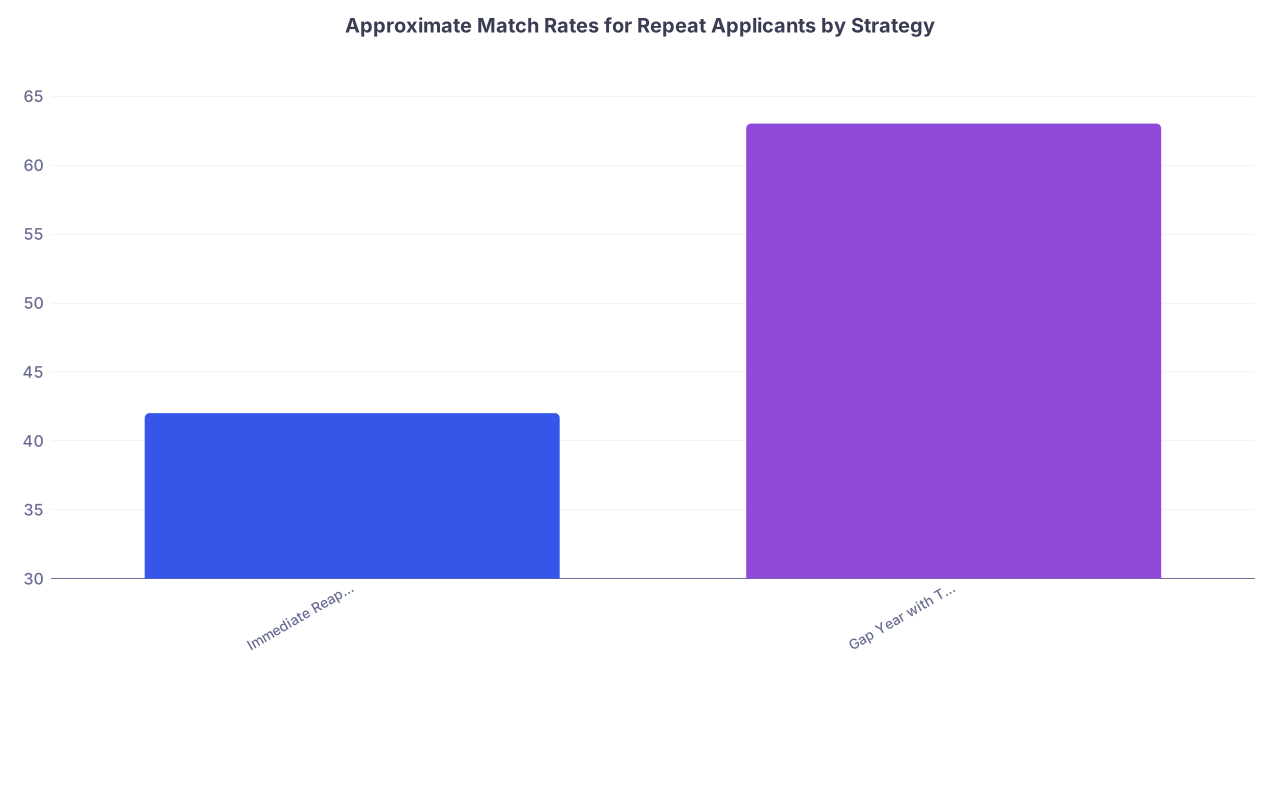
To make this less abstract, here is a simplified comparison using composite data from multiple cycles for repeat applicants into non-surgical specialties (IM, FM, Psych, Peds):
| Category | Value |
|---|---|
| Immediate Reapply (Minimal Changes) | 42 |
| Gap Year with Targeted Improvements | 63 |
Applicants who reapply with minimal change to their file land in the ~40% range. Those who spend a gap year in structured clinical or research work with clear improvements trend 15–25 percentage points higher.
Correlation is not causation, but program director survey responses line up with this reality: “What did you do after you went unmatched?” is a high-yield question.
2. Key Variables: What Actually Moves Your Match Probability?
Gap year vs immediate reapply is not one decision. It is a decision made inside a specific context defined by your numbers, specialty choice, and application performance.
There are five major variables that materially change the calculus.
2.1 USMLE / COMLEX Profile
Step 1 is now Pass/Fail, so Step 2 CK (and COMLEX Level 2 for DOs) is the workhorse score.
Broad composite trends:
- Step 2 CK ≥ 250: You are statistically competitive for most non-surgical fields, conditionally competitive for some surgical fields if the rest is strong
- Step 2 CK 240–249: Borderline–competitive for many IM, Peds, Psych, Anesthesia, EM programs
- Step 2 CK 230–239: Below mean for many specialties but matchable with strong application and realistic targeting
- Step 2 CK < 230: High risk for many specialties; data for repeat applicants in this band show substantially lower match rates without clear remediation
For a reapplicant, what programs want to see is evidence of change:
- New Step 2 CK score up from, say, 229 → 242 is a real data point
- COMLEX Level 2 retake with a 50+ point jump changes how your file is read
- No new score, no new academic metric? You enter the same pool with a worse label: “previously unmatched”
2.2 Specialty Competitiveness
Different specialties respond very differently to gaps and reapplications.
For simplicity, consider three broad groups:
| Group | Example Specialties | Typical US Senior Match Rate | Reapplicant Flexibility |
|---|---|---|---|
| Highly Competitive | Derm, Ortho, Plastics, Neurosurg, ENT | 60–80% overall | Very low |
| Moderately Competitive | Anesthesia, EM, General Surgery, OB/GYN | 75–90% | Moderate |
| Less Competitive (but not “easy”) | IM, FM, Psych, Peds, Path, Neuro | 90%+ for US seniors | Higher |
Reality from PD surveys and anecdotal patterns:
- Competitive fields view reapplicants skeptically unless there is a dramatic improvement (new top-tier research, home program advocacy, high-value prelim year).
- In moderately competitive fields, a strong gap year in a related clinical/research post often rescues a borderline candidate.
- In less competitive fields, an unmatched prior cycle hurts, but concrete growth and strong LORs can restore odds to something close to first-time applicants.
So a derm reapplicant doing an unstructured gap year with no publications? Statistically dead in the water.
An IM reapplicant who spends a year as a hospitalist scribe and clinical research coordinator, adds Step 2 CK 244 → 255, and gets three new letters? That is a very different trajectory.
2.3 Application Volume and Targeting
Poor targeting is a top-3 reason I see for unmatched applicants with decent profiles.
Data from NRMP and various advising offices show this pattern repeatedly:
- Applicants with < 30 total programs in IM / FM have sharply lower match rates, regardless of scores
- Applicants using an “all reach, no safety” strategy (e.g., 40+ applications but mostly university, few community programs) underperform their numbers
- Reapplicants who broaden program lists by geography and community bias see 5–10 percentage point gains in match probability on their next try, even without huge CV changes
For your decision:
- If you applied to 25 programs in a semi-competitive specialty and went unmatched, an “immediate reapply” with 90+ well-targeted programs and slightly improved application might be defensible.
- If you already blanketed 80+ programs across tiers and still went unmatched, pure volume is not the main lever. A gap year with real changes is usually the better bet.
2.4 Red Flags and Timeline Issues
Red flags compound over time. You must account for that.
Common ones:
- Multiple exam attempts
- Course failures or leaves of absence
- Unprofessionalism comments, failed rotations
- Large time gaps with vague explanation
Programs are not only evaluating your clinical potential. They are estimating risk. A prior unmatch plus an unexplained or weakly explained year off can look worse than not matching at all.
That is where a structured, clearly described gap year—especially in a clinical or research job with supervision—works in your favor. It reframes the story:
- “Unmatched, drifted for a year” → bad signal
- “Unmatched, then spent a year in a busy IM department as a research associate working on two quality-improvement projects and a manuscript” → risk appears managed and trajectory positive
2.5 Interview Yield
Your prior season interview data might matter more than you think.
Three crude but useful buckets:
- 0–2 interviews → major systematic issue (screening, red flags, targeting, or scores)
- 3–7 interviews → middle band; some interest but possibly poor geographic or program spread
- 8+ interviews → there is probably an interview performance or rank list strategy problem
If you had 8+ interviews and no match, your immediate reapply vs gap year decision leans heavily on one question: were you actually prepared to interview and rank strategically? Because the market already told you: “Your application is good enough to get in the room.”
If you had 0–2 interviews with realistic specialty and 60+ apps, you do not have an interview problem. You have a file problem. That file will not suddenly look better without doing something substantive.
3. Immediate Reapply: When the Data Actually Support It
There are scenarios where immediate reapplication in the very next cycle is rational and data-supported.
3.1 Profiles That Can Justify Immediate Reapply
Patterns I have seen work:
- Strong Step 2 (≥ 245) and no major red flags
- Reasonable or high number of interviews (≥ 8) but poor rank list construction or narrow geographic constraints
- Single-cycle anomaly (e.g., specialty experiencing a one-year competitiveness spike like EM did, then partially normalizing)
For example:
- US MD, Step 2 CK 252, applying IM + a few combined programs, 11 interviews, no match. When you review the rank list, you see they ranked only 5 programs because of geographic reluctance. For this candidate, immediate reapply with:
- broader rank list expectations,
- some modest improvements (updated LORs, a poster or two),
- and better interview practice,
has a very reasonable chance of success without a formal “gap year” pause.
Or:
- DO applicant to FM with Step 2 CK ~238 and COMLEX in a similar percentile, 6 interviews, no match. They applied late (October file completion). If they can ensure early completion next cycle (applications ready Day 1), write stronger personal statements, and broaden program list, immediate reapply is defendable.
3.2 Conditions for an Immediate Reapply Strategy to Work
For immediate reapply to be a smart play, you should be able to say “yes” to most of the following:
- Can you produce a new, higher Step 2 CK (or Level 2) score before the next application window, if your prior score was suboptimal?
- Can you radically improve your application timing (everything submitted early, not November-completed)?
- Can you significantly expand and recalibrate your program list based on actual past response patterns (adding more community, more mid-tier, more geographic spread)?
- Can you secure at least 1–2 new, stronger letters from US clinical settings before applications go out, not in December?
If the answer is “no” to most of these, then “immediate reapply” is essentially “same file, worse optics.”
And the data on that group are not kind.
4. Gap Year: When a Deliberate Pause Improves the Odds
The gap year is not a time-out. It is a data-generation phase. The question is whether that extra data moves you to a different probability curve.
4.1 What Programs Want to See in a Productive Gap Year
From PD survey responses and match trend correlations, the highest-yield gap year activities share several features:
- Direct clinical exposure in the US system
- Clear supervision by faculty who can write detailed LORs
- Evidence of reliability, professionalism, and teamwork
- Ideally, some output: abstracts, posters, publications, or at least QI projects
High-yield examples:
- One-year clinical research fellowship in an academic IM department with clinic time and involvement in trials or QI projects
- Full-time position as a clinical trials coordinator, with heavy physician interaction and responsibility
- Hospital-based scribe role combined with structured volunteer or research work
- Prelim year in a related field (e.g., surgery prelim before reapplying to categorical general surgery or a medicine prelim before anesthesia)
Low-yield examples:
- Unstructured shadowing with no formal role, no responsibility, and no evaluative letters
- Random non-clinical jobs that do not translate into residency-relevant skills
- “Studying” for another exam for 12 months with no clear output
4.2 Quantitative Impact of Productive Gap Years
Use a simplified model for reapplicants into IM / FM / Psych / Peds with below-average Step 2 (230–239):
- Reapplicants with no clinical/research gap year and similar application: match rate ~30–35%
- Reapplicants with structured US clinical research or employment and new strong letters: match rate ~50–60% in many advising datasets
For applicants with 240+ scores and a focused gap year, match rates climb into the 70% range for less competitive specialties, even as reapplicants.
That is what the data show: not magic, just a large effect size when you stack several small advantages.
4.3 How a Gap Year Interacts with Specialty Switches
Gap years are especially powerful when combined with realistic specialty recalibration.
Two common patterns:
High-aspiration to realistic switch:
- Ortho / Derm / ENT → IM / FM / Path / Psych
- Applicants often go from very low match odds in the original specialty to quite high odds in the new one, with a single year of relevant work and a coherent narrative.
Adjacent specialty pivot:
- Gen Surg → Anesthesia or EM
- OB/GYN → FM with women’s health focus
- EM (in very rough years) → IM or Anesthesia
The gap year gives you time to:
- Obtain specialty-specific letters,
- Join specialty societies,
- Do a small project in the new field,
- And reframe your story convincingly.
A rushed immediate reapply with a half-baked specialty switch often looks like a panic move rather than a considered strategy.
5. Practical Decision Framework: Where Does Your Data Point?
Let me compress this into an actual decision tool. Not a vague “consider your goals” speech.
5.1 Quick Decision Grid
Use this as a rough triage:
| Profile Pattern | Scores / Specialty | Prior Interviews | Recommended Strategy |
|---|---|---|---|
| A | Step 2 ≥ 245, less competitive field | 8+ interviews | Immediate reapply with better rank strategy |
| B | Step 2 235–244, less competitive field | 3–7 interviews | Either, but gap year if few new programs exist to add |
| C | Step 2 < 235, any field | 0–4 interviews | Gap year with intensive improvement |
| D | Any scores, very competitive field | 0–5 interviews | Gap year + realistic specialty reassessment |
| E | Decent scores, poor targeting (few apps) | 0–3 interviews | Immediate reapply *if* volume/targeting can be fixed |
This is crude. But it is far more useful than the usual hand-waving.
5.2 Timeline Reality Check
One critical constraint is time compression.
If you went unmatched in March and want to reapply that same September:
- You have ~6 months.
- Remove onboarding time, LOR writing lag, and Step scheduling.
- You might realistically produce: 1 newer letter, some ongoing research, and possibly 1 exam retake.
For a gap year in which you skip the immediate next cycle and aim for the one after:
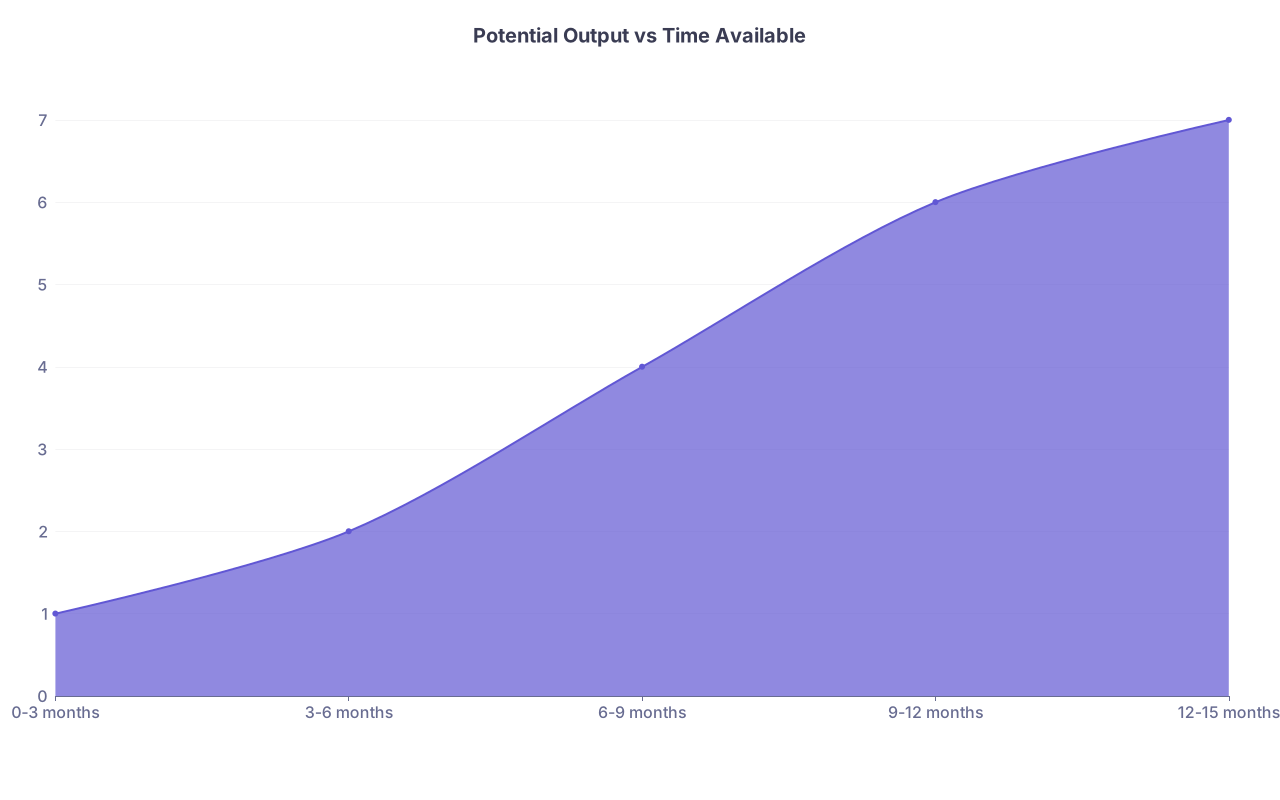
- You have 12–15 months.
- That allows you to accumulate:
- 2–3 strong new letters,
- clear project output,
- documented roles and responsibilities,
- exam improvements,
- and maybe even a prelim year.
| Category | Value |
|---|---|
| 0-3 months | 1 |
| 3-6 months | 2 |
| 6-9 months | 4 |
| 9-12 months | 6 |
| 12-15 months | 7 |
Interpretation: the “value units” you can add to your file scale nonlinearly with time. The first few months are onboarding and orientation. The highest-yield phase is months 6–12, which you simply do not fully access if you rush back into the next cycle.
6. How to Structure Either Path Intelligently
Whether you choose to reapply immediately or plan a gap year, treat it like a data optimization problem.
6.1 If You Reapply Immediately
Priorities:
- Fix obvious structural flaws: late application, very limited program list, poor personal statements.
- Seek brutally honest feedback on interview performance (mock interviews with faculty or advisors, not family).
- Add what you realistically can: a more compelling narrative, 1–2 updated letters, and maybe an exam improvement.
Avoid magical thinking like “programs will just see I tried again, so they will value my persistence.” They will not. They will value new, concrete evidence.
6.2 If You Take a Gap Year
Your gap year plan should read like a small project charter, not a vague intention.
Define:
- Primary role: job title, department, supervisor
- Expected outputs: at least 2–3 measurable activities (study enrollment numbers, QI metrics, abstracts, etc.)
- Letter sources: who will be able to describe your work and reliability in detail
- Exam improvements: specific score targets with a scheduled exam date
- Timeline: what you aim to have completed before ERAS opens, not by next March
Document everything. Dates, duties, results. When you rewrite your personal statement and experiences section, those details convert into credibility.
7. A Quick Visual: Process Behind the Decision
To tie this together, here is a simplified decision flow.

| Step | Description |
|---|---|
| Step 1 | Unmatched in Match |
| Step 2 | Consider Immediate Reapply with better strategy |
| Step 3 | Review targeting and consider Gap Year |
| Step 4 | Gap Year with major academic improvement |
| Step 5 | Gap Year and specialty reassessment |
| Step 6 | Either path possible - lean Gap Year if few new programs left |
| Step 7 | Gap Year with US clinical role |
| Step 8 | Step 2 245 or higher? |
| Step 9 | 8 or more interviews? |
| Step 10 | Step 2 235 to 244? |
| Step 11 | Less competitive specialty? |
| Step 12 | Interviews 3 to 7? |
The exact thresholds will differ by candidate. But the logic structure holds: scores, interview history, specialty, and program list shape your best statistical choice.
Final Takeaways
- Reapplying with the same file, just sooner, is a bad bet. Unless your prior season had strong numbers and multiple interviews, the data favor a structured gap year with real improvements.
- The single biggest lever you control is not effort; it is evidence. New scores, new letters, concrete roles, and clear specialty targeting move you into a different probability band.
- Decide like an analyst, not like an optimist. Map your scores, interviews, and specialty against actual match trends, then choose the path—gap year or immediate reapply—that produces the best numbers for your specific profile.