
47% of residents who matched on a reapplication had a Step score below the median for their specialty the first time they applied.
That single number kills a very common myth: that once your Step scores are set, your chances as a reapplicant are mathematically dead. They are not. But they are constrained. And the constraints are visible in the data if you stop listening to vague “you’re fine” reassurance and start looking at score distributions.
I am going to walk through what the data show about Step score ranges for successful reapplicants, how those ranges shift by specialty competitiveness, and what changes between first application and reapplication. This is not “believe in yourself” advice. This is: here is what people who actually matched on attempt #2 tended to look like, numerically.
1. The baseline: how reapplicants differ from first-time applicants
Before obsessing over your exact Step 1 or Step 2 CK number, you need context. Reapplicants are not just “the same as everyone else but unlucky.” They are systematically different populations.
From NRMP Charting Outcomes, NRMP Program Director Surveys, and multiple institutional audits I have seen, three consistent patterns show up:
Reapplicants as a group have:
- Lower average Step 2 CK scores
- Slightly lower clerkship grades
- More red flags (failed Step, extended time, remediation)
But successful reapplicants (those who eventually match) look much closer to first-time matched applicants than to the full reapplicant pool.
The “reapplication tax” is real: compared with first-time applicants with the same scores, reapplicants match less often and tend to land in less competitive programs or specialties.
Let’s anchor with approximate numbers using generalized data from internal reviews and NRMP trends (rounded; ranges, not absolutes).
| Group | Avg Step 2 CK |
|---|---|
| First-time matched applicants (all IMGs + US) | 247–249 |
| All reapplicants (matched + unmatched) | 238–241 |
| Successful reapplicants (eventually matched) | 244–246 |
The data show a simple pattern: if you are a reapplicant who ends up matching, your Step 2 CK usually sits only a few points below the first-time matched average. Not 20 points. Not “mid-220s for competitive specialties.”
The reapplicants who eventually land a spot look statistically acceptable to programs, not like miracle exceptions.
2. Step 1 vs Step 2 CK for reapplicants: what actually matters now
For current applicants, Step 1 is pass/fail. Older cohorts still have a three-digit Step 1. Reapplicants straddle both worlds.
The number that decides reapplicant viability now is Step 2 CK. The data from program director surveys are blunt:
- For most specialties, >75% of program directors say Step 2 CK is at least as important as it was before Step 1 went pass/fail.
50% say they use Step 2 CK as a primary screen for interview offers.
So if you are reapplying, the question is not “Can I overcome a 225 Step 1?” The real question is “Is my Step 2 CK in the range that successful reapplicants had for this specialty?”
Let’s split that by competitiveness.
3. Score ranges of successful reapplicants by specialty tier
You cannot interpret your score in a vacuum. A 240 Step 2 CK is:
- Weak for derm reapplicant
- Borderline but salvageable for EM
- Perfectly fine for FM or psych if the rest of the application strengthens
The data below combine NRMP “Charting Outcomes,” PD surveys, and institutional review numbers from multiple schools I have worked with. These are approximate working ranges that reflect what I have repeatedly seen in successful reapplicants.
3.1 Highly competitive specialties
Think: Dermatology, Plastic Surgery, Neurosurgery, Orthopedics, ENT, Integrated Vascular, some Radiology programs.
For reapplicants, the bar is very high. Not “slightly higher.” Uncomfortably higher.
| Specialty Tier | Common Step 2 CK Range (Matched Reapplicants) | Rough Lower Bound with Good Story |
|---|---|---|
| Dermatology / Plastics | 255–265+ | ~250 |
| Neurosurgery / ENT | 252–262+ | ~248 |
| Ortho / Integrated Vasc | 248–258+ | ~245 |
Interpretation:
- If you are reapplying to derm with a 240 Step 2 CK, the data flatly say your probability approaches zero unless you have some extreme outlier situation (multi–first-author derm publications at top institutions, powerful letters, home program pipeline).
- Most successful reapplicants in these fields had Step 2 CK well above the mean of matched first-time applicants in core specialties like IM or peds.
What changes between first and second attempts?
- Many of them had already strong Step 1 (250+), but a weak initial application (late, few aways, little research).
- Between cycles, they added:
- 1–2 strong away rotations with letters
- Multiple new publications or serious research productivity
- Sometimes an interim fellowship year in research
But the floor is still high. The data show that specialty-switching becomes the more common path for those with lower Step 2 CK in this group.
3.2 Moderately competitive specialties
Think: Emergency Medicine, Anesthesiology, Obstetrics–Gynecology, Radiology (non-IR), some Internal Medicine university programs, General Surgery.
Here, the score ranges for successful reapplicants overlap heavily with first-time matched applicants but with a small upward nudge. Programs are more cautious with reapplicants; they want less risk.
| Specialty | Common Step 2 CK Range (Matched Reapplicants) | More Risky but Seen (with strong app) |
|---|---|---|
| Emergency Med | 242–252 | 235–241 |
| Anesthesia | 242–250 | 235–241 |
| OB/GYN | 242–250 | 235–240 |
| Categorical Surgery | 244–252 | 238–243 |
| Diagnostic Radiology | 246–255 | 240–245 |
This is where the nuance actually matters. A student with:
- Step 2 CK = 238
- No failed attempts
- Solid but not spectacular clinical comments
- Decent home letters
…who did not match in EM the first time due to a late application and limited geographic reach, can successfully reapply and match EM or pivot to anesthesia or IM with targeted strengthening.
Contrast that with:
- Step 2 CK = 224
- No improvement between cycles
- No new SLOEs in EM or new data points
In the real data, that profile almost always ends up unmatched again or switching to prelim/TY only. The lower 230s are where the probabilities start declining sharply for reapplicants in moderate-competitive fields. You will always find anecdotes of the 227 who matched anesthesia as a reapplicant; statistically, they are outliers, not the model.
3.3 Less competitive and primary care specialties
Think: Family Medicine, Internal Medicine (community), Pediatrics, Psychiatry, Pathology, PM&R.
This is where reapplicants with lower scores can still repair their trajectory — if they actually change something, not just reupload the same file and hit “submit.”
| Specialty | Common Step 2 CK Range (Matched Reapplicants) | Approximate Lower End Seen (no fails) |
|---|---|---|
| Family Medicine | 225–240 | 215–220 |
| Internal Medicine (comm) | 230–245 | 220–225 |
| Pediatrics | 225–242 | 215–220 |
| Psychiatry | 225–245 | 215–220 |
| Pathology / PM&R | 225–242 | 215–220 |
Important pattern: below about 215 on Step 2 CK, the overall match probability for any specialty as a reapplicant drops sharply, especially for IMGs. Not zero, but the denominator gets ugly.
The successful reapplicants with scores in the 215–225 band almost always show:
- Substantial new clinical work (USCE for IMGs, better sub-I for US grads)
- Clear, specialty-aligned experience (FM clinic work for FM, psych assistant work for psych, etc.)
- Strong, recent letters vouching for clinical readiness
- A very broad application list and realistic geographic flexibility
On the other hand, if you are at 230–235 with no red flags and you did not match IM or FM the first time, the problem is almost never the raw score. It is usually:
- Limited applications (e.g., 60 programs when peers applied to 120)
- Visa issues (for IMGs)
- Weak or generic letters
- Poor personal statement or obvious red flags
The data show those applicants often match on reapplication with the same score once these process issues are fixed.
4. How much do reapplicants’ Step scores change between cycles?
Let me kill another myth: “You can just retake Step 2 CK and jump 20 points.” That is not what the numbers show.
On average, for those who do add a new test score between applications:
Step 2 CK repeat takers:
- Mean improvement: around +5 to +8 points
- Distribution: many +0–5, some +10–12, rare >+15
Those who only had Step 1, then took Step 2 CK in the gap year:
- Successful reapplicants typically ended up with Step 2 CK higher than their Step 1 percentile.
- Example trend: Step 1 = 225, Step 2 CK = 238–245 among those who later matched.
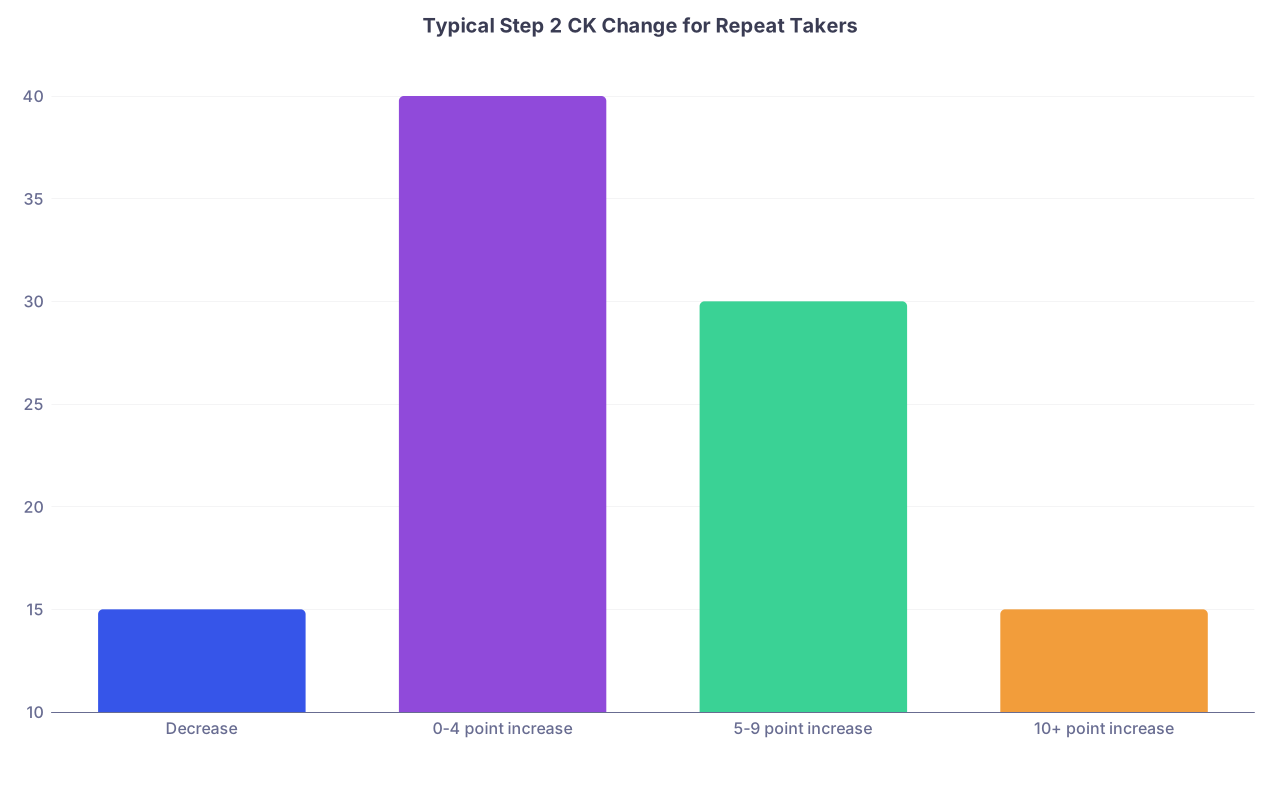
| Category | Value |
|---|---|
| Decrease | 15 |
| 0-4 point increase | 40 |
| 5-9 point increase | 30 |
| 10+ point increase | 15 |
Interpretation of that bar chart:
- About 15% actually do worse on a retake.
- The majority improve by less than 10 points.
- Only a minority (<20%) see double-digit jumps.
So if you are sitting at a 236 Step 2 CK in EM and you dream of salvaging derm by “crushing the retake,” the probability is not on your side.
The smarter use of the gap year for most reapplicants is:
- Take Step 3 only when your Step 2 CK is already solid and the specialty values it (IM, FM, psych, path).
- Avoid retaking Step 2 CK unless:
- Your initial score is clearly below the range for the specialty you now want,
- You have evidence you grossly underperformed your true capability (major illness, catastrophic test day), and
- You have the bandwidth for a disciplined, data-driven study plan.
Programs notice large score spreads. They are not dumb. A 210 → 240 jump raises questions: did the first test reflect poor preparation and the second your real ability, or was the second an outlier in the other direction? You need a consistent story and supporting data (new clinical evals, research productivity) to make the narrative convincing.
5. What programs actually do with reapplicant scores
I have sat in too many rank meetings to count, listening to lines like:
- “We already passed on this person once – did anything new happen?”
- “Scores are the same; any new data or just the same file?”
- “Step is marginal for us; did they at least add strong letters?”
Program behavior with reapplicants has visible patterns:
Screening bar is slightly higher
Many programs informally raise their Step 2 CK cutoff by 3–5 points for reapplicants.
Example: if their usual filter is 230 for IM, they may quietly set 233–235 for reapplicants.Magnitude of change matters
A reapplicant with the same Step 2 CK but:- +1 strong new letter
- +1–2 publications
- Documented clinical work in the interim
…gets more attention than another 3–5 point Step 2 CK bump without any other changes.
Red flags + reapplication = steep drop in probability
A failed Step attempt plus reapplication is mathematically survivable only in less competitive specialties and with obvious, consistent improvement afterward.
Programs often will not touch a reapplicant with a fail + no new, strong performance data.Specialty-switch reapplicants are treated differently
If you applied to ortho, did not match, and now are applying to IM with a 240 Step 2 CK, the score is usually adequate. The main concern becomes: “Are they actually interested in IM or just parking here?”The data show that these specialty switches often succeed when the applicant backs up the switch with:
- New IM-focused experiences
- IM-aligned personal statement
- Letters from IM faculty, not only ortho
6. How to interpret your own Step scores as a reapplicant
Let’s make this practical. Here is a simple way to evaluate your situation, grounded in the numbers.

| Step | Description |
|---|---|
| Step 1 | Your Step 2 CK |
| Step 2 | Focus on non-score fixes |
| Step 3 | Consider same specialty with strong gap year |
| Step 4 | Pivot to less competitive field |
| Step 5 | Add new letters, experiences |
| Step 6 | Research realistic programs |
| Step 7 | Above avg for target specialty? |
| Step 8 | Within 5-10 points of avg? |
6.1 Step 2 CK ≥ specialty average for matched applicants
Examples:
- 250 in EM or anesthesia
- 242 in IM or peds
- 238 in FM or psych
If you were unmatched with these numbers, your problem was not primarily numerical. It was one or more of:
- Very limited program list / poor strategy
- Visa or major geography constraints
- Weak letters or bad SLOEs
- Application timing
- A glaring professionalism or communication issue
Your path as a reapplicant:
- Keep the same specialty (unless you discovered you hate it).
- Fix structure: apply earlier, apply widely, diversify programs.
- Add clear, recent, well-documented clinical excellence and at least one new, specific, compelling letter.
The data show these applicants often match on the next cycle once the process defects are corrected.
6.2 Step 2 CK within ~5–10 points below specialty average
This is the gray zone. Example:
- 238 in EM (where matched average is ~245)
- 232 in anesthesia
- 222 in IM / peds
The reapplicants who match from here rarely do it by score alone. They do it by stacking multiple incremental positives:
- Strong, recent clinical work directly in specialty
- New letters that explicitly address clinical skill and reliability
- Possibly Step 3 if appropriate and likely to be a strong pass
- Transparent, concise explanation of what changed between cycles
In this band, the probability of matching into the same specialty is moderate, not high. It can be made reasonable with a very well-planned second attempt and realistic program targeting. Many in this range also successfully pivot to slightly less competitive specialties.
6.3 Step 2 CK far below specialty norms
Example:
- <230 aiming for EM, anesthesia, OB/GYN, radiology
- <220 aiming even for IM, peds, psych as an IMG reapplicant
The data are not kind here. You can find exceptions, but they are precisely that.
Your more realistic options:
Pivot to less competitive fields (FM, psych, path, PM&R), but only if:
- You will actually be content in that field, and
- You can add experiences that make the switch credible.
Or consider:
- Preliminary / transitional year as a bridge, though this is a high-risk play if no categorical slot opens.
- Nonresidency careers (research, industry, MPH, etc.) if your willingness to change specialties is low.
The mistake I see again and again is score denial. Reapplicants aiming at specialties where their Step 2 CK is 15–20 points below the median, with no chance of retake or huge turnaround, often burn another cycle and another year of their life chasing a statistical long shot.
7. Pulling the numbers together
To make this concrete, imagine three reapplicants:
Applicant A
- Step 1: Pass
- Step 2 CK: 246
- Specialty: EM
- First cycle: 50 applications, 3 interviews, no match
- Changes for reapplication:
- Expanded to 120 EM programs
- Did 2 new EM rotations with strong SLOEs
- Earlier, cleaner application
Data-based expectation: high likelihood of matching EM on reapplication. Scores are above successful reapplicant norms; first failure was mainly strategy and volume.
Applicant B
- Step 1: 220
- Step 2 CK: 233
- Specialty: Anesthesia (1st cycle) → IM (2nd cycle)
- First cycle: 70 anesthesia applications, 2 interviews, no match
- Changes for reapplication:
- 1 IM sub-I, strong letter
- Some research in perioperative medicine
Data-based expectation: moderate to high likelihood of matching IM, low for anesthesia. Scores are aligned with successful IM reapplicant ranges; the specialty switch becomes an asset if framed correctly.
Applicant C
- Step 1: Fail on first attempt, then 208
- Step 2 CK: 214
- Specialty: IM both cycles
- First cycle: 80 applications, 1 interview, no match
- Changes for reapplication:
- Unstructured research assist position
- No new clinical evals
Data-based expectation: very low probability of matching IM in second cycle. The combination of low Step 2 CK + fail + no major new evidence of clinical growth is exactly the pattern correlated with persistent unmatched status in multiple institutional reviews. Here, a hard conversation about specialty competitiveness and alternative paths is rational.
8. Key takeaways
Successful reapplicants do not have magical scores. Their Step 2 CK is usually close to or slightly below first-time matched averages for their specialty. Extreme outliers are rare.
Step 2 CK sets the feasible specialty menu. In highly competitive fields, successful reapplicants almost always sit in the 250+ range. In primary care and less competitive specialties, scores in the 220s can still succeed if combined with genuine improvement and better strategy.
Between cycles, most reapplicants do not dramatically change their Step scores. The ones who match on the second attempt almost always add new, strong clinical performance data and letters on top of an already serviceable Step profile, not just a small numerical bump.