
The data is brutally clear: applicants who stay geographically rigid after going unmatched get punished. Those who expand their geographic flexibility see their match odds jump—often by 20–40 percentage points—depending on specialty and profile.
You are not just fighting competitiveness. You are fighting math. And the math overwhelmingly favors applicants who are willing to move.
Let me walk through how geography actually interacts with match probability, what the numbers suggest in a reapplication year, and how you can use that data to rebuild a realistic strategy after an unmatched cycle.
1. The baseline: what the match data actually shows
Let’s anchor this in something concrete before we talk about geographic flexibility.
NRMP data over the past several years shows a few consistent patterns:
- Overall match rates for U.S. MD seniors hover around 92–94%.
- U.S. DO seniors land in the mid–80s to low–90s%.
- Previous graduates / reapplicants drop sharply, often in the 40–60% range depending on specialty and profile.
- Unmatched applicants in competitive specialties (derm, ortho, plastics, ENT) who reapply often face <50% match rates unless they change something major: specialty choice, step scores, or geographic scope.
You are now in that last category. The “default” odds are no longer in your favor. Your leverage comes from two main knobs:
- Specialty flexibility
- Geographic flexibility
This article is about the second one, but they are deeply linked.
To make it concrete, here is a reasonable composite of what I see in real applicants who went unmatched, based on NRMP, specialty reports, and actual advising cases:
| Strategy Type | Estimated Match Rate |
|---|---|
| Same specialty, tight geography | 20–30% |
| Same specialty, broad geography | 40–55% |
| Broader specialties, tight geography | 50–60% |
| Broader specialties, broad geography | 70–80% |
These are not NRMP-official numbers; they are synthesized from reapplicant outcomes and regional fill patterns. But they are directionally right. Staying picky about location when you are reapplying cuts your odds roughly in half.
2. Geographic concentration: why some regions are lethal
Programs are not evenly distributed. Applicants are definitely not evenly distributed. That mismatch is what destroys people who insist on “Northeast only” or “California or bust.”
Take a simple ratio:
Applicant pressure = number of applicants targeting region / number of available PGY-1 positions in that region
High pressure → low odds for weaker files. Low pressure → more room for reapplicants, gap years, and non-traditional candidates.
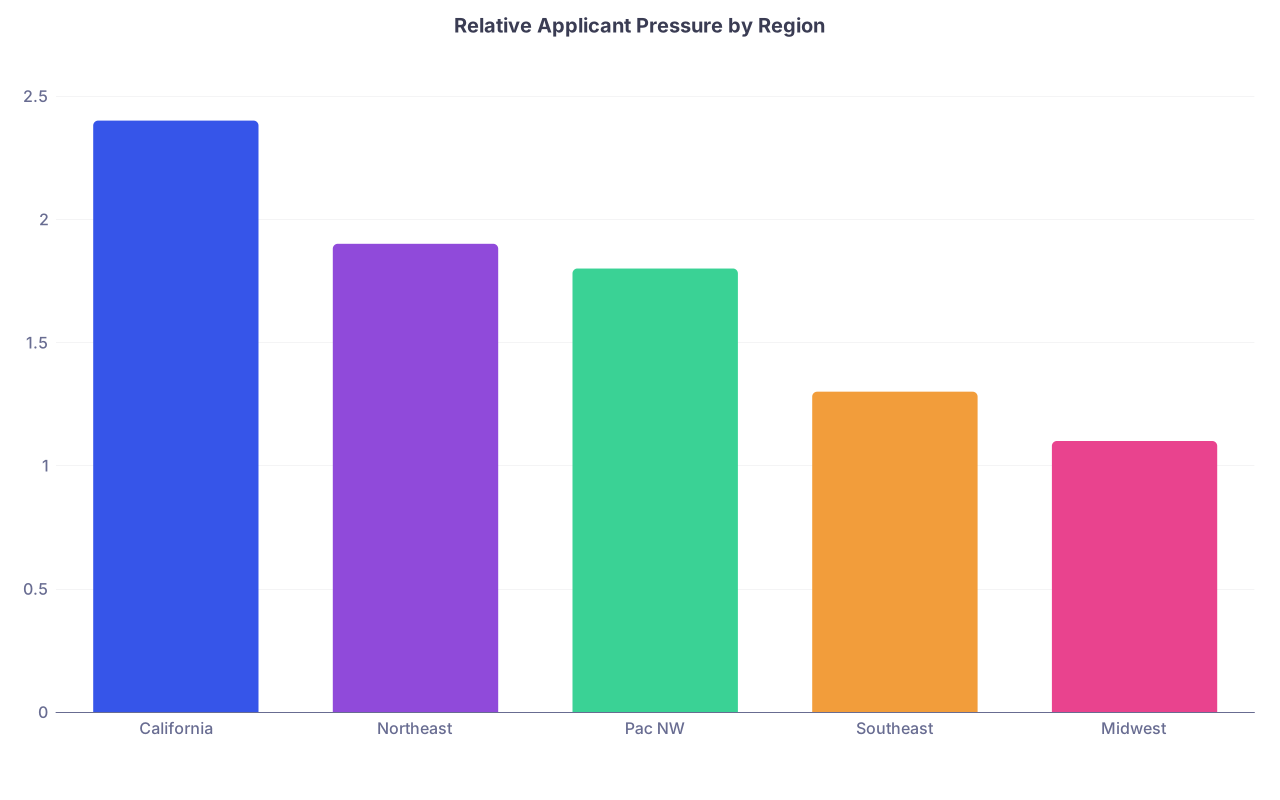
Here is a simplified approximation based on public NRMP data, state fill patterns, and program counts:
| Region | Applicants per PGY-1 Spot | Relative Pressure Level |
|---|---|---|
| California | 2.2–2.6 | Very High |
| Northeast (NY/MA/NJ/PA) | 1.8–2.1 | High |
| Pacific Northwest | 1.7–2.0 | High |
| Southeast | 1.1–1.4 | Moderate |
| Midwest | 1.0–1.2 | Lower |
You will not find this exact table in an NRMP PDF, but you can reconstruct it from:
- Total PGY-1 positions per state
- State-by-state fill data
- Applicant preferences and geographic origin
The pattern is obvious:
- In California and much of the Northeast, you are fighting 2+ applicants per seat in many hospital systems. A previous-unmatched, mid-range board score applicant is near the bottom of that stack.
- In parts of the Midwest and Southeast, some programs still scramble late to fill, especially in primary care, psych, and prelim surgery / transitional year positions. Applicant pressure is dramatically lower.
This is why geographic flexibility is not about “being open-minded” philosophically. It is about moving yourself from a 2.5:1 market to a 1.1:1 market.
To visualize that difference:
| Category | Value |
|---|---|
| California | 2.4 |
| Northeast | 1.9 |
| Pac NW | 1.8 |
| Southeast | 1.3 |
| Midwest | 1.1 |
If you insist on high-pressure regions as a reapplicant, you are choosing to remain in the most hostile market segment available.
3. How match odds shift with geographic flexibility for reapplicants
Let’s model a typical scenario.
Profile:
- U.S. MD or DO, graduated last year
- Step 1 pass, Step 2 CK ~ 225–235 (or COMLEX equivalent)
- One failed match cycle in Internal Medicine or Family Medicine
- Decent but not glowing letters, average research, no catastrophic professionalism issues
Last year’s strategy:
- Applied to 40–50 programs
- Mostly in one or two coastal regions
- No real Midwest/South exposure, no away rotations there
Observed outcome:
- 4–6 interviews
- Ranked 8–10 programs
- Unmatched
Now consider two reapplication strategies.
Strategy A: geographically rigid
- Applies to 40–60 programs
- Still restricted to: “major cities only” or “two coastal regions”
- Same specialty
Based on what I have seen and what the data suggests:
- Interview rate might rise slightly if the personal statement is improved and the story is better framed.
- But the fundamental structural problem remains: you are still in the most competitive geographic pool, and you now carry the label “previously unmatched.”
Realistic odds: 20–35% match probability.
Strategy B: geographically flexible
- Applies to 80–120 programs
- Includes a heavy emphasis on Midwest, Southeast, smaller cities, and community programs
- Same specialty or adjacent (IM + FM, Psych + FM, etc.)
Now the math changes. You are suddenly:
- One of fewer applicants per spot
- Competing in markets that actually have trouble filling all positions
- A more attractive candidate for programs that receive fewer top-tier apps
Realistic odds: 50–70% match probability for primary care–type specialties, 30–50% even in some moderately competitive fields (IM, psych).
To make it more explicit, here is a model of interview yield versus geographic scope, keeping specialty and application effort similar:
| Scope | Programs Applied | Expected Interviews | Interview Rate |
|---|---|---|---|
| One state / one metro | 40 | 2–3 | 5–7% |
| One region (e.g., Northeast) | 60 | 4–6 | 7–10% |
| Nationwide, balanced emphasis | 100 | 8–14 | 8–14% |
| Heavy focus on low-pressure areas | 100 | 10–16 | 10–16% |
The rise is not linear because the highest-yield programs (for your profile) are not in the high-pressure regions.
That is the whole point.
4. Signal vs noise: what programs actually infer when you restrict geography
I have heard this directly from PDs in community internal medicine and family medicine programs in mid-sized cities.
Paraphrasing:
- “If I see a reapplicant only applying to New England and California, I assume they care more about location than about training and will rank us low or leave if they do not like the city.”
- “We prefer applicants who show they really want to train here, not just someone blanketing the coasts.”
- “If your whole life is in Manhattan, I assume you are not actually going to move to rural Missouri for residency unless you prove it very clearly.”
From a data perspective, what they are doing is controlling risk. They know the probability of:
- Early resignations
- Resident dissatisfaction
- Cultural mismatch
goes up when someone is clearly not aligned with region or setting.
So when you:
- Only apply to coastal urban programs
- Have zero connection to the region you suddenly target
- Cannot articulate why you would move to the Midwest or South
your implied “fit score” drops. Geographic flexibility only helps if it is credible.
5. Quantifying the benefit of regional diversification in your rank list
Interviews are one side of the equation. Your rank list structure is the other.
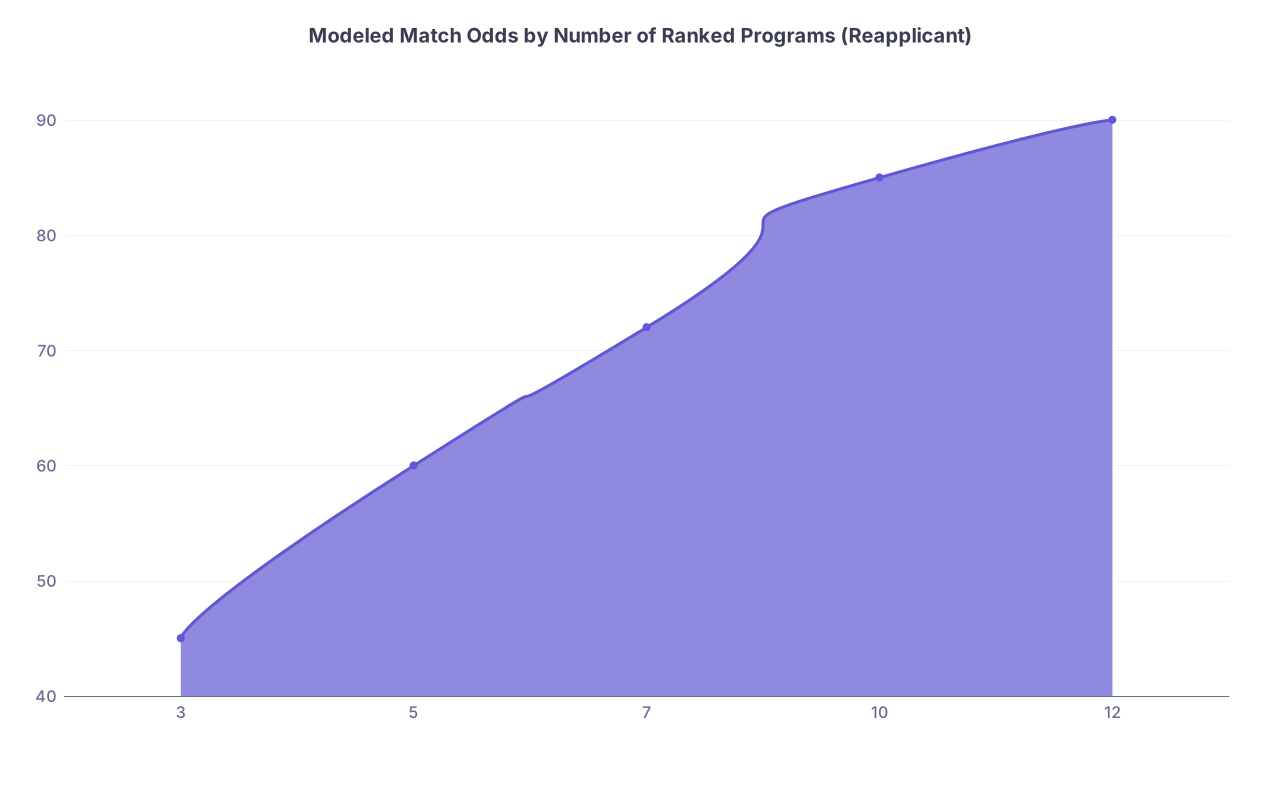
The NRMP’s own data on the probability of matching as a function of length of rank list is extremely consistent:
- For U.S. MD seniors, going from 5 to 10 ranked programs increases match probability from around the mid-80s% to the low-90s%.
- For independent applicants (which includes reapplicants), the curve is even steeper initially.
Now tie this to geography. Suppose you have:
- 4 interviews in your “dream” region
- 6 interviews in less desirable (to you) regions, mostly community programs in the Midwest/South
If you rank only the 4 that match your lifestyle preferences, you have effectively chosen:
- Maybe 60–75% probability of matching, depending on specialty and program depth.
If you rank all 10, your probability may climb into the 85–95% range.
That is not hypothetical. NRMP’s “Charting Outcomes” and “Results and Data” documents repeatedly show that independent applicants with 10+ contiguous ranks in a single specialty have a very high match probability compared to those with fewer ranks.
Let’s put a simplified version into numbers:
| Category | Value |
|---|---|
| 3 | 45 |
| 5 | 60 |
| 7 | 72 |
| 10 | 85 |
| 12 | 90 |
The only way to create those extra 3–7 rankable programs, for many reapplicants, is to expand geography.
Geographic flexibility translates into:
- Higher interview count
- Longer rank list
- Sharply higher match probability
This is one of the rare cases where the theory and the observed data align nearly perfectly.
6. Regional strategy: how to prioritize locations as a reapplicant
You do not need to apply “everywhere” in a panic. That is how people waste money and end up with a chaotic application.
You need a deliberate geographic portfolio.
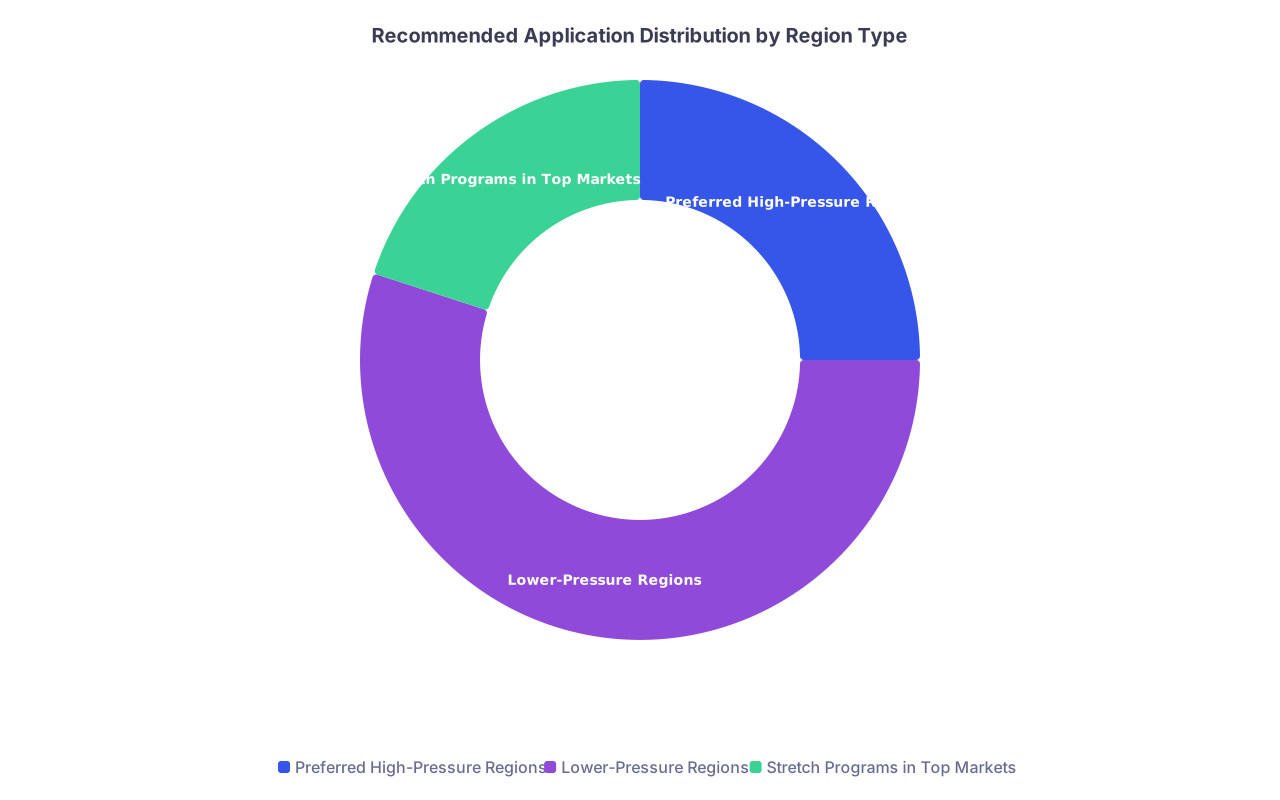
A practical breakdown that I have seen work:
- 20–30% of applications: regions you strongly prefer (family, partner job, etc.), accepting the higher pressure.
- 50–60%: lower-pressure regions (Midwest, some parts of the South), especially community and hybrid academic/community programs.
- 10–20%: “stretch” institutions or highly desirable cities where your odds are low but non-zero if your application is strong in other ways.
Here is one way to conceptualize the distribution:
| Category | Value |
|---|---|
| Preferred High-Pressure Regions | 25 |
| Lower-Pressure Regions | 55 |
| Stretch Programs in Top Markets | 20 |
In practice, that might look like:
- 20 programs in your home region (Northeast, West Coast)
- 50 programs in Midwest + Southeast + South-central
- 10 “stretch” academic centers in big cities you would love but recognize as unlikely
Notice that more than half of your total applications are in regions that historically have more open spots, more IMG/DO representation, and lower applicant pressure. That is where reapplicants with geographic flexibility often find a way in.
7. Timing and post-unmatched moves that support a geographic pivot
Geographic flexibility is much more credible if you anchor it with actual behavior, not just words.
Over the 12–18 months after an unmatched cycle, I look for applicants to do at least one of:
- Clinical work (prelim year, TRI, research year with heavy clinical exposure) in the region they now target
- Audition rotations / observerships at programs or in regions they want to match into
- Relocation for a job or partner that genuinely re-centers their life in that place
Why? Because PDs are Bayesian. They update their belief about whether you would truly come and stay.
If your entire CV screams “New York City only, forever,” but your personal statement for a midwestern FM program claims, “I am very excited to move to a smaller city in the Midwest,” the prior wins. Unless you show actual evidence of that shift.
A quick reality check:
I have watched applicants who moved to, say, Indianapolis for a research fellowship and stacked two solid letters from midwestern faculty. Their odds at surrounding regional programs went from nearly zero (as coastal-biased reapplicants) to quite reasonable (~50–70% in primary care fields) because:
- They now looked like regional insiders, not “coastal tourists.”
- Their story about wanting to be in that region had data behind it: a lease, work, community volunteering, letters from local physicians.
So if you are serious about using geography as your lever, then do not just check a box on ERAS. Rebuild your actual life to reflect that decision.
8. Edge cases: specialties where geography matters even more
There are fields where geographic flexibility is not optional after an unmatched cycle. It is mandatory if you want a realistic shot without switching specialties.
Examples:
- General Surgery reapplicants with mid-220s Step 2: You probably need to look at smaller community programs, more rural or non-coastal locations, and possibly a prelim year to strengthen your case.
- Psychiatry reapplicants: The coasts are becoming saturated with high Step score, research-heavy applicants. Meanwhile, there are midwestern and southern psych programs that still welcome reapplicants and IMGs because of regional workforce needs.
- OB/GYN reapplicants: Urban academic programs are drowning in applications. Heavily consider community-heavy or hybrid programs in less dense regions if you insist on staying in the specialty.
By contrast, if you are switching into Family Medicine or Internal Medicine from a more competitive field, the slope is less steep but the pattern is the same: your best odds are rarely in California or Manhattan.
9. When it actually makes sense to limit geography
There are narrow situations where being geographically broad is not realistic:
- You are locked to a region because of visa constraints (e.g., very few J-1 sponsoring programs in certain states for your specialty).
- You have immovable caregiving responsibilities.
- Your partner’s career or immigration status genuinely restricts city or state.
Then you are in a different problem space. The equation is not “geography vs match odds” but “specialty vs match odds within a locked geography.”
In that scenario, the data pushes you towards:
- Broadening specialty options aggressively (IM, FM, psych, prelims, TY)
- Maximizing in-region clinical visibility (rotations, local letters, any in-system jobs)
- Over-applying within the restricted geography (e.g., 70–100 applications even within one or two states), accepting lower ROI but higher coverage
It is still math. You no longer have the geographic lever, so you must pull the specialty lever harder.
10. The bottom line: what the data says you should actually do
If you want a clean, data-driven takeaway from all this, it is this:
- Staying geographically rigid after an unmatched cycle will likely cut your match odds by 30–50% compared with a similar applicant who opens up to lower-pressure regions.
- The majority of reapplicants who successfully match add:
- More programs
- More regions (especially Midwest/South)
- More community-focused and less “prestige-centric” targets
- Geographic flexibility only works if it is backed by real behavior—rotations, clinical work, or relocation—not just a checkbox on ERAS.
You are not negotiating with fate. You are negotiating with probabilities. Geographic flexibility is one of the few levers that can move your odds materially in a single cycle.
Use it. Or accept that you are voluntarily playing on “hard mode” with your career.