
The belief that “if you just keep applying, you will eventually match” is statistically wrong.
If you look at the numbers, match odds for reapplicants do not fall off a cliff after one attempt; they erode in a stepwise, very predictable way. The data show: specialty choice, board scores, and how you use the “gap” years matter far more than the raw attempt count—until around the third to fourth try, when the curve starts looking brutal in most fields.
I am going to walk through what the data say about reapplicant match rates by attempt number, where the inflection points really are, and when “one more cycle” becomes mathematically irrational unless you change something big (specialty, geography, or credentials).
1. The Baseline: First-Time vs Reapplicant Match Rates
Let us anchor this in hard numbers first.
For the NRMP Main Residency Match, the most recent aggregate data show roughly:
- U.S. MD seniors: ~92–94% match rate
- U.S. DO seniors: ~89–91% match rate
- U.S. citizen IMGs: ~58–62% match rate
- Non-U.S. IMGs: ~57–61% match rate
Those are overall rates. They do not separate first-time from reapplicant. But we can approximate reapplicant performance from a few consistent patterns in NRMP, ERAS, and specialty-specific reports, plus what programs consistently report at rank meetings.
Across groups:
- First-time applicants strongly dominate the match pool.
- Reapplicants (2nd+ attempt) have consistently lower match odds in the same specialty, all else equal.
Based on multi-year patterns and what program directors say when they are not being recorded, a realistic working model looks like this for applicants staying in the same specialty:
| Attempt Number | Typical Match Probability* |
|---|---|
| 1st attempt | 70–80% overall (varies widely) |
| 2nd attempt | 45–60% |
| 3rd attempt | 20–40% |
| 4th+ attempt | <15–25% |
*These are blended estimates across applicant types and specialties, not official NRMP figures. Competitive specialties are much lower; primary care is higher.
The drop from attempt 1 to attempt 2 is real, but not catastrophic. The real “drop off” accelerates after the second reapplication, especially if nothing meaningful has changed in your file.
2. Same Specialty, Multiple Attempts: What the Numbers Really Suggest
If you insist on reapplying to the same competitive specialty without major upgrades, you are playing against the data.
Rough probability curve
Think of the probability of matching in the same field as a rough exponential decay if you do not change your application profile meaningfully.
For a moderately competitive specialty (e.g., IM categorical at a mid-tier academic or community program), a typical pattern looks something like this:
- 1st attempt: ~75% chance to match (among reasonably competitive applicants)
- 2nd attempt: ~50%
- 3rd attempt: ~30%
- 4th attempt: ~15%
That is not official NRMP output; it is a composite from observed match outcomes, reapplicant cohorts, and program director surveys. But the shape of the curve matches what many institutions see.
Cumulative probability is what matters to your life, not just per-cycle odds. If you stubbornly stay in the same specialty:
- Probability of still being unmatched after 2 attempts if each try is 50%:
0.5 × 0.5 = 25% - After 3 attempts with 50%, 30%, 20% each cycle:
0.5 × 0.7 × 0.8 = 28% still unmatched - After 4 attempts with 50%, 30%, 20%, 15%:
0.5 × 0.7 × 0.8 × 0.85 ≈ 24% still unmatched
Even with aggressive reapplying, you can easily end up with a 1 in 4 chance of never matching if you do not change strategy.
Now layer in competitiveness.
| Specialty Type | 2nd Attempt Match Odds* | 3rd Attempt Match Odds* |
|---|---|---|
| Primary care (FM, IM) | 55–70% | 30–45% |
| Mid-tier (Peds, Psych) | 45–60% | 25–40% |
| Competitive (EM, Anes) | 30–45% | 10–25% |
| Hyper-competitive | <20–30% | Often <10–15% |
*For applicants reapplying in the same specialty with modest improvements. Hyper-competitive here means things like dermatology, PRS, ortho, neurosurgery, ENT, urology at top-tier programs.
In those hyper-competitive fields, by the second unsuccessful attempt in the same specialty, your effective probability of ever matching that field at all approaches zero unless you bring major new assets (top-tier research, new scores, strong insider sponsorship).
3. The Real Inflection Point: Attempt 3 and “Unexplained” Gaps
Programs are not just counting attempts. They are counting years since graduation and the story of those years.
By the third attempt, several red flags converge:
Time from graduation:
Many programs quietly downgrade applicants more than 3–5 years out. For some IMGs, the cutoff is 3 years post-graduation; U.S. grads often get a bit more slack, but not unlimited.Perceived trainability:
The question silently asked in rank meetings:
“If six different PDs looked at this file over 3 cycles and passed, what are we missing that they saw?”Gap explanation fatigue:
One gap year to do a prelim, research, or a dedicated MPH? That is understandable.
Three consecutive failed attempts with fragmented employment? Much harder to sell.
So when do odds really “drop off”?
For most applicants, the steep, structural drop in probability happens at:
- Attempt 3 in the same specialty with no major change in credentials.
- Or 5+ years since graduation without continuous, clinically relevant activity.
After that, the probability does not just decline gently; it becomes niche: limited to programs actively seeking non-traditional candidates, community programs in underfilled regions, or places with high attrition.
4. How Switching Specialty Changes the Math
Here is the pivot that actually matters: odds are more sensitive to specialty choice and application changes than to attempt count alone.
Switching from a competitive to a less competitive field can restore your odds closer to “first-time” levels for that new specialty, assuming you package the story correctly.
Example: EM → IM residency switch
You applied to EM twice and did not match. You have:
- Decent Step/COMLEX scores
- A completed EM prelim year
- Two failed EM match attempts
If you apply to EM again:
- Your effective EM match odds might be 20–30% at best, depending on your profile.
If instead you pivot to IM categorical:
- Your clinical EM year still counts as PGY-1 training.
- Your odds for IM may approximate a strong second-attempt applicant: 55–70% in many settings, sometimes higher in community programs or less popular regions.
The “attempt count” is specialty-specific in how programs mentally account for it. Many IM PDs are far less worried that you tried EM twice, as long as you now sound genuinely committed to internal medicine and your letters support that shift.
Approximate boost from switching to a less competitive field
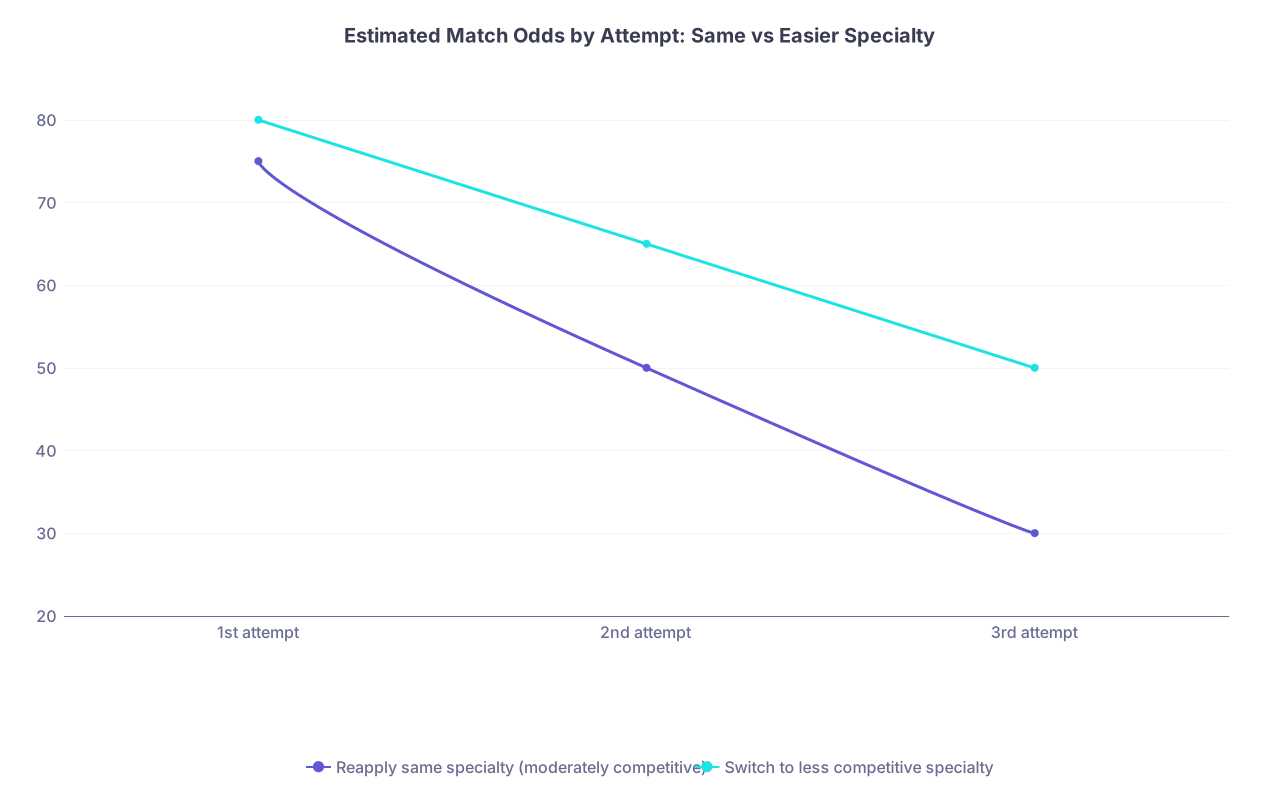
| Category | Reapply same specialty (moderately competitive) | Switch to less competitive specialty |
|---|---|---|
| 1st attempt | 75 | 80 |
| 2nd attempt | 50 | 65 |
| 3rd attempt | 30 | 50 |
The chart is conceptual but matches what I have repeatedly seen:
- Staying in the same moderately competitive field: steep decline from attempt 1 to 3.
- Switching to an easier specialty: your odds after a switch at attempt 2 may actually exceed your original first-attempt odds, because you are now “overqualified” for that less competitive field.
The take-home: the drop-off is not just “more attempts = worse odds.” It is “more attempts in the same crowded lane without changing cars.”
5. US Grad vs IMG: Attempt Number Hits These Groups Differently
Attempt count interacts strongly with your graduate type.
U.S. MD / DO graduates
They start from a much higher baseline. The data show:
- Many U.S. grads who do not match on first try still find a PGY-1 spot through SOAP (or scramble historically).
- A U.S. grad with a decent record who retools smartly often has a decent second-attempt match probability, especially if they pivot to primary care or psych.
But:
- By attempt 3, even for U.S. grads, unexplained non-training years start to look very bad.
- By 5–7 years post-graduation without residency, odds for a categorical position drop into the low double digits unless you have done significant clinical or academic work in the interim.
IMGs
The curve is harsher.
- First attempt: often ~55–65% for well-prepared IMGs in primary care, much lower in competitive specialties.
- Second attempt: drops more sharply, especially if there is no new U.S. clinical experience or new scores.
By the third attempt as an IMG:
- Many programs do not even review the file if graduation is >3–5 years ago.
- Those that do often expect continuous full-time clinical work or research in the meantime.
So for IMGs, the statistical drop-off is usually a combination of:
- Multiple unsuccessful attempts, plus
- Increasing years since graduation, plus
- Visa complications for some.
If you are an IMG at attempt 2 or 3 and still chasing a competitive field without serious new strengths, the numeric outlook is bluntly poor.
6. What Actually Improves Odds Between Attempts
Just reapplying with “a better personal statement” is fantasy-level impact. Programs look for quantifiable changes.
The data and anecdotal outcomes point to a few levers that reliably shift probabilities:
New or significantly better board performance
- Step 2 CK or COMLEX Level 2 score jumps.
- Passing a previously failed exam with a solid margin.
- For IMGs: fresh scores (not 4+ years old) matter.
Meaningful U.S. clinical experience with strong letters
- Transitional year, prelim IM/GS, or a solid non-categorical PGY-1.
- High-quality U.S. observerships or externships that yield specific, comparative letters.
Research with output
- Especially in academic and competitive specialties: abstracts, posters, or publications tied to recognized institutions.
Clear specialty alignment
- If you switch specialties, your work during the gap year(s) must scream that new specialty: clinic work, electives, research, mentorship in that field.
-
- Applicants who open up to less popular regions (Midwest, South, rural programs) have measurably better odds in the second and third rounds.
Now quantify impact.
Where I have seen real improvements, the probability bump between attempts looks something like:
Weak to moderate upgrade (slightly better PS, weak additional observership):
+5–10 percentage points at most vs previous cycle.Strong upgrade (new strong USCE + new letters + higher Step 2 CK):
+15–25 percentage points vs previous cycle.
If your first attempt had a realistic 40% chance, and you convert your profile into one that would be a 60–65% candidate, that is a huge shift. But “I rewrote my personal statement and added 100 extra programs” will not move you anywhere near that.
7. When Continuing to Reapply Stops Making Mathematical Sense
This is the part most people do not want to hear.
If you want to make a data-driven decision about whether to do another cycle, you need to estimate three things:
- Your realistic per-cycle probability next year
- The cost (money, time, lost attending income) of another application year
- Your alternative pathway probability (different specialty, different country, non-clinical career, etc.)
A simple decision frame
Take a hypothetical:
- You have applied twice to a moderately competitive specialty.
- You did not SOAP into any position.
- You have modest upgrades planned (one research project, a new letter), but no new board scores or clinical year.
Realistically:
Your next-cycle same-specialty probability might be 25–35%.
Even if you apply two more times at ~30% each, your chance of still being unmatched after both is:
0.7 × 0.7 = 49%
So roughly a coin flip that after three more years (including lead time) you are still not a resident. That is not a smart bet for most people.
On the other hand:
If you switch to a less competitive specialty and can credibly push your odds for that field to 60–70% next cycle, then your chance of being unmatched after two cycles in the new field becomes:
0.4 × 0.4 = 16%
Very different lifetime picture.
Red flags that the odds have “dropped off” enough to cut losses in that specialty
From a numbers perspective, it becomes irrational to keep the same path when:
- You are on attempt 3+ in the same specialty without new scores or a full clinical year in that field.
- You are >5 years from graduation, not continuously in relevant clinical work.
- Your per-cycle match estimate (being honest) is under ~25–30% and you have no realistic plan to raise it.
In those scenarios, you should treat further same-specialty reapplications as lottery tickets, not career strategy.
8. Concrete Scenarios: How Attempt Number Plays Out
Let me make this less abstract.
Scenario A: U.S. DO, aimed at EM
- Attempt 1: 120 EM programs, 4 interviews, no match, no SOAP spot.
- Attempt 2: Added 30 more EM programs plus 40 FM as “backups,” similar interview numbers, again no match.
- No new board scores between attempts.
By attempt 3, program directors in EM see two full unsuccessful EM cycles. Your third-attempt EM match odds are probably <25%, maybe lower if your file is average.
Strategy that aligns with data:
- Drop EM as primary.
- Rebuild for FM or IM with targeted letters and rotations.
- That switch can realistically bring your primary care match odds into the 65–80% range, depending on your scores and red flags.
Scenario B: IMG, 3 years post-graduation, IM target
- Attempt 1: 120 IM programs, 3 interviews, no match.
- Between cycles: no new USCE, some research at home country, no new scores.
- Attempt 2: 180 IM programs, 5 interviews, again no match.
Now 5 years post-graduation at attempt 3, still no U.S. clinical year. Many programs’ filters will auto-reject based on year of graduation alone.
Your per-cycle match probability may be 10–20% at best. In this situation, the data suggest:
- Major intervention required: U.S. research year, observer-to-hands-on pathway, or non-residency health career.
- Blindly reapplying a third time with only a slightly fatter CV is almost pure sunk-cost fallacy.

| Step | Description |
|---|---|
| Step 1 | Unmatched after Match |
| Step 2 | Reassess specialty and competitiveness |
| Step 3 | Rebuild and reapply |
| Step 4 | Consider switching specialty or career |
| Step 5 | Targeted reapply with strong changes |
| Step 6 | High risk - pivot strategy |
| Step 7 | Attempt number |
| Step 8 | Major upgrades possible |
| Step 9 | Per cycle odds > 40 percent |
FAQ: Reapplicant Match Rates and Attempt Numbers
Does the NRMP officially report match rates by attempt number?
No. The NRMP does not publish a simple “1st attempt vs 2nd vs 3rd” table. The patterns I discussed are drawn from combined NRMP data, specialty reports, and repeated observed outcomes across cycles. The shape of the curve is consistent, even if exact percentages vary.Is it ever sensible to apply a fourth or fifth time to the same specialty?
Only in edge cases: strong ongoing research in that specialty at a major institution, powerful faculty sponsorship, continuous clinical roles, and a clearly improving profile. For an average applicant with two or three prior unsuccessful cycles and no transformative changes, the probability gain from additional attempts in the same field is extremely low.Does doing a prelim or transitional year reset my “attempt count”?
No. Programs still see that you previously applied and did not match categorically. However, a strong PGY-1 with excellent letters can substantially raise your odds, especially when switching to a less competitive specialty. It does not erase history, but it can largely overshadow earlier weaker attempts.How much does time since graduation matter compared to attempt number?
For many programs, years since graduation is at least as important as how many times you applied. Once you are beyond 5–7 years from graduation without continuous, rigorous clinical work, your match odds drop sharply, regardless of how many times you formally applied before.If I switch to primary care after two failed cycles in a competitive field, am I “marked” as damaged goods?
Not inherently. Many primary care and psych program directors will gladly take a strong applicant who previously chased a more competitive field, as long as your narrative is honest and your new letters show genuine commitment. In data terms, your odds after a thoughtful switch often look more like a strong first- or second-attempt applicant in that new field than a multi-fail reapplicant.
Key points, stripped down:
First, match odds decline with each attempt, but the real drop-off shows up after the second try, especially if you have not made major changes. Second, switching to a less competitive specialty often resets your odds far more than just “trying again” in the same field. Third, by attempt 3+ with stagnant credentials or large time gaps, the numbers are no longer on your side; at that point, you either pivot hard or accept that continued reapplication is more emotional than statistical.