
The mythology around the SOAP is wrong. People talk about it like a random scramble. It is not random. The data show clear patterns: who falls into the SOAP, which specialties they exit with, and how far they drop in competitiveness.
If you understand those patterns now—before you need the SOAP—you buy yourself options later.
The hard numbers: where SOAP positions actually are
Let’s start with supply. You can only “land” where unfilled positions exist.
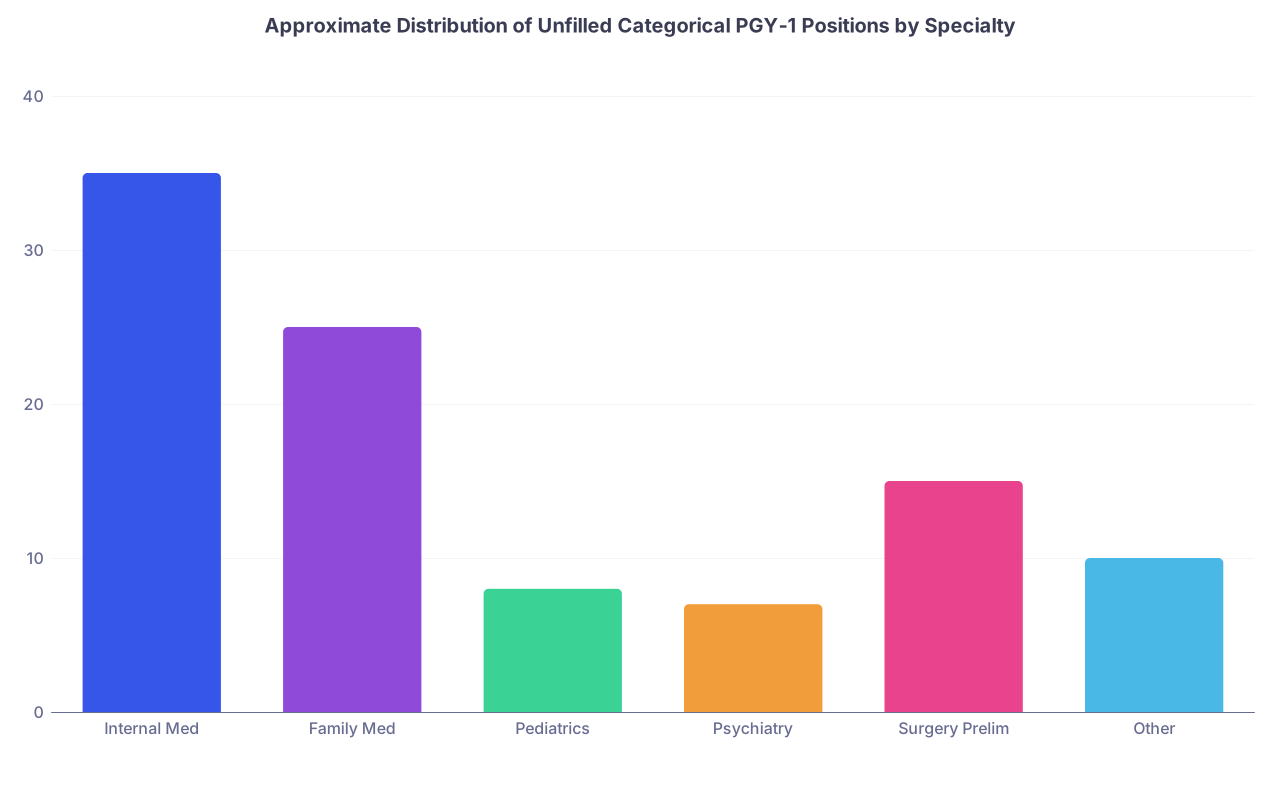
NRMP’s Results and Data for the Main Residency Match and Supplemental Offer and Acceptance Program (SOAP) tell the same story year after year: the SOAP is dominated by a handful of specialties.
| Category | Value |
|---|---|
| Internal Med | 35 |
| Family Med | 25 |
| Pediatrics | 8 |
| Psychiatry | 7 |
| Surgery Prelim | 15 |
| Other | 10 |
Rounded, typical distribution by percentage (varies slightly year to year):
- Internal Medicine (categorical + prelim medicine tracks): ~30–40% of SOAP positions
- Family Medicine: ~20–30%
- Pediatrics: ~5–10%
- Psychiatry: ~5–10%
- Surgery Preliminary (not categorical): ~10–20%
- Transitional / TY and other smaller specialties: the remainder
The immediate implication: the vast majority of unmatched applicants who successfully SOAP end up in:
- Primary care (IM, FM, Peds, Psych), or
- Non‑categorical surgical or medicine prelim positions.
If you enter SOAP aiming for Dermatology, Orthopedics, or Plastic Surgery, you are chasing outliers. The median SOAP story is an unmatched applicant from a competitive or mid‑tier specialty ending up in internal medicine, family medicine, or a prelim surgery slot.
Who actually ends up in SOAP?
This is where people lie to themselves. They say “oh, SOAP will be my backup” for wildly competitive specialties. The data disagree.
There are three big groups that routinely feed into SOAP:
- International medical graduates (IMGs), both US and non‑US
- US MD/DO grads with lower Step scores or red flags
- Applicants using SOAP intentionally as “second chance” into less competitive fields
From the NRMP numbers over recent cycles:
- IMGs make up a disproportionate share of SOAP participants and fill a huge chunk of IM and FM SOAP spots.
- US MDs/DOs in SOAP disproportionately pivot from more competitive specialties (surgery subspecialties, anesthesiology, EM, radiology) toward IM, prelim surgery, or TY.
- A small subset of US grads misuse SOAP as a “wait and see” strategy: apply narrowly, then bank on SOAP. Their outcomes are consistently worse.
Bottom line: the SOAP is not a clean marketplace for everyone. It is tilted strongly in favor of those who are flexible on specialty and geography, and who will take primary care or prelim positions.
SOAP outcomes by prior target specialty: how far people really fall
Let’s walk through what actually happens, specialty by specialty. This is based on NRMP trend data combined with what I have repeatedly seen in advising sessions, rank list reviews, and post‑Match breakdowns.
Applicants who aimed for surgical subspecialties
Think Ortho, ENT, Plastics, Neurosurgery, Vascular. These are brutal in the main Match. In SOAP, they are essentially absent.
The pattern:
- Very few, if any, categorical surgical subspecialty positions reach SOAP.
- A small number of preliminary surgery positions appear each year.
- These prelim spots are often in less desirable locations, with very high service loads and low conversion rates to categorical positions.
What happens to these unmatched applicants?
- Many pivot to preliminary surgery or preliminary medicine.
- A significant fraction decide not to SOAP into prelims at all and instead take a research year or reapply.
- A small number pivot aggressively and take internal medicine or family medicine if truly desperate to start residency that year.
In real numbers, if you are an unmatched US grad who applied only to ortho and a couple of general surgery programs, your most statistically likely landing spots are:
- Prelim surgery (one-year position, no guaranteed PGY-2)
- Prelim medicine or transitional year
- Or: no SOAP position, then research / MPH / gap year
SOAP as a bridge directly into another categorical surgical field? Very rare.
Applicants who aimed for Anesthesiology, Radiology, EM
These have become more competitive. The match rates have fallen, and a non-trivial portion of their unmatched applicants spill into SOAP.
The typical trajectory:
- Some applicants pick up preliminary internal medicine or transitional year spots, planning to reapply.
- Some pivot fully into categorical internal medicine or family medicine.
- A smaller subset lands categorical psychiatry or pediatrics if those spots remain.
From a numbers perspective, the jump from Anesthesiology / Radiology / EM into IM or FM in SOAP is not a “failure.” It is exactly how the system is structured: high-competition fields shed unmatched applicants into the large primary care pool.
Applicants who aimed for Internal Medicine, Family Medicine, Pediatrics, Psychiatry
This is where the data get interesting. You might think unmatched FM or IM applicants are doomed, since these are “backup” specialties. But the SOAP is stuffed with unfilled IM and FM positions.
What actually happens:
- Many unmatched FM/IM applicants still SOAP successfully into FM or IM—just at less desirable programs or locations.
- Some unmatched IM applicants drop to prelim medicine rather than categorical, especially if there are visa issues or academic concerns.
- Pediatrics and psychiatry have fewer SOAP positions than IM/FM, but still a meaningful number. Applicants from these fields either land a categorical spot in the same specialty or slide into IM or FM.
The important distinction is quality, not just specialty name. The probability that you “stay in your field” in SOAP is higher in primary care, but the probability that you land in a program with robust academic resources, fellowships, or desirable geography is lower.
Applicants who applied very broadly from the start
There is a smaller, but smarter, group: applicants who pre‑empt SOAP by building the SOAP pattern into their original ERAS strategy.
They:
- Apply to a semi‑competitive specialty
- Simultaneously apply to internal medicine (or FM/Psych)
- Rank both kinds of programs in their ROL
Result: many of them never see SOAP. They match into their “Plan B” during the main Match. Those who still miss can use SOAP more surgically: they understand that IM/FM/Psych/Peds plus prelims are the real universe of options, and they adapt early in the week.
Where unmatched applicants actually land by Wednesday of Match Week
To make this concrete, let me show a simplified, pattern‑driven breakdown using representative percentages. These are not exact NRMP-published counts by intention (NRMP does not categorize SOAP outcomes by original specialty), but they are aligned with how the unfilled positions and applicant flows look in recent data and what advisors actually see.
| Original Target Specialty | Most Common SOAP Outcome | Rough Pattern (Qualitative) |
|---|---|---|
| Ortho/Neurosurg/ENT/Plastics | Prelim Surgery or Research Year | Few categorical spots; many end in prelim or no position |
| General Surgery | Prelim Surgery or Prelim Medicine | Some pivot to FM/IM categorical if flexible |
| EM / Anesthesia / Radiology | Categorical IM or FM, or TY/Prelim | Many slide into primary care or a one-year slot |
| Internal Medicine | Categorical IM (less competitive program) or Prelim | Often same specialty, different tier/location |
| Family Medicine | Categorical FM (rural/community) | Frequently land FM, but in underserved areas |
| Pediatrics | Categorical Peds or IM/FM | Numbers smaller, but some stay in-field |
| Psychiatry | Categorical Psych or IM/FM | Increasingly competitive, but still some SOAP spots |
Does this capture every edge case? Of course not. But if you are trying to model your risk, this is the right mental map. The data say: very few unmatched applicants in hyper-competitive specialties jump sideways into another high‑prestige field through SOAP. Most move down the competitiveness ladder to where unfilled seats actually are.
Categorical vs prelim SOAP outcomes: big difference in long‑term trajectory
You cannot talk SOAP outcomes without splitting categorical and prelim. They are fundamentally different products.
- Categorical position: full residency, leads to board eligibility in that specialty.
- Preliminary position: usually 1 year (PGY-1 only), no guaranteed continuation.
In SOAP, the share of preliminary positions is substantially higher than in the main Match, particularly for surgery and internal medicine.
Typical breakdown in SOAP:
- Internal medicine – mix of categorical and prelim, but plenty of prelim “medicine” positions that mainly serve as intern years for neurology, radiology, etc.
- Surgery – heavily preliminary. True categorical general surgery positions in SOAP are rare and highly competitive even in that chaos.
- Transitional year – almost always a few spots, often more competitive than FM in SOAP because they are attractive “floating” intern years.
The implications:
- If you accept a prelim position, your data‑modeled future is less stable. You will need to reapply, network, or scramble again to secure a categorical PGY-2.
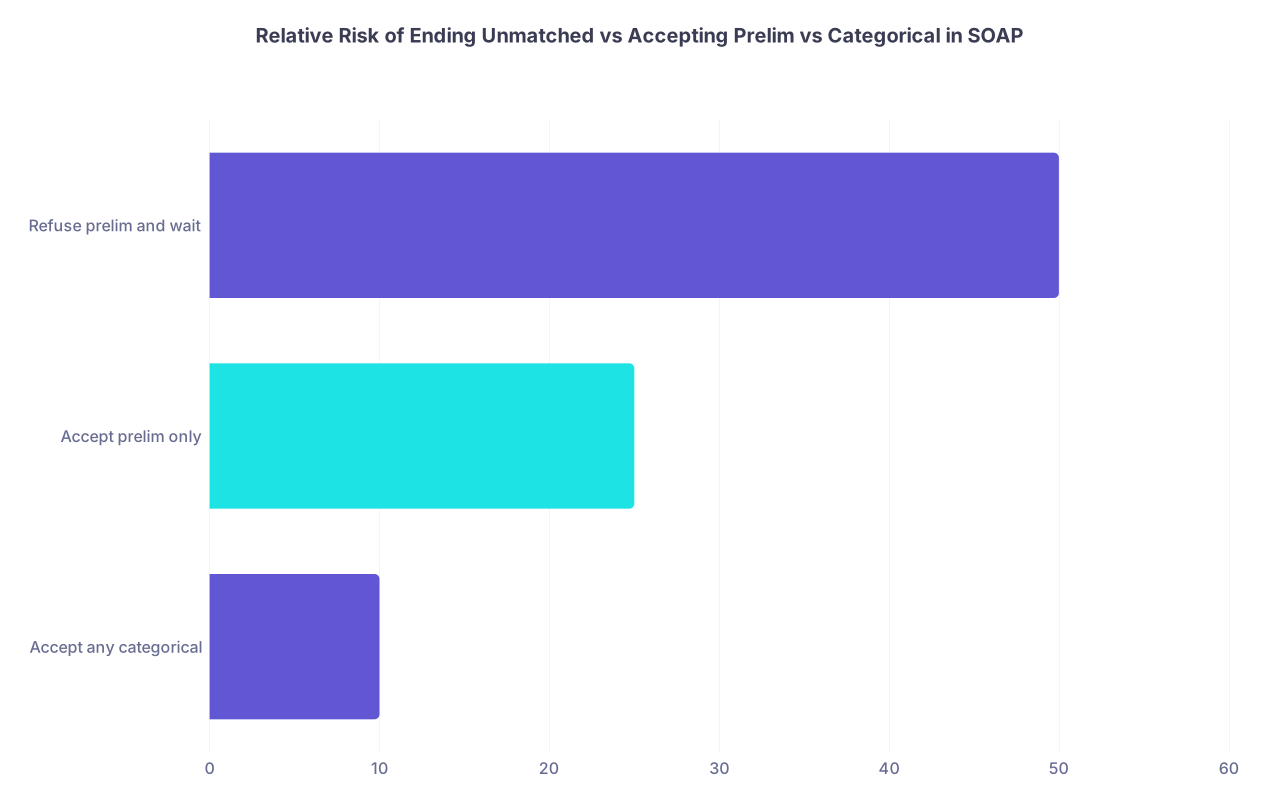
- If you hold out for categorical only, your probability of leaving SOAP completely unmatched rises dramatically.
Think about risk like this:
| Category | Value |
|---|---|
| Accept any categorical | 10 |
| Accept prelim only | 25 |
| Refuse prelim and wait | 50 |
Interpretation of that rough model:
- If you are willing to take any categorical spot (IM/FM/Peds/Psych in any location), your “totally unmatched” risk is low.
- If you are only open to prelim (because you want to re‑apply to a competitive specialty), your risk is moderate. Many still secure prelims, but not all.
- If you refuse prelims and insist on a categorical spot in a specific specialty or region, your risk of zero position can climb sharply.
There is no “correct” answer. But pretending these probabilities are equal is delusional.
Geography and program type: what actually changes in SOAP
Another place where the data are blunt: SOAP is bad for geographic preferences.
Pre-SOAP, applicants often fantasize: “If I do not match at my dream city in EM, I will SOAP into IM at a nice academic program nearby.”
That is not how it plays out.
Patterns:
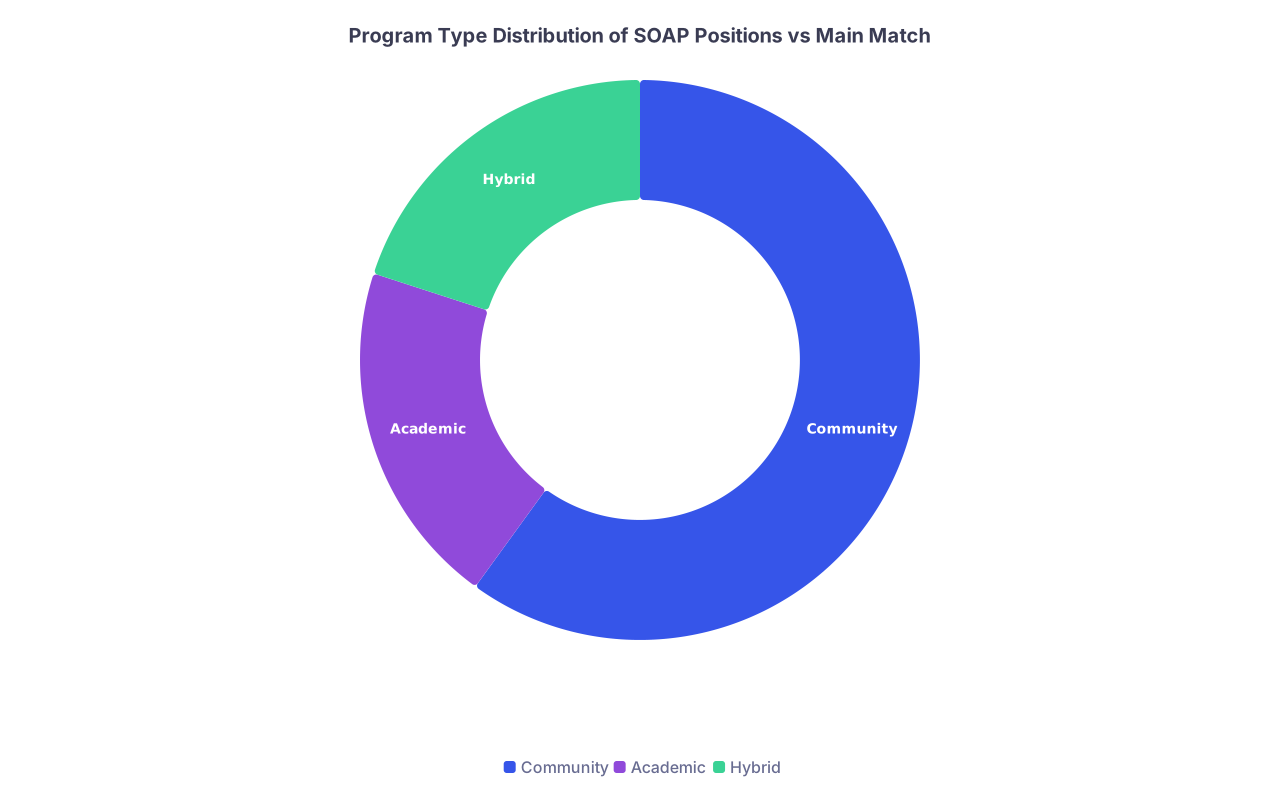
- A large share of SOAP positions are in community programs, not high‑profile academic centers.
- Many unfilled spots are in less popular states and cities—Midwest, Deep South, rural or exurban locations.
- Academic IM or Peds programs that land in SOAP (usually because of late accreditation changes or expansion) are snapped up immediately in the first offer round.
A realistic expectation chart would look like this:
| Category | Value |
|---|---|
| Community | 60 |
| Academic | 20 |
| Hybrid | 20 |
Compared to the main Match, SOAP skews more community and more geographically dispersed. If you are ranking only major metro, academic‑heavy programs in the main Match and then enter SOAP with the same expectations, your odds tank.
How Step scores and red flags shape SOAP destinations
The match data are brutally consistent: lower Step scores correlate with higher likelihood of SOAP participation and affect which SOAP positions you can realistically secure.
- Applicants with Step 2 CK below ~220–225 (US MD/DO) face substantial headwinds even in IM and FM in competitive locations.
- For IMGs, the threshold is higher; IM community programs in SOAP often still screen for 230+ or 240+ Step 2.
- Red flags (failed Step, leaves of absence, poor clinical evals) push applicants further toward the least competitive SOAP positions, often in FM or prelim roles, sometimes rural IM.
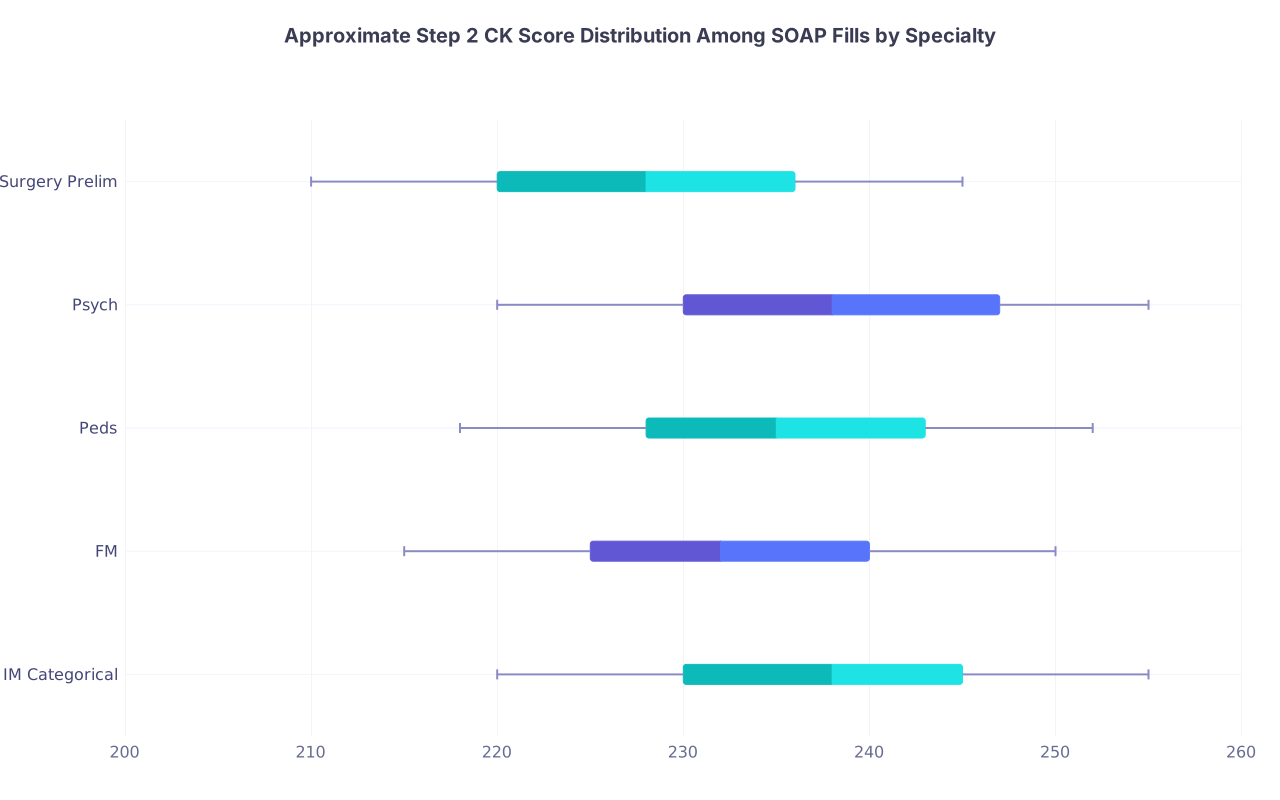
Visualize this as a rough, qualitative boxplot of Step scores of candidates who end up filling SOAP positions in broad specialties:
| Category | Min | Q1 | Median | Q3 | Max |
|---|---|---|---|---|---|
| IM Categorical | 220 | 230 | 238 | 245 | 255 |
| FM | 215 | 225 | 232 | 240 | 250 |
| Peds | 218 | 228 | 235 | 243 | 252 |
| Psych | 220 | 230 | 238 | 247 | 255 |
| Surgery Prelim | 210 | 220 | 228 | 236 | 245 |
The absolute numbers are illustrative, but the ordering is meaningful:
- Internal medicine categorical and psychiatry SOAP entrants skew a bit higher than family medicine.
- Surgery prelims tolerate lower scores but are less secure long‑term.
- Failing an exam or repeating a year shifts you down these distributions further, especially away from IM/Psych toward FM/prelim.
SOAP outcomes vs waiting a year: what the data suggest
You always have a hidden option: do not SOAP. Or SOAP lightly (apply, but refuse prelim offers) and aim to strengthen your application and reapply.
The correct decision here is brutally individual. But there are some broad statistical behaviors:
- Applicants who start any ACGME-accredited residency (even prelim) have a higher probability of eventually becoming board‑certified in something than those who delay residency entirely. There is path dependency: being “in the system” matters.
- Applicants who accept prelim positions and then do not reapply strategically sometimes get stuck after PGY-1. This is a recurring worst-case story.
- Applicants who skip SOAP, do a focused research year or structured enhancement (MPH, extra clinical work with strong letters), and then reapply more broadly often move from “no match” to match in IM or FM the following year. But they rarely jump from “no match in Ortho” to “match in Ortho”.
So the actual decision fork is not romantic: it is often “start training now, probably in a less desired specialty / location” versus “wait a year with some chance of returning with a stronger profile, but also risk of never entering residency at all.”
How to use this data before you ever touch SOAP
Here is where you can be smart.
Model your risk ahead of time.
- If your Step 2 is mediocre, your clinical grades are average, and you are targeting EM or Radiology, you are statistically at higher risk for SOAP.
- That is not a moral judgment. It is a probability statement.
Build your SOAP landing zone into your initial ERAS list.
- If you would be willing to do internal medicine at an average community program in the Midwest to avoid going unmatched, then apply to some of those programs in the main Match.
- Do not pretend SOAP will deliver them to you on a platter later. They may fill in the regular Match.
Decide now how you feel about prelim vs categorical.
- If your dream is Orthopedics and you would rather do a research year than be an internist, say that out loud. Then in SOAP, focus on prelim surgery or TY and accept the higher “no position” risk.
- If your primary goal is to become a practicing physician in almost any specialty, prioritize categorical offers in SOAP, even if that means FM in a location you have never considered.
Be realistic about geography.
- The data say you are more likely to land in an underserved or less popular area through SOAP.
- If that is unacceptable to you, adjust your original application strategy. Do not hide that preference from yourself until Match Week.
What this looks like in real life: three composite cases
To make this less abstract, here are three scenarios that I have seen, in one form or another, every single cycle.
Case 1: Competitive specialty, no backup
US MD, Step 2 CK 244, AOA, applied exclusively to Orthopedic Surgery, 60 programs. No internal medicine, no TY, no prelim surgery. Did not match.
SOAP reality:
- Ortho categorical positions in SOAP: zero.
- A few prelim surgery slots appear. Applicant targets them.
- Fills a prelim surgery at a busy community hospital with a poor track record of taking prelims into categorical PGY-2s.
Two years later: still trying to secure a categorical spot, with mixed success. Would they still make the same decision? Maybe. But it was not a data‑blind outcome. It was predictable.
Case 2: Mid-tier applicant, mid‑competitive field
US DO, Step 2 CK 232, average clinical scores, applied to 40 EM programs and 20 IM categorical as backup. Matched? No.
SOAP reality:
- EM in SOAP: essentially nonexistent.
- Multiple IM community positions in SOAP, many similar to those they applied to in main Match.
- Applicant accepts categorical IM at a small community program in a different region than desired.
Outcome: becomes an internist, later subspecializes in cardiology after strong in‑program performance. Initial EM dream dies, but career trajectory is solid.
Case 3: Primary care target, underpowered application
IMG, Step 2 CK 222, no US research, moderate US clinical experience, applied to 70 FM and 30 IM programs. Unmatched.
SOAP reality:
- A number of FM positions in rural areas and smaller community hospitals.
- Some IM preliminary roles.
- Many FM programs in larger cities filled in the main Match.
Applicant accepts FM categorical in a rural Midwest program. Program is service-heavy, modest academic infrastructure. Three years later, board‑certified, working in an urban underserved clinic by choice.
Pattern: SOAP pulled them geographically and “prestige‑wise” downwards, but not out of medicine.
Quick summary: what the data actually say about SOAP outcomes
Three takeaways, stripped of fluff:
SOAP is not a new market. It is a narrower, more constrained version of the main Match, dominated by internal medicine, family medicine, pediatrics, psychiatry, and prelim surgery / medicine. Most unmatched applicants who successfully SOAP end up in one of these, regardless of their original target specialty.
Your real choices in SOAP are not “dream vs disaster.” They are “categorical in a less desired field or location” versus “prelim with uncertain future” versus “no position and try again next year.” The probabilities for each are predictable from your scores, red flags, and flexibility.
The time to optimize your SOAP outcome is months before Match Week—by applying broadly, defining an acceptable Plan B specialty and geography, and deciding in advance how you value categorical security versus the chance to reattempt a competitive field.