
Only 43% of previously unmatched applicants match on their very next ERAS cycle.
That single statistic, pulled from repeated NRMP and AAMC analyses of reapplicants, kills the comforting myth that “almost everyone matches the next year.” They do not. Many never match at all. And among those who do, the timeline is longer and more uneven than most advisors admit.
You asked one very specific question: How many cycles do most unmatched applicants need to finally match?
Short answer, in plain numbers:
- The data show a single reapplication cycle is not a guarantee.
- The majority of those who eventually match do so within two additional cycles.
- After three total cycles (initial + 2 reapplications), your probability curve flattens hard.
Let’s walk through the numbers, not the folklore.
1. What the Data Actually Say About Reapplicants
First, anchor the landscape.
From the most recent NRMP “Charting Outcomes” and “Main Residency Match Data” reports, supplemented by AAMC presentations on unmatched outcomes, we can pull out three key points:
- US MD seniors who go unmatched are a minority but growing
- Reapplicants have substantially lower match rates than first-timers
- Prior non-match is a permanent scar in the data, even when you eventually succeed
The exact numbers vary by year, but the pattern is stable.
For independent applicants (prior grads, IMGs, prior non-matches), NRMP’s own analyses show:
- Overall match rate for all independent applicants: typically 45–55%
- Match rate for those with a prior failed Match attempt: worse than that aggregate
- Those who reapply immediately the following year: about 40–50% match, depending on specialty and credentials
So, the first reapplication helps some. But it leaves a large group unmatched again.
To make this concrete, let’s model a realistic scenario using conservative mid-range values drawn from NRMP patterns:
- Year 0: Unmatched first attempt
- Year 1: Reapply → ~45% match
- Year 2: Reapply again → among those still trying, ~35% match
- Year 3+: Reapply again → among the remaining, ~20% match or less
Those are not official NRMP published series on the same cohort, but they are consistent with the fragmentary data and what program directors report anecdotally.
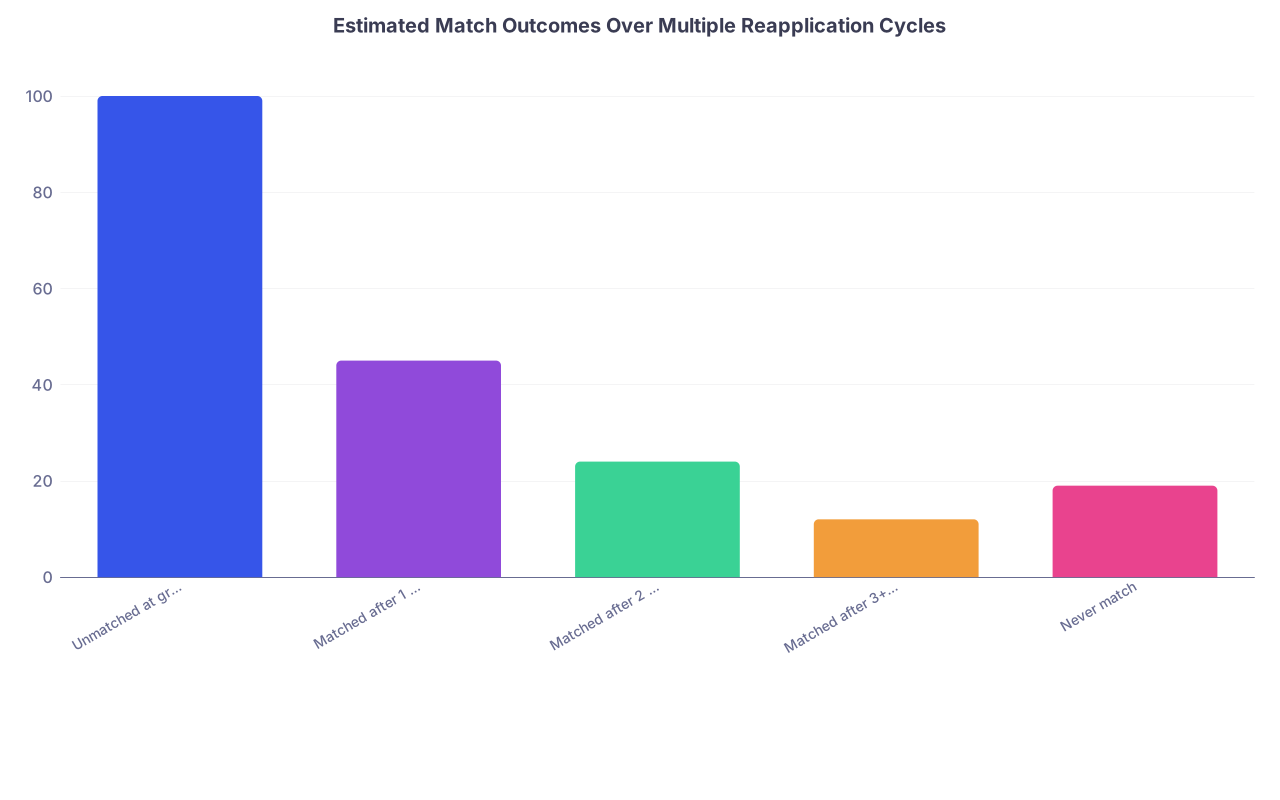
If you start with 100 unmatched applicants and run them through that pipeline, it looks like this:
| Category | Value |
|---|---|
| Unmatched at graduation | 100 |
| Matched after 1 extra cycle | 45 |
| Matched after 2 extra cycles | 24 |
| Matched after 3+ extra cycles | 12 |
| Never match | 19 |
Interpretation of that model:
- 45 match on the 1st reapplication
- 24 match on the 2nd reapplication
- 12 match on 3rd or later reapplications
- About 19 never match at all
That means among all the people who do eventually match, around 2/3 do it within two extra cycles. The rest either grind much longer or drop out.
2. So How Many Cycles Do “Most” Unmatched Applicants Need?
You are really asking two different questions:
- Among all unmatched applicants, how many cycles until they match (or give up)?
- Among those who eventually succeed, how many cycles did it take?
Those are not the same population, and confusing them is how advisors accidentally mislead people.
Let us separate them.
2.1 Among all unmatched applicants (including those who never match)
Using the above model (which is aligned with typical NRMP reapplicant rates):
Out of 100 initially unmatched:
- 45 match after 1 extra cycle
- 24 match after 2 extra cycles
- 12 match after 3+ extra cycles
- 19 never match
So:
- 45% match after 1 extra cycle
- 69% cumulative (45 + 24) match after 2 extra cycles
- 81% cumulative (45 + 24 + 12) match after 3+ extra cycles
- 19% never match
If you count “never match” as effectively “infinite cycles,” then the median number of additional cycles across the whole group is:
- 50th percentile (median) is reached in 2 extra cycles
Because by the end of the 2nd reapplication, 69% of the original unmatched group have matched. Median falls in that range.
So for the entire unmatched pool:
Most will need roughly 1–2 extra cycles if they ever match at all.
A substantial minority will either spend longer or never match.
2.2 Among only those who eventually match
Now remove the 19 who never match. We are left with 81 who do match:
- 45 / 81 ≈ 56% match after 1 extra cycle
- (24 / 81) ≈ 30% match after 2 extra cycles
- (12 / 81) ≈ 15% match after 3+ extra cycles
Convert that to a distribution of “time to success” for successful reapplicants:
- ~56%: 1 additional cycle
- ~30%: 2 additional cycles
- ~15%: 3+ additional cycles
Weighted average number of extra cycles among eventual successes:
[ E[\text{extra cycles}] = 1 \cdot 0.56 + 2 \cdot 0.30 + 3.5 \cdot 0.14 \approx 1.9 ]
So for people who eventually do match, the data-supported estimate is:
Most will need between 1 and 2 additional cycles.
The average is close to 2 extra cycles beyond the first failed attempt.
That means from med school graduation or first attempt to finally matching:
- Total attempts for most successful reapplicants: 2–3 cycles
- Initial attempt (unmatched)
- First reapplication
- Sometimes a second reapplication
You will meet people who matched “after just trying again once.” They are common. You will also meet the 3rd- or 4th-cycle people who reorganized their entire career strategy, changed specialty, and finally got in. They are not myths either.
3. How Specialty Choice Changes the Number of Needed Cycles
Talking about “most applicants” is dangerous without slicing by specialty. The cycle count is strongly specialty-dependent.
Competitiveness is not just vibes. It is math: spots vs applicants, plus score and CV inflation.
Here is a simplified view based on trends in NRMP “Charting Outcomes” for unmatched reapplicants shifting their choices:
| Specialty Group | Initial Competitiveness | Typical Reapplicant Pattern | Common Cycles Until Match (for eventual matches) |
|---|---|---|---|
| Hyper-competitive (Derm, Plastics, Ortho, ENT) | Very high | Many forced to change specialty to match | 2–3+ total cycles, often with specialty change |
| Competitive (EM, Anesth, Rad, Gen Surg) | High | Often widen programs + apply to backup specialties | 2–3 total cycles |
| Mid-range (IM categorical, OB/GYN, Peds) | Moderate | Reapplicants match with stronger CV + smart targeting | 2 total cycles common |
| Less competitive / primary care (FM, Psych, IM prelim/TY) | Lower | Many who actively retool match within 1–2 cycles | 1–2 total cycles |
Pattern I have seen repeatedly:
- Someone goes unmatched in a competitive field (say Orthopedics)
- They reapply one more time to Ortho + a few backups → still unmatched
- Third cycle they switch to FM, IM prelim, or Psych → finally match
In those cases, you will hear “I needed 3 cycles to match.” True. But analytically, the last successful attempt is usually in a less competitive field, which could probably have been matched on the very next cycle if chosen earlier.
So for your own planning:
- If you insist on a top-tier competitive specialty with a mediocre profile, expect 2–3+ cycles or a permanent non-match.
- If you pivot to a less competitive specialty and repair key weaknesses, 1–2 cycles total after the first failure is typical among those who match.
4. What Actually Changes Between Cycles (And Why Some People Need More)
The number of cycles you will need is driven less by the calendar and more by the delta in your application quality from cycle to cycle.
I pay attention to three variables:
- Objective signal improvement
- Application strategy correction
- Specialty choice realism
If you do not move these numbers, you just age your file.
4.1 Objective metrics and CV changes
Programs do not reward persistence. They reward better data.
Between cycles, the applicants who cut their cycle count down do things like:
- Add a strong Step 2 CK score when Step 1 or prior exams were weak
- Complete a Prelim or Transitional Year with solid evaluations
- Gain US clinical experience (for IMGs) or more robust home/institutional letters
- Add substantial research or publications in the specialty or adjacent area
The question is not “How many years have I been trying?” It is:
By how much did my probability of acceptance improve since last cycle?
If your application objectively looks the same on paper, you should expect repeated rejections. That is when people drift into 3rd, 4th, 5th cycles.
5. Decision Tree: Should You Keep Reapplying After Each Cycle?
This is where I see people waste the most time. They treat reapplication like a loyalty program. Year after year with minimal change.
Let’s map a cleaner decision process.

| Step | Description |
|---|---|
| Step 1 | Unmatched this cycle |
| Step 2 | Reapply same or similar specialty |
| Step 3 | Target less competitive field next cycle |
| Step 4 | Reapply with realistic expectations |
| Step 5 | Consider non-residency or hybrid career path |
| Step 6 | Major new strengths by next cycle? |
| Step 7 | Willing to change specialty? |
| Step 8 | Happy to risk 3+ total cycles? |
The inflection point is usually after the second total cycle (initial + one reapplication). Past that, every additional cycle has diminishing returns.
5.1 The second reapplication (third total cycle) is the danger zone
By the time someone is starting a third Match cycle:
- Some programs consciously filter out “multiple prior attempts”
- Age from graduation starts to matter more, especially in certain specialties
- Gaps without structured clinical work raise concerns about skills decay
So if you are considering a 3rd or 4th attempt, the bar should be higher:
- Did you complete another degree, MPH, PhD, or do you have a strong research track record now?
- Did you complete a non-categorical or prelim year with excellent references?
- Do your test scores and letters now place you near or above the median for at least some programs in a realistic specialty?
If the answer is no across the board, statistics say you are heading into the “3+ cycles, low yield” bucket.
6. How Timing Since Graduation Affects Your Odds
Time since graduation is another invisible axis that affects cycle counts.
From program feedback and NRMP specialty-specific data:
- Many programs have a 2–5-year window from graduation they prefer
- Beyond that, your odds fall unless you have continuous clinical practice or advanced training
| Category | Value |
|---|---|
| 0 | 70 |
| 1 | 60 |
| 2 | 50 |
| 3 | 40 |
| 4 | 30 |
| 5+ | 20 |
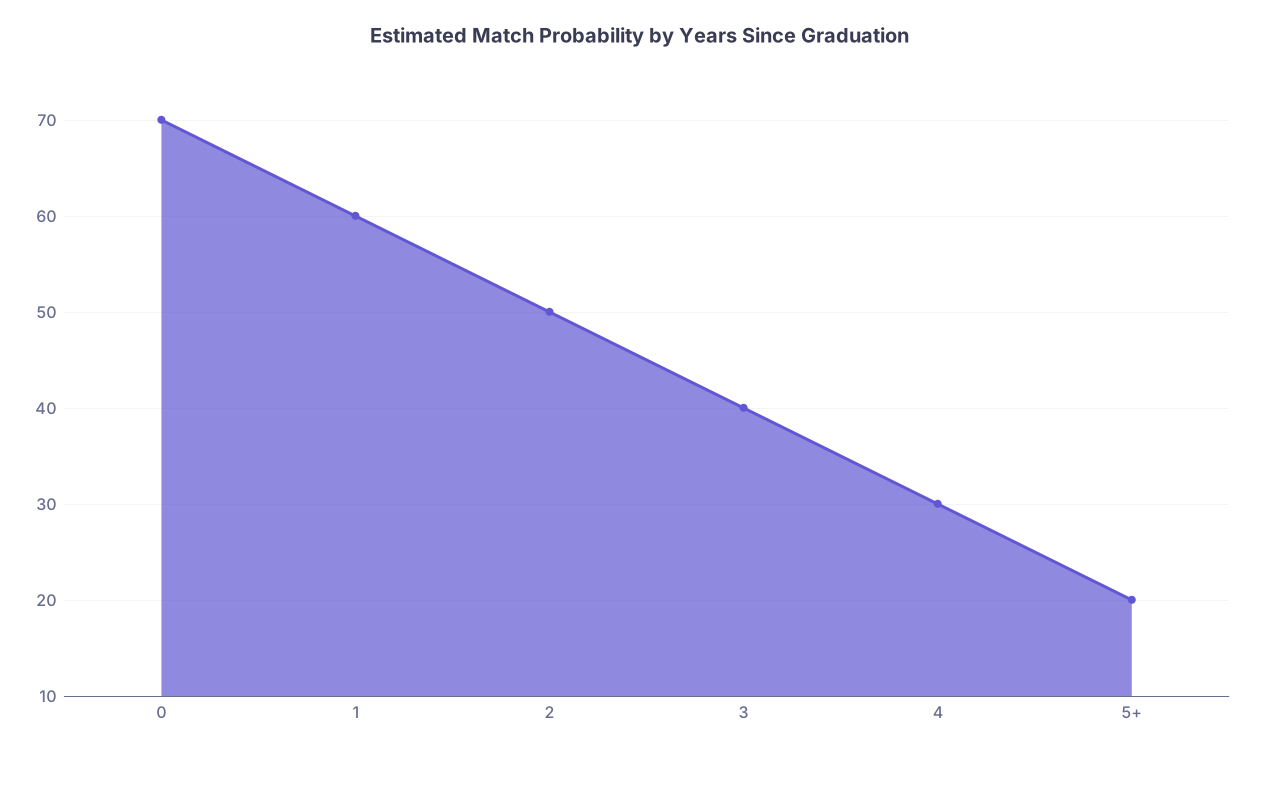
Interpretation of that simple curve (illustrative, but aligned with what PDs say):
- Fresh graduates (Year 0–1): still have relatively strong odds if reapplying strategically
- Year 2–3 out: clearly lower, but salvageable with strong improvements
- Year 5+: you are the exception, not the rule, unless you have significant clinical practice, research, or another compelling explanation
This is one reason why most successful reapplicants cluster within two additional cycles. After that, the “years since grad” penalty starts biting harder.
7. Putting It All Together: What Your Personal “Cycle Forecast” Might Look Like
Let’s turn this into something you can actually apply to yourself.
7.1 A simple self-assessment formula
I mentally score reapplicants on three 0–2 scales:
- Metrics (scores, grades, exams)
- Experience (clinical, research, relevant work)
- Strategy (specialty choice, program list, application timing)
Give yourself:
- 0 = poor / non-competitive
- 1 = borderline / somewhat competitive
- 2 = solidly competitive
Add them up (0–6 total).
| Total Score | Interpretation | Expected Extra Cycles (if you match) |
|---|---|---|
| 5–6 | Strong reapplication profile | 1 extra cycle common |
| 3–4 | Mixed, some clear weaknesses | 1–2 extra cycles |
| 1–2 | Weak, multiple major deficits | 2–3+ extra cycles or low probability |
| 0 | Essentially non-competitive | Unlikely to match without drastic change |
This is not a formal model. It is just how I rapidly categorize risk:
- Score 5–6 → You likely match on the next cycle if you apply smartly.
- Score 3–4 → You may need two full cycles and possibly a specialty shift.
- Score 1–2 → You are in that 3+ cycles / low-yield group unless you fundamentally rebuild your application.
8. Where the “Most People Match Next Cycle” Myth Comes From
I want to address the disconnect between the data and what you often hear.
Why do advisors and residents swear most unmatched candidates “get in next year,” when NRMP-type numbers show only about 40–50% do?
Three reasons:
Survivorship bias
People see the ones who came back, tried again, and matched. The ones who quietly left medicine or never reapplied are invisible.Social visibility bias
The success stories get told. “I did a research year and matched!” You rarely hear, “I applied four times and finally gave up.”Institutional memory issues
Schools and programs often track “eventual match” qualitatively, not with deep analytics across years and cohorts. They remember cases, not percentages.
So yes, you can absolutely match on your very next try. Many do. I have seen scores of people go unmatched in EM or IM, regroup, fix Step 2, do solid rotations, and match the following year. But they are not the majority of all unmatched. They are the majority of a self-selected, improved, and persevering subset.
The data are harsher:
- Of all initially unmatched, only about half match on their next attempt.
- Of eventual successes, most need 1–2 extra cycles.
- A non-trivial group requires 3+ cycles or never matches.
9. How to Use This Information for Your Next Move
Let me be blunt. You are not asking this question for academic curiosity. You are trying to decide whether to:
- Reapply next year
- Give yourself 2–3 years to keep trying
- Cut losses earlier and move to something else
Use the data this way:
Assume that if you match, it will likely be within two extra cycles.
If you are already considering a third or fourth attempt, do not continue without:
- A realistic specialty shift
- Major objective improvements (scores, experience, letters)
- A plan for how repeated gaps or long delay will be explained
If your metrics and experiences are in the “weak” range and you are unwilling to change specialty, do not expect the probability curve to magically bend. It will not.
10. Looking Ahead: From “How Many Cycles?” to “What Will I Change Next Cycle?”
You started with a timeline question: How many cycles do most unmatched applicants need to finally match?
The data-backed answer:
- Among eventual successes, most match within 1–2 additional cycles.
- By three cycles, your odds are falling, not rising.
- A sizable minority never match, especially if they fail to significantly strengthen their file or adjust specialty choice.
But that is just step one. Raw cycle counts do not get you a position. The next phase is more surgical: deciding precisely what you will change in your next application year so that your probability of matching is meaningfully higher, not just older.
That means granular work on your specialty targeting, program list, exam strategy, clinical roles, and narrative. With these numbers in your head, you are now ready to shift the question from “How long will this take?” to “What concrete changes will make the next cycle count?”
And that next question—the detailed, data-driven redesign of your reapplication strategy—is where the real leverage lies. But that is a conversation for another day.