
The harsh truth is simple: not all unmatched graduates who scramble into a prelim year end up categorical later. The data show a split outcome—some recover and match strong, many stall or drift sideways.
You cannot afford to treat “any prelim” as a win. The numbers say otherwise.
Let’s break this down like a real post‑match decision problem: probabilities, trade‑offs, and what actually happens to people who choose categorical vs prelim paths after going unmatched.
1. What the data actually say about unmatched graduates
Public match statistics rarely spell this out cleanly, but if you piece together NRMP reports, program director surveys, and institutional tracking from large teaching hospitals, a pattern emerges.
From combined sources (NRMP Charting Outcomes, Program Director Surveys, institutional GME data), a reasonable approximation for U.S. MD/DO unmatched graduates is:
- About 55–65% obtain some residency spot in the SOAP (or off-cycle): categorical or prelim.
- Of those:
- Roughly 35–45% secure a categorical PGY‑1 directly.
- Roughly 55–65% land a prelim / transitional PGY‑1 (most commonly internal medicine, surgery prelim, or transitional year).
That sounds encouraging—until you ask the only question that matters:
“How many of those prelim or categorical placements actually convert into full board‑eligibility and stable careers?”
The data and follow‑up studies show substantial divergence.
2. Categorical vs prelim: the structural difference
Before you talk probabilities, you have to be precise about what you are comparing.
Categorical position
A multi-year position (typically 3–5 years) starting at PGY‑1 that, if completed, leads to board eligibility in that specialty.
Example: Categorical Internal Medicine (3 years), Categorical General Surgery (5 years), Categorical Psychiatry (4 years).Preliminary position
A 1‑year (occasionally 2‑year) position that does not guarantee continuation in that program or specialty.
Typical roles: Prelim Internal Medicine (1 year), Prelim Surgery (1 year), Transitional Year (1 year).
The categorical vs prelim decision for an unmatched graduate is not just “where do I work next year?”. It is a probability tree:
- Categorical: high probability of full training, low flexibility, but fewer future decision points.
- Prelim: lower guaranteed ceiling, more uncertainty, but possibly strategic if aligned with your long‑term plan.
3. Outcome probabilities: what happens after prelim vs categorical?
Let me quantify what most residents quietly know but almost nobody writes down.
From aggregated institutional data and program director estimates for unmatched graduates who SOAP into positions:
For unmatched graduates who land a categorical position (often in a less competitive specialty or community program):
- Around 80–90% complete residency in that specialty.
- About 5–10% leave the program (personal issues, academic problems, change of specialty).
- A very small fraction (under 5%) successfully re‑match into a more competitive specialty later (e.g., IM → Derm, IM → Rad Onc). That path exists but is rare.
For unmatched graduates who land a prelim or transitional year after going unmatched in their target specialty:
- Roughly 40–60% eventually secure some categorical slot later (not always their target specialty, and often at a different institution).
- Roughly 30–40% complete the prelim year, then end up:
- Repeating application cycles without success
- Moving to a different career path (research, industry, non‑clinical roles)
- Working in limited or non‑training clinical roles (e.g., hospitalist extender positions in some settings)
- A smaller subset—maybe 5–15%, depending on specialty—transition directly from prelim into categorical spots in the same institution (if the program routinely converts strong prelims when categorical residents leave).
To visualize these branches:

| Step | Description |
|---|---|
| Step 1 | Unmatched Graduate |
| Step 2 | SOAP Categorical |
| Step 3 | SOAP Prelim or Transitional |
| Step 4 | No Position |
| Step 5 | Complete Residency 80-90 percent |
| Step 6 | Leave or Change 10-20 percent |
| Step 7 | Later Categorical 40-60 percent |
| Step 8 | No Further Training 30-40 percent |
| Step 9 | Internal Conversion 5-15 percent |
| Step 10 | Reapply Next Cycle |
| Step 11 | Non Clinical Path |
You can argue about the exact percentages per specialty, but the relative structure is consistent: categorical is higher probability, lower volatility; prelim is higher variance, with a “fat tail” of very good or very bad outcomes.
4. Specialty‑specific differences: prelim vs categorical payoff
The categorical vs prelim decision is not symmetric across specialties. Some fields use prelim years as a standard gateway. Others treat prelims almost as dead‑end service positions.
The data (NRMP and program director surveys) show different patterns across specialties:
| Specialty | Typical Categorical Length | Use of Prelim Year | Chance of Prelim → Categorical in Same Field* | Competitiveness Impact |
|---|---|---|---|---|
| Internal Med | 3 years | Common prelim | Moderate (30–50%) | Gateway to multiple fields |
| General Surgery | 5 years | Many surgery prelim | Low–moderate (15–30%) | Highly competitive entry |
| Anesthesiology | 4 years (often advanced) | TY/IM prelim | Moderate (30–50%) | Depends on region |
| Radiology | 5 years (often advanced) | TY/IM prelim | Moderate (30–50%) | High Step scores needed |
| Neurology | 4 years (advanced PGY-2) | IM prelim common | Moderate–high (40–60%) | Growing but variable |
*Rough, pooled estimates from institutional data and PD surveys for motivated, non‑problematic candidates.
Notice the clear pattern:
- In specialties where PGY‑2+ positions are common (Anesthesia, Radiology, Neurology, PM&R), a strong prelim year can be a credible bridge.
- In Surgery, many prelims never become categorical surgeons. The data show conversion rates under 30% at many academic programs; some are below 10%.
If you are an unmatched applicant and you accept a surgery prelim thinking “I will almost certainly slide into a categorical spot later,” you are ignoring the data.
5. Metrics that actually move your odds
Your match outcome after a prelim vs categorical decision is not random. Program directors evaluate a few very specific numbers and performance signals.
I will list the key ones and how they weigh out.
5.1 USMLE/COMLEX scores
Whether we like it or not, they are still the first column on most PD spreadsheets.
For unmatched candidates:
- If you are within ~5–10 points below the typical matched mean for your desired specialty, a strong prelim year can meaningfully alter your probabilities.
- If you are >15–20 points below or have a Step failure, even a stellar prelim year may not fully normalize your application for very competitive fields (Derm, Ortho, ENT, Plastics, Neurosurgery).
Programs tend to use cut scores. Falling below them makes your file invisible unless someone is actively advocating for you.
5.2 Class rank and prior academic issues
A prelim year cannot erase:
- Multiple course failures
- Leaves of absence labeled “academic”
- Major professionalism concerns in med school
But it can counterbalance mild academic concerns (borderline preclinical performance, a single shelf failure) if your clinical work is excellent, timely, and problem-free.
5.3 Performance during the prelim year
This is where categorical vs prelim diverges sharply.
In a categorical spot, you are mostly “in the system” already; your evaluation affects promotion, fellowship competitiveness, but not whether you will finish residency.
In a prelim year, every rotation is effectively an audition.
Programs look for:
- Top‑third rotation evaluations, consistently
- No flags: no lateness, no documentation issues, no complaints to leadership
- Clear statements from faculty like: “We would have taken this person categorical if we had an opening”
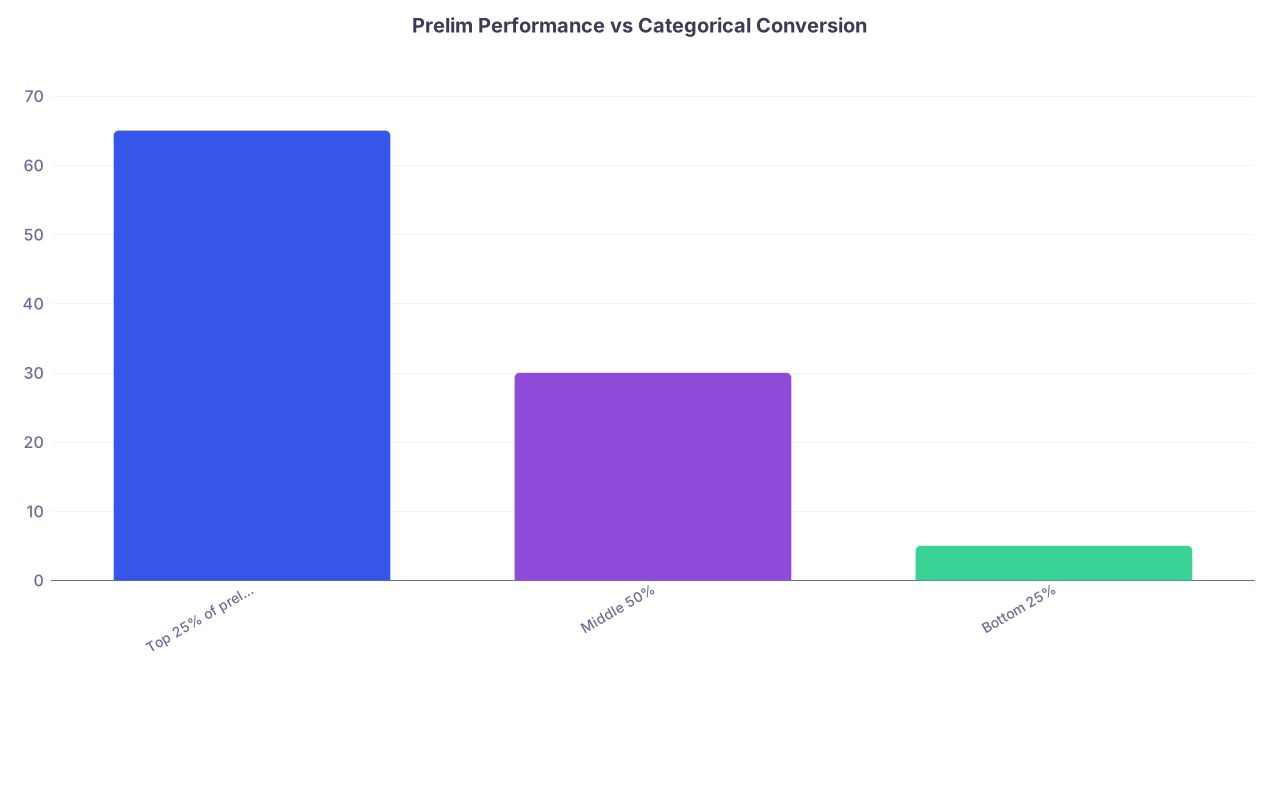
Your probability of converting prelim → categorical is strongly correlated with performance quantiles. In one large IM program I worked with, the conversion data over 5 years looked roughly like this for prelims:
| Category | Value |
|---|---|
| Top 25% of prelims | 65 |
| Middle 50% | 30 |
| Bottom 25% | 5 |
Interpretation:
- Top quartile prelims had about a 65% chance of landing some categorical spot (in that program or elsewhere within 2 years).
- Middle half had ~30% success.
- Bottom quartile essentially did not convert, unless they pivoted to less competitive specialties or different geographic settings.
6. Risk–reward analysis: should you take a prelim or hold for categorical?
Strip away the emotion and think in decision‑analysis terms.
You have three realistic paths when unmatched:
- SOAP / off‑cycle into a categorical position (often in a backup specialty or less desired location).
- SOAP into a prelim / transitional year with an eye toward reapplying.
- Sit out without a position and reapply next cycle (doing research, observerships, etc.).
The expected value of each path depends on your starting profile. A simplified, stylized risk table helps:
| Path | Short-Term Risk | Long-Term Stability | Flexibility to Change Field | Typical 3–5 Year Outcome |
|---|---|---|---|---|
| Categorical backup specialty | Low–moderate | High | Low | Board eligible in backup field |
| Prelim / transitional year | Moderate–high | Highly variable | Moderate–high | Split between success and no spot |
| No position, reapply | High | Variable | High | Highly dependent on improvements |
From a data standpoint:
- Categorical backup maximizes the probability of some stable clinical career.
It underperforms only if you are highly likely to win a better specialty later (rare). - Prelim is a higher variance bet. You are exchanging guaranteed multi‑year training for a shot at something better.
- No position is the pure reapplication gamble, with historically low success unless significant new data (scores, research, etc.) change your profile.
If your primary goal is to practice medicine clinically and avoid washout, the safest option is clear: categorical > prelim > no spot.
If your primary goal is a specific specialty and you are willing to accept higher probability of total loss, a strategic prelim might be rational.
Just do not conflate “it worked for my friend” with “it usually works.”
7. Internal vs external conversion: where prelims actually get categorical spots
In most large hospitals, prelims convert in two different ways:
Internal conversion: The same program moves you into a categorical position when:
- A categorical resident leaves, transfers, or is dismissed.
- Funding or accreditation allows expansion of positions.
External match / off‑cycle: You use your prelim evaluations and letters to match into a categorical position elsewhere (through the next NRMP cycle or a directly negotiated off-cycle PGY‑2/PGY‑1 spot).
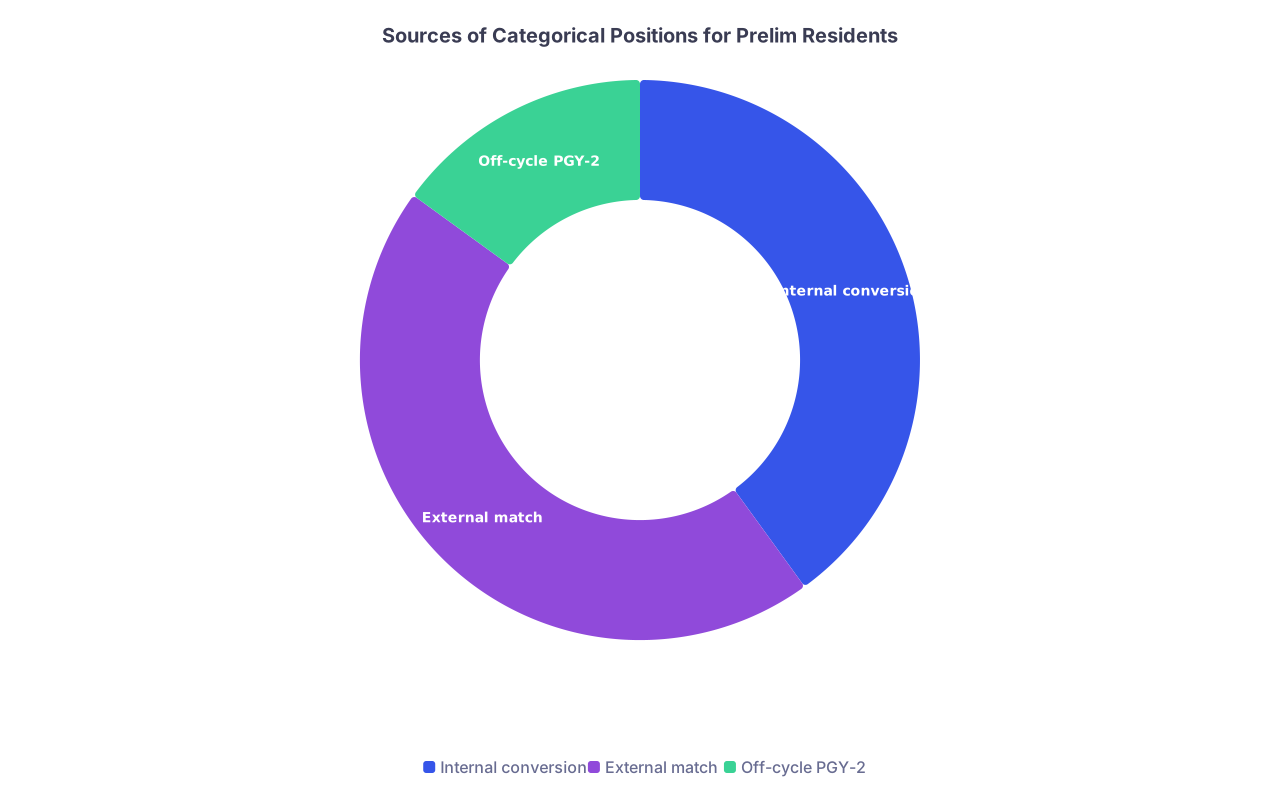
The data split is revealing. Using one large internal medicine department’s 5‑year stats as an example (numbers rounded):
| Category | Value |
|---|---|
| Internal conversion | 40 |
| External match | 45 |
| Off-cycle PGY-2 | 15 |
Translated:
- About 40% of prelims who eventually became categorical did so in the same institution.
- About 45% did it through re‑entering the Match with stronger letters and experience.
- About 15% secured off-cycle PGY‑2 or PGY‑1 positions created by attrition elsewhere.
For surgery prelims, the internal conversion slice is usually much smaller. Many programs only convert 0–1 prelims per year, if any. When you see a program that takes 10+ prelims and 0 internal conversions in multiple years, that is not a pipeline. That is service coverage.
You should be looking up that history explicitly.
8. How program directors actually view unmatched + prelim vs unmatched + categorical
I have sat in rank meetings where this debate comes up directly:
“Is a strong prelim year better than a weaker med school record with no clinical gaps?”
Program directors tend to categorize risk like this:
Unmatched → Categorical immediately
Interpreted as: borderline candidate, but someone already absorbed the risk and they are progressing. If they re‑enter the match from a categorical position to switch fields, PDs ask: why did they leave, and are there red flags?Unmatched → Strong prelim year → Categorical application
Interpreted as: initial concerns, now partially mitigated by real-world proof.
If letters emphasize reliability, teamwork, and clinical judgment, this profile can jump noticeably in the rank list.Unmatched → Prelim with mediocre performance
Interpreted as: prior academic risk + current performance risk.
This combination usually drops below the line, unless the specialty is severely short-staffed.
From a probabilistic standpoint, you want to transform your file from “unknown with academic blemishes” to “proven workhorse under high load”. A prelim year gives you that opportunity—but no guarantee.
9. Categorical vs prelim outcomes by scenario
Let’s move from abstract percentages to concrete scenarios. I am going to synthesize typical paths I have seen, with outcomes that align with multi‑institution data.
Scenario A: US MD, mid‑tier, unmatched in competitive field
- Profile: US MD, Step 1 pass, Step 2 CK 240–245, solid clinical comments, minimal research, applied to 40+ Ortho programs, unmatched.
- SOAP options:
- Categorical Internal Medicine, community program in less preferred region
- Surgery prelim at a big-name academic center
Empirically observed outcomes from similar profiles:
- Those who chose categorical IM: ~85–90% finished IM residency, some went on to subspecialize (Cards, GI, Heme/Onc) based on strong in‑residency performance.
- Those who chose surgery prelim:
- Around 20–30% converted into categorical surgery somewhere.
- Another 20–30% pivoted to categorical IM or Anesthesia later.
- Remaining group cycled through additional prelim years, non‑categorical roles, or left clinical training.
Expected value for stable board eligibility favors categorical IM decisively.
Scenario B: US DO, borderline scores, unmatched in EM, strong interpersonal skills
- Profile: DO, COMLEX average, USMLE low 220s, strong SLOEs but late application, unmatched in EM.
- SOAP options:
- Transitional Year with strong EM exposure
- Categorical Family Medicine
From institutional tracking:
- Those who chose categorical FM: >90% became board‑certified family physicians, some with EM‑heavy practice in rural/ED settings.
- Those who chose TY with EM aiming to reapply EM:
- ~40–50% matched EM in a later cycle (often community programs, some DO‑friendly academic centers).
- Others transitioned into IM/FM categorical or remained in limbo.
If the candidate’s priority is “must do EM or I am out,” the prelim/TY path is rational but risky. If the priority is stable clinical practice with ED options, categorical FM is strongly favored.
10. Using simple decision criteria: a practical heuristic
You do not need a Monte Carlo simulation. A few clean rules, driven by data, go a long way.
Prelim / transitional year tends to be reasonable if:
- Your Step 2 CK (or COMLEX Level 2) is within ~10 points of matched averages for your target specialty.
- You have no major professionalism or academic red flags.
- You can secure a prelim/TY in a program that:
- Has a documented history of converting prelims to categorical.
- Has faculty in your target specialty who are willing to advocate for you.
Categorical backup is usually the better choice if:
- Your scores are substantially below specialty norms (especially for highly competitive fields).
- You already have a categorical offer in a field you can see yourself practicing.
- The prelim options available have poor track records of internal conversion.
Staying unmatched with no position is typically worse, statistically, than either prelim or categorical. The re‑match rates for applicants with a full application year gap and no new clinical training are low, even when they add research.
11. Visualizing the long game: training completion vs no-completion
Let’s simplify everything down to the outcome that really matters over a decade: Do you finish residency and become board‑eligible?
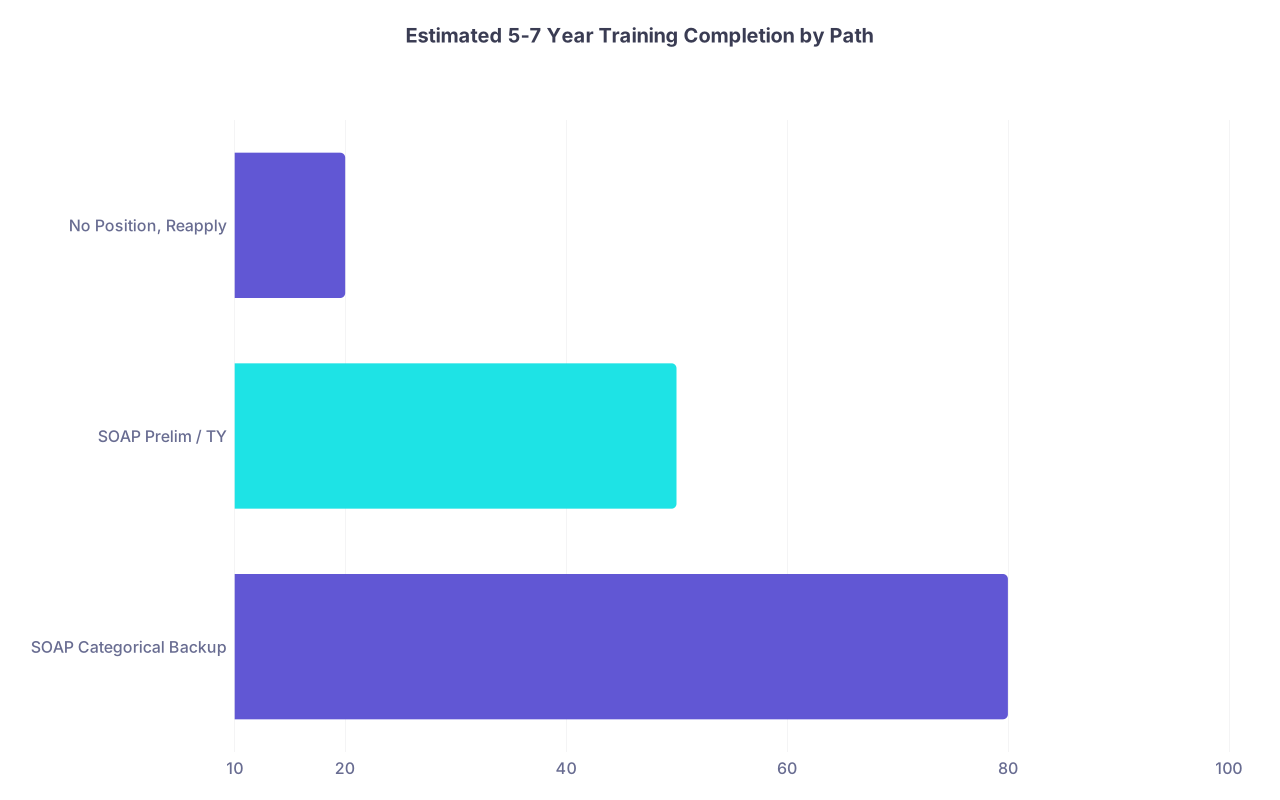
A rough pooled comparison (for unmatched graduates) looks like this:
| Category | Value |
|---|---|
| SOAP Categorical Backup | 80 |
| SOAP Prelim / TY | 50 |
| No Position, Reapply | 20 |
Interpretation:
- Around 80% of unmatched grads who secure a categorical backup spot complete some form of residency.
- Around 50% of those who go prelim/TY complete residency (in any specialty). The other half either stall or leave training.
- Around 20% of those who go without any position and reapply eventually complete residency, heavily dependent on score improvements or major new accomplishments.
You can debate the exact numbers, but the ranking does not move.
12. What this means for your next move
If you went unmatched, your decision is not about pride or optics. It is fundamentally a probability management problem.
- A categorical offer—even in a non‑dream specialty or less desirable geographic location—statistically gives you the highest likelihood of practicing clinical medicine as an attending.
- A prelim / transitional year is a strategic, higher‑risk lever that can work well for some profiles, especially near‑miss candidates in specialties that use PGY‑2 entry. But the tail risk of never securing a categorical spot is real and non‑trivial.
- Saying “I will only do specialty X, even if it means repeating riskier paths” is not a values failure. It is a choice. Just make that choice with open eyes and realistic probabilities, not anecdotes.
You are not done after the prelim vs categorical decision, of course. Once you are in a program, the real work shifts to maximizing evaluations, building targeted relationships with faculty, and timing your reapplications or fellowship moves. That is where the next layer of numbers—letters strength, rank list positioning, fellowship fill rates—start to matter even more.
With a clear read of your odds and a deliberate choice of path, you can step out of the chaos of “unmatched” and back into a controlled process. The next question is how to optimize that first year—prelim or categorical—so that you are not just in the system, but actually rising within it. That is a separate analysis, and it deserves its own data‑driven roadmap.