Only 28–35% of U.S. MD seniors who go unmatched and reapply the next year actually match, despite most increasing their number of applications by 40–60%.
That disconnect is the entire story here: more volume, modest gains, brutal diminishing returns.
Title: Application Volume vs Match Rate for Reapplicants: Diminishing Returns
Category: POST MATCH OPTIONS
Phase: RESIDENCY MATCH AND APPLICATIONS
The Hard Numbers: How Reapplicants Actually Do
The NRMP data are fairly unforgiving once you move from first-time applicants to reapplicants.
From recent Charting Outcomes, Program Director Survey, and NRMP Main Match data (aggregated and rounded):
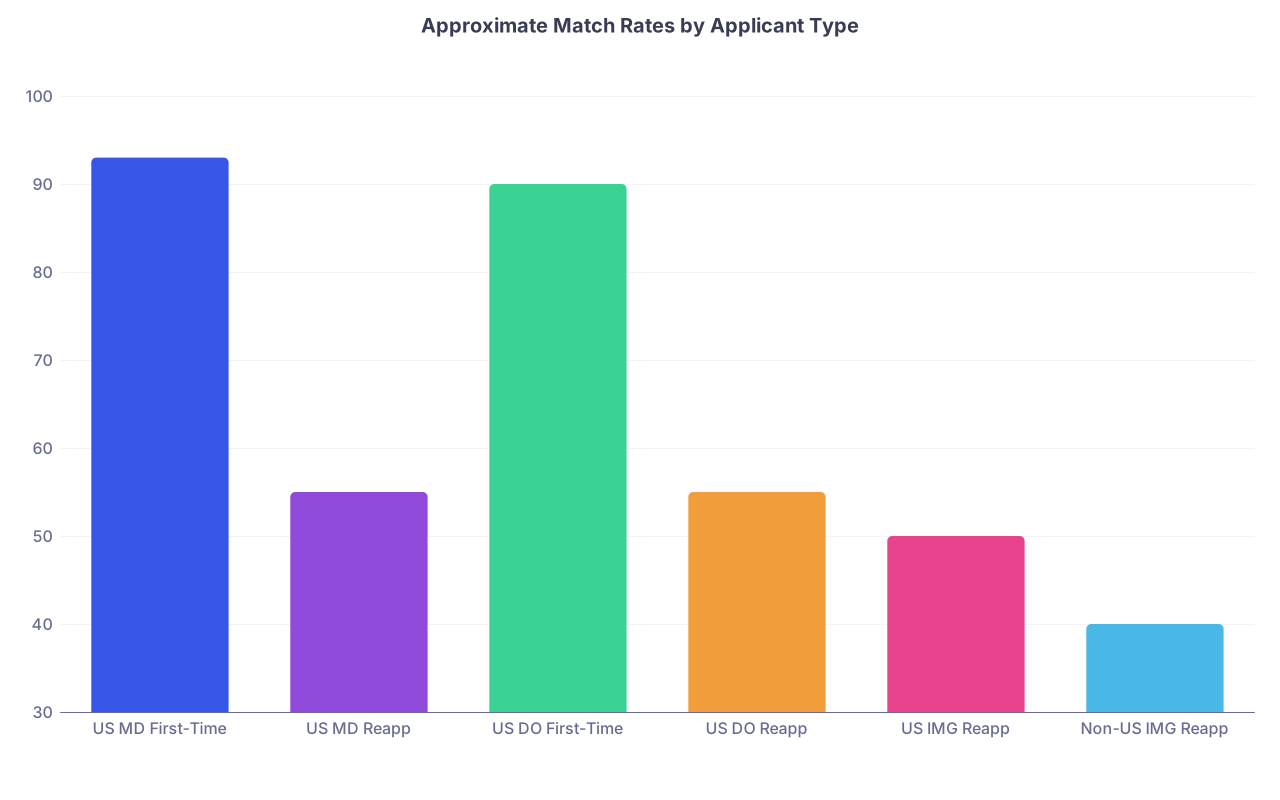
- U.S. MD seniors (first-time) match rate: ~92–94%
- U.S. MD previous graduates / reapplicants: ~50–60%
- U.S. DO seniors (first-time) match rate: ~89–91%
- U.S. DO previous graduates / reapplicants: ~50–60%
- U.S. citizen IMGs reapplying: ~45–55% match rate
- Non-U.S. IMGs reapplying: ~35–45% match rate
So when you miss the first time and re-enter the pool, your baseline odds typically drop by 25–50 percentage points. Even before we talk about how many applications you send.
And yet, reapplicants overwhelmingly respond with volume:
- Typical first-time U.S. MD applicant in Internal Medicine: ~40–60 programs
- Reapplicant in the same specialty: often 70–120+ programs
- For IMGs in competitive-ish fields: 150–250+ applications is not rare
The belief is simple: “I did not cast a wide enough net. I will fix that.”
The data say something different: after a certain point, extra applications buy you very little extra match probability, especially as a reapplicant.
| Category | Value |
|---|---|
| US MD First-Time | 93 |
| US MD Reapp | 55 |
| US DO First-Time | 90 |
| US DO Reapp | 55 |
| US IMG Reapp | 50 |
| Non-US IMG Reapp | 40 |
You are not starting from the same baseline as a fresh M4. Program directors know you applied before. Many of them remember your file. Some have comments in ERAS.
This is why the “just apply to more” strategy looks powerful on Reddit and WhatsApp, but underperforms in the match data.
Where Diminishing Returns Actually Kick In
Let’s quantify what happens as you increase application volume as a reapplicant. Obviously, exact numbers vary by specialty and profile, but the pattern is remarkably consistent.
Take a relatively common scenario: Internal Medicine or Family Medicine reapplicant, U.S. grad or strong IMG, no large professionalism violations, average Step 2 score.
Empirically, from a mix of NRMP data, institutional advising numbers, and what I have seen in advising spreadsheets:
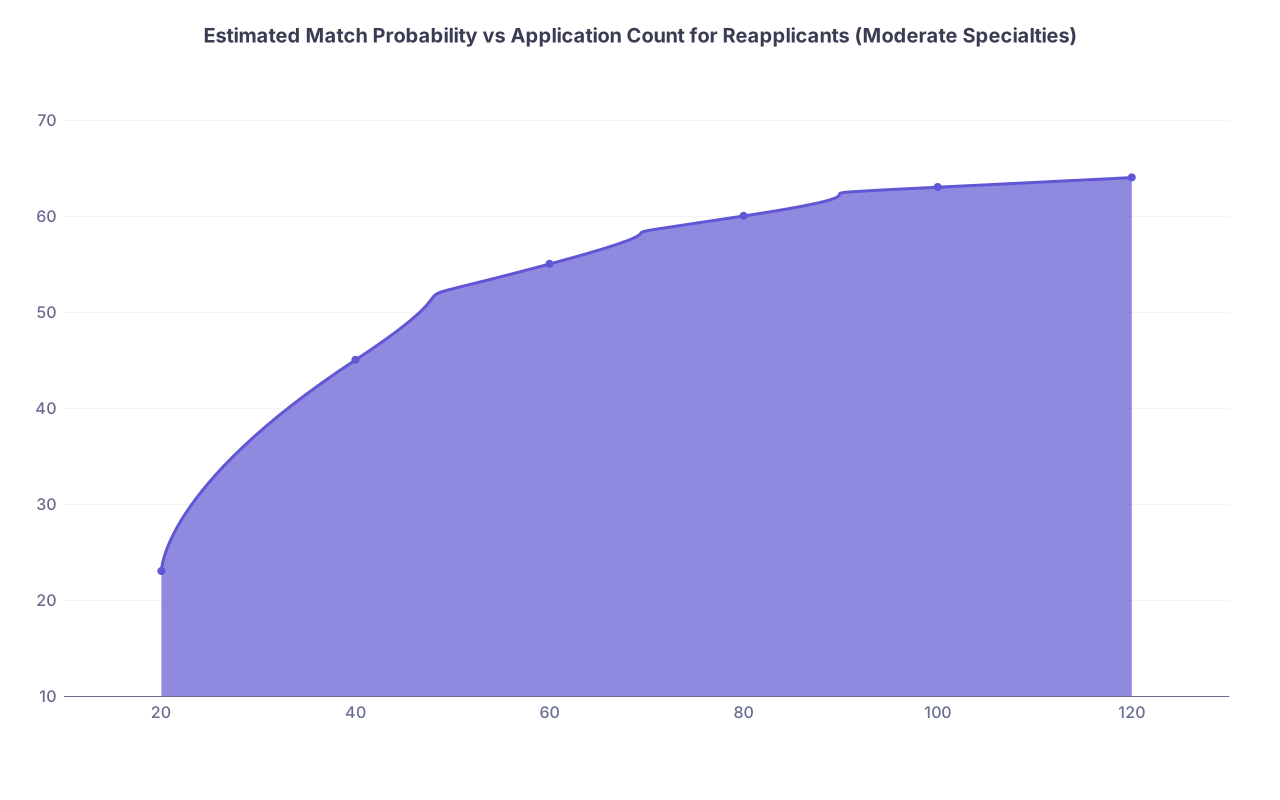
Moving from 20 → 40 applications:
- Interview count often roughly doubles.
- Match probability may increase from ~20–25% to ~40–50% (big jump).
Moving from 40 → 60 applications:
- Interview count might increase by 20–40%.
- Match probability might improve from ~40–50% to ~50–60%.
Moving from 60 → 100 applications:
- Interview count often increases only slightly.
- Match probability might creep from ~50–60% to ~55–65%—if your underlying profile is viable.
Beyond ~100 programs in the same specialty, interview yield often collapses to well under 5%. People send 50 extra applications and get 1–2 extra interviews, sometimes none.
| Category | Value |
|---|---|
| 20 | 23 |
| 40 | 45 |
| 60 | 55 |
| 80 | 60 |
| 100 | 63 |
| 120 | 64 |
The curve is steep early, then flattens aggressively. That is textbook diminishing returns.
And it gets worse in competitive fields:
- Dermatology, Ortho, Plastics, ENT, IR, Integrated Vascular, Neurosurgery
- Top-heavy specialties like Radiology, Anesthesiology, EM (post-2023 volatility)
For those, a reapplicant can go from 60 → 120 applications and see zero change in interview count. Why? Because the binding constraint is not “programs that have not seen your application” but “programs willing to interview someone with your stats and previous-match status.”
More targets only help when at least some of them are actually open to you.
The Core Problem: The Bottleneck Is Not Applications
You are not limited by the ERAS send button. You are limited by:
- Your score profile and exam history
- Your clinical record (red flags, failed rotations, gaps)
- LOR quality and credibility
- Specialty fit signals (sub‑Is, research, home support)
- The fact that you did not match last time
Programs are filtering through those dimensions before they ever get to volume.
Let me be blunt:
If a program screened you out last year because of a failure, low Step 2, weak letters, or obvious lack of specialty fit, sending them your file again (unchanged) is almost pure noise. That is not “casting a wider net.” That is paying for the same rejection twice.
This is where people confuse “effort” with “strategy.” Reapplicants think:
- “I applied to 60. Everyone online says 80–120 is safer.”
- “So I will double my volume. That is what competitive applicants do.”
Except competitive applicants generally have:
- Stronger scores
- Stronger letters
- Recent clinical work and advocacy
- And they are often first-time applicants
You cannot solve a quality problem with quantity. Especially as a reapplicant.
Comparative Data: Volume vs Match for First-Timers vs Reapplicants
Let us put some numbers side by side.
| Applicant Type | Apps Sent | Typical Interviews | Approx Match Rate |
|---|---|---|---|
| US MD first-time (IM) | 30–40 | 10–12 | 90–95% |
| US MD reapplicant (IM) | 60–80 | 6–8 | 55–65% |
| US DO first-time (FM) | 25–35 | 8–10 | 90–95% |
| US DO reapplicant (FM) | 50–70 | 5–7 | 55–65% |
| US IMG reapp (IM/FM mix) | 100–150 | 5–8 | 45–60% |
Rough numbers, yes. But the pattern is clear:
- Reapplicants are sending 1.5–3x more applications than first-timers.
- Despite that, they often get fewer interviews.
- And their match rate is dramatically lower.
So the candidate who matched in IM with 12 interviews and 35 applications last year is not simply the “more diligent” version of the reapplicant who sent 120 applications and landed 5 interviews this year. They are playing a different game with fundamentally different starting stats.
Financial and Opportunity Costs of High-Volume Shotgunning
Now add cost. Not hypothetical cost—actual line items.
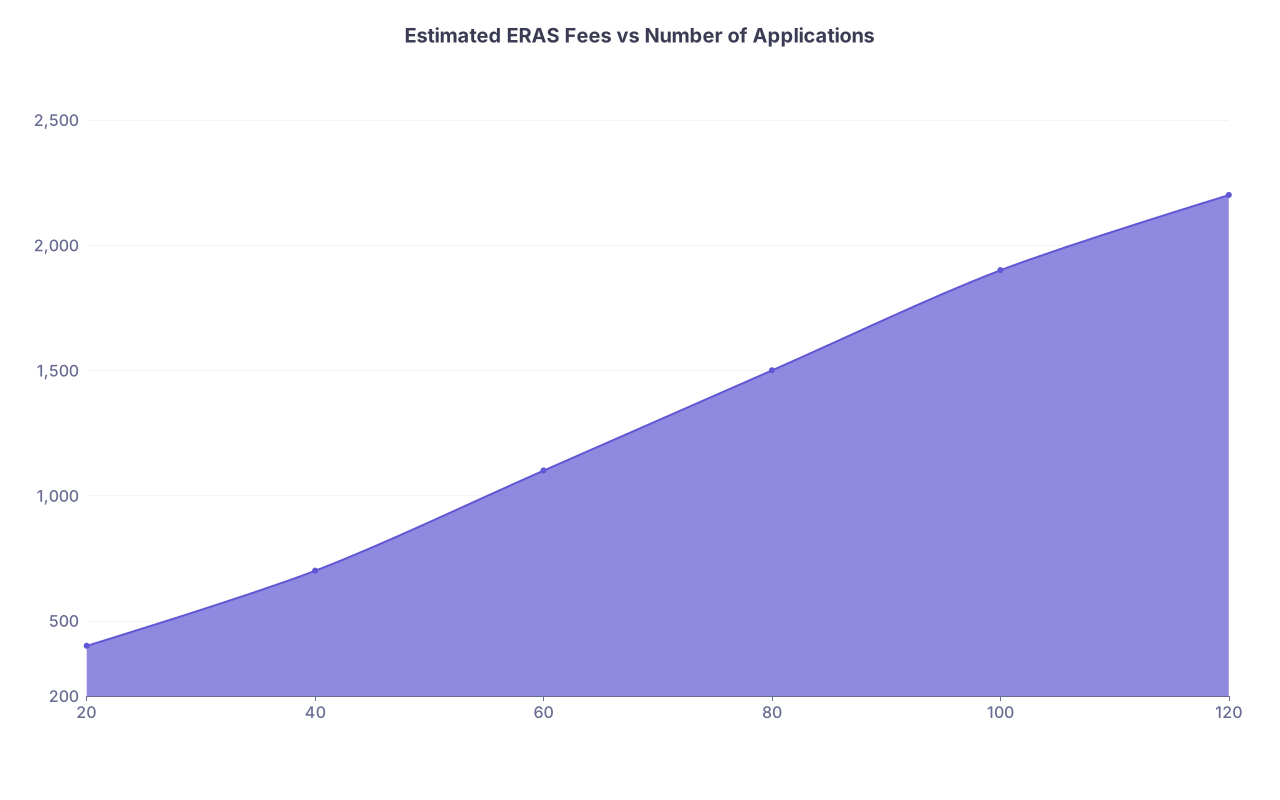
For a reapplicant sending 120 programs via ERAS:
- ERAS fees (2025 structure-esque, but scenario-level accurate):
- First 30: about $99
- 31–60: ~$19 each → ~$570
- 61–90: ~$23 each → ~$690
- 91–120: ~$27 each → ~$810
- Total: roughly $2,100 in ERAS fees alone
Then add:
- Transcript, USMLE/COMLEX score transmission fees: ~$100–150
- Supplemental ERAS application fees (if used by your specialties): additional hundreds
- Interview travel (if in-person) or time / missed work cost (if virtual but you are doing a research year or job)
You can easily burn $2,500–4,000 on a high-volume application cycle.
If those extra 40–60 low-yield applications at the end of your list generate 1 extra interview with a maybe 40–50% chance of converting to a rank, and then maybe 40–50% chance of contributing to a match… you are often paying four figures for maybe a 2–4% absolute increase in match odds.
Sometimes that is rational. If your alternative is another unmatched year, that extra 3% could be very valuable. But it is not a free move, and pretending that 120 apps = “safe” is fantasy.
| Category | Value |
|---|---|
| 20 | 400 |
| 40 | 700 |
| 60 | 1100 |
| 80 | 1500 |
| 100 | 1900 |
| 120 | 2200 |
The financial curve accelerates as your match probability curve flattens. That is the worst possible combination.
Why Reapplicants Hit Diminishing Returns Faster
There are five structural reasons reapplicants see diminishing returns sooner than first-time applicants.
1. Prior Non-Match Is Itself a Negative Signal
Program directors are explicit about this. In PD Surveys, many list “previously unmatched” as a concerning factor, particularly if unexplained.
They do not know if:
- Your school counselled you away
- You had professionalism issues
- There were failed rotations or exams
- You had interpersonal or communication problems on prior interviews
They just see that the market, as a whole, passed on you once. That pushes you down the pile before they even evaluate your new cycle in detail.
2. Filters Hit You Twice
If you are at or below common auto-filter thresholds (Step 2 < ~220 for some fields, or large score gaps, multiple failures), those filters do not relax for reapplicants. In some institutions, they get stricter for “previous graduates.”
So your effective pool of “reachable” programs might be:
- First-time IM applicant with Step 2 230: maybe 80–120 programs still willing to review
- Reapplicant with Step 2 219 and a prior no-match: maybe 40–60 programs in practice
Sending 120 applications does not conjure 120 genuine opportunities. You still have perhaps 40–60 programs that will truly consider you. The rest are paid rejections.
3. Program Memory and Institutional Notes
Programs do track past applicants. Some have explicit notes in ERAS or their own spreadsheets:
- “Declined interview last year”
- “No-showed interview”
- “Poor communication, rank low”
- “Weak clinical evaluation from Dr. X”
- Or simply: “Reviewed last year, did not interview.”
If nothing materially changed in your file, you will not suddenly convert those programs to interviews just by reapplying and doubling volume.
4. Static Letters and Stale Clinical Work
Reapplicants often re-use the same letters and have no new, strong U.S. clinical experiences. Program directors are very good at spotting this. Old letters, old dates, no recent performance data. That signals stagnation.
In data terms: your “features” fed into PD decision-making have not improved. So why would the output (interview or no interview) change?
5. Misaligned Specialty or Overreach
Many reapplicants are still overreaching in specialty or program tier even after a failed cycle. I have seen:
- 220s Step 2 trying to re-enter Ortho with 80 additional apps.
- Non-U.S. IMG with no U.S. clinical, reapplying to EM, 160 programs deep.
- Prior unmatched in Anesthesiology reapplying only Anes again, 100+ programs, without a single new letter in the field.
If your profile-skill mismatch is the bottleneck, volume becomes a very expensive illusion of control.
When Adding Volume Actually Helps
There are scenarios where more applications do provide meaningful gains for reapplicants. But they share a pattern: the underlying quality or fit changed, and volume is being used to exploit that improvement, not to compensate for its absence.
Examples:
- You improved scores: Step 2 taken or retaken with a substantial jump (e.g., from 215 to 240).
- You added strong, recent U.S. clinical experience with solid letters.
- You switched to a more appropriate specialty (e.g., from General Surgery to Internal Medicine or FM) where your stats are within typical ranges.
- You expanded to more community / mid-tier / less desirable geographic regions after previously focusing only on brand-name academic programs or a narrow region.
In those cases, increasing application volume from, say, 30 → 60 or 40 → 80 can leverage a genuinely improved signal into more interviews.
But notice the order:
- Improve your profile.
- Adjust specialty and tier targeting.
- Then increase volume into realistic programs.
Most reapplicants invert this and start at step 3.
A Data-Driven Framework: How Many Applications Make Sense?
Instead of random shotgunning, treat this like an optimization problem. What is your marginal gain from each application bucket?
A functional framework for reapplicants:
Estimate your realistic interview yield.
- Look at prior cycle:
- Interviews per 10 applications?
- Adjust for any profile improvements or deteriorations.
- Example: last year, 50 apps → 5 interviews (0.10 per app). You improved your Step 2 and added a solid IM letter. Maybe now you expect 0.12–0.15 per app in IM.
- Look at prior cycle:
Set a target interview count.
- For most moderate specialties (IM, FM, Peds, Psych, Path):
- 8–12 interviews gives a high probability of matching.
- For more competitive but not ultra-elite specialties (Radiology, Anes, EM in its current chaos):
- 10–14 interviews is safer; lower than 8 is precarious.
- For most moderate specialties (IM, FM, Peds, Psych, Path):
Back-calculate your application volume.
- If your expected yield is 0.12 interviews per application and you want 10 interviews:
- 10 / 0.12 ≈ 84 applications needed.
- If you improve your yield to 0.20 with a better profile and better targeting:
- 10 / 0.20 = 50 applications.
- If your expected yield is 0.12 interviews per application and you want 10 interviews:
Cap where the marginal yield collapses.
- If your historical/interim data show that after 80 apps you are getting almost no new interview invitations (e.g., 80 apps → 9 interviews; 120 apps → 10 interviews), you have hit diminishing returns.
- At that point, extra money is buying you very little in terms of match probability.

This is where many advisors get it wrong. They quote big safe ranges—“Apply to 80–120 programs”—without conditioning on your actual interview yield. That is lazy. You have your own data from your prior cycle. Use it.
Case Studies: Three Reapplicants, Three Different Curves
Let me show you what this looks like in practice. All examples are composites, but the patterns are real.
Case 1: U.S. MD, Internal Medicine, Prior No-Match
- Step 2: 225
- First cycle: 45 IM apps, 3 interviews, no match
- Reapp year:
- Did an IM prelim year at mid-tier community hospital
- Secured 2 strong new IM letters
- Step 2 unchanged (already taken)
Now:
- Expected yield maybe doubles: from 3/45 (0.067) to ~0.12–0.15 per app.
- Target: 10–12 interviews.
Back-calculation:
- 10 / 0.14 ≈ 71 apps.
- Strategy:
- Apply to ~70–80 IM programs, very broad geographically, heavy on community and lower-tier university programs.
- Strong personal outreach from current PD and letter writers.
In this case, volume in the 70–90 range makes sense, because the profile changed significantly. He is not sending 120 identical applications into the same void.
Case 2: Non-U.S. IMG, EM Reapplicant, No New USCE
- Step 2: 232
- Initial cycle: 120 EM apps, 3 interviews, no match
- Reapp year:
- No new U.S. clinical experience
- No new specialty-specific letters
- Added some remote research, no publications yet
If this person applies to 150 EM programs this time, the data suggest:
- Yield likely remains close to 3/120 = 0.025 per app
- At 150 apps → expected 150 × 0.025 = 3.75 interviews (optimistic)
- They probably will not cross the 8–10 interviews threshold regardless of volume.
What actually changes their curve:
- Switching to IM/FM/Psych
- Getting real U.S. clinical rotations with strong letters
- Maybe taking Step 3
If they pivot to IM with new U.S. letters and Step 3:
- Could realistically see yields of 0.07–0.12 per application
- 80–100 IM apps might get them 6–10 interviews
- That is a probability landscape you can actually work with.
Volume alone in EM here is just self-funded rejection.
Case 3: U.S. DO, Psychiatry Reapplicant, Strong Improvement
- First cycle: DO201, 40 Psych apps, 3 interviews, waitlisted, no match
- Year off:
- Research year in Psych with 1–2 posters
- New strong letter from Psych chair
- Step 2: 238
Reapp plan:
- Apply to 60–70 Psych programs, heavily community/mid-tier, broad geography.
- Expected yield per app is now much higher than 3/40 (0.075). Maybe 0.15–0.20.
- 60 apps × 0.17 ≈ 10 interviews.
Does applying to 100 programs help? Probably marginally. Extra 30–40 apps might add 1–2 interviews, at high financial cost. Here, 60–80 is a rational band. 120 is just panic spending.
How to Decide Your Own Application Volume as a Reapplicant
You are not a generic applicant. So stop acting like you should use generic application numbers.
Run through this checklist:
What changed since last cycle?
- Big positive: Step improvement, Step 3, strong new letters, new U.S. rotations, research, prelim year.
- Neutral: cosmetic essay changes, redrafted personal statement, slight CV updates.
- Negative: time gap without clinical work, additional failures, worsening geography or visa constraints.
What was your last cycle’s yield?
- Applications → Interviews → Ranks.
- That ratio is the single best predictor of what volume will do for you now.
Are you changing specialties or program tiers?
- Moving from overreach scenarios to realistic targets dramatically increases the value of extra volume.
- Reapplying to the same hyper-competitive specialty with identical stats offers almost no return on extra volume.
What is your financial ceiling?
- Set a real cap on how much you are willing (and able) to spend.
- Do not casually decide to double volume if it means adding another $1,000+ of low-yield apps.
Where does your curve likely flatten?
- Look at where similar applicants (advisors, alumni from your school) typically see their interview count plateau.
- That big slope → flat plateau transition is exactly where diminishing returns hit. Avoid being deep in the flat zone.

| Step | Description |
|---|---|
| Step 1 | Start |
| Step 2 | Review last cycle data |
| Step 3 | Estimate higher interview yield |
| Step 4 | Assume same or lower yield |
| Step 5 | Set target interviews |
| Step 6 | Back-calc apps needed |
| Step 7 | Trim low yield programs |
| Step 8 | Finalize application list |
| Step 9 | Profile improved? |
| Step 10 | Above financial cap? |
Where to Put Effort Instead of Blind Volume
If you are going to work harder this cycle, allocate the effort where the data say it pays off most:
- New, recent, strong clinical experiences in your target specialty.
- High-quality, specific letters from people who know you and have credibility in that field.
- A Step 2 or Step 3 score that clears common filters if currently borderline.
- Smart specialty selection that aligns with your academic record.
- Honest conversations with mentors and PDs about whether you should reapply to the same field or pivot.
Each of those can move your entire interview-yield curve up. Volume just moves you along the curve.

Looking Ahead
Application volume is tempting because it is visible. You can see the number, feel the effort, watch your credit card statement. It feels like progress.
The data say otherwise. For reapplicants, especially, extra volume beyond a rational range often buys minimal increases in match probability at high financial and emotional cost.
Your next move is not to decide between 80 and 120 programs. It is to define:
- What will be different about you as a candidate this time.
- Which specialties and program tiers match that new reality.
- And then how many applications you need to hit a rational interview target—before the curve flattens.
Once you have that, you can design a focused, data-driven reapplication plan. And then your real work shifts from ERAS buttons to interviews, networking, and on-the-ground performance.
With that foundation, you are not just a reapplicant sending more files into the void. You are a stronger candidate entering a new cycle. What you do on the interview trail with those opportunities—that is the next problem to solve. But that is a story for another day.