
The biggest ethical mistake physicians make in correctional health is pretending the prison walls stop at the clinic door.
1. The Structural Reality: You Are Practicing Medicine Inside a Machine
Let me be blunt: a prison is not a hospital with fences. It is a coercive state institution whose primary function is security and punishment. When you walk in with a stethoscope, you are stepping into a system that can easily co‑opt you if you are not brutally clear about your role and your ethical duties.
The American Medical Association, World Medical Association, and National Commission on Correctional Health Care (NCCHC) all repeat the same core principle: physicians owe patients in detention the same ethical obligations as patients in the community. That sounds nice. Reality tests it every hour.
Three structural pressures define correctional health practice:
- Dual loyalty – Your obligations to your patient conflict with expectations from the institution (security, cost containment, discipline).
- Coercion and lack of autonomy – Patients cannot choose their environment, often cannot choose their clinician, and may feel compelled to accept or refuse care for reasons that have nothing to do with health.
- Systemic neglect – Chronic underfunding, understaffing, and political indifference generate a landscape where “standard of care” is constantly under siege.
If you do not see these as policy issues and ethical issues, you will slowly slide into being just another functionary who signs what is handed to you.
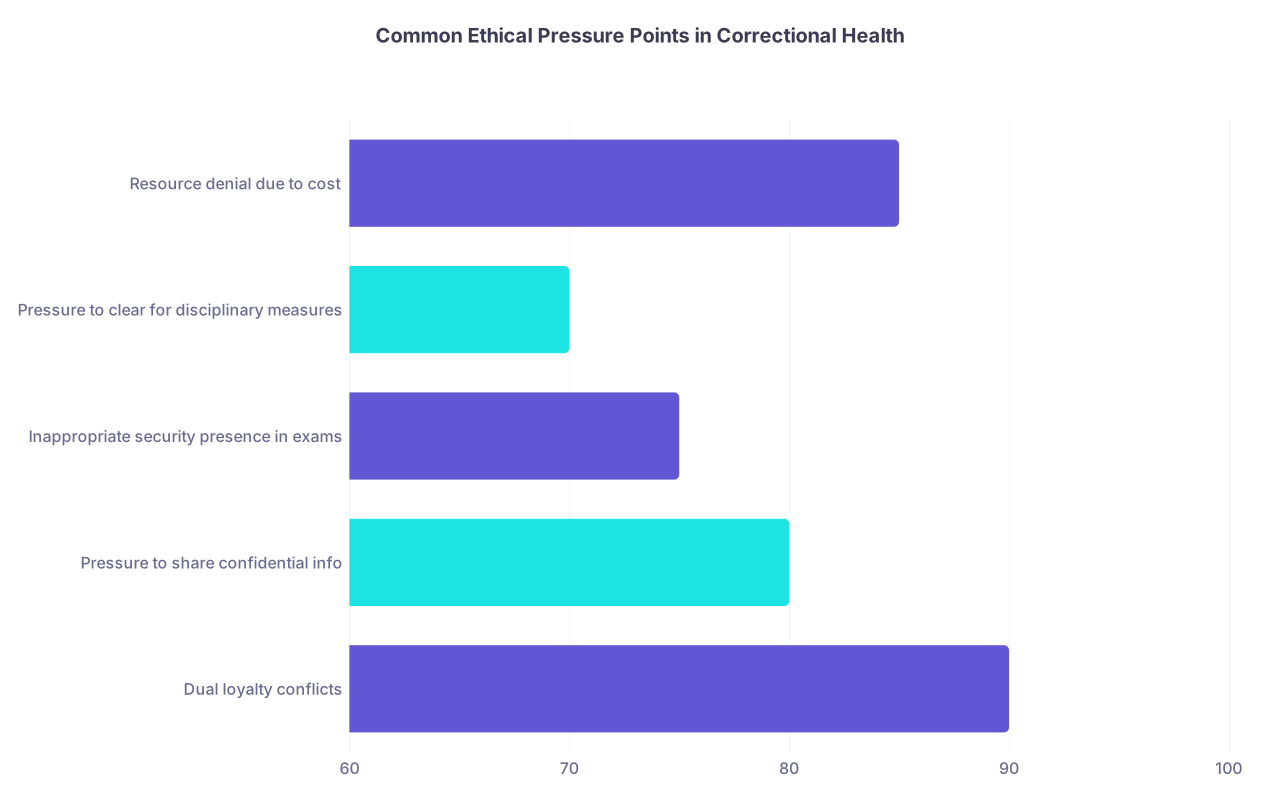
| Category | Value |
|---|---|
| Dual loyalty conflicts | 90 |
| Pressure to share confidential info | 80 |
| Inappropriate security presence in exams | 75 |
| Pressure to clear for disciplinary measures | 70 |
| Resource denial due to cost | 85 |
(Percentages here represent, roughly, how often clinicians in prisons describe facing these problems when you talk to them honestly. Not in polished surveys. In the break room.)
Your ethical duties do not shrink in this environment. They expand. Because the system is actively pushing against them.
2. Core Ethical Duties: What Does “Same Standard” Actually Mean?
“Same standard of care” is a cliché unless we unpack it. Here is what it concretely means behind bars.
2.1 Clinical competence and standard of care
You are obligated to:
- Provide evaluation and treatment that meets community standards, adjusted only for clinical indications, not for custody convenience.
- Advocate for and document when the system prevents you from doing that.
Typical example: a patient with chest pain. In a community clinic, recurrent chest pain with risk factors buys EKG, enzymes, possibly transfer. In a prison, I have seen:
- “He just wants to get out of his cell, vitals are fine.”
- “We don’t transport at night unless he’s actually collapsing.”
Your duty: act as if he were in your outpatient clinic. If the system blocks that, you document the recommendation, the refusal, and escalate. Repeatedly. In writing. To both medical and non‑medical leadership.
2.2 Respect for autonomy in a coercive setting
Autonomy is distorted in a prison. You cannot fix that. But you are still obligated to:
- Obtain informed consent without officers hovering if at all possible.
- Allow refusal of treatment, unless the patient lacks capacity and the situation meets strict criteria (imminent serious harm).
- Recognize that “voluntariness” is compromised: a patient may accept a medication to get moved to the infirmary or decline care to avoid being labeled “weak” on the tier.
For any significant intervention—psychotropics, procedures, HIV testing—your consent process must be more explicit than in the community. Spell out:
- This is voluntary.
- This will or will not affect your housing, parole, disciplinary status (be careful and honest; if you do not know, say so and find out).
- What information will remain confidential and what might be shared.
If the system conditions benefits or privileges on “accepting treatment,” that is an ethical red flag. You may not control prison policy, but you can refuse to participate in sham consent processes.
2.3 Beneficence and nonmaleficence under structural constraint
Your basic duty to help and not harm is warped by the environment:
- Sedating someone may quiet a unit. It also may chemically restrain a person for custody benefit, not health benefit.
- Writing a “medically cleared for segregation” note may directly contribute to psychological deterioration.
Your North Star: Would I do this, write this, or approve this if the patient were free and in my community clinic? If the answer is no and the only reason you are doing it is because custody asked, you are in dual‑loyalty territory.
3. Dual Loyalty: The Core Ethical Trap
Dual loyalty is not theoretical here. It is your Tuesday afternoon.
You are employed by (or contracted to) a correctional system that:
- Pays your salary.
- Controls your access.
- Controls your schedule.
- Can, in some jurisdictions, terminate your access if you “cause problems.”
At the same time, your primary ethical loyalty is to patients. Those two loyalties are often incompatible.
3.1 Common dual‑loyalty scenarios
Let me walk through several patterns that come up over and over.
Fitness for punishment or segregation
Custody: “We need to move him to segregation after this incident. Can you clear him medically?”
Ethical issue: You’re being asked to legitimize a non‑therapeutic, potentially harmful measure.
Ethically defensible response:- Perform an actual clinical assessment.
- Document concrete medical or psychiatric risk factors.
- State explicitly if segregation is contraindicated or requires specific accommodations (e.g., no bright lights, suicide precautions).
- Refuse to “rubber‑stamp” vague clearance. You can document “no acute medical emergency at this moment; however, segregation is likely to worsen X.”
Use of force examinations
Custody: “We tased him and used restraints. We need you to say he is okay.”
Your role is not to cover the institution. Your role is:- To document injuries fully and objectively (including photographs if policy allows).
- To treat acute injuries.
- To avoid speculating to support or refute custody’s narrative. Describe what you see. You are not an investigator. You are not internal affairs. But your documentation may be the only medically objective record this person ever gets.
Sharing confidential information
Officer: “What meds is he on? We need to know if he is faking.”
Your default is the same as in the community: confidentiality. Health information can be shared without consent only when:- There is a credible, specific safety risk (to others or the person).
- Law or court order requires it (and you disclose the minimum necessary). “Curiosity,” “manageability,” and “discipline” are not valid reasons.
Work and labor assignments
Administration: “We need him medically cleared to work kitchen duty. We are short staffed.”
Same standard: you assess functional capacity and risk. If his cardiac status or mobility limits make that unsafe, you say so. You do not adjust your opinion because the warden is frustrated.
3.2 Policy shields against dual loyalty
Individual resolve is not enough. You need institutional policy—ideally in writing—to back your ethical stance. Here is what robust systems do:
| Protection | Ethical Function |
|---|---|
| Independent health authority | Reduces custody control over clinicians |
| Clear confidentiality policy | Limits improper information sharing |
| No role in punitive decisions | Separates care from discipline |
| Documentation of security overrides | Creates accountability trail |
| Access to external review/ombuds | Provides escalation path beyond facility |
If you are in training or early practice and the system you are in has none of these, do not kid yourself: you are in a high‑risk environment for ethical erosion.
4. Confidentiality: How Much Privacy Is Possible Behind Bars?
Confidentiality in a prison is never absolute. But it is not optional either.
4.1 The minimum ethical floor
You are obligated to:
- Conduct clinical encounters out of earshot of other incarcerated people and staff, except when clear and specific safety concerns require presence.
- Use discreet communication about diagnoses and medications, especially for stigmatized conditions (HIV, TB, mental illness, gender dysphoria).
- Share health information with custody on a need‑to‑know, minimum‑necessary basis.
Common breach patterns I have seen:
- Officers sitting three feet from the exam table, commenting on symptoms.
- Nurses yelling “Who’s here for psych meds?” in a public corridor.
- Mental health notes shared wholesale with classification committees.
Each of these is ethically defective. You cannot fix architecture, but you can insist on:
- Closing doors when present.
- Ask officers to stand outside unless there is specific risk.
- Using generic language (“chronic condition medication”) in public areas.
4.2 Explaining the limits openly
You owe patients an honest explanation of the limits of confidentiality. That means:
- At intake: “What you tell me is private within the health team, except if you tell me about immediate plans to seriously harm someone, or escape, or harm yourself in a way that requires emergent safety intervention. In those cases, I may need to share limited information with security.”
- Before sensitive assessments such as suicide risk or assault reporting.
If you do not set expectations, patients will discover breaches indirectly and stop telling you the truth. Then your clinical care is compromised and you are just handing out pills.
5. Informed Consent and Refusal: Not a Check Box
In correctional health policy documents, consent is often treated as a form. In real life, it is a conversation under pressure.
5.1 Coercion distorts “yes” and “no”
Classic distortions:
- A patient “consents” to antipsychotics because he believes refusing will land him back in segregation.
- A patient refuses HIV testing because he knows results might leak on the tier and make him a target.
- A patient “agrees” to a certain surgery because he thinks it will help his parole case.
Your duty is to:
- Probe reasons behind consent or refusal.
- Explicitly separate clinical consequences from custodial consequences in your explanation.
- Document that you addressed these distortions.
If you sense that custody is using your treatments as levers—“if you do group therapy, maybe we can move you to a lower security unit”—you must challenge that. Quietly at first, formally if needed.
5.2 Forced treatment and involuntary interventions
Forced treatment in custody settings is ethically radioactive. Acceptable only when:
- The patient lacks decision‑making capacity regarding the specific decision.
- There is a serious risk of harm to self or others.
- Less restrictive alternatives have failed or are impossible.
- There is some form of review beyond the treating clinician (court order, ethics committee, administrative hearing with due process).
Two bright lines:
- Never participate in force‑feeding as punishment or as a response to peaceful hunger strikes meant as protest. The World Medical Association and most national codes are explicit: competent prisoners who refuse food must be respected, and clinicians should not be tools of political control.
- Never prescribe medications or perform procedures primarily to make someone more manageable for discipline, interrogations, or security convenience.
Your role is therapeutic, not custodial. When those blur, your professional integrity is at stake.
6. Participation in Punishment, Torture, and Degrading Treatment
Here is where many physicians get squeamish and start using euphemisms. I am not going to.
There is a hard ethical prohibition against:
- Participating in torture.
- Enabling cruel, inhuman, or degrading treatment.
- Using your skills or authority to facilitate punishment.
This is not abstract. It touches several very specific practices.
6.1 Solitary confinement / segregation
Long‑term isolation is a health hazard. The evidence on psychiatric harm is overwhelming: anxiety, depression, psychosis, self‑harm. International standards increasingly regard prolonged solitary as cruel, even torture.
Your ethical obligations:
- Screen for and document harm caused by segregation.
- State explicitly when segregation is medically contraindicated.
- Refuse to certify someone “fit” for conditions you believe constitute inhuman treatment.
- Advocate in writing for alternatives, especially for people with serious mental illness.
I have watched clinicians rationalize this with “if I say no, they will do it anyway without my input.” That is sometimes true. But your refusal and documentation still matter—for the patient, for legal accountability, and for your own line in the sand.
6.2 Restraints and chemical control
Physical restraints and chemical restraints (rapid tranquilization) may be necessary in rare, acute, emergent situations to prevent immediate serious harm. They are never ethically justified as:
- Punishment for rule violations.
- Convenience measures for staff.
- Long‑term behavioral management in lieu of proper treatment and environment.
If you are asked to sign off on restraint chairs, spit hoods, or recurrent “as‑needed” tranquilization for “behavioral control,” recognize that you are being invited into ethically dangerous territory. Your minimum obligations:
- Insist on clear clinical indication, time limits, and monitoring.
- Refuse standing “prn for staff safety” orders without clear criteria.
- Document your objections if practices drift toward punishment.
6.3 Death penalty involvement
Most ethical codes are clear: physicians should not participate in executions, period.
Unethical participation includes:
- Prescribing or preparing lethal injection drugs.
- Monitoring vital signs to guide execution steps.
- Pronouncing death immediately after execution as part of the execution protocol.
Ethically acceptable: providing usual care to a death‑sentenced person, up until the moment the execution process begins. Many professional organizations (AMA, WMA) explicitly forbid participation beyond that.
If your jurisdiction or employer expects clinician involvement, you have an ethical duty to refuse. That may cost you politically. It is still the correct call.
7. Advocacy, Policy, and the Line between Doctor and Activist
There is a quiet, cowardly belief in some corners of medicine that correctional physicians should “stay in their lane” and just see patients. That is ethically lazy.
When the structure itself drives disease—overcrowding, absence of addiction treatment, toxic segregation policies—clinical care without advocacy is palliative at best and complicit at worst.
7.1 Levels of advocacy available to you
You do not have to become a full‑time activist to fulfill your ethical responsibilities. But you do have to push.
Think in layers:
Clinical chart and case level
- Document health needs and harm clearly.
- Make specific recommendations (e.g., “requires asthma‑safe housing; avoid high‑allergen dorms,” “psychiatric condition contraindicates segregation”).
- Use language that can be read by courts, inspectors, and oversight bodies.
Facility policy level
- Participate actively in institutional health committees.
- Argue for policies that protect autonomy and confidentiality.
- Push back against rules that require health staff to attend disciplinary hearings, write punishment recommendations, or share broad clinical data.
System and public policy level
- Contribute de‑identified data to reports about conditions (suicide rates, access to MAT, TB control).
- Work with public health departments to link correctional health with community health, especially for re‑entry.
- Support legislation that reduces overcrowding and improves access to evidence‑based care.

| Step | Description |
|---|---|
| Step 1 | Identify Ethical Conflict |
| Step 2 | Discuss with Immediate Supervisor |
| Step 3 | Document in Chart |
| Step 4 | Escalate to Health Authority |
| Step 5 | Contact Oversight Body or Ombuds |
| Step 6 | Seek External Review or Legal Counsel |
| Step 7 | Resolved? |
| Step 8 | Still Unresolved? |
| Step 9 | Serious Ongoing Harm? |
You will hear the phrase “this is how we have always done it” a lot. Translate that mentally as: “We have normalized ethically dubious behavior and nobody stopped us.” Your job is not to accept that as an endpoint.
7.2 Protection from retaliation and burnout
Let me be realistic. Pushing on these issues carries risk:
- Subtle retaliation from custody (slower movement of your patients, less cooperation).
- Administrative cold shoulder.
- Personal burnout from constant conflict.
Ethically, you still have to push, but you should be strategic:
- Build alliances with other clinicians; never advocate as a lone martyr if you can avoid it.
- Use existing standards—NCCHC, ACA, national medical codes—as shields: you are not “being difficult,” you are insisting on baseline standards.
- Document, document, document. Ethical concerns, blocked care, refusals.
And yes, sometimes the ethical answer is: this system is incompatible with my professional integrity; I will leave. That is not failure. That is boundary setting.
8. Public Health Lens: The Prison Is Not a Closed System
Too many physicians think of correctional health as a closed universe. It is not. Almost everyone in jail or prison will return to the community. Infectious diseases, untreated addiction, unaddressed mental illness—these all walk back out the gate.
From a public health policy perspective, your duties include:
- Continuity of care at re‑entry: summarized records, medication bridges, linkage to community clinics and mental health/addiction services.
- Disease control: testing and treatment for HIV, HCV, STIs, TB, and now COVID and other respiratory infections—with an eye toward community impact, not just facility outbreaks.
- Harm reduction: evidence‑based addiction treatment (buprenorphine, methadone, naltrexone), overdose education, and naloxone on release.
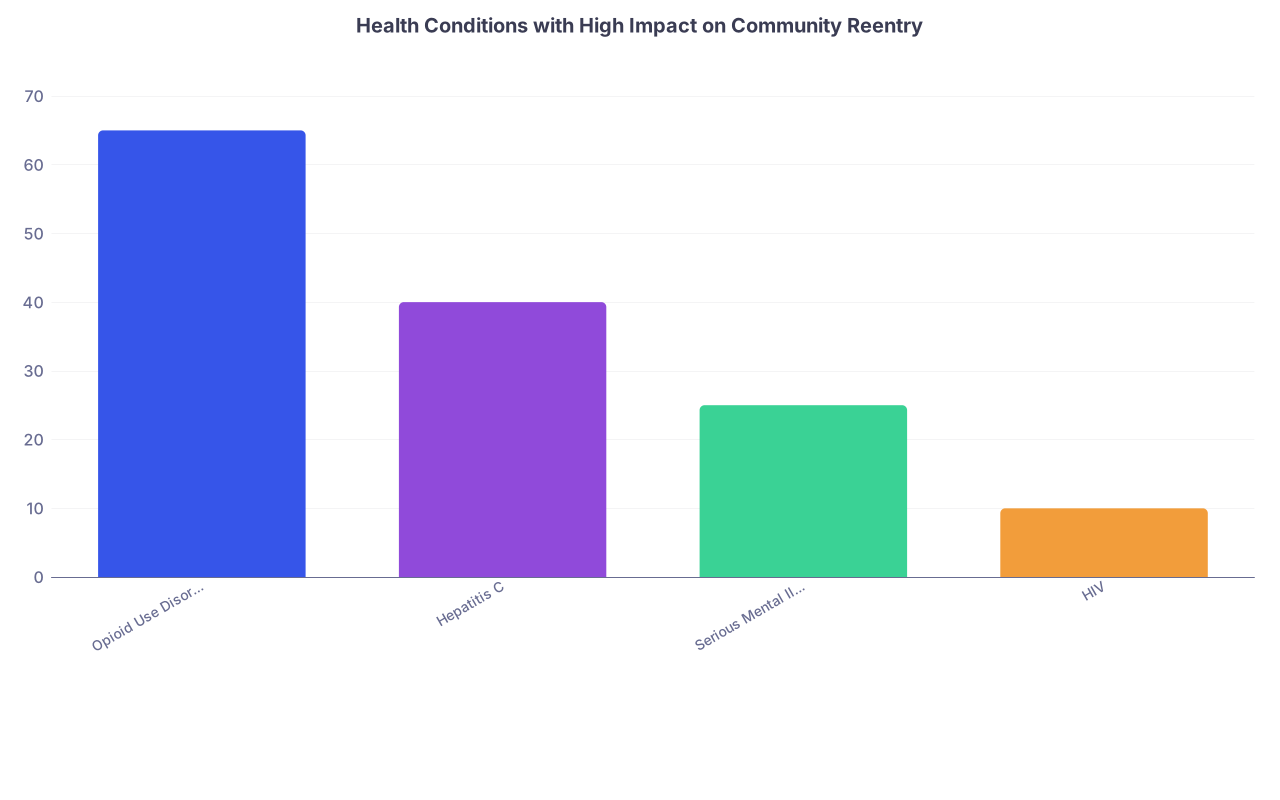
| Category | Value |
|---|---|
| Opioid Use Disorder | 65 |
| Hepatitis C | 40 |
| Serious Mental Illness | 25 |
| HIV | 10 |
(Approximate percentages of incarcerated populations affected, varying by jurisdiction. The takeaway: if you ignore these, community health pays the price.)
If you approach your role as narrowly clinical—“I just prescribe and treat what is in front of me”—you are missing an ethical dimension: duty to the community that will absorb your patients.
9. Training Yourself Ethically: Personal Development Behind Bars
You are in the “Personal Development and Medical Ethics” phase, which means you should not wait until you are hired by a correctional facility to think about this.
Here is what serious preparation looks like:
Study actual standards and codes
Do not rely on vague class lectures. Read:- AMA Code of Medical Ethics opinions on incarcerated patients and torture.
- World Medical Association’s Declaration of Tokyo (torture) and Declaration of Malta (hunger strikers).
- NCCHC standards for health services in jails and prisons.
Examine your own tolerance for moral injury
Ask yourself candidly:- How will I respond when I am the only person objecting in the room?
- Where is my personal line for participation in segregation, restraint, forced treatment? If you do not define this now, the system will draw the line for you later.
Watch for slow ethical erosion
It rarely happens with one big compromise. It happens like this:- You accept officers sitting in exam rooms “just this once.”
- You sign clearance forms without really assessing.
- You start describing obvious psychiatric reactions to segregation as “malingering.” By year three, you speak more like a sergeant than a clinician. I have seen it too often.
Build an external reference group
Colleagues outside corrections, mentors in ethics or public health, professional society committees. People you can call and say, “This is what is happening here. Am I overreacting?” You need that mirror, because inside, the abnormal becomes normal very quickly.

10. Practical Ground Rules You Can Actually Use Tomorrow
Let me anchor all this theory into specific behaviors that align with your ethical duties.
Never let custody write your clinical notes
Sounds obvious. Yet I have seen officers suggest language and clinicians type it. Your documentation is yours. Objective. Clinically grounded. Not an extension of an incident report.Consult another clinician before signing anything with a primary custodial purpose
“Fit for segregation,” “fit for pepper spray,” “mentally stable after use of force.” Take five minutes to talk to a colleague. If the system resents the delay, that tells you something.If you cannot do the right thing, at least refuse to do the wrong thing
You may not be able to stop segregation. But you can:- Refuse to certify someone as “unaffected.”
- Refuse to falsify records.
- Refuse to remain silent about clear harm.
Keep your language clinical, not custodial
Do not call patients “inmates” in your notes. Use “patient.” Describe behavior, not character (“patient shouted and hit door,” not “patient was manipulative”).When in doubt about confidentiality, ask: would I share this if he lived across the street?
If the only reason to share is that he is incarcerated, and there is no specific safety threat, you probably should not share.

Three points to keep front and center:
- A prison is structurally hostile to core medical ethics. Your duty is to hold the line, not to adapt your ethics to the environment.
- Dual loyalty is the central ethical hazard. Every time you act primarily for the institution rather than the patient, you erode trust and your own professional integrity.
- Correctional health is public health. Your ethical responsibilities extend beyond the gate—to the communities that will receive your patients and to the systems that shape their health in the first place.