
It is 4:45 a.m. You are a PGY-1 on night float, finishing notes, when someone casually mentions in sign-out: “By the way, the hospital is talking about cutting one of the categorical spots next year. Something about GME funding caps.”
You nod like you understand. You probably do not.
But that comment—that invisible money in the background—is shaping how many co-residents you have, how crushed your call schedule is, which subspecialists are on your team, and whether your hospital can afford an extra social worker so your patient is not discharged back to a shelter.
Let me break this down specifically. Graduate Medical Education (GME) funding is not some abstract budget line. It is one of the most powerful—and underappreciated—policy levers in U.S. health care. It decides:
- How many physicians we train.
- In which specialties they train.
- Where they train.
- And indirectly, what kind of doctor you become.
If you care about public health, workforce equity, or your own trajectory as a trainee, you have to understand how this system works—and how it could be changed.
1. The Core Mechanics: How GME Money Actually Flows
Before we talk policy levers, you need the plumbing diagram.
The two big buckets: DGME and IME
Medicare is the dominant payer for GME. It funds two main streams:
Direct Graduate Medical Education (DGME)
This is the “explicit” education money. It helps pay for:- Resident and fellow salaries and benefits.
- Teaching faculty time (a portion).
- Program administration (PD salary, coordinators).
- Educational infrastructure: simulation centers, conferences, some didactics.
Indirect Medical Education (IME)
This is the “we know teaching hospitals are expensive” money. It is an add-on to DRG payments for inpatient care to Medicare beneficiaries. It compensates for:- Higher acuity / more complex patients.
- More diagnostics and procedures.
- System inefficiencies intrinsic to teaching environments.
- The costs of running a teaching hospital ecosystem.
So: DGME is more transparent and educational. IME is larger, messier, and tied to hospital operations.
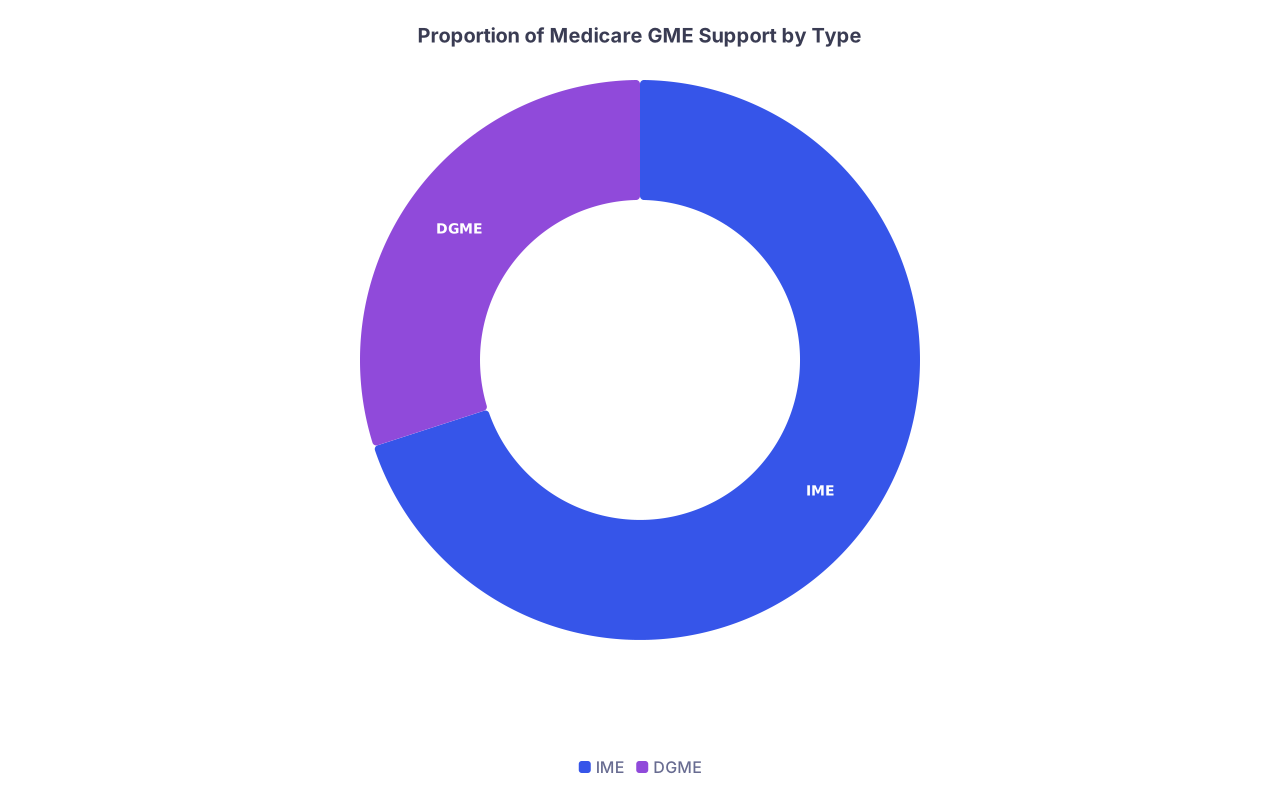
| Category | Value |
|---|---|
| IME | 70 |
| DGME | 30 |
Actual proportions vary by institution, but nationally IME dollars overshadow DGME.
The resident cap and per-resident amount
Two numbers dominate conversations in any GME office:
- The number of funded FTE residents (the “Medicare cap”).
- The per-resident amount (PRA) of DGME.
PRA is determined from hospital-specific historical costs in the late 1980s/early 1990s, inflated over time. A hospital with a high PRA and a large cap prints money (relatively). A hospital with a low PRA is always struggling. Caps, set in the Balanced Budget Act of 1997, locked in the number of residents Medicare would fund at each institution based on their training levels in the mid-90s.
Everything since then has been about working around, nibbling at, or modestly expanding that cap.
| Component | What It Pays For | How It Is Calculated |
|---|---|---|
| DGME | Salaries, benefits, admin, faculty | PRA × weighted resident FTE × Medicare share |
| IME | Teaching hospital add-on for inpatient care | Adjustment factor × resident-to-bed ratio × Medicare inpatient payments |
| Cap (FTE) | Max number of residents Medicare funds | Set mainly by 1997 levels with targeted later expansions |
| PRA | Per-resident amount for DGME | Based on 1984–1996 costs, updated for inflation |
You can already see the problem: costs, needs, and specialty mix of 2026 are being funded with a structure frozen in the 90s.
2. Policy Levers: Where Law and Regulation Quietly Run Your Life
Now to the levers. These are the knobs Congress, CMS, and states can turn that profoundly alter how and where you train.
Lever 1: The National Cap on Medicare-Funded Residency Positions
The big one. The 1997 Balanced Budget Act essentially said: “We are not paying for unlimited residents anymore.” Medicare capped the number of funded residency slots at each hospital, using 1996 training levels as the baseline.
Downstream effects you can feel as a resident:
- Program size decisions are often not about demand or need. They are about whether there is cap room.
- New specialties or tracks (e.g., addiction medicine, clinical informatics) are often unfunded from the Medicare perspective.
- Rural and community hospitals that had minimal training activity in the 90s got boxed out, which worsened the urban-heavy training distribution.
Later legislation (Consolidated Appropriations Acts of 2021, 2023, etc.) added relatively small numbers of new positions, often targeted to:
- Rural hospitals.
- Hospitals in states with new medical schools.
- Hospitals that train high numbers of underserved or shortage-area physicians.
But these are thousands of slots added against a workforce deficit that numbers in the tens of thousands over coming decades. It is patchwork, not structural reform.
Lever 2: IME Adjustment Formula
IME is not some random extra. The formula contains a policy choice. Medicare pays an IME adjustment—basically a multiplier on inpatient payments—based on the resident-to-bed ratio.
Increasing the IME adjustment:
- Makes teaching residents more financially attractive.
- Encourages hospitals to sustain and possibly expand training.
- But also sends more money to already-large, complex, academic centers.
Reducing the IME adjustment:
- Saves Medicare money on paper.
- Makes hospital administrators suddenly scrutinize every residency line item.
- Can push hospitals to favor high-margin services (cardiac, ortho, transplant) over primary care training.
For you as a trainee: IME generosity correlates with whether your institution invests in robust teaching or treats you as low-cost labor running a service line.
Lever 3: DGME Rules on Time and Site of Training
DGME rules decide which resident time “counts”:
- Time in the main teaching hospital vs. off-site clinics.
- Time in VA facilities.
- Time in non-hospital-based ambulatory settings.
CMS historically favored hospital time. Ambulatory rotations, community clinics, and non-hospital-based sites have been more constrained in terms of DGME reimbursement.
That biases program design. It pushes more inpatient-heavy curricula, even as population needs shift toward chronic disease management, preventive care, and behavioral health—mostly outpatient.
Policy tweaks in recent years have slightly broadened payment for residents in non-hospital settings if certain contractual, supervisory, and financial conditions are met. But creatively using community sites still takes a savvy GME office and a cooperative finance department.
3. Incentives that Distort Specialty Mix and Geography
Here is where public health policy, ethics, and your personal career intersect.
The specialty mix problem: the “primary care lip service” gap
Everyone in DC loves to say “We need more primary care.” Then they leave the most powerful incentive—GME funding—mainly specialty-neutral.
What we see:
- Large tertiary centers expand hospitalist, subspecialty, and procedural fellowships because those slots cross-subsidize high-margin services.
- True community-based primary care training programs struggle financially unless subsidized by states, health systems, or private philanthropy.
- Medical students feel the signal: procedural subspecialties are heavily resourced; outpatient primary care feels thin and rushed.
There have been attempts to correct this, for example:
- Teaching Health Center GME (THCGME) – funds primary care residency programs in community-based ambulatory settings (FQHCs, rural health clinics).
- Title VII programs supporting primary care training and pipeline efforts.
But these streams are small, repeatedly threatened in appropriations debates, and not nearly at the scale of Medicare GME.
So we get what the money pays for: more subspecialists clustered in academic and high-resource environments, not robust primary care networks.
The geographic maldistribution: training where patients are not
Most GME dollars go to urban, coastal, and large academic health systems. That is where residents learn and where many ultimately practice.
We have decades of data: physicians tend to practice near where they trained. So if you pour money into Boston, New York, LA, Houston, you produce exactly what we see—dense clusters of specialists and chronic shortages in rural and underserved areas.
Some corrective policies:
- Rural training track (RTT) programs in family medicine and internal medicine.
- Cap expansions targeted to rural and shortage areas.
- State Medicaid GME payments to encourage training in specific locations (safety-net hospitals, rural hospitals, behavioral health, etc.).
They help. But they are layered on a base system still structurally tilted toward urban tertiary centers.
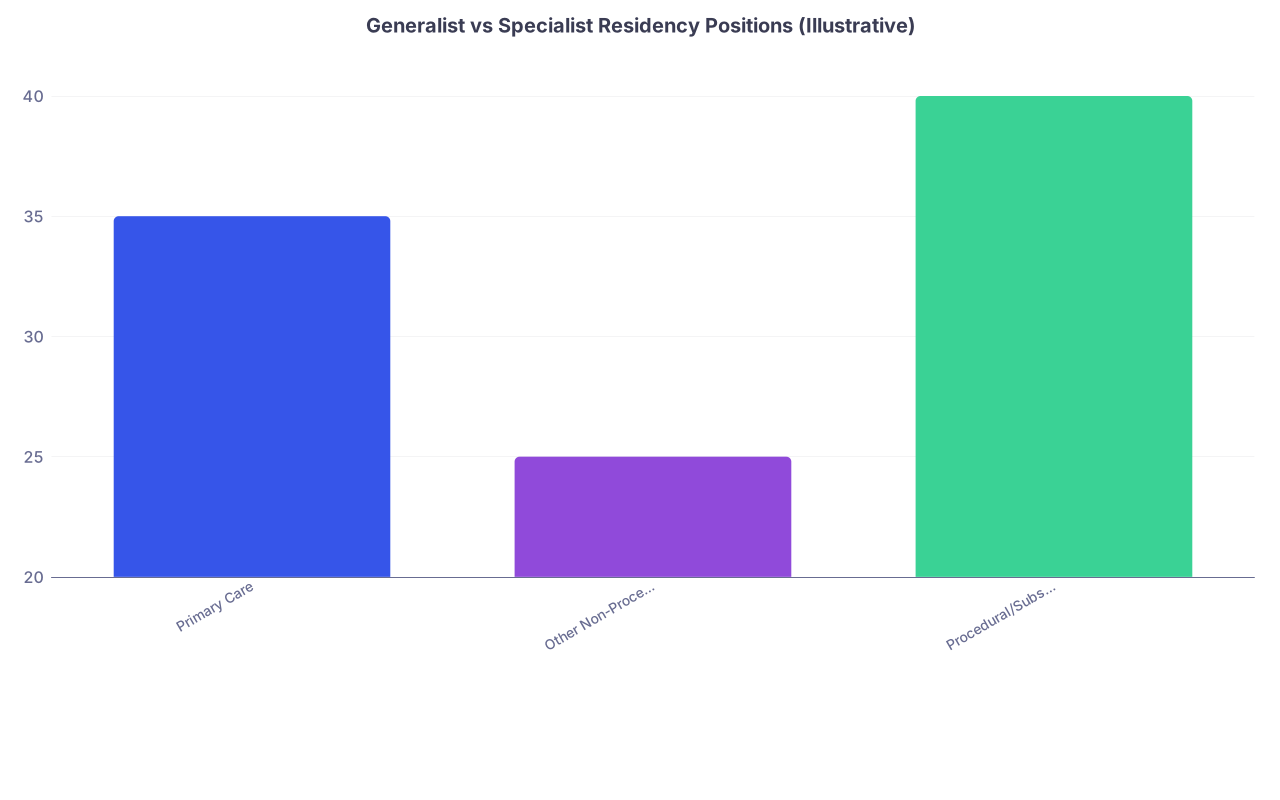
| Category | Value |
|---|---|
| Primary Care | 35 |
| Other Non-Procedural | 25 |
| Procedural/Subspecialty | 40 |
Numbers above are approximate, but directionally accurate: we skew toward specialty care.
4. Ethical Tensions Embedded in GME Funding
Now we move from policy plumbing to ethics—where you actually live as a trainee.
Residents: learners or revenue-generating labor?
On paper, GME is about education. In practice:
- Residents provide a massive amount of billable care.
- They staff nights, weekends, and holidays.
- They maintain throughput for complex service lines.
Hospitals know this. When IME and DGME are strong, there is at least some insulation that allows for protected didactics, elective time, simulation, QI projects. When margins are tight, residents quickly become service units.
The ethical tension:
- Public dollars are justified on the grounds of training competent future physicians.
- But without guardrails, systems can treat residents primarily as cheap labor to sustain under-reimbursed or complex care.
ACGME duty hours, supervision requirements, and educational standards are the formal guardrails. But they operate inside a financial environment dominated by GME funding formulas.
If your program feels like a service mill with thin teaching, you are feeling a policy failure manifesting at the bedside.
Maldistribution as an equity problem
Where GME money goes decides which communities have access to:
- Specialists.
- Hospital-based advanced care.
- Comprehensive primary care.
Historically, Black, Latino, Indigenous, and rural communities have received comparatively fewer residency programs and trainees. That means:
- Fewer physicians likely to stay and practice in those communities.
- Limited local capacity to train diverse future physicians.
- Underrepresentation in the physician workforce and leadership.
When policymakers talk about “health equity” but do not re-engineer GME flows, they are ignoring one of the most direct levers to change the geography and composition of the workforce.
Hidden curriculum: what funding teaches you about value
You learn quickly what your institution values:
- Is outpatient continuity clinic protected and well-resourced, or chronically overbooked and under-supported?
- Do global health, addiction medicine, and correctional health rotations get real institutional backing, or are they passion projects running on fumes?
- Are under-resourced community partners treated as equal training sites or as afterthoughts?
These patterns are not random. They track the underlying financial priorities, which are deeply shaped by GME and related reimbursement. That becomes part of your ethical formation as a physician—what you implicitly learn is “important” and “worth time.”
5. State, VA, and Alternative Funding Streams
It is not just Medicare. Other actors pull their own levers.
State Medicaid GME funding
Many states use Medicaid dollars to support GME. Design is highly variable:
- Some states mimic Medicare: broad support with little targeting.
- Others explicitly steer funds to:
- Primary care specialties.
- Rural hospitals.
- Safety-net institutions.
- Behavioral health or pediatrics.
Well-designed Medicaid GME can correct national distortions by targeting underserved areas and specialties. Poorly designed Medicaid GME just layers another opaque payment system with little accountability.
If you are in a safety-net program that feels relatively well-supported despite low commercial payer mix, odds are your state Medicaid GME structure is doing some heavy lifting.
VA GME funding
The VA is a major training site and has its own GME funding mechanism, often co-financing positions that also interact with Medicare caps. VA expansions over the past decade have:
- Added residency positions.
- Opened new training sites in rural areas.
- Emphasized primary care, mental health, and geriatrics.
For you: time at the VA is often where you see integrated behavioral health, strong primary care teams, and systems-level quality work. That model reflects a different funding and mission structure than pure Medicare GME.
Teaching Health Center GME (THCGME)
THCGME is unique:
- Funded by HRSA, not Medicare.
- Dollars flow directly to community-based ambulatory sites (FQHCs, rural health clinics, etc.).
- Programs are explicitly primary care-focused (FM, IM, peds, psych, OB/GYN, dentistry).
This is the closest thing we have to a GME policy explicitly engineered around community health and primary care. The catch: it is small in absolute terms and reauthorized in chunks, so programs live with chronic uncertainty.
6. Policy Ideas on the Table—and What They Would Change for You
Let’s talk about levers that could realistically move in the coming decade and what they would do to your training life.
Idea 1: Tie new GME slots to workforce need
Instead of random incremental increases, expand GME in:
- Primary care and psychiatry.
- Rural and urban underserved areas.
- Geriatrics, addiction medicine, and palliative care.
This is already happening in a limited way in recent legislation, but on a small scale. A more aggressive version would:
- Force hospitals to justify new slots based on demonstrable community need.
- Require retention metrics (e.g., fraction of graduates serving in shortage areas).
- Potentially reallocate cap slots from saturated markets to shortage areas over time.
For you: more training options in mission-driven sites, more competition for hospital systems that currently rely on prestige alone, and potentially more leverage as a trainee if your training aligns with explicit national priority areas.
Idea 2: Differential funding by specialty
Right now, a cardiology fellow and a family medicine resident are not very different from Medicare’s perspective. But they are very different for the population.
A policy shift could:
- Pay more for primary care and psychiatry training positions.
- Offer bonus DGME or IME for programs that maintain a certain percentage of graduates in shortage areas.
- Reduce subsidies for oversaturated subspecialties in high-density markets.
Is this politically messy? Absolutely. Specialty societies will fight. But without differential incentives, “we want more primary care” remains mostly rhetoric.
Idea 3: Shift more GME into outpatient and community settings
Mechanically, this would require:
- DGME credit for ambulatory time to be clearer and easier to claim.
- Direct funding streams (like THCGME) scaled up dramatically.
- Requirements that a certain portion of training occur in non-hospital, community-based settings.
Implications for you:
- Less purely inpatient-heavy training.
- More continuity with patients over time.
- More exposure to social determinants, public health interventions, and interprofessional teams.
And frankly, a better reflection of where most actual care happens.
Idea 4: Transparency and accountability requirements
GME funding is notoriously opaque. Many hospitals cannot (or will not) show how DGME/IME dollars translate to actual educational investment.
A stronger accountability framework could require:
- Public reporting of GME funding received and how it is spent.
- Workforce outcome metrics: specialty choice, practice location, underserved service.
- Tying a portion of future funding to outcomes, not just historical baselines.
If this happens, residents and applicants will finally have some leverage:
- You can compare programs on how they actually use public dollars.
- Policymakers can reward institutions that train the workforce we claim to need.
7. What This Means for You as a Trainee or Early-Career Physician
You are not going to personally rewrite the Medicare statute next week. But you are not powerless.
Understand your institution’s GME reality
Ask concrete questions:
- How many of our residency positions are at or above our Medicare cap?
- Where does our IME money go? Does it visibly support education?
- Are there discussions about cutting or expanding positions—and why?
If no one can answer this, that is itself a data point.
Choose training environments aligned with your values
When you look at programs, do not just ask about the call schedule and fellowship match:
- Where do graduates practice? In what communities?
- How much of your time is ambulatory versus inpatient?
- Are there robust rotations in FQHCs, rural sites, VA, correctional health, addiction services?
- Does the institution see residents as learners or primarily as throughput?
Those are ethical and policy questions disguised as “program culture.”
Engage in advocacy with precision
Vague “increase GME funding” advocacy is lazy. It often just means more money to the same places, doing the same things.
If you are going to engage politically or with professional societies, be specific:
- Expand GME in primary care and psychiatry with clear workforce targets.
- Shift funding toward community-based and outpatient training.
- Tie new slots and a portion of funding to serving underserved areas.
- Increase transparency on GME flows and training outcomes.
That is the level of detail policymakers take seriously.
FAQ (exactly 4 questions)
1. Why can’t hospitals just add more residency positions if they need more staff?
They can add “unfunded” positions beyond their Medicare cap, but then the hospital eats the full cost of salary, benefits, and lost billable attending time for supervision. In high-margin systems this sometimes happens, especially in lucrative service lines. In thin-margin or safety-net hospitals, it is rarely feasible. The cap makes expansion a real financial risk unless there is alternative funding (state Medicaid, philanthropy, system cross-subsidy).
2. Does GME funding affect fellowship opportunities as much as residency spots?
Yes, but in a slightly different way. Fellowships can be funded under GME if they are ACGME-accredited and the trainee is still within their initial period of eligibility for Medicare GME support. Programs often expand fellowships in revenue-generating fields (cardiology, GI, critical care) because those fellows both attract IME and bolster profitable hospital services. By contrast, geriatrics or addiction medicine fellowships often struggle—less procedural revenue and smaller institutional priority, despite huge public health need.
3. Is Teaching Health Center GME a realistic alternative path for most residents?
Not yet. THCGME programs are still a small slice of national training capacity, heavily primary care-focused, and sensitive to federal budget cycles. For family medicine and some internal medicine residents who want intense community-based training, they are excellent, mission-aligned options. But they are not scaled to absorb large numbers of residents from other specialties. Expanding THCGME or replicating its model at scale would require major, sustained federal investment.
4. As a resident, how can I practically influence GME-related decisions locally?
You will not rewrite federal formulas, but you can absolutely affect how your institution uses its GME resources. Get onto the GMEC (Graduate Medical Education Committee) or its subcommittees. Push for outpatient rotations in underserved clinics to be structurally supported, not ad hoc. Ask for data on graduate practice locations and highlight misalignment with community needs. When administration claims “we can’t afford that,” ask how GME funding and IME dollars are being deployed. Local pressure, especially when aligned with clear policy arguments, does shift priorities.
Key points to walk away with:
- GME funding is the central structural force shaping how many physicians we train, in what specialties, and where—not just abstract budget noise.
- The current system, built around 1990s baselines and largely specialty-neutral payments, structurally favors urban tertiary hospitals and specialty expansion over primary care and underserved areas.
- If you care about equity, public health, or your own training environment, you need to engage with GME policy specifically—on caps, specialty targeting, outpatient training support, and accountability—not just call for “more funding.”