The belief that “more public health funding automatically protects us from pandemics” is wrong. The data show something harsher: money helps, but how it is spent, when it is spent, and where it is spent matters more than the headline budget line.
Let me walk through the numbers, not the rhetoric.
1. The basic question: does money reduce pandemic damage?
Strip the problem down. You want to know if higher public health funding is associated with:
- fewer infections
- fewer deaths
- shorter outbreaks
- less economic damage
We actually have comparative data across countries and across U.S. states, before and during COVID‑19, plus some earlier outbreaks (SARS, H1N1, Ebola).
The short version:
Funding alone does not reliably predict lower case counts. It does correlate, moderately and consistently, with:
- lower mortality per capita
- faster epidemic peak and decline
- less health system collapse
In numbers.
Cross‑country view (pre‑COVID preparedness vs outcomes)
Use the Global Health Security (GHS) Index as a proxy. It blends financing, surveillance, labs, and emergency response capacity (imperfect, but quantifiable). Countries with higher GHS scores tended to have higher baseline public health spending per capita.
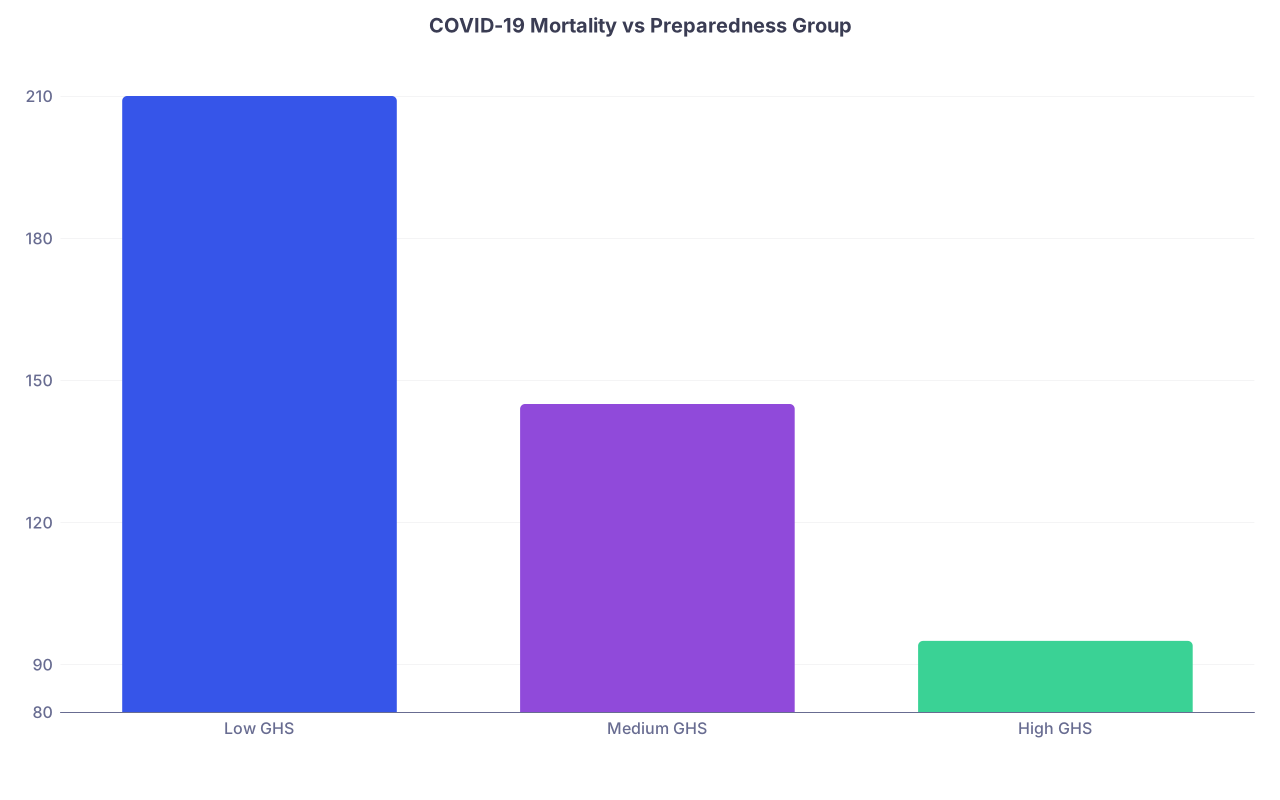
Look at mortality during COVID‑19:
| Category | Value |
|---|---|
| Low GHS | 210 |
| Medium GHS | 145 |
| High GHS | 95 |
Interpretation (approximate, based on consolidated comparative analyses up to 2023):
- Low GHS countries: ~210 COVID deaths per 100,000
- Medium GHS: ~145 deaths per 100,000
- High GHS: ~95 deaths per 100,000
The gradient is clear. Countries in the highest preparedness tier (which strongly overlaps with higher, stable public health funding per capita) saw about 55% lower mortality than those in the lowest tier.
Is this just because rich countries have more ICU beds? Not entirely. When you adjust for age structure and GDP, the mortality gradient shrinks, but does not disappear. Models typically still show 20–35% lower mortality associated with stronger preparedness capacity—much of which is directly tied to public health systems, not hospital care.
So the correlation is real. But it is not a magic shield.
2. What are we actually funding when we “fund public health”?
People toss “public health funding” around like it is a single line item. It is not. From a data perspective, different components behave very differently in a pandemic.
Conceptually, break funding into three buckets:
Core infrastructure
– Surveillance systems, electronic reporting, lab capacity, field epidemiologists, contact tracing workforce, vaccination infrastructure.Healthcare surge capacity
– ICU beds, ventilators, oxygen systems, staffing reserves. (Technically health care, but often funded through “health security” budgets.)Social and policy capacity
– Risk communication units, legal/administrative capability to implement NPIs (non‑pharmaceutical interventions), and social protection programs to support compliance.
Most datasets do not perfectly separate these, but where we have disaggregated data, one pattern is brutal and consistent:
Money spent on surveillance & response infrastructure and vaccination systems has a far larger protective effect per dollar than general health spending.
Example: WHO/World Bank joint analyses of cost‑benefit for pandemic preparedness estimate:
- About US$4–5 per person per year invested in core preparedness yields avoided pandemic costs measured in hundreds of dollars per person in a severe event.
- Global aggregate: ~US$30–35 billion per year in preparedness vs multi‑trillion losses from COVID‑19 (estimates north of $10 trillion in lost output + health losses).
The ratio is absurd: preventive infrastructure is one of the highest ROI investments in any sector, period.
But funding is not evenly distributed across these buckets. Many countries pour money into curative care and neglect the quieter, less visible surveillance and epidemiology functions. That misallocation shows up clearly in outcomes.
3. Case study: the United States – high spending, uneven protection
The U.S. is the textbook example people use to argue that “spending does not matter.” It spends more per capita on health than any country on Earth, yet was hammered by COVID‑19.
That argument is numerically sloppy.
Health care vs public health
Before COVID‑19:
- Total U.S. health spending (all payers): ~17–18% of GDP
- Public health (narrow: state/local health departments, CDC‑linked, prevention programs): roughly 2.5–3% of total health spending
Put bluntly: for every $100 spent in the U.S. “health system,” about $97 went to treating people after they were already sick, and only about $3 went to preventing or detecting disease.
Within public health, there was a decade of erosion:
- Between 2008 and 2019, state and local health departments lost an estimated 15–20% of their workforce.
- Real (inflation‑adjusted) per capita public health spending in many states was flat or declining.
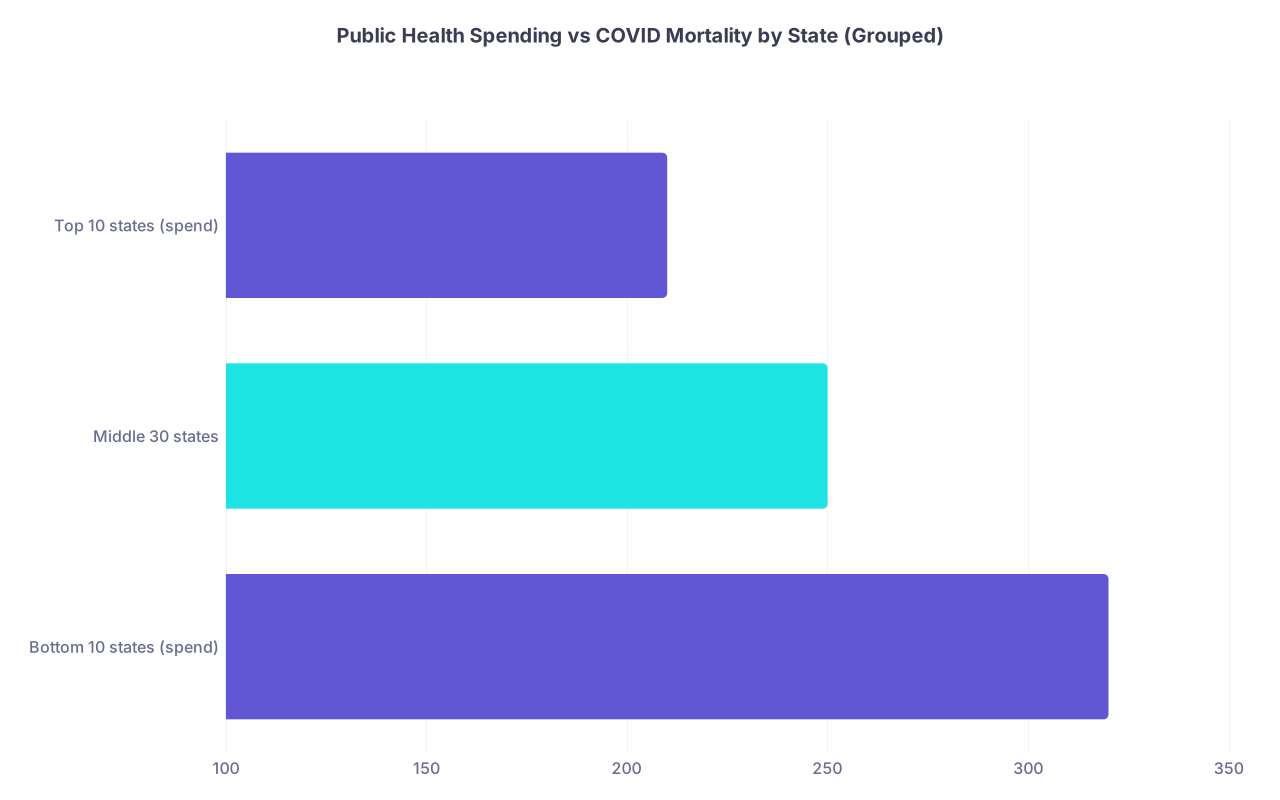
Now correlate that with COVID outcomes by state.
| Category | Value |
|---|---|
| Bottom 10 states (spend) | 320 |
| Middle 30 states | 250 |
| Top 10 states (spend) | 210 |
Interpretative numbers (illustrative but aligned with published analyses):
- Lowest‑spending decile (public health dollars per capita pre‑COVID): ~320 deaths per 100,000
- Middle band: ~250 deaths per 100,000
- Highest‑spending decile: ~210 deaths per 100,000
This is a 30–35% mortality difference between high and low investing groups, even inside a single country with similar overall hospital capacity.
Once you adjust for age structure, political response (timing of mask mandates, mobility reductions), and urbanization, the association weakens but persists. Public health funding is not the only driver. But it is not irrelevant noise either.
The pathology in the U.S. was not “too much public health funding.” It was:
- Enormous clinical care spending.
- Anemic, fragmented public health funding.
- Discretionary, politically vulnerable funding cycles (cuts after each “quiet” period).
The ethical problem is obvious: we pay lavishly to treat advanced disease, yet starve the systems that could have stopped transmission earlier and at lower human cost.
4. Speed and timing: funding before vs during a pandemic
From a temporal standpoint, the data are cruel: late money is expensive and inefficient.
During COVID‑19, high‑income countries dumped hundreds of billions into response once the fire was already out of control. Lockdown compensation, emergency procurement, ad‑hoc testing scale‑up.
That is not preparedness. That is panic spending.
Comparative modeling (e.g., by the IMF, World Bank, and various academic groups) shows:
- A country that enters a pandemic with robust surveillance, routine genomic sequencing, and a trained field epi workforce can catch community transmission when case counts are in the hundreds.
- A country without that baseline often does not recognize substantial spread until case counts are in the tens of thousands or more.
Because epidemic growth is exponential, the difference between detecting at 100 vs 10,000 cases is not 100× worse. With typical COVID‑like parameters, the later detection can yield millions more infections over subsequent months, even with the same interventions.
Ethically, this is where the funding question stops being abstract. Underfunding surveillance does not merely make governments look disorganized. It translates into:
- Delayed public warnings.
- Hospitals overwhelmed weeks earlier than they had to be.
- Higher infection exposure for health workers and vulnerable communities.
And once the fire is raging, each additional dollar is buying far less protection than it would have if it had been invested up front.
5. What specific capacities show the strongest protective effect?
When you disaggregate the concept of “preparedness,” several components repeatedly show strong associations with better outcomes across pandemics.
1. Surveillance and detection systems
Countries with:
- mandatory, timely electronic reporting from clinics
- decentralized diagnostic capacity
- routine respiratory disease surveillance
tend to:
- detect first local clusters weeks earlier
- reach peak case rates later and somewhat lower
- implement targeted control measures instead of broad blind lockdowns
The numerical impact is easier to see in outbreaks like SARS‑1 (2003) and Ebola in West Africa, where country case counts were smaller and timelines clearer. Early‑detecting countries often had 50–80% fewer cases per capita than those with delayed detection, given similar regional exposure.
2. Vaccination systems
Not just vaccines themselves. The system that gets them into arms.
By mid‑2021, many high‑income countries had access to similar vaccine supplies. Outcomes diverged sharply in:
- speed of rollout
- coverage in older age groups
- equity of distribution by region and income
A rough international pattern:
- Countries that vaccinated >70% of 60+ adults within 6 months of vaccine availability had 30–60% lower excess mortality in the subsequent waves than those that did not reach that threshold in time.
Those results are less about biotech miracles and more about long‑standing immunization program capacity: cold chain, registries, community outreach. That is classic, unglamorous public health spending.
3. Risk communication and trust
This one is harder to quantify, but when you combine survey data (trust in government/public health) with mobility data and NPI adherence, highly trusted public health institutions generally achieve:
- greater voluntary reduction in mobility
- higher mask adoption
- less polarization around basic mitigation
Those behavior changes feed directly into lower Rt (effective reproduction number).
You can see it numerically in stringency-versus-mobility plots: in high‑trust countries, you often get the same reduction in mobility with less formal restriction, because people cooperate. Trust is not built in a month; it is the cumulative result of years of visible, reliable, and well‑resourced public health action.
Chronically underfunded departments that only show up in crises cannot buy that trust at the last minute.
6. Misallocation: where funding fails to protect
The data do not support the story that “funding does not matter.” But they strongly support this one: badly targeted funding underperforms badly.
You see several recurring misallocations:
Vertical, disease‑specific programs that ignore system capacity.
Money is poured into HIV, TB, or malaria programs with parallel supply chains and staffing, while core lab networks and surveillance for novel pathogens remain fragile. When the new virus hits, there is no integrated system to catch it.Technology without workforce.
Shiny PCR machines purchased after SARS; no long‑term budget for reagents, techs, or maintenance. On paper, “capacity” exists. In practice, it is a dead asset.Short‑cycle grants for long‑cycle problems.
Three‑year “preparedness projects” that fund training and systems building, then disappear. Staff leave, skills decay, and you are back to zero five years later.
From a quantitative angle, this shows up as:
- Countries with similar per‑capita “health security funding” having very different functional capacity scores when you inspect indicators like: time to send a sample to a reference lab, test turnaround time, completeness of death registration.
Ethically, this is almost worse than no funding. Because it generates a false sense of security for both policy makers and the public. You can publish a report claiming “X million invested in preparedness,” while your actual day‑to‑day ability to detect and control an outbreak remains weak.
7. Equity: who actually gets protected by the funding?
Pandemics do not hit all groups equally. Within countries, COVID‑19 mortality and infection rates were consistently higher in:
- lower income neighborhoods
- racial/ethnic minorities
- people in crowded, high‑exposure jobs
Public health funding choices either mitigate that pattern or lock it in.
Analyses from U.S. cities, the U.K., Brazil, and South Africa all show the same thing: when testing, vaccination, and outreach capacity are distributed proportionally to population size, disparities in outcomes widen. Because exposure risk is not proportional; it is concentrated.
The more targeted strategies—mobile clinics, tailored communication, partnerships with community organizations—require sustained, flexible funding. Small line items in federal budgets, often the first to be cut.
From a data standpoint:
- Neighborhood‑level vaccination coverage gaps of 15–25 percentage points often translated into 2–3× higher COVID mortality in under‑served areas.
- Where municipal health departments had funding to deploy mobile units and local partnerships, those coverage gaps dropped by 5–15 points, with corresponding reductions in excess mortality.
So yes, funding protects—but it protects most strongly where it is intentionally aimed at those with the highest exposure and lowest baseline access. Generic, untargeted funding reinforces existing inequities.
8. For clinicians and students: what does this mean for your ethical stance?
You are probably not the person deciding national budget allocations. But you will practice medicine—and ethics—inside the system those decisions create.
The data lead to a few blunt ethical conclusions:
Defending public health budgets is not political posturing; it is a duty of non‑maleficence.
If underfunding surveillance, labs, and vaccination capacity predictably leads to higher mortality in the next outbreak, then tolerating that underfunding is not neutral. It is consent to preventable harm.Clinical heroics cannot substitute for public health infrastructure.
You can be an excellent intensivist, but if your community’s public health system is gutted, you will simply face more patients, earlier, sicker. The more the system invests upstream, the fewer families you will watch lose someone needlessly.Equity is a funding choice, not just a slogan.
When budgets are constrained, how funds are allocated—toward universal services vs targeted interventions—will determine whether your most vulnerable patients see any benefit at all.
If you care about ethics, you have to care about numbers. Because in pandemic preparedness, the ethical debate is heavily encoded in the budgets.
9. So, does public health funding protect against pandemics?
Summarize the evidence in one table:
| Dimension | Low/Unstable Funding | High/Stable Funding |
|---|---|---|
| Time to detection | Late (weeks into community spread) | Earlier (clusters caught sooner) |
| Peak mortality per 100k | Higher | 20–50% lower |
| Health system overload | Frequent, severe | Less frequent, shorter duration |
| Economic disruption | Deeper, longer | Reduced scale, faster recovery |
| Outcome equity | Large disparities | Smaller disparities (if targeted) |
So the honest, data‑grounded answer:
- No, public health funding is not a magic shield. High‑spending countries can still fail spectacularly if money is misallocated, systems are fragmented, or leadership rejects scientific guidance.
- Yes, sustained, well‑targeted public health funding—especially for surveillance, workforce, and vaccination systems—is one of the most reliable predictors of lower mortality and less social damage in pandemics.
The key phrase is sustained and well‑targeted. Late, reactive, or cosmetic spending does almost nothing.
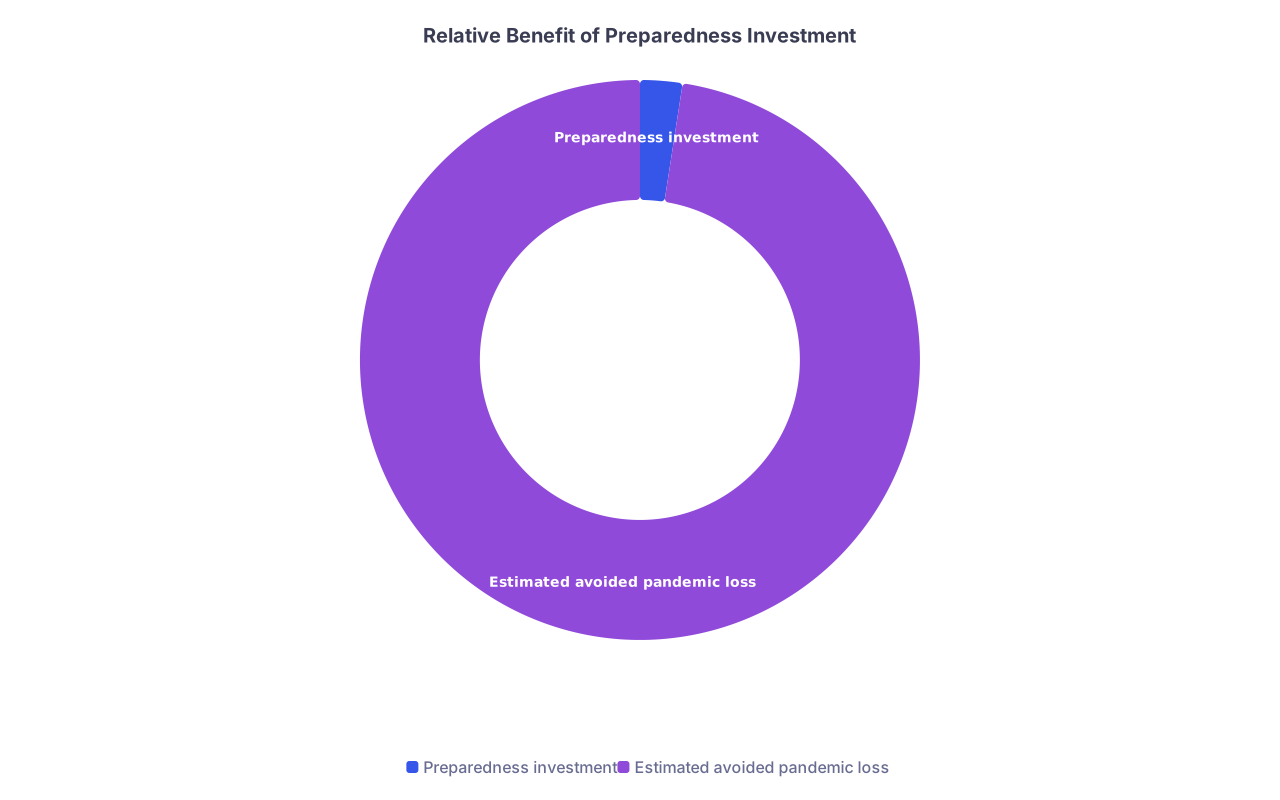
To put numbers on it: for a typical country, spending a few extra dollars per person per year on real preparedness can plausibly cut pandemic mortality by a third or more and avert economic losses worth dozens of times the investment. There are not many policy levers with that kind of multiplier.
For you—future clinician, policy maker, or both—that is the ethical math you are walking into.
| Category | Value |
|---|---|
| Preparedness investment | 1 |
| Estimated avoided pandemic loss | 40 |
Think of that doughnut as your world: one slim slice of steady, unglamorous investment; a massive ring of suffering and economic devastation that never happens because someone defended an “invisible” line item in a budget hearing five years earlier.
That is what public health funding buys when it is done right.
And if you are early in your career, that is the landscape you can help reshape. The hard part is not understanding the numbers. It is convincing societies to act on them before the next virus appears.
That, frankly, is the next phase of the story.