
You’re in a cramped office at the state capitol, badge still swinging from your neck, coffee going cold. You just finished walking a legislator through why a proposed bill on overdose prevention is half-baked. They nod, lean back, and then drop it:
“Okay, so how many overdose deaths in my district could this bill realistically prevent in the next two years?”
You freeze. Because you do not have that number. No one has that number. To estimate it would take a week, a data request, a biostatistician, and a favor from your state epidemiologist.
But you’re on the spot. Staff are watching. The legislator is clearly impatient. And a stupid part of your brain whispers: “Just give a ballpark…”
This is the line. Ethically and professionally. You either handle this well—build trust and maybe shape good policy—or you start down the road of bullshitting, which will eventually burn you.
Here’s how to handle it, step by step, when a legislator (or their staff) asks for data you do not have.
Step 1: Stop Trying To Impress Them
The biggest mistake I see: people panic and start approximating out loud.
“Well, statewide we have about X, and your district is about Y% of the state, so maybe…”
No. Do not do this on the fly in front of them. You are now guessing. And they will remember your guess as “what the doctor said,” then repeat it into a microphone. Congratulations, you’ve just become the source of a fake statistic.
Your first internal rule in these situations:
- I will not make up numbers
- I will not pretend I know what I do not know
- I will not let my ego push me into speculation dressed up as fact
You can be persuasive without having the exact statistic. But you cannot be credible if you fake it.
Step 2: Use a Clean, Confident “I Don’t Have That—Yet” Script
You need a stock sentence ready, because your brain will be busy managing anxiety.
Something like:
“Good question. I do not have district-level projections for that right now, and I don’t want to guess. What I can tell you is [relevant data you do have]. If you’d like, I can work with our data team to pull a district-specific estimate and get that to your office by [time].”
Or stripped down:
“I don’t have that specific number, and I do not want to mislead you. Here’s what we do know right now…”
Notice what that does:
- Admits the gap without sounding weak
- Signals you care about accuracy over ego
- Immediately pivots to what is known
- Offers a concrete follow-up, with a timeline
If you sound ashamed of not having the number, they’ll interpret it as unpreparedness. If you sound matter-of-fact—“that’s a reasonable question, and this is how real data works”—they’ll interpret it as professionalism.
Step 3: Move From “Exact Number” to “Decision-Useful Information”
Legislators often ask for a precise number when what they really need is a sense of scale or direction.
They say:
“How many deaths will this prevent in my district?”
What they actually need to know:
“Is this a trivial effect or a meaningful one for my constituents?”
“Is this worth spending political capital on?”
Your job is to translate.
Example pivot:
“I can’t tell you it’s exactly 37 deaths prevented in District 14, because prediction doesn’t work that cleanly. What I can tell you is this: in districts with similar rates and similar interventions, we’ve seen a 15–25% reduction in fatal overdoses over 3–5 years. In your district, that kind of reduction would mean moving from roughly [X] deaths per year to something closer to [Y]. That’s the order of magnitude we’re talking about.”
You’ve:
- Declined the fake precision
- Offered a range grounded in real data
- Made it local by tying the range to their known baseline
If they push for a single number, you can be blunt:
“If I gave you one number, it would be a guess dressed up as science. I’m not going to do that to you. What I can give you is a range and the confidence we have behind that range.”
Legislators respect that more than you think.
Step 4: Use the Data You Do Have—But Label the Boundaries Clearly
You almost never have nothing. You usually have:
- State-level data
- Regional data
- Trend data (past 5–10 years)
- Published literature from similar jurisdictions
- Model outputs with stated assumptions
The trick is to use these without quietly pretending they’re something else.
Bad:
“About 100 deaths in your district could be prevented.”
Better:
“At the state level, we’ve seen that when X intervention was scaled up, overdose deaths dropped by about 20% over three years. Your district currently has about 50 fatal overdoses per year. If your district followed that same pattern, we’d expect something like 10 fewer deaths per year. That’s an extrapolation, not a district-specific model, but it gives us a ballpark scale.”
You’ve kept the extrapolation visible. Ethically, that matters. If they quote you later, you can stand behind it.
Here’s how the “data you have vs data they want” usually looks:
| What You Have | What They Ask For |
|---|---|
| State-level rates, 5–10 yr trend | Exact district-level impact next 2 yrs |
| Published effect sizes from studies | Number of lives saved in *their* county |
| Model ranges with assumptions | Single precise number they can quote |
| Qualitative evidence from programs | Clean statistic for a talking point |
Your job is to stay in the left column, and translate responsibly toward the right without pretending they’re identical.
Step 5: Do Not Let Political Urgency Hijack Your Ethics
You will hear some version of this:
“Look, we just need something we can put in the talking points. Ballpark is fine. Off the record.”
Two things:
- There is no such thing as “off the record” for you in this context
- Your professional duty is to the truth and the public, not to their comms shop
You can still help them.
Response I use:
“I get that you need something succinct. Let me give you a line that’s accurate and still clear: ‘Based on state data and similar interventions elsewhere, experts expect this bill to meaningfully reduce overdose deaths, potentially by double digits per year in districts like mine.’ That’s honest, it’s supported by the evidence, and you’re not locked into a fake precise number.”
You’re giving them language, but you’re not laundering speculation into “facts.”
Step 6: Build a Simple On-the-Spot Triage in Your Head
You should have an internal algorithm for data questions. Otherwise you wing it, which is how people get in trouble.
Something like:

| Step | Description |
|---|---|
| Step 1 | Legislator asks for data |
| Step 2 | State number clearly with source |
| Step 3 | Say I do not know and offer follow up |
| Step 4 | Offer range and assumptions |
| Step 5 | Ask if they want written follow up |
| Step 6 | Do I know this from vetted source? |
| Step 7 | Can I estimate without misleading? |
If you haven’t seen the stat in a written, verifiable form that you remember, it’s a “No.” You do not know it. Full stop.
Then you decide: is there a responsible range you can describe? If not, you defer and follow up.
This mental flowchart keeps you from crossing into the grey zone of “I sort of remember reading something about…”
Step 7: Protect Yourself With Receipts and Follow-Up
Let’s say you did the ethical thing: you acknowledged not knowing, you gave what context you could, and you promised to follow up.
Now you actually have to follow up. And protect yourself.
Concrete steps:
Immediately after the meeting, jot down:
- Exact question they asked
- What you said you’d send
- Any ranges or caveats you mentioned
Email their staff that same day:
- “Thanks for the conversation. As discussed, I’ll send [data/summary] on [topic] by [date]. For now, based on existing state data, we know that…”
This locks in your caveats in writing.
- “Thanks for the conversation. As discussed, I’ll send [data/summary] on [topic] by [date]. For now, based on existing state data, we know that…”
When you send the data:
- Include the source (URL, citation, or agency name)
- State limitations right in the body, not buried in a footnote
- Explicitly separate fact from inference
Example language:
“Attached is the state-level data on X from 2018–2024. We do not currently have validated district-level projections for Bill 123. The estimate of ‘roughly 10 fewer deaths per year in a district like yours’ is an extrapolation based on [assumption A, assumption B].”
If they later distort it, you have documentation of what you actually said.
Step 8: Handle the “Can You Just Say…” Trap
At some point, someone will say something that makes your stomach drop.
“Could you say that this bill will cut overdose deaths by half?”
“Can we say this will save 100 lives a year?”
They’re asking you to put your professional authority behind a number you know is garbage.
Here’s the line you need ready:
“I can’t say that, because the evidence does not support that claim. If you want my name or my organization’s name associated with a statistic, it has to be something I can defend in front of a legislative committee or a reporter. ‘Meaningful reduction’ I can defend. ‘Cut in half’ I cannot.”
If they push:
“I’m here as a health professional, not as a political spokesperson. Once I start saying things that are not backed by evidence, I stop being useful to you in the long run.”
It feels confrontational. It is. But that’s the job.
Step 9: Know When to Say “The Data Don’t Exist Yet”
Sometimes the honest answer is not “I don’t have it,” it’s “No one has it.”
This matters when you’re dealing with:
- New interventions (e.g., statewide drug checking services)
- Emerging threats (new variants, new drug trends)
- Under-reported issues (intimate partner violence in certain populations, trans health trends, etc.)
Say it clearly:
“Right now, we do not have good data to answer that question. Not just in our state—anywhere. There are a few small studies that suggest [direction], but nothing that would justify a precise estimate. If you want better answers in the future, one of the best things this legislature could do is fund better surveillance and evaluation.”
You’ve turned the gap into a policy point: data infrastructure is also public health.
Step 10: Prepare a “Rapid Response” Toolkit So You’re Not Scrambling
If you keep walking into these situations unarmed, that’s on you.
You need a small, brutally practical toolkit:
A 1–2 page “Top 10 stats I trust” for your issue area, with:
- Exact numbers
- Clear definitions (e.g., “overdose death” vs “nonfatal overdose”)
- Sources, with year
A set of pre-vetted phrases:
- “State-level data show…”
- “In similar jurisdictions, this intervention led to…”
- “We can say with high confidence that…” vs “This is an early signal, not a firm conclusion.”
A go-to person for:
- Quick sanity checks on numbers (epidemiologist, biostatistician, analytic team)
- Getting district-level cuts if they exist
This is not about perfection. It’s about having enough ready that you rarely feel completely naked in those meetings.
Here’s a simple way to visualize how you spend your time as a policy-facing health professional:
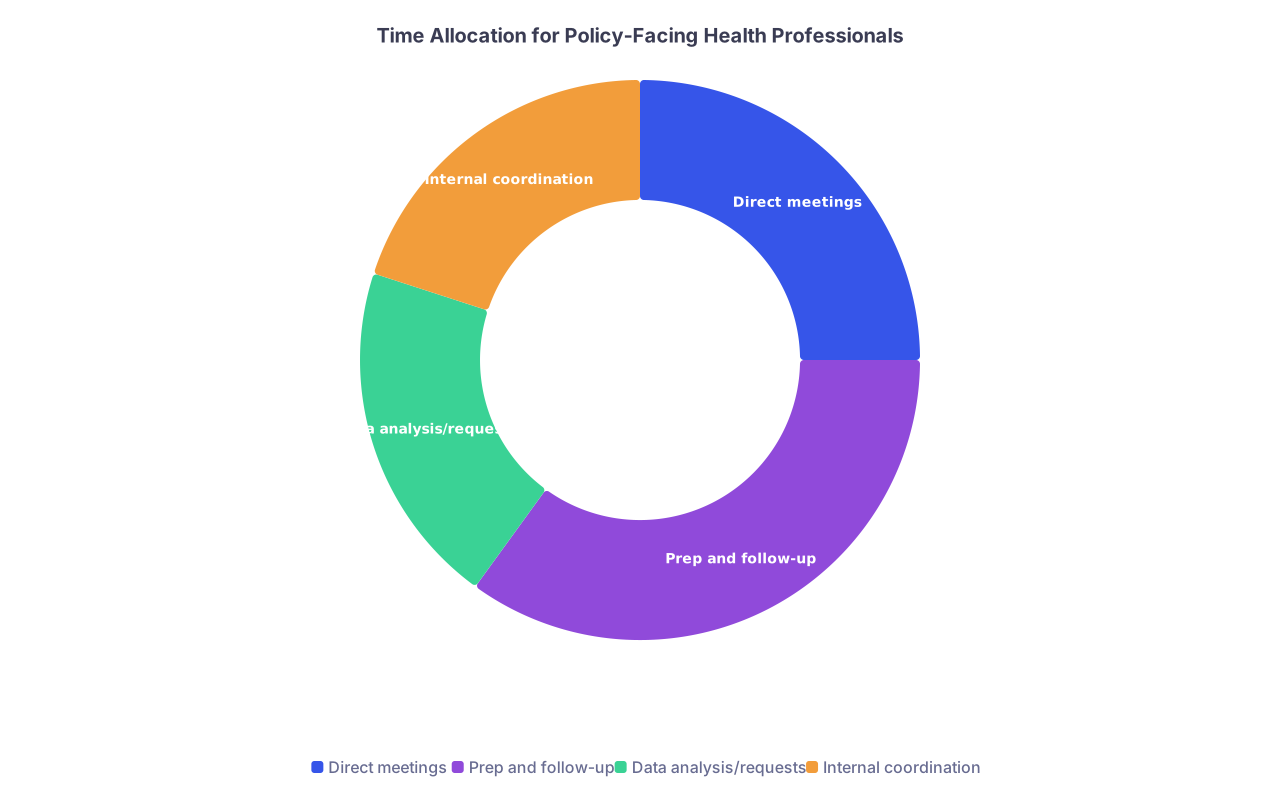
| Category | Value |
|---|---|
| Direct meetings | 25 |
| Prep and follow-up | 35 |
| Data analysis/requests | 20 |
| Internal coordination | 20 |
Most of the “not embarrassing yourself with data” work happens in that 35% prep/follow-up band. Not in the 25% of time you’re actually in the room.
Step 11: Balance Advocacy Passion With Data Discipline
You probably care deeply about the policy you’re discussing. Safe injection sites. Medicaid expansion. School-based mental health. Whatever it is, you believe it will save lives.
That passion can push you to oversell the numbers.
Common internal monologue: “I know this is good policy. If I slightly overstate the impact, and that gets it passed, I’m doing more good overall.”
Slippery slope. Classic ends-justify-the-means rationalization.
Here’s the line I use for myself:
- I can argue the direction forcefully (this reduces harm vs increases it)
- I can’t fabricate the magnitude
So:
“I am confident this will reduce overdose deaths.”
Yes.
“I am confident this will reduce overdose deaths by exactly 50% within two years.”
No, unless you actually have hard data to back that. (And usually, you don’t.)
Hold that line. Because once legislators discover you inflated one set of numbers, they’ll question every future number you bring. And they talk to each other.
Step 12: When You Truly Screw Up a Number—Fix It, Fast
You will eventually misstate something. Wrong year. Misremembered denominator. Old statistic you forgot was outdated. It happens.
The difference between ethical and unethical is how you respond after you realize it.
The playbook:
- As soon as you notice, confirm the correct data from a reliable source.
- Email the staff you met with:
- “I realized after our meeting that I misstated one statistic. I said X, but the correct, most recent figure is Y (source attached). Apologies for the error—I want to make sure you have accurate information.”
- If it was in a public setting (hearing, public briefing), send a brief correction to the committee staff or organizer.
This is mildly humiliating once. The alternative is slow reputational rot.
People actually respect visible corrections. It signals you care about truth more than being right.
Step 13: Recognize the Power Dynamic—and Don’t Abdicate Your Role
One more uncomfortable truth: legislators outrank you politically, but they do not outrank you on facts in your domain. That’s why you’re in the room.
You’re not a guest there to please them. You’re an expert there to inform them.
So when a legislator asks for data you don’t have, the real question is: are you going to let their urgency strip you of your standards, or are you going to hold the line on evidence?
That means sometimes saying:
“I can’t give you that number, but I can give you the best available evidence, with its limitations. If you need someone who’ll give you a specific number regardless of the truth, I’m not your person.”
Blunt, yes. But if you never draw that boundary, you’ll get used.
A Quick Concrete Example: Put It All Together
You’re testifying about a proposed syringe services program (SSP) expansion. After your prepared remarks, a senator asks:
“So, if we pass this, how many HIV infections will this prevent in our state over the next five years?”
A clean, ethical, effective response could be:
“Senator, I don’t have a precise five-year, state-specific projection, and I don’t want to make one up. Here’s what we do know:
In cities that expanded syringe services in line with CDC recommendations, we’ve seen reductions in new HIV infections among people who inject drugs on the order of 30–50% over several years. Right now, in our state, we’re seeing about 40 new HIV infections per year linked to injection drug use. If we achieved even the lower end of that range, that would mean preventing roughly a dozen infections per year. That’s a back-of-the-envelope extrapolation from other jurisdictions, not a formal model for our state, and I’d be happy to work with our epidemiology team to get you a more precise estimate.”
You’ve:
- Admitted the gap
- Used external data appropriately
- Localized it with transparent assumptions
- Offered a follow-up
That’s how a professional answers.
Your Next Concrete Step (Today)
Do something small but real right now:
Open a blank document and write three sentences:
- Your go-to “I don’t have that number and I don’t want to mislead you” line.
- Your go-to “here’s what we do know” pivot line.
- Your go-to “let me follow up by [date] with district-specific data” commitment line.
Save it somewhere you’ll actually see before your next meeting or hearing. Practice saying them out loud once.
Next time a legislator asks for data you don’t have, you won’t freeze. You’ll reach for those lines, stay honest, and still be useful. That’s the job.