
You are here
You’re a resident. Somewhere between PGY-1 and PGY-3.
You keep seeing calls for “physician voices in public health policy.” Your inbox has invites from the hospital quality committee, the county medical society, and some advocacy group asking you to sign a letter, join a task force, or testify about prior auth insanity.
And you’re wondering:
When do I actually start saying yes?
PGY-1? PGY-3? Fellowship? Attending only?
Here’s the blunt answer:
There are leadership roles you should absolutely take on as a PGY-1.
There are others you have no business touching until PGY-3 (or later).
The trick is matching the scope of leadership to your stage of training.
We’ll walk this like a real timeline: year-by-year, then zooming into decision points.
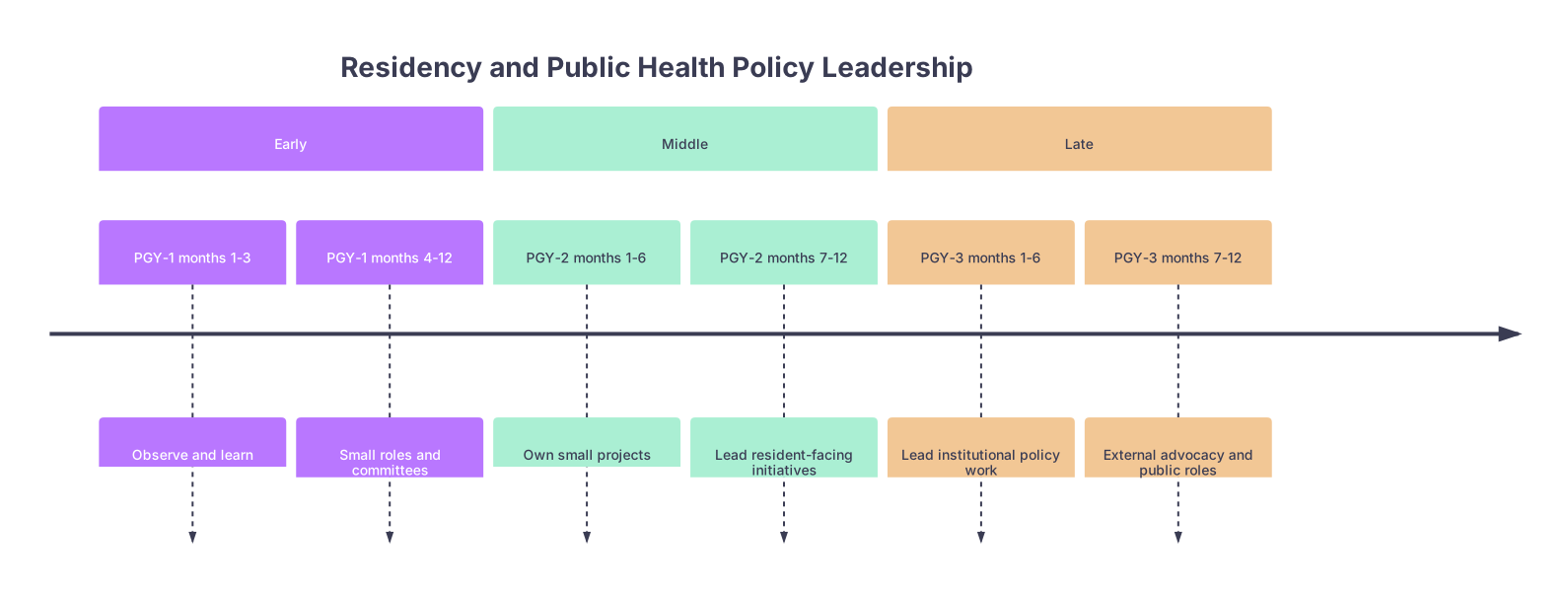
| Period | Event |
|---|---|
| Early - PGY-1 months 1-3 | Observe and learn |
| Early - PGY-1 months 4-12 | Small roles and committees |
| Middle - PGY-2 months 1-6 | Own small projects |
| Middle - PGY-2 months 7-12 | Lead resident-facing initiatives |
| Late - PGY-3 months 1-6 | Lead institutional policy work |
| Late - PGY-3 months 7-12 | External advocacy and public roles |
Big picture: what “leadership in public health policy” actually means
Before the timeline, anchor the categories. When people say “get involved in policy,” they’re not all talking about the same thing.
At the resident level, it usually falls into a few buckets:
Hospital / system policy
- Clinical protocols, quality improvement, infection control, discharge planning
- Committees like antimicrobial stewardship, sepsis, maternal mortality review
Education and training policy
- Duty hour changes, wellness initiatives, curriculum around addiction, gun violence, etc.
Local or state public health
- Health department working groups (e.g., overdose task forces, vaccination campaigns)
- City or county boards, advisory panels
Professional organizations / advocacy
- AMA, ACP, AAP, ACEP, specialty societies’ advocacy arms
- Writing resolutions, position statements, organizing lobby days
Public-facing influence
- Media interviews, op-eds, social media advocacy, speaking at public hearings
You don’t jump into all of these at once. Or you’ll drown. And you’ll probably be bad at all of them.
So let’s break it down.
PGY-1: Months 1–3 – Do not “lead” anything yet
First three months of intern year? You’re leading exactly one thing: your own survival.
At this point you should:
Say no to:
- Chairing anything
- Being “resident lead” on a hospital-wide policy project
- Signing up as your program’s official rep for some big external coalition
Say yes to:
- Listening and watching:
- Hospital grand rounds on public health topics (e.g., overdose policy, firearm injury prevention)
- M&M conferences where system failures get dissected
- Short, low-commitment tasks:
- One-off advocacy days (e.g., your state medical society’s “doctor day at the capitol”)
- Attending—not running—local health department or community meetings
- Listening and watching:
Your job in Q1 of residency is to understand:
- How decisions actually get made in your hospital
- Who holds power (CMO, CNO, QI director, GME office, union, etc.)
- How policy hits the front line: prior auth, discharge delays, consult bottlenecks, code status confusion
If someone offers you a committee slot as a voting member in these first 3 months, the correct response is usually:
“I’d love to observe for a few meetings first and see where I can be useful later in the year.”
PGY-1: Months 4–12 – Take on micro-leadership in policy
Once you’re not drowning on every call night, you can start taking on very small leadership roles. Think influence, not control.
At this point you should prioritize resident-facing and narrowly scoped policy work.
Safe PGY-1 leadership roles (good ideas)
Residency-level committees
- Wellness, scheduling, night float redesign, curriculum changes
- You’re not crafting state law; you’re helping decide how your program runs
QI projects with a clear public health angle
- Reducing unnecessary telemetry
- Improving post-discharge follow-up for heart failure or COPD
- Increasing HIV or HCV screening rates in the ED
You can be:
- Project co-lead with a senior resident or faculty
- The “intern champion” who presents data at noon conference
Policy-adjacent tasks
- Drafting resident comments on new EHR workflows
- Helping survey housestaff about barriers to vaccinations, buprenorphine prescribing, or naloxone use
Where PGY-1s go wrong is by saying yes to things like:
- “Can you be the resident representative on the hospital-wide sepsis guideline redesign?”
- “We need you as the main clinician voice for the county overdose policy task force.”
Without time, clout, and systems understanding, you become the powerless “token trainee” in the room. You get used, not heard.
So your rule for late PGY-1:
Micro-leadership only. If the project fails because you get slammed with ICU nights, the institution should still be fine.
PGY-2: Early (Months 1–6) – Start owning something small
Now you’re not new anymore. You know the annoying consultants, the broken discharge pathways, the insane prior auth hoops. You’re dangerous—in a good way.
At this point you should:
- Choose one policy-adjacent lane for the year. Not three. One.
Common lanes for PGY-2:
Clinical + public health intersection
- Example: You’re in EM. You lead a project to implement universal screening and fast-track linkage to care for OUD or IPV.
- Example: You’re in IM. You take charge of improving inpatient vaccination rates with an opt-out policy.
Education policy
- You redesign how your program teaches addiction medicine, health equity, or climate and health.
- You lead a PGY-1 orientation module about structural determinants of health and local resources.
Hospital operational policy
- You join (and show up consistently for) a meaningful committee:
- Antimicrobial stewardship
- Readmissions reduction
- Maternal mortality / morbidity review
- You don’t chair it yet. But you own one specific workstream.
- You join (and show up consistently for) a meaningful committee:
What “owning something” looks like in early PGY-2
You’re responsible for a specific, bounded deliverable, like:
- “By June, we’ll have a standardized naloxone at discharge order set live in the EHR.”
- “By block 6, PGY-1s will all have a new curriculum module on community resources for food insecurity.”
You present:
- At residency conference
- Maybe at a hospital QI meeting
- Potentially as a poster at a regional meeting
You’re still not the face of a citywide or statewide movement. That comes later, if you still want it.
PGY-2: Late (Months 7–12) – Resident-level leadership, early external steps
Now you’re in the sweet spot for real leadership that touches policy. You’re senior enough to understand the system and junior enough to still have protected time and faculty support.
At this point you should seriously consider:
Becoming a formal resident leader in one or two of these:
- Chief resident-elect–like roles (where they exist)
- Resident representative to the hospital GME committee
- Lead resident for DEI, quality/safety, or advocacy
Taking a defined role in your specialty society
- AAP Section on Med Students/Residents/Fellows
- ACP Council of Resident/Fellow Members
- ACEP or EMRA health policy committees
- AMA Resident and Fellow Section
These are where you start touching:
- Position statements on public health issues
- Testimony drafts
- Resolutions about gun violence, reproductive health, climate, immigrant health, etc.
You’re not writing federal regulations, but you are part of the pipeline that shapes them.
Guardrails so this does not wreck your training
At late PGY-2, time is your main bottleneck. The mistake I see over and over: someone tries to do all of this at once:
- QI project
- Local advocacy work
- A national committee
- Social media activism
They end up exhausted, resentful, and mediocre at all four.
So build yourself a quick decision filter:
| Question | If the answer is "No"… |
|---|---|
| Does this align with my top 1–2 public health interests? | Decline. |
| Is there a clear senior/faculty sponsor? | Decline. |
| Is there a defined end point or product? | Push back or decline. |
| Can this tolerate me disappearing for a bad ICU month? | If not, decline. |
If a role fails two or more of those, it’s probably not for you right now.
PGY-3: Early (Months 1–6) – This is where real leadership should kick in
This is usually the best window to take on bigger roles. You know the system. You have credibility. You can speak fluently about what’s broken and what might actually work.
At this point you should look at broader-scope leadership roles, for example:
1. Hospital / system-level policy leadership
Good fits for PGY-3:
Co-chairing a hospital committee focused on:
- Readmission reduction for a key condition
- Social needs screening and referrals
- Opioid stewardship
- ED boarding / throughput (with equity and safety lens)
Being the resident lead for:
- A new EHR build that standardizes public-health-critical processes (e.g., safe opioid prescribing, STI treatment workflows)
- Implementing a hospital protocol aligned with new state or federal regulations (e.g., buprenorphine rules)
2. Local public health infrastructure
You’re finally in a position where your presence is useful, not token.
Examples:
- Official member of a county overdose prevention task force
- Physician representative in a city vaccine outreach working group
- Liaison between your hospital and the local health department on:
- TB control
- Homeless health initiatives
- Migrant health efforts
You’re still a trainee. You must be clear about that. But your frontline experience gives you something many “policy people” lack: reality.
3. Specialty and state/national advocacy bodies
PGY-3 is prime time for:
Holding a vice-chair or chair role in:
- A national resident/fellow council
- A state medical society resident section
- A specialty organization’s health policy subcommittee
Leading:
- A resolution on a pressing public health concern
- A working group to draft or update a position statement about:
- Firearm injury prevention
- Climate and health
- Reproductive health access
- Substance use policy
- Carceral health
Here you transition from “person who helped” to “person whose name is on this.”
PGY-3: Late (Months 7–12) – Public visibility and high-stakes advocacy
End of PGY-3 is where your potential policy leadership can start affecting people far beyond your hospital.
At this point you should very deliberately choose if you want public-facing roles yet.
Roles that make sense in late PGY-3
Testifying at:
- State legislature hearings
- City council or county board meetings
- Health department public hearings
Media engagement, with support:
- Writing op-eds in local or national outlets
- Participating in press conferences for major policy initiatives
- Interviews about policies that directly affect your patients (e.g., Medicaid changes, overdose response)
Leading coalitions, not just attending:
- Multi-institution resident coalition on reproductive rights access
- Cross-hospital group on gun violence prevention data sharing
- Interdisciplinary group on climate resilience in your health system
You’re no longer “just a resident” in these roles. You’re a recognizable voice. Which can be powerful, and risky.
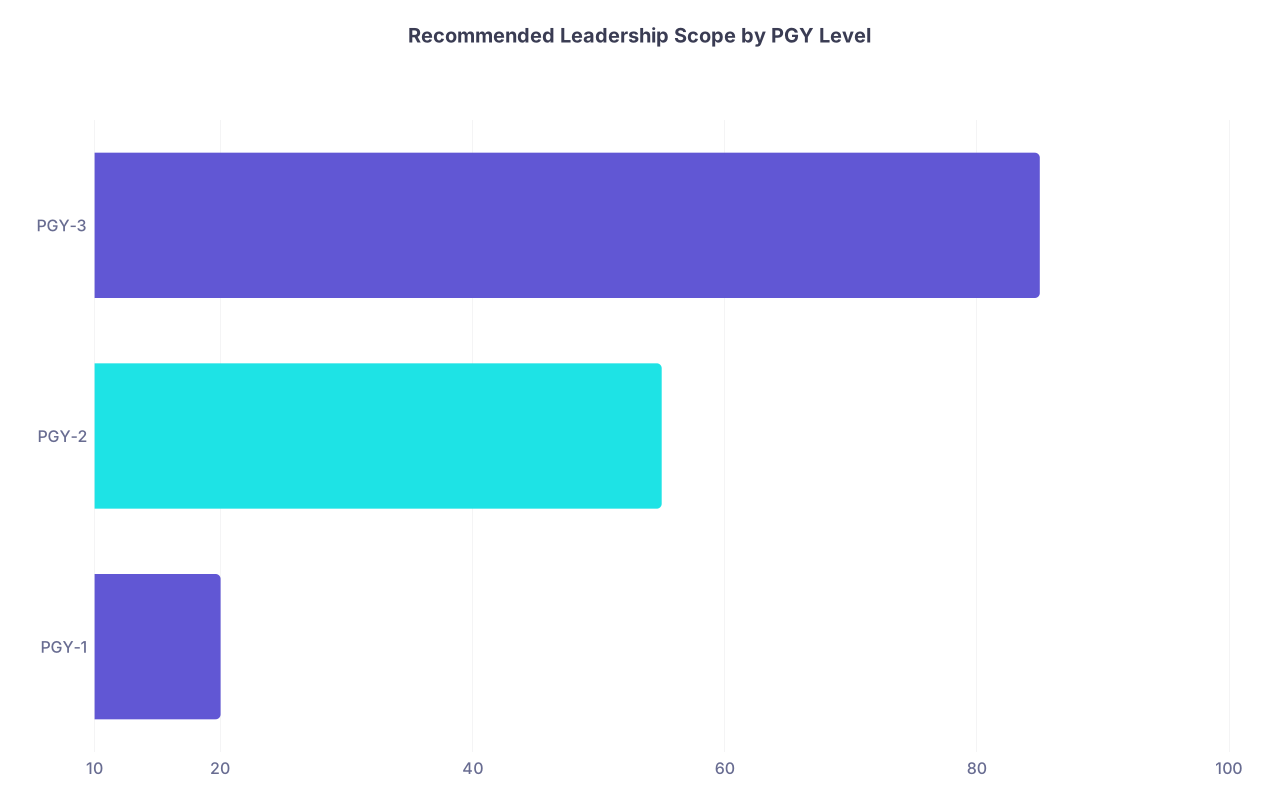
| Category | Value |
|---|---|
| PGY-1 | 20 |
| PGY-2 | 55 |
| PGY-3 | 85 |
How to decide: PGY-1 vs PGY-3 for any specific opportunity
Residents always ask: “Should I take this particular role right now?”
Use this quick mental timeline filter.
If you’re PGY-1 and offered:
- Chair of a hospital-wide committee → No. Ask to shadow or be a regular member.
- Resident rep to the local health department overdose coalition → Maybe later. Ask if you can attend a few meetings, then reconsider in PGY-2.
- Small QI project with clear scope (screening rates, discharge education, etc.) → Yes, with a senior partner.
- A talking-head media spot as “expert” on some law → No. Defer to faculty, maybe help with background.
If you’re PGY-3 and offered:
- Leadership in a major policy initiative that overlaps your career interests → Strongly consider yes.
- Public testimony or high-visibility role → If you have institutional backing and enough prep time, yes.
- Another random committee with no clear product → Still no. Being PGY-3 does not mean saying yes to nonsense.
Ethics: What you should and should not do at each stage
Public health policy isn’t just “be loud.” It’s ethics, power, and representation.
PGY-1 ethical guardrails
At this point you should not:
- Present yourself as a subject-matter expert on complex policy questions
- Take positions that your patients would clearly oppose if they heard your reasoning was shallow
- Commit to public stances you haven’t actually studied
You can ethically:
- Speak about your patients’ lived experiences (without identifying details)
- Describe frontline barriers: access to meds, follow-up, insurance, language, transport
- Support more senior colleagues’ well-researched positions
PGY-2 ethical responsibilities
Now you’re more accountable.
You should:
- Start reading beyond Twitter. Actual white papers, guidelines, law summaries.
- Be honest about:
- What is data
- What is your clinical experience
- What is your personal value judgment
You still defer on high-complexity, high-stakes issues where you’ve done no homework, but you aren’t silent when something directly harms your patients.
PGY-3 ethical weight
By PGY-3, if you choose leadership roles, your words carry weight.
You should:
- Be transparent about your training level in public forums
- Avoid overselling your “expertise” where senior colleagues or community leaders should lead
- Partner with affected communities rather than “speaking for” them
- Push back when institutions try to use you as moral cover without meaningful change (this happens a lot—“look, residents support this!”)
And you need to face a simple fact: your name on something will follow you into fellowship or attending life. Treat signatures and titles as permanent.
Practical year-by-year checklist
PGY-1 Checklist
By the end of PGY-1, aim for:
- You can name 3–5 policy failures harming your patients.
- You’ve attended at least 1–2 relevant:
- Hospital QI/policy committees
- Local public health or advocacy events
- You’ve contributed to one small QI or policy-adjacent project.
- You’ve not taken on any role that depends on you for institutional continuity.
PGY-2 Checklist
By the end of PGY-2, aim for:
- You own one clearly defined project with a public health policy angle.
- You hold a real role (not just “name on a list”) in:
- A residency committee, or
- A hospital committee, or
- A professional organization’s trainee group.
- You’ve presented your work at least once:
- Residency conference
- Hospital QI forum
- Regional/national meeting
- You can clearly say: “My policy interests are mainly in X and Y.”
PGY-3 Checklist
By the end of PGY-3, if you want a serious policy career, aim for:
- You have held at least one formal leadership title tied to policy/QI/advocacy.
- You’ve had one meaningful role in:
- Institutional policy (hospital/system), or
- Local/state public health work, or
- A national specialty/medical organization.
- You have at least one tangible output:
- Protocol or pathway adopted
- Resolution or position statement
- Policy-related publication, op-ed, or major presentation
- You have 1–2 mentors in public health policy who actually know your work, not just your name.
Final takeaways
- PGY-1 is for micro-leadership and learning, not for chairing major policy efforts.
- PGY-2 is for owning a small, focused project and stepping into structured roles with clear mentorship.
- PGY-3 is when you should take on real institutional or public-facing leadership—if you’ve done the groundwork and you’re willing to carry the ethical and time burden that comes with it.