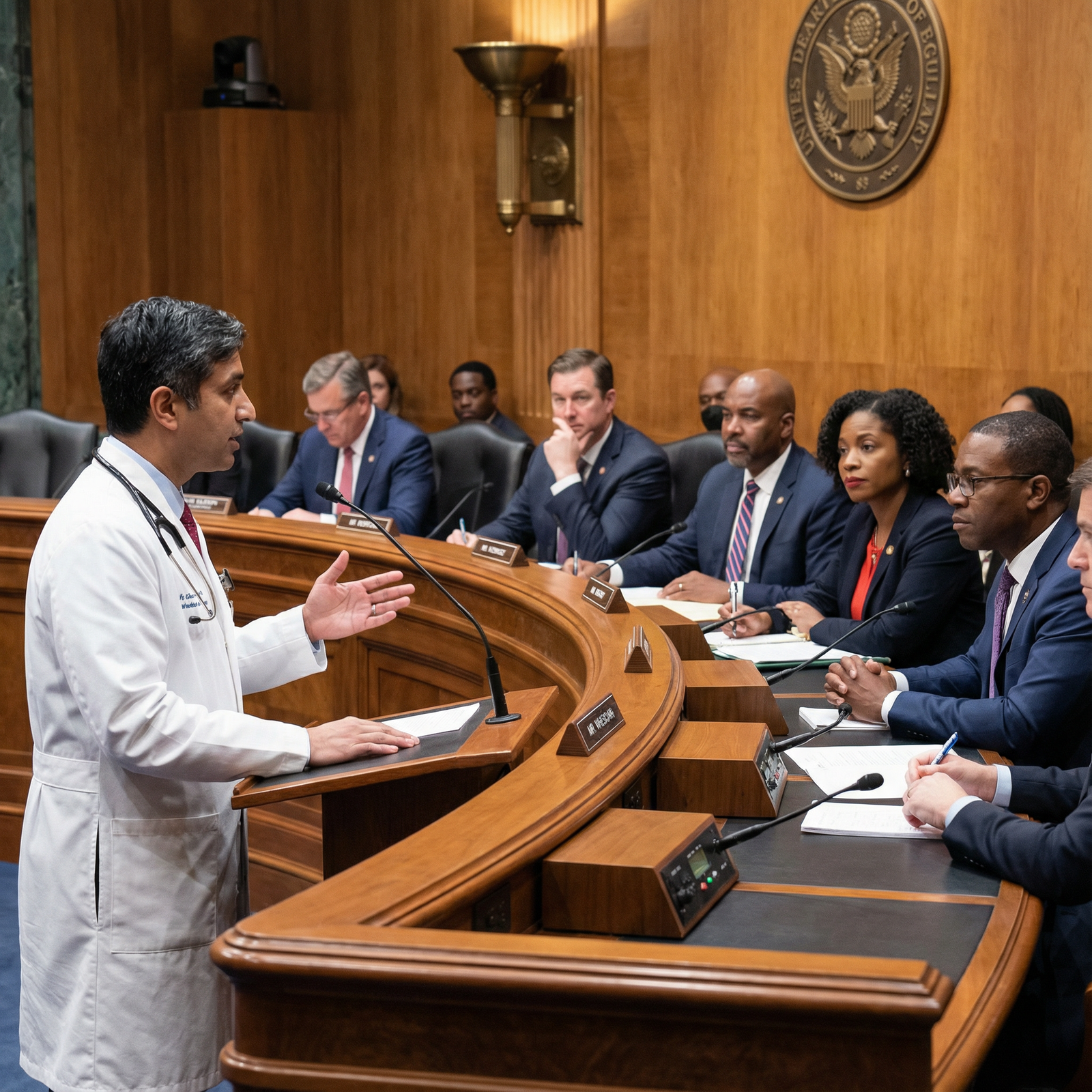
The way most hospitals run M&M conferences wastes 80% of their safety potential.
You get smart people, real harm events, and honest discussion. Then the meeting ends, everyone goes back to work, and nothing structural changes. Maybe a reminder email. Maybe a new checkbox. Then the same theme shows up again three months later.
You want to stop that cycle? You have to treat M&M like a policy engine, not a confession booth.
This is the playbook for turning recurring M&M themes into concrete, system-level safety policy changes that actually stick.
Step 1: Clean Up the Front End – Design M&M to Produce Actionable Themes
If your M&M is mostly storytelling and blame, you will never get good policy out of it. You will get drama, defensiveness, and rituals.
You need three structural changes.
1. Standardize the case format
Every M&M case should answer the same questions, in the same order, every time. That makes patterns obvious and policy work possible.
Use a bare-bones template:
- Brief case summary (3–5 sentences)
- Timeline of key events (with times)
- What went wrong (clinical and system factors)
- What went right (safety nets that helped)
- Contributing factors (categorized: human, communication, equipment, environment, policy)
- Which of these are:
- Individual/knowledge issues
- Local workflow issues
- Organization-level system issues
- Existing policies or guidelines that should have applied
- Potential system fixes (from the presenter)
You do not need a 20‑page root cause analysis for every case. You do need the same skeleton every time.

| Step | Description |
|---|---|
| Step 1 | Select Case |
| Step 2 | Assign Presenter |
| Step 3 | Fill Standard Template |
| Step 4 | Review with Faculty |
| Step 5 | Identify System Issues |
| Step 6 | Add Draft Recommendations |
2. Track themes deliberately, not by memory
If your “theme recognition” is just senior people saying, “We see this a lot,” you are guessing.
Create a simple tracking system. It can be a spreadsheet. Do not over-engineer it; just make sure it is used.
For each M&M case, log:
- Date
- Service/department
- Brief title (e.g., “Delayed recognition of sepsis,” “Anticoagulation dosing error”)
- Primary harm type (diagnostic, medication, procedural, communication, handoff, equipment)
- Contributing factor categories (tick boxes)
- Whether this theme has appeared before
- If yes, how many times in last 12–24 months
| Field | Example Entry |
|---|---|
| Service | General Surgery |
| Primary Harm Type | Handoff |
| Contributing Factors | Communication, Policy, Environment |
| Repeated Theme? | Yes |
| Count Last 12 Months | 4 |
| Related Policy Exists | Yes / No |
One person owns this file. Usually the M&M chair or a quality/safety liaison. Ownership matters; “shared responsibility” means “nobody actually does it.”
3. Separate “clinical learning” from “system learning”
Most M&Ms drift into clinical teaching: “Next time, remember to order X test.” Fine for education. Useless for system change.
You need an explicit pivot in each discussion:
- First half: Clinical management and medical decision-making
- Second half: System factors and preventable patterns
Literally have a slide that says:
“SYSTEM FACTORS – WHAT IN THE SYSTEM MADE THIS MORE LIKELY?”
Force the room to answer that question before discussion ends.
Step 2: Convert Themes into a Prioritized Policy Problem List
Raw themes are not enough. “Communication issues” might show up in 70% of cases. That is too vague to act on.
You need to translate themes into a problem list that policy can actually address.
1. Aggregate and translate
Every 3–6 months, pull your M&M theme log and ask three ruthless questions:
- What keeps showing up?
- Of those, which cause serious harm or near misses?
- Of those, which are realistically modifiable by policy or system changes?
You end up with a list that sounds like:
- Inconsistent escalation when vital signs deteriorate overnight
- Unreliable closed-loop communication on critical lab results
- Variable anticoagulant dosing in patients with renal impairment
- Inadequate handoff documentation during weekend coverage
Each of those can be tied to:
- A policy that exists but is ignored
- A policy that is vague, outdated, or incomplete
- A missing policy / process
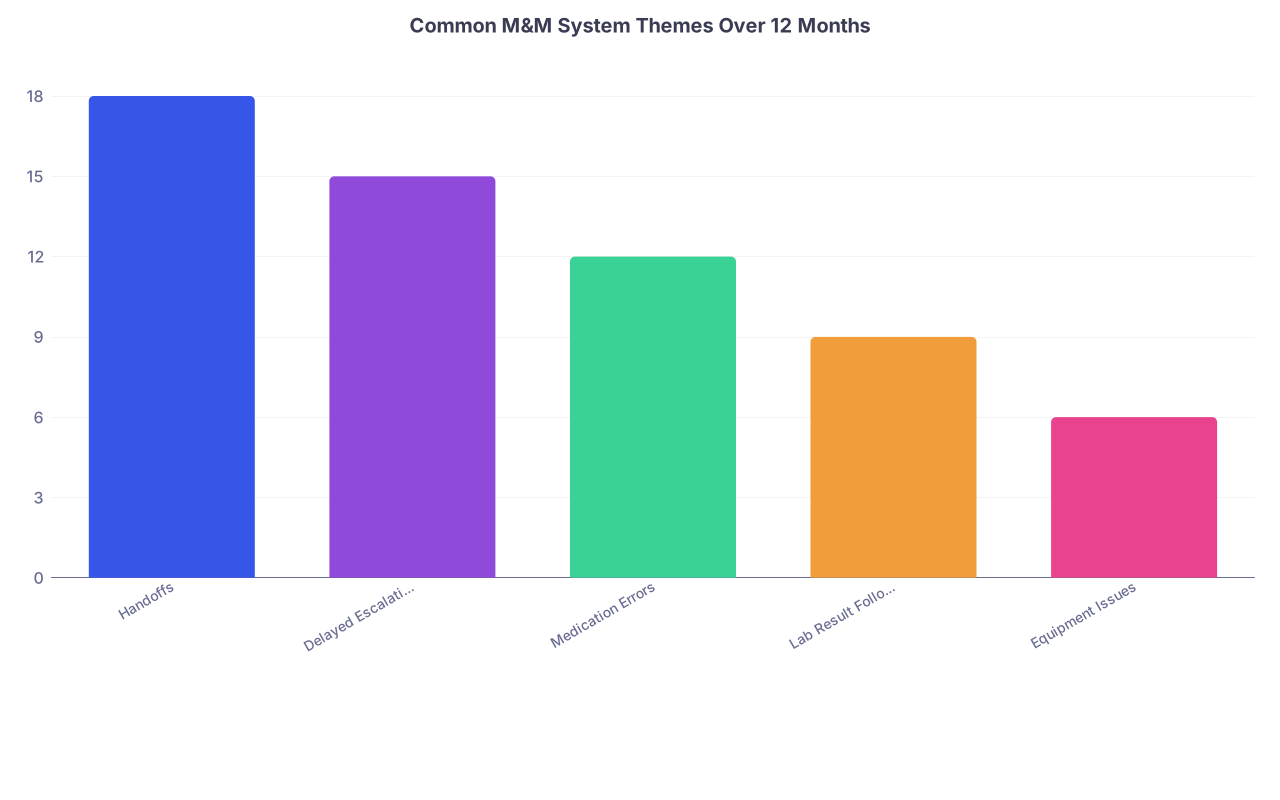
| Category | Value |
|---|---|
| Handoffs | 18 |
| Delayed Escalation | 15 |
| Medication Errors | 12 |
| Lab Result Follow-up | 9 |
| Equipment Issues | 6 |
2. Prioritize with a simple matrix
Do not try to fix everything at once. You will burn people out and dilute impact.
Use a crude but effective two-axis approach:
- Axis 1: Harm impact (high / medium / low)
- Axis 2: Feasibility of change (high / medium / low)
You want to focus on:
- High harm + high feasibility (top priority)
- High harm + medium feasibility (next)
- Medium harm + high feasibility (good early wins)
Skip low harm + low feasibility. Those become research projects, not policy changes.
Write this into a one-page “M&M Safety Priority List,” updated every 6–12 months. This is your to‑do list for system-level policy work.
Step 3: Build a Formal Pipeline from M&M to Policy
If this step is missing, everything else is performative. You can have brilliant insights in M&M and still change nothing.
You need a defined, boring, bureaucratic pipeline. Yes, bureaucracy. That is how hospitals actually change.
1. Define handoff points and owners
Every institution needs a clear answer to:
“When an M&M reveals a system problem, who owns turning that into a policy proposal, and where does it go?”
Typical structure:
- M&M Conference → Service Quality/Safety Committee → Hospital Patient Safety / Quality Council → Policy & Procedures Committee → Medical Executive / Governing Body
Spell it out. Map it.

| Step | Description |
|---|---|
| Step 1 | M&M Conference |
| Step 2 | Service Quality Committee |
| Step 3 | Hospital Safety Council |
| Step 4 | Policy Committee |
| Step 5 | Medical Executive Committee |
| Step 6 | Implementation Teams |
Then assign roles:
- M&M Chair: Identifies cases with policy implications, sends a one-page summary.
- Service Quality Rep: Drafts or refines proposed change, coordinates with stakeholders.
- Hospital Safety Council: Prioritizes, ensures alignment across services.
- Policy Committee: Edits language, ensures consistency with regulations.
- Exec Committee: Approves.
If you do not know who sits on each of these bodies in your hospital, find out. That is professional responsibility if you care about patient safety, not “administrative trivia.”
2. Standardize “M&M to policy” documentation
For every theme worthy of policy work, you should be producing the same document type: a short, structured “M&M-Initiated Safety Change Proposal.”
Keep it to 1–2 pages:
- Title of proposed change
- M&M cases that motivated it (case IDs / dates, not PHI)
- Problem statement:
- What is happening?
- Who is affected?
- Evidence:
- M&M frequency, brief summary
- Any external evidence/guidelines (NPSG, specialty society guidelines, etc.)
- Proposed policy or process change:
- Specific behaviors required
- Where it will be documented (policy manual section, order set, checklist)
- Impact estimate:
- Expected effect on harm, workflow, costs
- Stakeholders to involve:
- Departments, nursing, pharmacy, IT, etc.
- Metrics for success:
- What will we measure after implementation?
If you cannot define the policy in that format, you are probably still dealing with an educational issue, not a system issue.
Step 4: Design Policies that Actually Change Behavior
Most safety policies fail because they tell people what they already know, add steps without removing others, or fight the EHR instead of using it.
You want policies that:
- Are specific
- Are embedded in the workflow
- Are easy to audit
- Are resistant to quiet erosion over time
1. Move away from “be more careful” language
Bad policy language:
- “Providers should carefully review lab results.”
- “All staff are expected to communicate effectively.”
- “Residents must escalate care appropriately.”
That is moralizing, not policy. It changes nothing.
Instead, write behavioral specifics:
- “Critical potassium results (≤ 2.5 or ≥ 6.5) must be verbally communicated from lab to the responsible clinician within 15 minutes. The clinician must document receipt and action plan in the EHR using the ‘Critical Lab’ template.”
- “For deteriorating patients with MEWS ≥ X, the nurse will page the on-call resident and activate the rapid response team if there is no response within 5 minutes.”
If you cannot turn it into an audit question—“Did X happen within Y time?”—it is not a good policy.
2. Embed in tools, not just PDFs
Policy that lives in a binder or intranet is aspirational. Policy that lives in your orders, notes, and handoff tools is real.
For example, if M&M repeatedly shows missed DVT prophylaxis post-op, do not just email a reminder. You:
- Modify surgical order sets to:
- Default to appropriate prophylaxis
- Require an explicit opt-out reason
- Add a nursing checklist item to verify prophylaxis is ordered within 24 hours
- Build a daily automated report of patients without prophylaxis when indicated
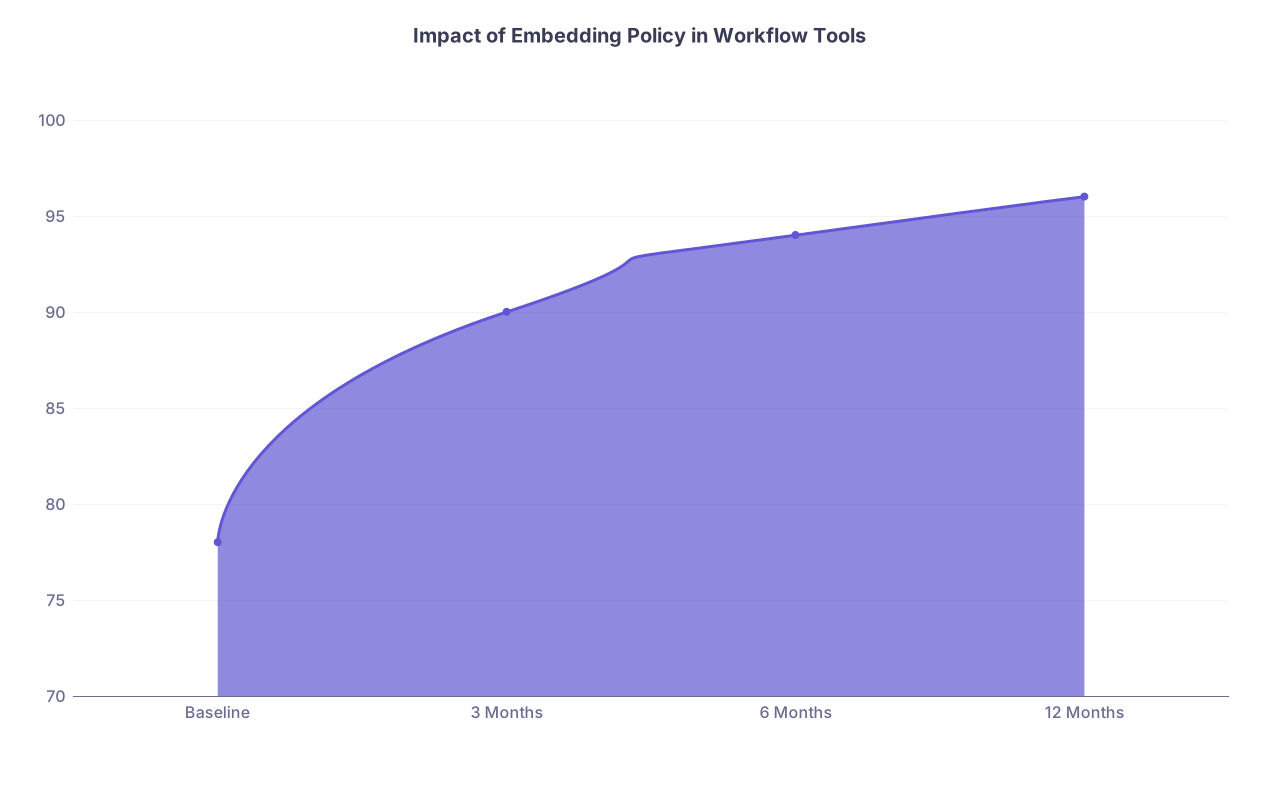
| Category | Value |
|---|---|
| Baseline | 78 |
| 3 Months | 90 |
| 6 Months | 94 |
| 12 Months | 96 |
(Values could represent percent of eligible patients receiving proper prophylaxis.)
Same logic for handoffs, escalation pathways, consent processes, timeouts, etc.
3. Design for the worst day, not the best day
I have seen too many policies written as if everyone on the floor is fully staffed, well-rested, and experienced.
That is fantasy.
When you build a policy based on M&M themes:
- Assume people are tired.
- Assume staffing is thin.
- Assume interruptions are constant.
- Assume the newest person on the team will have to follow it.
That means:
- Clear triggers (“If X, then do Y.”)
- Simple escalation chains (no guessing who to call)
- Redundancy where stakes are high (double checks, alerts)
- Minimal dependence on heroic memory
However, resist the urge to patch every failure mode with a new required field or checkbox. That is how you create checkbox fatigue and shadow work.
Every new requirement should come with at least one thing you remove or simplify. Net behavioral load matters.
Step 5: Close the Loop – Ethics, Culture, and Feedback
You cannot ethically ask clinicians to expose their worst outcomes in M&M, then ignore the system issues that put them there. That is moral injury dressed up as education.
Turning themes into policy is partly technical and partly ethical.
1. Commit to non-punitive, system-focused framing
This does not mean nobody is ever accountable. It means you start with the system.
Examples of wrong responses:
- “We will write up the resident who missed the lab result.”
- “We will remind people again to read the policy.”
- “We will document that the nurse failed to escalate appropriately.”
Compare that to:
- “Our process for communicating critical labs allows silent failures; we need a mandatory verbal handoff and documentation standard.”
- “Our escalation thresholds are unclear and vary by service; we need a unified, cross-service escalation protocol.”
Ethically, if leadership only uses M&M to find individuals to discipline, you have a broken safety culture, and policy will not fix that. People will simply stop talking.
2. Give visible feedback on what changed because of M&M
If people never see the downstream effects, they stop investing emotionally.
Create a simple “You spoke, we acted” feedback loop:
- Once or twice a year, share:
- “From last year’s M&M, here are 4 policies/processes that changed.”
- “Here is what we are tracking to see if it worked.”
- For each, link back to specific M&M themes:
- “Multiple M&M cases showed delayed escalation for high-risk obstetric patients. In response, we implemented…”
This is not PR work. It is moral closure. It also turns M&M into a visible driver of system improvement, which makes attendance and honesty feel more meaningful.

3. Integrate this into professional identity formation
You are in the personal development and ethics lane here, whether you like it or not.
For trainees:
- Make participation in M&M-linked quality projects part of their evaluation or portfolio.
- Explicitly teach:
- The pathway from incident → M&M → theme → policy → practice.
- Expect senior residents/fellows to:
- Co-author at least one M&M-derived improvement proposal.
- Present follow-up data when possible.
For attendings:
- Normalize that part of being a “good doctor” is:
- Knowing your institution’s major safety priorities.
- Contributing cases and ideas that feed into those.
- Participating in policy refinement.
If professionalism stops at clinical bedside behavior and never touches system stewardship, you are training technicians, not physicians.
Step 6: Measure, Adjust, and Avoid the Two Classic Traps
Once you start turning M&M themes into policy, you will hit two predictable problems:
- Nothing seems to change.
- Or, everything becomes “add a policy” even when culture or staffing is the real issue.
You can avoid both if you are disciplined.
1. Define specific metrics for each policy linked to M&M themes
For every M&M‑driven policy, define:
- One process measure (did we do the thing?)
- One outcome measure (did it help?)
Examples:
New escalation policy
- Process: Percent of rapid responses called according to trigger criteria.
- Outcome: Time from documented deterioration to ICU transfer.
New handoff standard
- Process: Percent of handoffs using structured template.
- Outcome: Number of handoff‑related safety events.
New anticoagulation dosing guideline
- Process: Percent of doses ordered according to protocol.
- Outcome: Incidence of supratherapeutic INR–related bleeding events.
You do not need perfect data. You need enough signal to know if the direction is right.
Then, bring that data back to M&M at least annually:
- “Here is a theme we saw.”
- “Here is the policy we implemented.”
- “Here is what changed since.”
That reinforcement cycle matters.
2. Watch for policy bloat and misdirection
A bad safety culture has a simple reflex: “Something bad happened? Write a new policy.”
This leads to:
- Policy manuals nobody reads.
- Contradictory rules.
- Wide gaps between written policy and actual practice.
- Cynicism.
You combat this with three constraints:
No new policy without a clear owner
- Someone responsible for education, monitoring, and review.
No new requirement without subtracting something
- Reduce redundancy.
- Remove outdated steps.
- Simplify documentation.
No policy fix for a staffing problem
- If the real issue is chronic understaffing or impossible workloads, writing a new policy is dishonest.
- Use M&M data to make the case for resource changes, not to protect leadership with more paper.

Step 7: A Practical Mini-Protocol You Can Start This Month
You may not control your institution’s entire governance structure. But you can start a small, disciplined experiment on your own service.
Here is a 90‑day micro‑protocol.
Weeks 1–2: Set up the structure
Create:
- A one-page M&M case template.
- A simple theme tracking spreadsheet.
At your next M&M:
- Use the template.
- Log the theme.
- Explicitly label system versus individual factors on the last slide.
Weeks 3–6: Start recognizing themes
After 3–4 M&Ms:
- Review the log with one faculty colleague and one trainee.
- Identify 2–3 recurring system issues.
Write one draft “M&M-Initiated Safety Change Proposal” for the most promising issue.
Take it to:
- Your service chief.
- Or your departmental quality committee.
Ask a very specific question:
“Can we pilot this as a service-level protocol for 3–6 months and track a couple of basic measures?”
Weeks 7–12: Implement and learn
Implement a small, tightly scoped change:
- One handoff checklist.
- One critical lab workflow.
- One high-risk medication protocol.
Educate:
- Brief teaching at sign-out or pre-rounds for one week.
- One email with the policy attached.
- Visual reminder in workroom.
Track:
- A single process metric.
- Any obvious safety events related to it.
Present:
- After 3 months, bring a short “before/after” update to M&M.
- Highlight the ethical dimension: “We saw harm; here is what we actually did with it.”
Once you have one working example, it becomes much easier to get institutional buy‑in for a formal pipeline.
Final Thoughts: What Actually Matters
Three core points, stripped of fluff:
M&M must be redesigned as a system tool, not just an educational ritual. Standardize case templates, track themes, force explicit system-factor discussion.
There needs to be a clear, boring, bureaucratic pipeline from “M&M theme” to “draft policy” to “approved and embedded change,” with named owners and measurable outcomes.
Ethically, if you ask clinicians to expose failure without fixing the system that set them up, you are complicit in that harm. The only defensible M&M is one that reliably produces concrete, system-level safety changes over time.