

The biggest misunderstanding about burnout surveys is this: leadership is not reading them like a therapist; they’re reading them like a risk manager.
Let me walk you through how your program director, chair, and GME office actually review your burnout data. Not the PR version you hear at town halls. The real, behind-closed-doors version I’ve watched play out in multiple programs.
What Happens The Moment You Click “Submit”
You think you filled out “a survey.” Leadership sees a data asset that can be weaponized or leveraged—depending on how smart they are.
There are three immediate questions program leadership asks when they get burnout survey results, usually in this exact order:
- Do we have a problem that can threaten accreditation or recruitment?
- Where are the landmines (services, attendings, rotations) that could blow up into formal complaints?
- What can we fix cheaply that will show up in next year’s data?
Notice what’s missing: “How are our residents really doing as people?” That’s not how institutions think. Individuals do, sometimes. Institutions think in risk, optics, and trends.
Most medium-to-large residency programs receive burnout data in some combination of:
- Annual institutional wellness or “climate” surveys
- ACGME Resident/Fellow Survey (not labeled “burnout” but heavily related)
- Ad-hoc departmental or program-level surveys
The first people to see the clean, aggregated data are often not your PD. It’s usually someone in GME or an institutional “Office of Professional Well-Being” or “Office of Faculty and Learner Development.” These folks package the data before your leadership ever lays eyes on it.
That packaging process matters a lot.
How The Data Really Gets Packaged And Filtered
Let me be blunt: leadership is almost never seeing raw, line-by-line burnout data. It’s summarized, smoothed, and sanitized.
Usually it looks something like this:
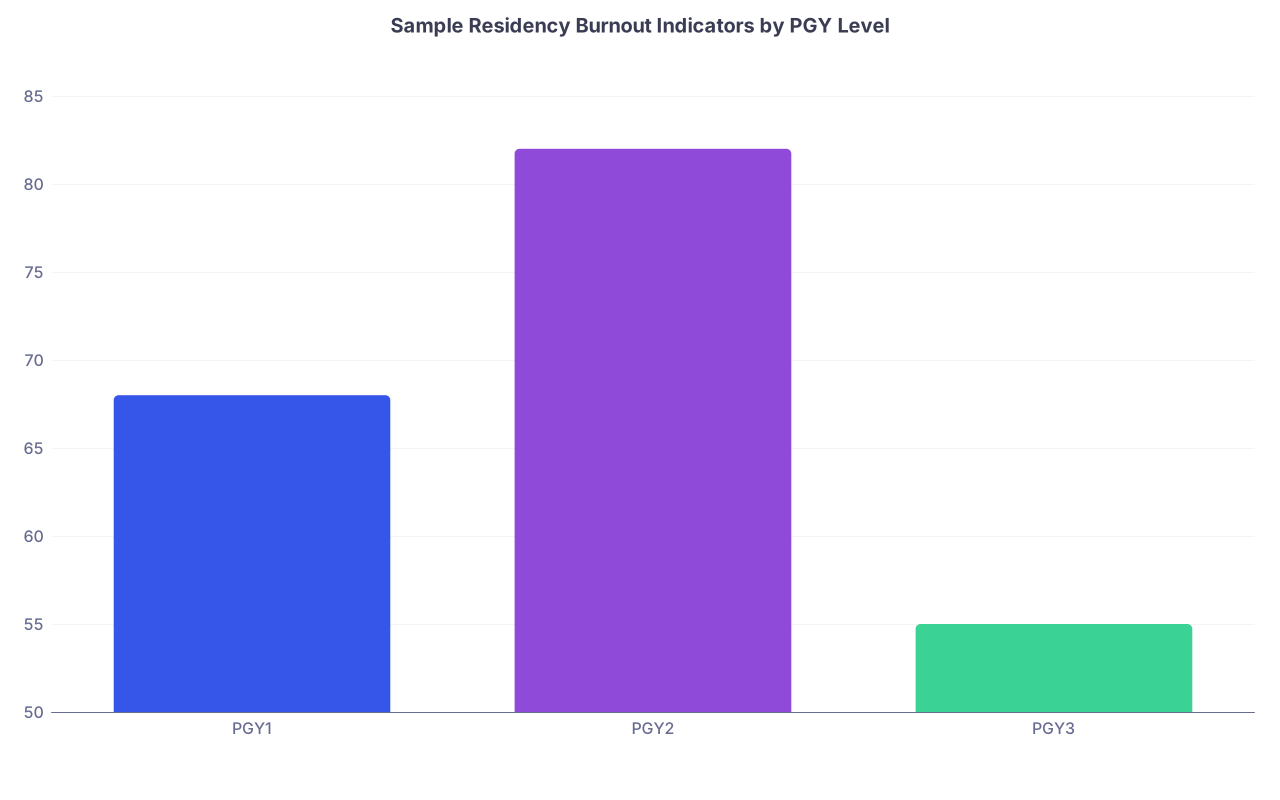
| Category | Value |
|---|---|
| PGY1 | 68 |
| PGY2 | 82 |
| PGY3 | 55 |
Where those “values” might represent the percentage of residents in that class reporting at least one burnout marker (high emotional exhaustion, depersonalization, etc.).
Behind the scenes, the GME or wellness office typically:
- Aggregates by program, sometimes by PGY level
- Hides any subgroup with too few respondents (to “protect anonymity”)
- Benchmarks you against institutional averages or national data
- Flags “concerning” thresholds (either by pre-set cutoffs or standard deviations from the mean)
You are not anonymous to the software. You are only anonymous to the people looking at the reports. Usually. At least that’s what’s supposed to happen. But I’ve watched PDs try to reverse-engineer small sub-group comments more than once.
Then the GME office generates a deck: slides with bar graphs, a few line trends over 3–5 years, and a “red-yellow-green” summary by program.
| Program Label | Burnout Level (Unofficial) | Leadership Reaction |
|---|---|---|
| Green | Low to moderate | Minimal action |
| Yellow | Moderate, trending worse | Watch, low-cost fixes |
| Red | High or worsening fast | Meetings, committees, documentation |
That “red-yellow-green” classification is what drives how seriously your burnout data gets treated. Not your individual suffering. The color on a hidden dashboard.
Behind The Closed-Door Meeting: Who’s In The Room And What They Say
Here’s the part you never see.
There’s usually a meeting that looks something like this:
- Program Director (PD)
- Associate PDs
- Program Coordinator (quiet but paying attention)
- Maybe Chief Residents (if the PD is relatively open)
- Department Chair or Vice Chair for Education (for bigger issues)
- Sometimes a GME rep or wellness officer
Someone from GME or wellness pulls up the slide deck. Then the real conversation starts.
Step 1: Benchmarking – “Are We In Trouble Yet?”
The first slide is almost always a comparison.
- Your program vs institutional average
- Your program vs national average (if they have those numbers)
- This year vs last year, maybe over 3 years if there’s enough data
If you’re “about average,” a lot of places shrug. I’ve literally heard:
“We’re the same amount of burnt out as everyone else. So we’re fine.”
That’s the bar. “Equally miserable” is often considered acceptable.
If your program is “worse than peers,” the tone changes. Especially if:
- You are a flagship specialty (IM, Surgery, EM, Peds)
- There’s been recent turnover or drama (PD change, ACGME citation)
- Recruitment has been weak and applicants are asking tough questions
Then burnout moves from “soft issue” to “strategic problem.”
Step 2: Pattern Hunting – “Where’s The Fire?”
Next, leadership digs into patterns. They’re looking for:
- PGY class differences: “Why are PGY-2s on fire but PGY-1s ok?”
- Rotation-specific signals (sometimes cross-linked with other surveys): “Why are the ICU months repeatedly mentioned?”
- Time trends: “We dropped after last year’s schedule change…”
This is where the chiefs or APDs often speak up with anecdotes:
- “Yeah, nights on that service are brutal, they’re regularly staying post-call until noon.”
- “The trauma attending X is infamous for screaming at interns; we’ve had three complaints.”
- “They’re getting crushed with scut after 5 pm; no ancillary staff.”
The PD is mentally sorting issues into two piles:
- Things we can plausibly address
- Things that are politically expensive or financially impossible
Guess which pile dies quietly in a “we’ll keep monitoring this” note.
Step 3: Comment Mining – The Dirty Truth About “Free Text”
Let me tell you what actually gets read most carefully: the free-text comments.
Not the Likert scales. Not the standardized burnout items.
The open-ended free-text comments are where they look for:
- Phrases that could trigger institutional risk: “unsafe,” “retaliation,” “sexual harassment,” “bullying,” “patient harm”
- Patterned mentions of the same attending, rotation, or site
- Anything that smells like a whistleblower complaint in the making
Faculty names and specific stories stick in their minds far more than the numbers. I’ve seen PDs literally say, “Who do you think wrote this?” and start narrowing it down by PGY year and rotation.
Do they officially try to identify you? They’re supposed to avoid that. But in a small program with 12 residents, it’s not hard to guess who keeps using the word “toxic” or referencing “I have a young child at home.”
So yes, free text is powerful. But it’s not without risk in practice, despite the “we can’t see your identity” assurances.
What Leadership Actually Fears About Burnout Data
You need to understand the fear landscape to understand their decisions.
Program leadership tends to worry about four things:
ACGME Exposure
If burnout data tracks with ACGME survey problems (duty hours, supervision, patient safety concerns), that’s blood in the water.
The fear: ACGME shows up, finds a mess, issues citations, and your chair is furious.Recruitment Optics
If your program gets a reputation for being miserable, applicants talk. Word spreads frighteningly fast in certain specialties.
The fear: going unfilled in the Match, or sliding down in the quality of matched residents.Institutional Liability
Burnout plus mentions of “unsafe workloads,” “patient care compromised,” or “hostile environment” sets off institutional alarms.
The fear: lawsuits, external reviews, or press attention.Faculty Relations
Many burnout drivers are specific attendings or services.
The fear: asking powerful faculty to change, especially big billers or influential surgeons, and causing political fights.
Burnout interventions that address these fears get prioritized.
Your well-being as a person gets attention only when it’s aligned with one of those four buckets. Harsh, but that’s what I’ve seen repeatedly.
The Playbook: Superficial vs Real Responses
Let me break down how programs typically respond to “bad” burnout data. There are two broad tracks: cosmetic and substantive. Most programs do some mix.
The Cosmetic Moves (Fast, Cheap, High-Visibility)
These are the moves you’ve seen over and over:
- Wellness lectures with free food
- Resilience workshops, mindfulness sessions, “yoga with Dr. Smith”
- Emails about “resources” and the EAP hotline
- “Wellness Day” programming with tiny scheduling concessions
- Branded swag: water bottles, fleece jackets, “Wellness Week” posters
Do these fix systemic burnout? No. They’re cheap, photograph well, and look good in institutional reports.
They also create nice lines in the program’s response documents to the GME office:
“We instituted quarterly wellness sessions and increased awareness of resources.”
Check. Box.
The Substantive Moves (Slow, Costly, But Actually Helpful)
The real tell is whether leadership is willing to do the following:
Change schedules in meaningful ways:
- Reduce consecutive nights
- Move q3 to q4 call or eliminate in-house 24s in certain rotations
- Add buffer days after ICU or trauma blocks
Add manpower:
- Hire an extra resident per class
- Add advanced practice providers or scribes to the worst services
- Secure more ancillary staff so residents are not doing clerk work
-
- Restrict certain attendings from working with interns
- Require professionalism remediation
- Remove serially abusive faculty from teaching roles
Protect time that’s actually protected:
- No paging during didactics (enforced, not performative)
- Real post-call days off, not “you can stay if the work is done”
These moves cost money, political capital, or both. When you see them happen, that usually means one of two things:
- The burnout numbers were truly ugly and linked to other serious red flags.
- Your PD and chair actually care and are willing to spend their currency on you, not just their own metrics.
How Programs Use Trends And “Improvement” To Declare Victory
Programs are terrified of looking stagnant on burnout. So they love to show trend lines that look like this:
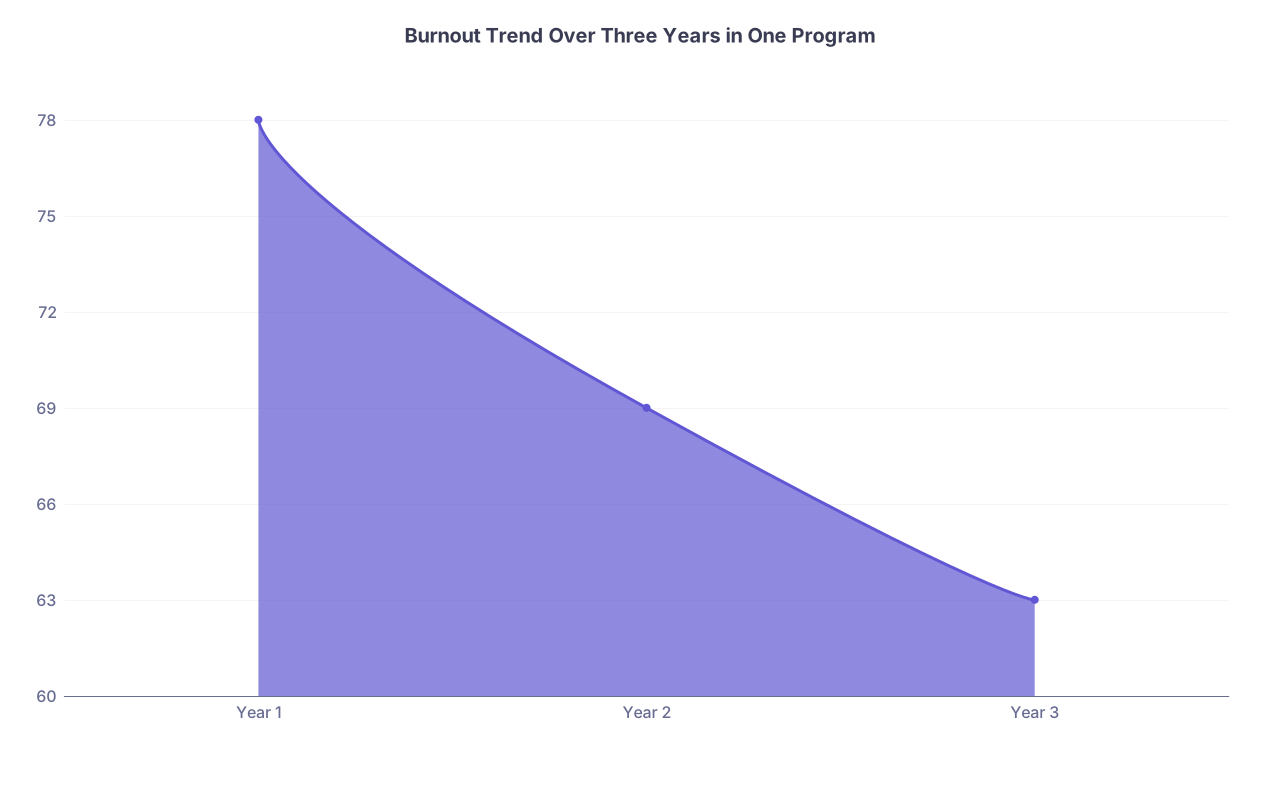
| Category | Value |
|---|---|
| Year 1 | 78 |
| Year 2 | 69 |
| Year 3 | 63 |
Then someone at the town hall says:
“We’ve reduced reported burnout by 15 points over the last three years.”
Here’s what they don’t say:
- The questions might have been slightly changed.
- Response rates might have dropped. (More burnt-out people tend not to bother with surveys.)
- The worst residents left, transferred, or went quiet.
- Some residents simply learned that being too honest gets you extra “check-ins.”
Leadership loves statistically significant improvements. They can show them to GME, to the Dean’s office, to visiting site reviewers. Whether your day-to-day life feels better may or may not track with those tidy graphs.
How This Data Flows Into ACGME And Accreditation
You should understand how this all plugs into the ACGME machine.
The ACGME Resident/Fellow Survey isn’t branded as a burnout instrument. But many items are burnout-adjacent:
- Duty hours violations
- Supervision quality
- Work environment respect
- Fatigue mitigation
- Program responsiveness to concerns
Internally, leadership crosswalks:
- Institutional burnout survey results
- ACGME survey results
- Any formal complaints or incident reports
If all three are pointing at the same service, attending, or site, that’s when real pressure hits from above.
At some institutions, the DIO (Designated Institutional Official) will meet with “red” programs and require a formal action plan. That plan will quote your burnout data, your climate data, your ACGME numbers, and then lay out “interventions.”
Most of these plans are written with an eye toward defensibility, not necessarily maximum resident relief. The internal logic is:
“If ACGME or a legal team asks what we did, can we show a reasonable, documented response?”
Your suffering becomes part of a paper trail.
The Quiet Reality of “Anonymous” Surveys
Let’s address the question you actually care about: How safe is it to be honest?
Technically:
- Responses are de-identified.
- Data are aggregated to avoid subgroup identification.
- Leadership cannot see which resident gave which answer.
Practically, in a 10–20 resident program:
- If only 3 PGY-2s are on a certain rotation, and a comment says, “As a PGY-2 on cards night float with young kids at home…” everyone knows exactly who that probably is.
- Unique writing style, recurring phrases, or very specific stories can make you identifiable, at least to people who know the group well.
So here’s the uncomfortable truth:
- Yes, these surveys matter and can trigger real change.
- Yes, they are safer than one-on-one complaining in many cases.
- No, they’re not bulletproof if someone is aggressively trying to guess who’s behind a particular comment.
I’ve watched PDs read a brutal but fair comment and say, “I’m pretty sure that’s X, and we need to be careful not to make them feel targeted.” That’s the best-case scenario. But I’ve also heard, “Well, you know Y complains about everything.”
That’s the human factor in “anonymous” systems.
How You Can Use This System Without Getting Burned
No, you cannot single-handedly fix your program with surveys. But you’re not powerless either. If you want your burnout data to actually move the needle, you need to think like leadership does.
Here’s how to play it strategically:
Write comments that are:
Specific to systems, not just feelings:
- “Average sign-out time is 10 pm on ‘short call’ days because we admit until 8 pm with only one resident and no APP support.”
- “Residents on X service routinely stay 4–5 hours post call because of late consults and no float coverage.”
Objective where possible:
- “In the last three months, I logged more than 80 hours/week on 5 separate weeks on Y rotation.”
Linked to risks leadership cares about:
- “Fatigue is contributing to near-misses on overnight cross-cover; we had three code situations in the last month where only one resident was available due to staffing.”
- “Several residents have reported delaying calling attendings overnight because they fear being belittled or yelled at.”
And when you can, comment as a group. Multiple residents surfacing the same issue in parallel, with similar language, is harder to dismiss than a single “whiner.”
There’s also power in connecting your comments to retention and recruitment:
- “Several residents in my class have openly discussed looking at transfer options because of the call burden on X service.”
- “Applicants on interview day have already heard that our Y rotation is ‘not survivable’; this will hurt recruitment if unchanged.”
You’re speaking their language: risk, optics, sustainability.
Finally, understand that the most effective pressure is layered:
- Survey data
- Chiefs raising issues
- PD hearing about concrete incidents
- GME tracking trends
- ACGME survey reflecting the same problems
When all of those line up, that’s when systemic change actually happens.
FAQ (Exactly 5 Questions)
1. Can my program director actually see my individual burnout survey answers?
Usually no. Institutional or vendor systems aggregate responses before PDs see the data, and individual-level responses are not shared. But in small programs, patterns in comments can make it possible for leadership to guess who wrote what, especially with very specific details.
2. Do programs really change anything based on burnout surveys, or is it just lip service?
Both happen. Many programs do the bare minimum—wellness talks, food, token gestures. But when burnout data aligns with ACGME concerns, recruitment worries, or patient safety risks, I’ve seen programs make real changes to call schedules, staffing, and even remove abusive faculty. The more concrete and consistent the data, the more leverage it has.
3. Is it safer to stay vague in free-text comments to protect my identity?
If you’re extremely specific about your personal situation, yes, you’re easier to identify. But comments that are too vague are easy to ignore. The sweet spot is being specific about systems and patterns (hours, workload, staffing, behavior) without including unnecessary personal identifiers like “as the only parent in my class” or “as the only international grad.”
4. Should I fill out every burnout or climate survey I get, or does it not matter?
It matters more than you think, especially when response rates are high. Leadership does look at response rates, and GME offices take low responses as either apathy or fear. Consistent, strong participation plus aligned messaging across residents makes it harder for leadership to dismiss the signal as “a few disgruntled people.”
5. What’s the single most impactful thing I can do with these surveys to help my program improve?
Coordinate. Informally align with co-residents on the major pain points you all agree on—specific rotations, call structures, abusive behaviors, dangerous workloads—and make sure those show up repeatedly in the survey responses. Leadership pays attention to patterns, not one-off outbursts. When multiple independent comments point to the same structural issues, that’s when change moves from “optional wellness initiative” to “we have to fix this.”
Key things to remember: leadership reads burnout data through the lens of risk and optics, not therapy. Free-text comments are far more powerful—and more dangerous—than you’re told. And when residents coordinate around clear, system-focused problems, burnout surveys can stop being a venting exercise and start becoming leverage.


