

You’re sitting in the call room at 2:34 a.m., staring at the computer screen. Your pager finally went quiet. Your co-resident is sleeping. You’re not. Because all you can think is: “I chose the wrong specialty. I hate this. I can’t do this for 30 years.”
You’ve probably already googled: “Switching specialties residency,” “Can I change residency after PGY-2,” or “I hate my residency, what now.” You might be half-convinced it’s just burnout. Or half-convinced it’s something bigger and permanent.
Here’s the situation you’re actually in: you’re trying to decide if you should blow up your current career track while you’re exhausted, under-slept, and emotionally fried. That’s a dangerous combo.
So let’s separate three things:
- Burnout.
- A bad program or bad environment.
- A true specialty mismatch.
And then we’ll talk concretely about what to do in each case and how to decide if switching specialties is actually the right move—or a burnout-driven hail mary.
Step 1: Get Out of “Emergency Decision” Mode
Right now, your brain is doing this thing: “I feel terrible → Therefore, I chose wrong → Therefore, the only fix is a totally different specialty.”
That might be true. Often it is not.
You cannot make a good specialty decision while:
- Sleeping 4 hours a night.
- Eating vending machine food.
- Carrying unresolved depression or anxiety.
- Getting crushed by a toxic senior or malignant PD.
Your first move is not “change specialties.” Your first move is “stabilize yourself enough to think clearly.”
Concrete moves you can make in the next 2–4 weeks:
- Protect sleep where you actually can. Not perfect sleep. Just better than now. Say no to “optional” extras. Do not volunteer for every swap. Aim for even one extra real night of sleep per week.
- Book an appointment with someone outside the program: therapist, primary care, psychiatrist. Tell them straight: “I’m a resident considering switching specialties; I need help sorting burnout vs depression vs true mismatch.”
- Take 1–2 days of PTO or sick time if you are at the edge. People do this. They don’t announce it at noon conference. They just quietly use their days. That’s what they’re for.
- Tell one trusted person in your life what you’re considering. Not to get their answer. To get their reality check. A co-resident at a different program, an old attending, or a non-medical friend who knows you well.
Your goal here isn’t to “fix” burnout in a month. You’re just getting your head above water enough that the question “Do I switch?” isn’t coming from absolute crisis mode.
Step 2: Diagnose the Real Problem – Burnout, Environment, or Specialty?
You wouldn’t jump to major surgery without a workup. Same principle here. You need a diagnosis.
Let’s walk through the big three.
A. Signs it’s mostly burnout
Burnout often looks like “I chose the wrong field” when the core issue is exhaustion and moral distress, not the specialty itself.
Red flags for classic burnout:
- You used to like this specialty—at least parts of it—early on in residency or in med school, and that’s basically vanished.
- You feel emotionally flat or irritable with patients you used to care about.
- You think “I hate this” about literally everything: rounds, notes, patients, colleagues, even things you used to enjoy outside of medicine.
- You fantasize about leaving medicine altogether, not just changing fields.
- Your sleep, appetite, and motivation are wrecked across the board.
- If someone offered you your “dream” specialty tomorrow, your main reaction would be: “I’d still be tired and miserable.”
If this is you, changing to another high-burnout specialty (or even another residency) might just move your symptoms to a new address.
B. Signs it’s a toxic program or environment
Sometimes the problem is not “internal medicine” or “surgery.” It’s your specific program or institution.
Clues:
- Residents above you say, “It gets better after you graduate this place” rather than “It gets better as you progress in the field.”
- There’s serious, repeated, unaddressed bad behavior: yelling, shaming, retaliating for speaking up, chronic understaffing with no fixes.
- Graduates tell horror stories that all center on this program, not the specialty in general.
- You do rotations at outside sites and think, “Oh. This is humane. I could tolerate this.”
- You’re dreading your program, not the type of work itself. On away rotations or electives elsewhere, you feel human again.
If the program is rotten, switching specialties might help, but switching programs within the same field might be the smarter, cleaner move.
C. Signs it’s a true specialty mismatch
Now the hard truth: sometimes you did pick the wrong field. It happens more than programs like to admit.
Signs it’s a mismatch:
- Even on “good” days—decent sleep, kind attending, reasonable census—you feel bored, drained, or like you’re cosplaying someone else’s job.
- The day-to-day tasks drain you, not just the hours. Example:
- As a medicine resident, you loathe chronic disease management and endless med rec, even on quiet days.
- As a surgical resident, you can’t stand the OR, the culture, the pace, or the emergencies—even when cases go smoothly.
- Rotations in other fields (electives, off-service rotations) felt noticeably more “right,” even when workload was similar.
- You scroll jobs in other specialties or non-clinical roles at 1 a.m. not as a fantasy, but because something core feels off.
- Residents who love your field light up talking about things that make you think, “I do not care about that at all.”
Here’s the key test: think back to a relatively good block. Enough sleep, not getting destroyed by a malignant senior. Did you still feel like you were in the wrong movie? If yes, that’s more likely mismatch than burnout alone.
Step 3: Pressure-Test the “New Specialty” Before You Jump
Before you torch your current path, you need to answer: “Do I actually want that new specialty—or do I just want not this?”
This is where people screw up. They flee one fire by running straight into another.
Do a rapid but honest workup of your target specialty:
List 2–3 realistic alternative specialties you’re considering. Not 10. Maybe: psych, anesthesia, radiology. Or FM, path. Or going from surgery to radiology or anesthesia.
For each, answer questions like:
- What’s the day-to-day actually like? Morning to night. Not the Instagram version.
- What parts play to your strengths? (Procedures, thinking, pattern recognition, talking, longitudinal relationships, acute management.)
- What parts will you probably hate but can tolerate?
- How does your personality mesh with the culture? You know exactly what I mean by “culture.” Some fields are blunt and hierarchical, some are cerebral and quiet, some are chatty and patient-facing.
Talk to current residents in that field.
- Not just attendings. Attendings have survivor bias and money.
- Ask them directly: “What do people who switch into your specialty from X usually say they were running from, and are they actually happier?”
- Ask: “Who in your program seems miserable, and why?” That answer tells you more than anything glossy.
If you can, get:
- An elective in that field.
- A shadow day or weekend (yes, people will let you; you just have to ask someone you trust).
- A night or call shift exposure if that specialty has it.
You are not looking for perfection. You’re looking for: “Can I see myself tolerating the worst days here better than the worst days in my current field?” That’s the right benchmark.
Step 4: The Practical Reality Check – Timing, Money, and Training
Now let’s talk logistics. Because you’re not making this decision in a vacuum; you’re making it with loans, visas, contracts, and sometimes kids involved.
Here’s a basic comparison grid you should sketch out for yourself:
| Factor | Stay in Current Specialty | Switch to New Specialty |
|---|---|---|
| Years to Attend | 0–X (time left now) | Likely +1–3 more years |
| Income Delay | None | 1–3 years of resident pay instead of attending pay |
| Board Eligibility | Straightforward | Depends if prior years count |
| Visa Issues | Usually stable | New program must sponsor |
| Competitiveness | Already in | Need to re-apply/match |
You have to stare directly at:
- How many extra years of residency would this add?
- Can you financially and emotionally tolerate that?
- Are you in a competitive field already or trying to jump into one?
- Will your current years count as “prelim” time toward anything? Sometimes yes (IM → cards, hospitalist; surgery → anesthesia credit in some places; IM → neuro in rare setups), sometimes no.
You do not need these answers perfect now. But you at least need to know if you’re talking about “add 1–2 years” or “restart from scratch.”
Step 5: Who to Tell (and Who Not To) While You’re Figuring It Out
This part is political. And yes, politics matter.
Here’s the general rule:
Early stage (just thinking): keep the circle very small.
Later stage (committed to exploring): selectively widen.
People you can safely talk to early:
- Therapist/psychiatrist.
- Trusted mentor not in your direct supervisory chain.
- An attending who has explicitly said, “If you ever want to talk about career stuff, come find me,” and has a track record of not gossiping.
- Former med school faculty or advisors.
People to be careful about:
- Program Director or APD: If you’re early in your doubts, telling them “I might leave” can change how they see you—some are great, some are not. I’ve seen residents get written off as “checked out” after one vulnerable conversation.
- Co-residents who share everything with leadership.
- Anyone who loves drama.
You talk to your PD when:
- You’ve done the work: therapy, honest reflection, exploration of alternatives.
- You’re leaning strongly toward switching, not just venting.
- You need concrete help: letters, off-cycle transition, or a plan to leave after this year.
When you do go to them, you bring:
- A clear narrative: “I’ve realized X about myself, I’ve explored Y, and I believe Z specialty/program is a better fit because…”
- A timeline: “I’d like to finish this year and apply” or “I am not sure I can safely complete this year; I’d like to discuss options.”
- A calm tone. Not tears and chaos. That freaks people out and makes them defensive.
Step 6: Decision Branches – What You Actually Do Next
Let’s break this into realistic scenarios.
Scenario 1: It’s mostly burnout, not true mismatch
What you do:
- Commit to not making a specialty decision for 3–6 months while you treat the burnout as if it’s severe.
- Get mental health support. If you’re having daily thoughts of quitting medicine or passive SI, you need a clinician, not just “wellness tips.”
- Aggressively prune non-essential stuff: research, extra committees, moonlighting, the “resume-padding” junk you said yes to when you still had energy.
- Find one thing in your current field that you don’t hate and lean slightly toward it: a niche, a patient population, a certain type of rotation.
You re-evaluate once your sleep, mood, and energy are at least 50% of baseline. If you still feel deeply misaligned with the work, you revisit the specialty question then. Not before.
Scenario 2: The program is the main problem
What you do:
- Quietly collect data: talk to graduated residents, look at transfer stories, see how other programs in your field function.
- Consider switching programs within the same specialty before you torch the whole field.
- Talk to a trusted senior faculty member about whether your program has a pattern of residents leaving or being miserable.
- If you decide to transfer programs:
- You likely have to involve your PD at some point.
- You may frame it as “geographic/family/fit” rather than a full indictment of the program. You don’t need to fight a culture war to leave.
In a surprising number of cases, a program change is enough. Same specialty, entirely different life.
Scenario 3: It’s a true specialty mismatch and you’re early (PGY-1 or early PGY-2)
This is the easiest time to change.
What you do:
- Intensify your exploration of your target specialty: electives, shadowing, talking to PDs informally.
- Check application timelines. Some programs will take off-cycle transfers, especially if you come with good evaluations.
- Build a narrative: “I realized early that my strengths and interests align better with X. My current training gave me strong Y skills that would make me a valuable resident in X.”
- Start assembling letters from:
- People in the new specialty, if possible.
- Attending(s) in your current specialty who can vouch that you’re competent and not fleeing because you’re failing.
You may have to:
- Finish the year and then re-enter the Match.
- Take a prelim year and transition.
- Or, in some cases, jump mid-year if a spot opens. These spots exist more often than programs admit; positions open when people leave for family, health, or exactly what you’re thinking about.
Scenario 4: It’s a true specialty mismatch and you’re later (PGY-3+)
Harder. Not impossible.
What you do:
- Ask yourself seriously: “Can I tolerate finishing this and then adjust my career within this specialty?”
Examples:- IM → non-hospitalist roles, outpatient only, subspecialty with better fit.
- EM → urgent care, telemedicine, less shift-heavy sites.
- Surgery → minimally invasive niche, more clinic-heavy practice, or even transitioning later to admin/research roles.
- Run the economic math:
- If you’re 1 year from finishing and attending pay is 200–400k+, versus adding 3–4 more years of 60–80k pay… that’s a big hit.
- If you’re still sure switching specialties is right:
- Accept that you’re choosing long-term alignment over short-term convenience and money. That’s valid.
- Talk to PDs in the new specialty honestly. Some will value your prior training and may grant advanced standing.
Late switches work best when:
- Your prior field has skills that translate (IM → anesthesia; surgery → radiology; peds → child psych).
- You’re realistic about time and finances.
- You have strong evaluations and no professionalism issues.
Step 7: Build a Clean Story – For Yourself and Others
Whether you stay or leave, you need a story that makes sense. To programs. To mentors. To yourself.
A good “switch” story hits these beats:
- Self-awareness: “I learned X about myself during residency.”
- Respect: “I respect my original specialty and the training I’ve received.”
- Fit: “I realized I’m better suited to [nature of new specialty] because of [concrete traits/experiences].”
- Contribution: “Here’s how my prior training will make me a stronger resident and colleague in your field.”
What you do not do:
- Trash your current program or specialty in public or in personal statements.
- Frame yourself as a victim only. Even if your program is toxic, you still want to show agency in your decision.
- Present as impulsive: “I just decided I hate this and want that now.” Terrible look.
You’re making a career pivot, not apologizing for a crime.
Visual Reality Check: How Much Is This Burnout vs Mismatch?
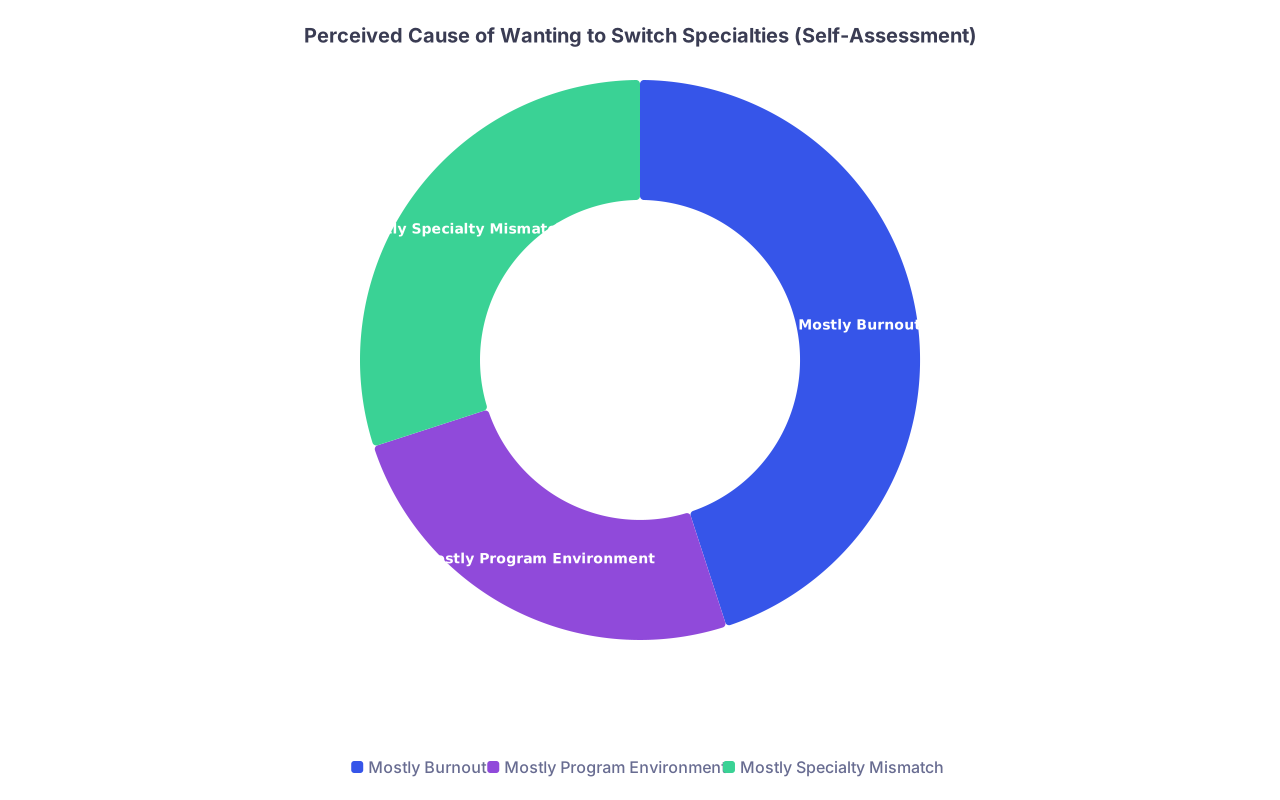
| Category | Value |
|---|---|
| Mostly Burnout | 45 |
| Mostly Program Environment | 25 |
| Mostly Specialty Mismatch | 30 |
If you’re honest with yourself, your “pie chart” probably isn’t 100–0. It’s usually mixed. That’s fine. Your job is to identify which slice is actually driving your misery the most—and target that.
Step 8: If You Decide to Stay – Don’t Just White-Knuckle It
Say you do the work and realize: “No, this is actually the right specialty. I’m just burnt to a crisp.”
Then staying cannot mean “I’ll just endure this until it’s over.” That’s how people break.
You need an active plan:
- Change what you can within residency: swap a brutal elective for something you actually like; adjust your continuity clinic if possible; request a mentor in a niche you’re interested in.
- Design your post-residency life intentionally: You don’t have to practice like your current attendings. Lots of fields are more flexible than residency makes them look.
- Protect a non-medical identity: hobby, people, exercise, anything. The residents who survive intact aren’t the ones with the highest test scores; they’re the ones who didn’t let medicine be the only pillar of their self-worth.
Step 9: If You Decide to Switch – Make It a Strategic Exit, Not a Panic Move
Once you’re clear you’re changing specialties, act like a strategist, not someone running from a burning building.
Sequence it:
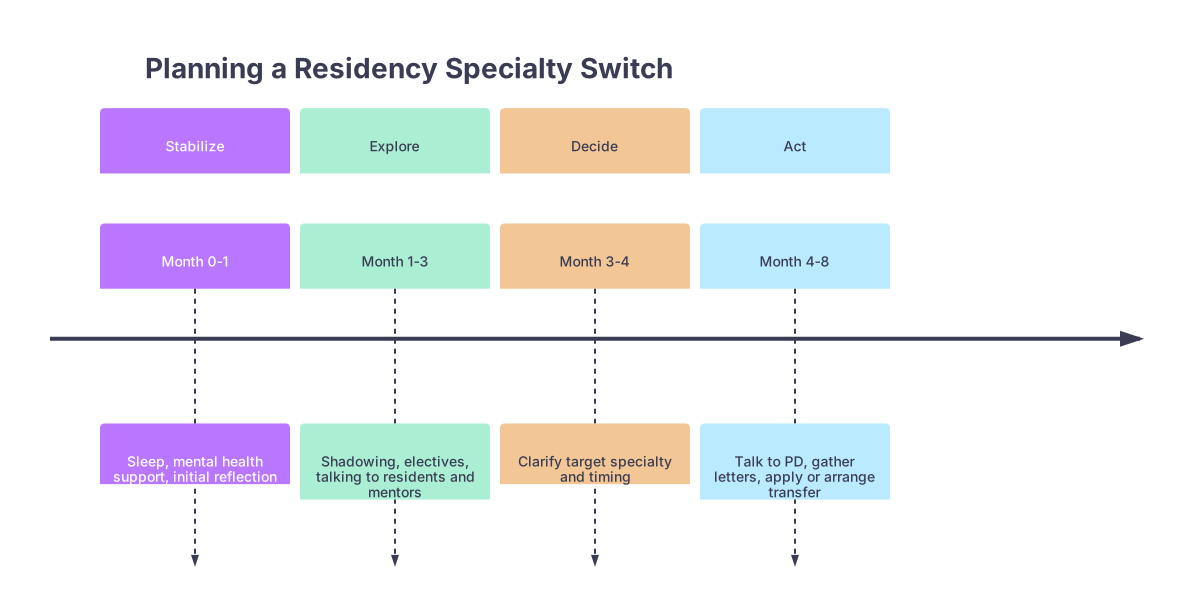
| Period | Event |
|---|---|
| Stabilize - Month 0-1 | Sleep, mental health support, initial reflection |
| Explore - Month 1-3 | Shadowing, electives, talking to residents and mentors |
| Decide - Month 3-4 | Clarify target specialty and timing |
| Act - Month 4-8 | Talk to PD, gather letters, apply or arrange transfer |
You’ll adjust the months based on your situation, but the sequence is the point: stabilize → explore → decide → act. Not decide → act → crash.
Key Takeaways
- Do not make a permanent specialty decision from the middle of acute burnout and sleep deprivation. Stabilize first, then reassess.
- Separate three diagnoses: burnout, bad program, and true specialty mismatch. The solution for each is different.
- If you switch, do it strategically—after talking to people in the new field, understanding the time/financial cost, and crafting a clear story. If you stay, don’t just endure; redesign your training and eventual practice so it’s actually livable.


