
The blunt truth: You should almost never disclose past burnout episodes in your fellowship application materials.
That’s the starting point. Then we add nuance. Because there are a few very specific situations where it can help you, and a lot more where it can quietly sink you.
Let me walk you through how programs actually think, when disclosure helps vs hurts, and how to talk about your experience without branding yourself as “a problem.”
How Programs Really See Burnout
Program leadership does not read applications like therapists. They read them like risk managers.
When a PD or faculty reviewer sees anything related to burnout, depression, leave of absence, or “struggles with wellness,” they automatically ask three questions:
- Will this person complete our program without major issues?
- Will they be reliable under pressure and call?
- Is there any risk of professionalism, performance, or patient safety problems?
That’s the harsh lens. Even at very supportive programs.
So while you may see your burnout story as one of growth, resilience, and insight (and it might genuinely be that), many reviewers will see potential liability first and your personal growth second, if at all.
And you do not get to control which reviewer you get.
When You Should NOT Disclose Past Burnout
Most residents are in this bucket.
If any of these are true, you should not put burnout in your personal statement, ERAS application, or fellowship essays:
- Your burnout never led to:
- a formal leave of absence
- remediation
- major professionalism concerns
- patient safety issues
- You weren’t reported to GME, wellness, or the state board
- Your evaluations and milestones are currently solid
- Your program director letter is expected to be positive and straightforward
In that situation, bringing up “I struggled with burnout PGY-2” is almost always a net negative.
Why? A few reasons:
It creates a problem they weren’t looking for.
They weren’t going to ask. You hand them a reason to doubt your stamina for fellowship.You cannot fully control how it’s interpreted.
You may mean “I grew from it.” They may hear “I might crash when the ICU gets busy.”You’re competing with people who look lower risk on paper.
In competitive fellowships, small perceived risks matter.
Instead, you take what you learned from that experience and frame it as maturity, boundaries, and clinical judgment—without naming it “burnout” or describing it clinically.
Example of what NOT to write in a personal statement:
“During my PGY-2 year, I experienced significant burnout and nearly left residency. Through therapy and time off, I learned to cope better and returned to full duties.”
This triggers flags: nearly quit, needed time off, mental health concerns.
Better version without explicit disclosure:
“Midway through residency I realized my approach to work was not sustainable. I was overextending, saying yes to every extra task, and ignoring my own limits. With mentorship and support, I made concrete changes in how I manage workload, recover between shifts, and ask for help. Since then, my performance and satisfaction have both improved significantly, and I’ve become more intentional about promoting healthy team culture for the interns I supervise.”
Same growth. None of the red flags.
When You Might Need to Disclose (Or At Least Address It)
There are narrow but important exceptions where ignoring the issue is worse than addressing it. These usually involve something already visible in your record.
You should strongly consider addressing past burnout / leave / mental health issues if:
- You took a formal leave of absence that appears in your record
- You extended residency or did an extra year
- There were major professionalism concerns clearly documented
- Your PD letter or MSPE will mention time away or remediation
- Your state license, board, or credentialing already has a note about it
In those cases, the question is not “Should I disclose?”
The question is “How do I control the narrative before someone else does?”
Here, you want to:
- Acknowledge briefly that there was a disruption.
- Own your part without oversharing personal details.
- Emphasize insight, stability, and objective evidence of current function.
- Close the loop clearly: “This is addressed, I am stable, and it will not impact fellowship.”
You still don’t need to use the word “burnout” or spell out diagnoses. You can frame it around “a health issue,” “personal health challenge,” or “circumstance that required time away” if you prefer, as long as it’s honest and consistent with what your PD might write.
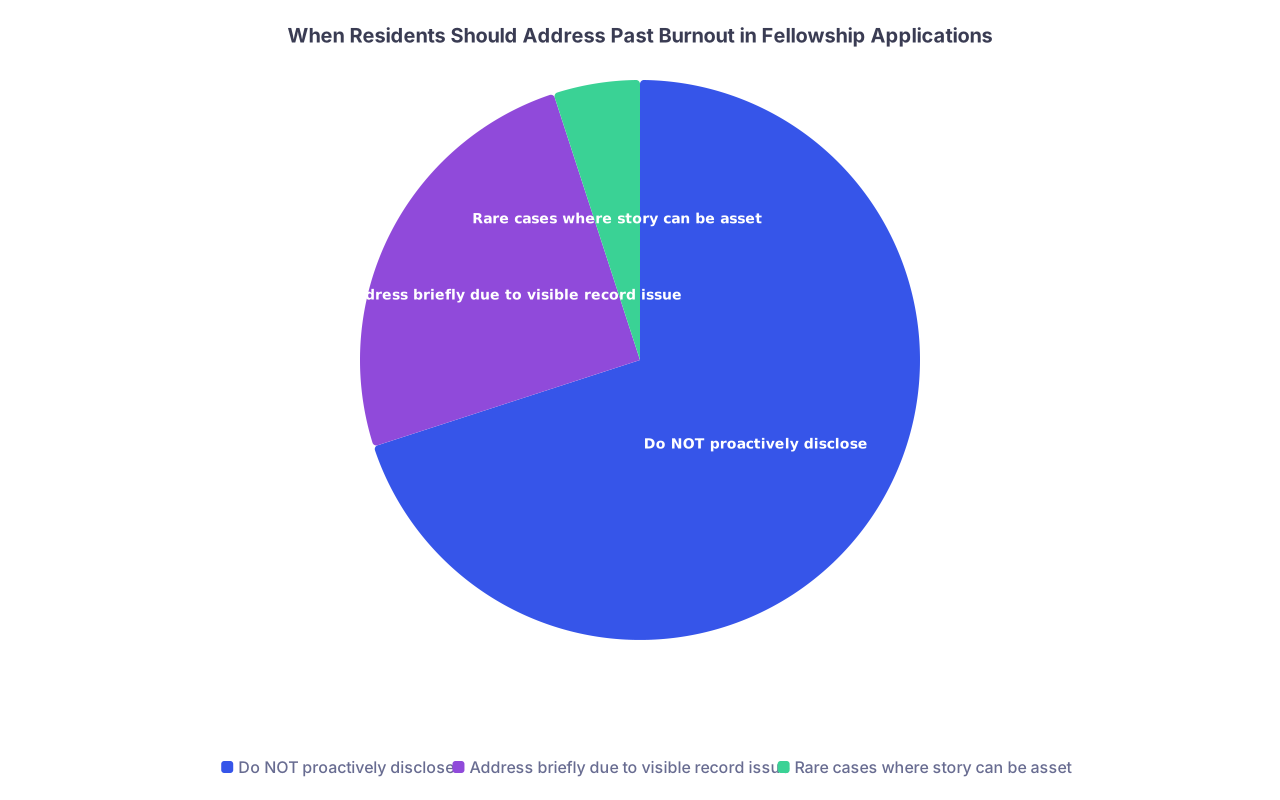
| Category | Value |
|---|---|
| Do NOT proactively disclose | 70 |
| Address briefly due to visible record issue | 25 |
| Rare cases where story can be asset | 5 |
Turning a Risk into a Strength (If You Have To Talk About It)
Let’s say you’re in the group that has to address it because it’s already on paper: you had a documented leave, remediation, or a delayed graduation.
Here’s the basic structure that works.
1. One-line factual description
You don’t write a confession. You write a concise fact.
Examples:
- “During my PGY-2 year, I required a brief leave for a personal health issue.”
- “My residency training was extended by one year due to a personal health challenge that is now fully resolved.”
Notice what’s missing: diagnosis labels, emotional detail, dramatic language.
2. Insight without drama
You show that you understand what happened and how you’ve changed, but in professional language.
Example:
“That period forced me to confront how I was working—chronically overcommitted, reluctant to ask for help, and relying on unsustainable habits to get through call. With support from my program leadership and mentors, I learned to recognize early warning signs of exhaustion and to set limits that protect both my patients and my own functioning.”
You’re not venting. You’re showing judgment.
3. Concrete evidence you’re stable and high functioning now
Words are cheap. You need data.
You can point to:
- Recent strong evaluations
- Assumption of leadership roles (chief, QI lead, curriculum work)
- High-volume rotations you’ve completed successfully since then
- Board scores or in-training exam improvement
Example:
“Since returning to full duties, I’ve completed back-to-back MICU and cardiology blocks with strong evaluations, taken on a senior role in resident scheduling, and maintained full clinical productivity without interruption.”
4. Explicit reassurance about the future
You do not leave them guessing about recurrence.
Example:
“I’ve put durable structures in place—regular follow-up with my physician, boundaries around nonessential work, and early communication with supervisors—that have worked well over the past two years. I’m confident these habits will allow me to contribute fully in a demanding fellowship environment.”
That last sentence matters more than you think. You are answering their unspoken question: “Are we going to get burned again?”

Places You Should Absolutely Avoid Burnout Disclosure
Different parts of the application carry different weight. Some should stay clean of this topic.
Avoid discussing past burnout in:
- The “Why this specialty/why this program” section
- Dedicated research or project essays
- Short answer questions that don’t explicitly ask about challenges
- Letters of recommendation (do not ask your letter writer to mention it)
- Anything that will be skimmed quickly by a big committee
Those sections should be used to show:
- Clinical excellence
- Academic interests
- Teamwork and leadership
- Fit with the fellowship and its strengths
Don’t trade prime real estate for a story about suffering, even if it’s true. The story to tell there is your value to them, not your hardship.
If a program explicitly asks about “a professional challenge” or “a time you struggled,” you can choose something related but less radioactive than “I burned out and almost quit.”
For example:
- Managing a difficult family or end-of-life conflict
- Being overwhelmed on your first ICU rotation and how you adapted
- Balancing multiple QI projects and learning to say no
You can layer in subtle wellness themes (recognizing limits, seeking mentorship, building systems), but you don’t need to label anything burnout.
Handling Burnout Questions in Interviews
Sometimes the risk doesn’t come from what you write; it comes from what you say off the cuff.
Program faculty may ask variants of:
- “How do you handle stress?”
- “What’s been the hardest part of residency for you?”
- “Tell me about a time you felt overwhelmed.”
This is not an invitation to unpack your worst nights as a PGY-2 in raw detail.
Use a controlled, professional version:
- Pick a specific situation, not your whole emotional history.
- Describe the challenge briefly.
- Focus most of your answer on what you did, learned, and changed.
- End with how that’s made you better prepared for fellowship.
Example answer:
“My hardest stretch was a run of night float early in PGY-2 when our service was short-staffed. I was saying yes to extra admissions and tasks, and I let my own rest slide. I realized quickly that I wasn’t working at the level I expected of myself. I talked with my senior, adjusted how we triaged pages and admissions, built structured sign-out, and I started protecting sleep between shifts much more intentionally. Since then I’ve been much more proactive about system fixes and explicit about my limits. The result has actually been better patient care and less chaos for the team.”
You’ve communicated: stress happens, you know your limits, you fix systems, and you didn’t fall apart.
If someone directly asks about leaves or wellness issues that are in your record, use the same four-part framework from earlier: brief fact, insight, evidence of current function, reassurance.

| Step | Description |
|---|---|
| Step 1 | Past burnout episode |
| Step 2 | Do NOT disclose in application |
| Step 3 | Address briefly with growth and stability |
| Step 4 | Use controlled, concise explanation |
| Step 5 | Let your PD letter and application speak |
| Step 6 | Focus on lessons and maturity without label |
| Step 7 | Visible in official record? |
| Step 8 | Asked directly in interview? |
Using Your Experience Without Calling It “Burnout”
You can absolutely use what you learned from burnout to make your application stronger—without flagging yourself.
What programs actually like hearing:
- That you’ve learned to work sustainably
- That you understand your limits and ask for help
- That you mentor juniors around wellness and workload
- That you’re thoughtful about error prevention and safety
You can frame experiences like this:
- “Learning to set boundaries around extra shifts taught me to prioritize high-value work and protect time for reflection and QI projects.”
- “Supporting an intern who was struggling with workload forced me to be more explicit about expectations, check-ins, and psychological safety on rounds.”
- “I’m deliberate now about pre-call routines, debriefing hard cases, and not carrying emotional weight alone; that’s made me steadier and more present with patients.”
All of this may have come from your own burnout. But the story you tell is: I’m a stable, reflective clinician who will not implode in your fellowship.
| Scenario | Recommended Approach |
|---|---|
| Burnout with no formal leave/remediation | Do not disclose; integrate lessons indirectly |
| Formal leave of absence on record | Briefly address with growth + stability |
| Extended residency due to personal health | Address clearly and concisely |
| No documented issues, but tough PGY-2 year | Do not label burnout; focus on maturity |
| Interview question on hardest challenge | Use controlled example, not full burnout saga |
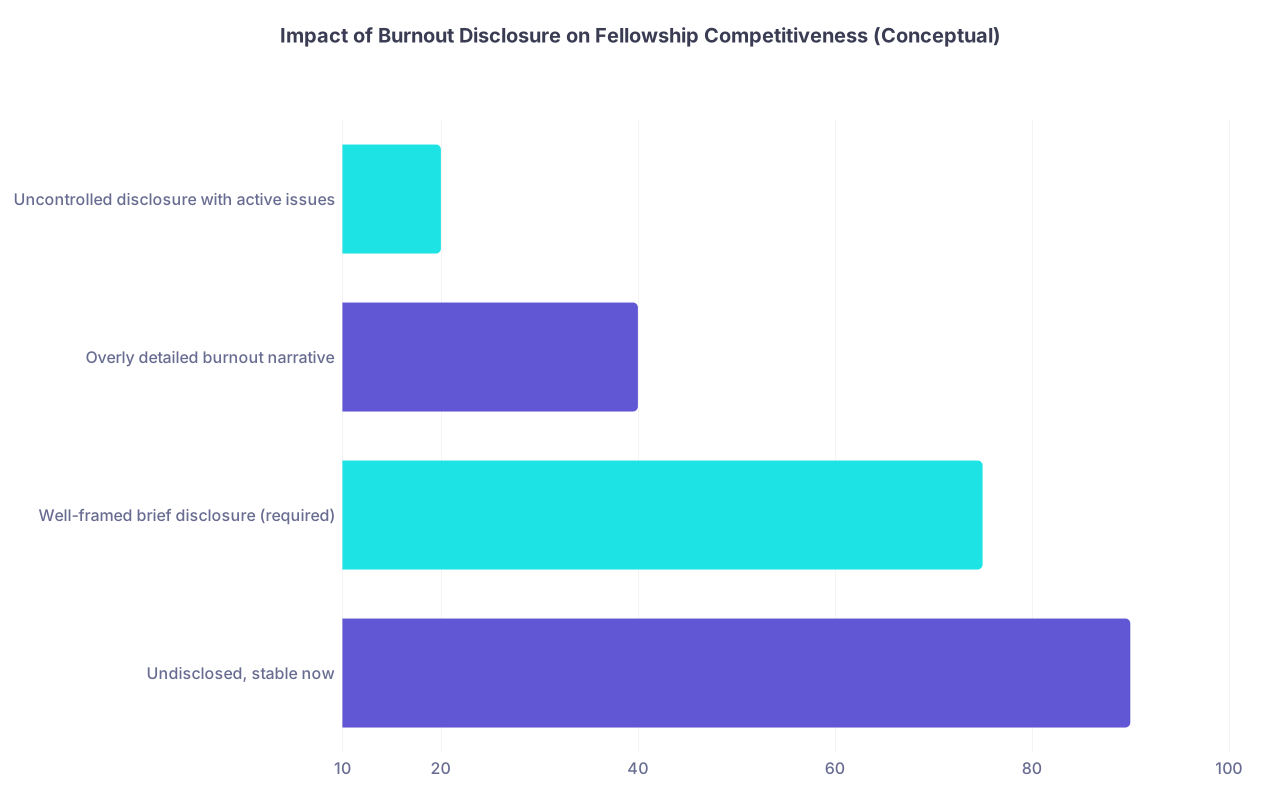
| Category | Value |
|---|---|
| Undisclosed, stable now | 90 |
| Well-framed brief disclosure (required) | 75 |
| Overly detailed burnout narrative | 40 |
| Uncontrolled disclosure with active issues | 20 |

Quick Rules You Can Actually Use
If you remember nothing else, use these:
- If it’s not in the official record and you’re functioning well now, do not label past burnout in your application.
- If it is in the record (leave, extension, remediation), address it briefly, factually, and emphasize stability and objective performance since then.
- Never let the burnout story be the central theme of your application. Your value is your clinical skill, judgment, and fit—not your suffering.
- In interviews, answer questions about stress and challenge with controlled, professional stories that show growth, not fragility.
- Use what you learned to talk like someone who will survive fellowship intact and be good to work with.

FAQs
1. My burnout was severe but never formally documented. Should I mention it at all?
No. If there is no official record (no leave, no remediation, no notation in your file), you gain almost nothing and risk a lot by naming it. Take the lessons—boundaries, insight, better coping—and talk about those as part of your growth as a resident, without using the words “burnout,” “depression,” or “mental breakdown.”
2. What if a program asks directly, “Have you ever felt burned out?” in an interview?
You can answer honestly but lightly: “Like most residents, I’ve had stretches that were very tough. The key for me has been learning earlier recognition and building sustainable habits—[brief example]—so that I can stay effective for patients and the team.” You don’t have to unpack your worst episode in detail.
3. My leave of absence was for mental health related to burnout. Do I have to say that specifically?
You must be honest and consistent with what’s in official documents, but you don’t have to give diagnostic labels in your personal statement. Framing it as “a personal health challenge requiring brief leave, now fully resolved,” paired with clear evidence of current stability and performance, is usually enough. Align this with your PD so your stories match.
4. Can my burnout story ever be a “strength” in my personal statement?
Very rarely. Only consider this if: (a) it’s already on record, (b) you are clearly thriving now for at least a year or two, and (c) your work and future plans directly relate to physician wellness, system redesign, or similar. Even then, it should be one paragraph, not the spine of your entire statement.
5. Should I talk to my program director before deciding what to disclose?
Yes, if you have any documented leave, remediation, or concerns. Your PD knows what’s in your file, what they plan to write, and how fellowship PDs will read it. Ask directly: “How much of this do you think I should address in my application, and how?” Align your message with theirs so you’re not sending mixed signals.
Bottom line:
Most residents should not explicitly disclose past burnout in fellowship applications.
If it’s in the record, address it briefly with evidence of growth and current stability.
Either way, your main job is to present yourself as a capable, reliable, and sustainable fellow—not a recovery project.


