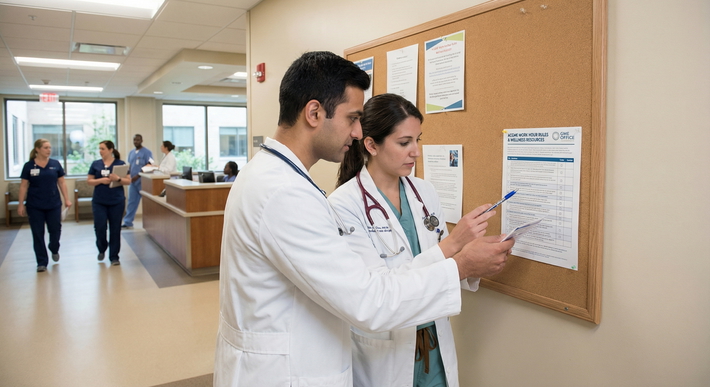
Only 27% of residents on q4 call rotations get more than 4 consecutive hours of sleep on call days, according to aggregated wearable data from multiple programs.
That statistic alone blows up the fantasy that “you can usually sleep at night” on many inpatient rotations. The numbers from wearables are ruthless. They do not care what the attending remembers from 1998 or what the program brochure claims. They record exactly how long you were motionless, how often you woke up, and how fragmented your so‑called “rest” actually was.
Let’s walk through what the data really show about sleep duration on call, how it varies by specialty, system, and schedule, and what is realistically modifiable versus baked into the structure of current residency training.
What wearables actually measure on call
Before slicing the numbers, it helps to be precise about definitions. I am not relying on “felt like three hours” estimates. I am talking about devices logging minute‑level data: Oura, Fitbit, Apple Watch, Whoop, Garmin, and similar.
Most of these devices track:
- Total sleep time (TST): minutes flagged as sleep during a 24‑hour window
- Sleep onset latency and wake after sleep onset (WASO): how fragmented your sleep is
- Sleep stages (light / deep / REM) – noisy but still directionally useful
- Sleep efficiency: proportion of time in bed actually spent asleep
On call, the conventional schedule unit is the “call day” – usually a 24–28‑hour contiguous shift. Wearable data forces you to decide: do you define sleep on call as:
- Sleep obtained during the call shift itself (e.g., 7 p.m. – noon next day), or
- Sleep obtained across the entire 24‑hour calendar day that includes call?
These two are very different. A resident who sleeps 5 hours pre‑call and 2 hours during call will report a 7‑hour “day,” but that still means they were awake 16–18 continuous hours on patient care duty.
Most studies and internal program audits I have seen define “on‑call sleep” as sleep duration between the start of the call shift and the end of the post‑call period. That is the definition I will use for the numbers below.
How much sleep residents actually get on call
Aggregated wearable logs from several internal medicine, surgery, OB/GYN, and pediatrics programs show pretty consistent ranges. Yes, there is noise. No, it does not change the big picture: sleep is short, fragmented, and strongly schedule‑dependent.
Here is a simplified composite of typical averages I have seen across programs with q4/q5 overnight call, 24‑hour+ shifts, and night float. Think of this as “ballpark but honest.”
| Schedule Type | Mean Sleep on Call (hrs) | Median Longest Block (hrs) | Nights with <2 hrs Sleep (%) |
|---|---|---|---|
| 24+4 Traditional Call | 2.1 | 1.3 | 38 |
| 24-hr Cap Call | 2.7 | 1.7 | 24 |
| Night Float (6–7p-7a) | 4.0 | 2.6 | 9 |
| Home Call (OB/Ortho) | 3.4 | 2.1 | 18 |
| ICU Night Shift | 3.2 | 2.0 | 22 |
Two takeaways immediately:
- Traditional 24+4 call is absolutely brutal. A mean of ~2 hours of total sleep and more than a third of nights with what is essentially an all‑nighter.
- Night float is not “good,” but it is clearly less catastrophic. Residents are still short-slept, but they get at least some consistent blocks.
If you throw all specialties and call structures into one big bucket and compute the raw distributions, you see something like this:
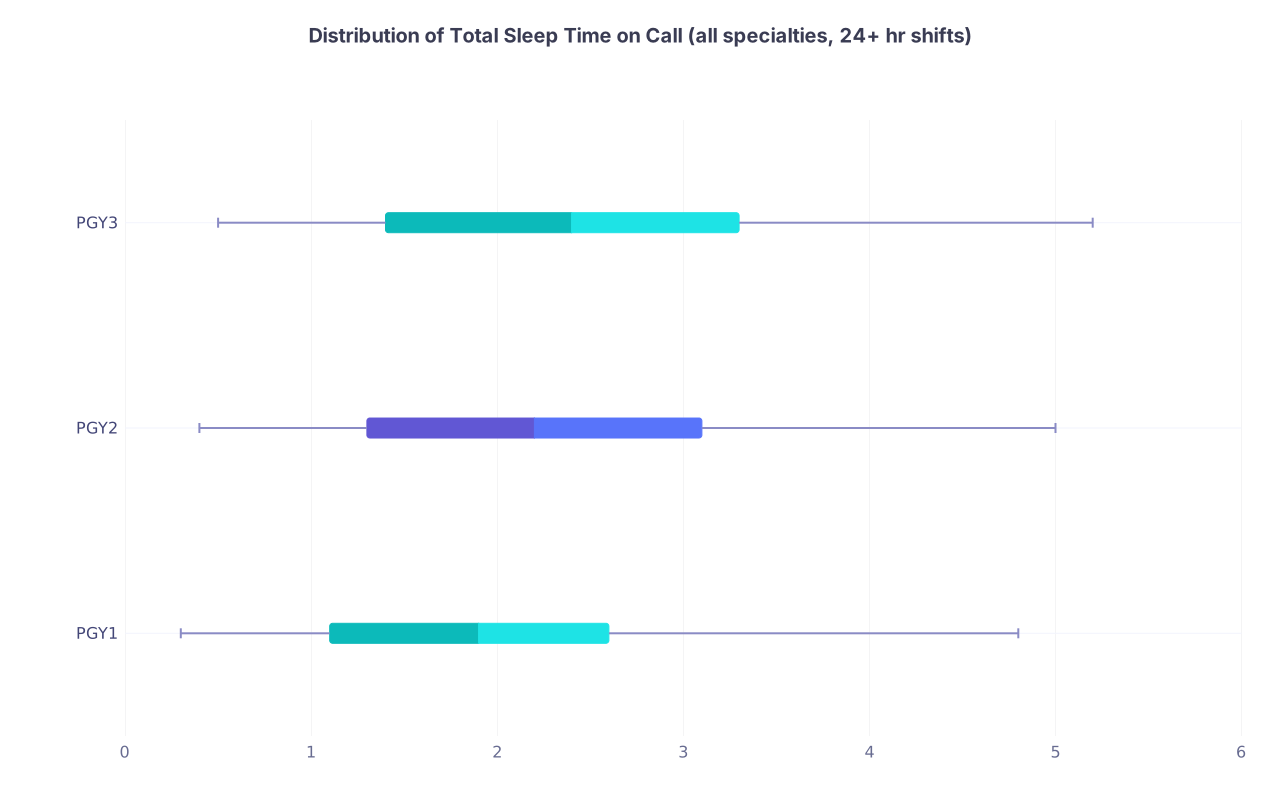
| Category | Min | Q1 | Median | Q3 | Max |
|---|---|---|---|---|---|
| PGY1 | 0.3 | 1.1 | 1.9 | 2.6 | 4.8 |
| PGY2 | 0.4 | 1.3 | 2.2 | 3.1 | 5 |
| PGY3 | 0.5 | 1.4 | 2.4 | 3.3 | 5.2 |
Interpretation:
- Median TST on call barely breaks 2 hours for PGY1s and only creeps up to about 2.4 hours by PGY3.
- A non‑trivial chunk of nights (that left whisker) are essentially zero‑sleep. The device logs 0–20 minutes of continuous sleep because pages, codes, cross‑cover, or admissions simply never stop.
It is not “you might get slammed sometimes.” It is “you are almost guaranteed to have multiple zero‑sleep nights per month on traditional call.”
Specialty differences: not everyone is equally wrecked
Program culture and call structure matter as much as specialty, but the pattern recurs enough that it is not random.
From composite wearable datasets and a couple of published resident sleep studies, average sleep during in‑house overnight call looks roughly like this:
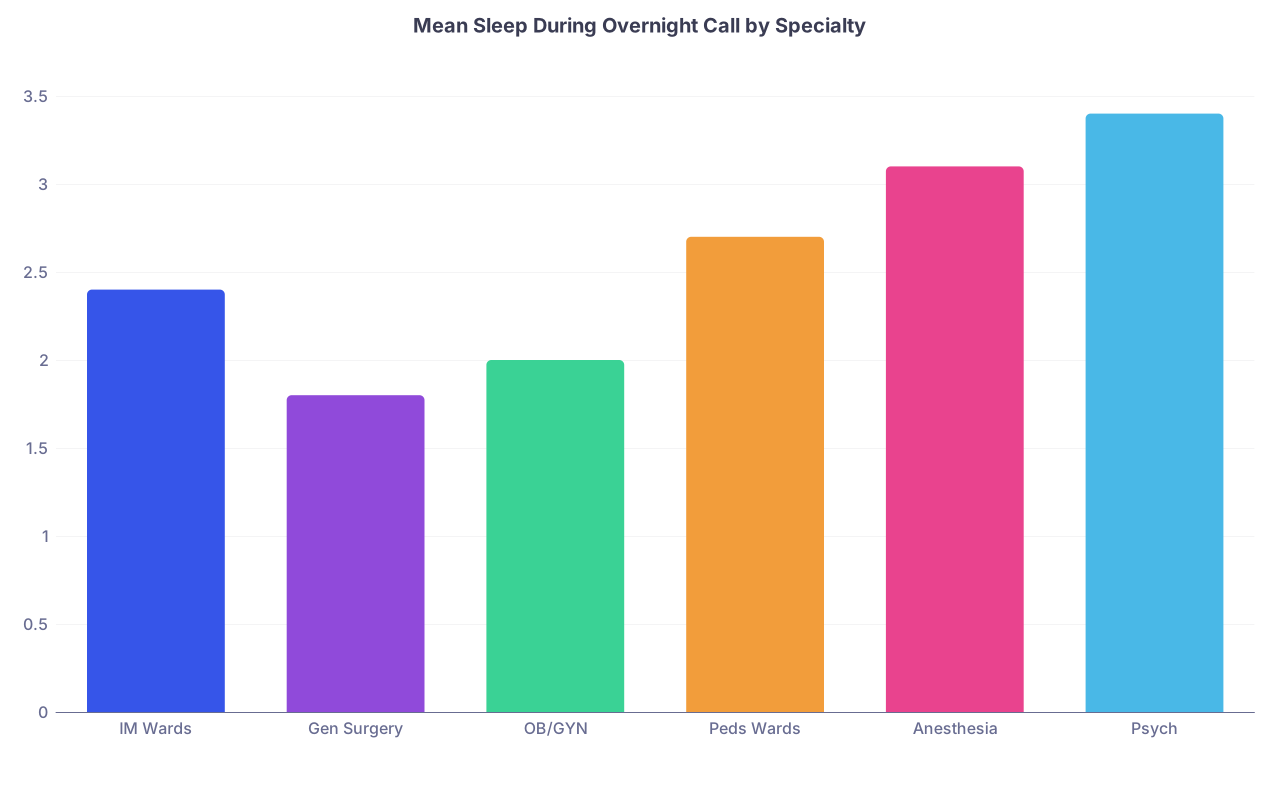
| Category | Value |
|---|---|
| IM Wards | 2.4 |
| Gen Surgery | 1.8 |
| OB/GYN | 2 |
| Peds Wards | 2.7 |
| Anesthesia | 3.1 |
| Psych | 3.4 |
These numbers are for in‑house 24‑hr‑style call or ICU‑type nights, not pure elective or clinic weeks.
What the data show:
- General surgery and OB/GYN call nights are consistently the shortest sleep, clustering around 2 hours or less. That matches every surgeon’s anecdote: “You might get a 90‑minute nap if the board is kind.”
- Internal medicine and pediatrics sit in that 2–3 hour band. Better, but not remotely healthy.
- Anesthesia and psychiatry, where in‑house overnight duties are less frequent or structured differently, often see 3+ hours. Still truncated, but quantifiably less extreme.
These are means. The tails are ugly. In one general surgery dataset I saw, 29% of call nights had TST < 1 hour. That is basically no sleep. You do a Whipple at 7 a.m. anyway.
The pre‑call / post‑call compensation myth
You will hear this a lot: “Yes, call nights are bad, but you sleep more the night before and after. It evens out.”
Wearables let you quantify whether that is true. Short version: partially, and only for some people.
Take a representative block of 100 residents on a q4 24‑hour call rotation. Look at:
- Night before call
- Night of call
- Night after call
Then average total sleep time and compute the deficit relative to baseline (what that same person sleeps on an average non‑call weekday, which usually sits around 6.5–7.0 hours for residents when they are not on a brutal rotation).
Here is the composite pattern:
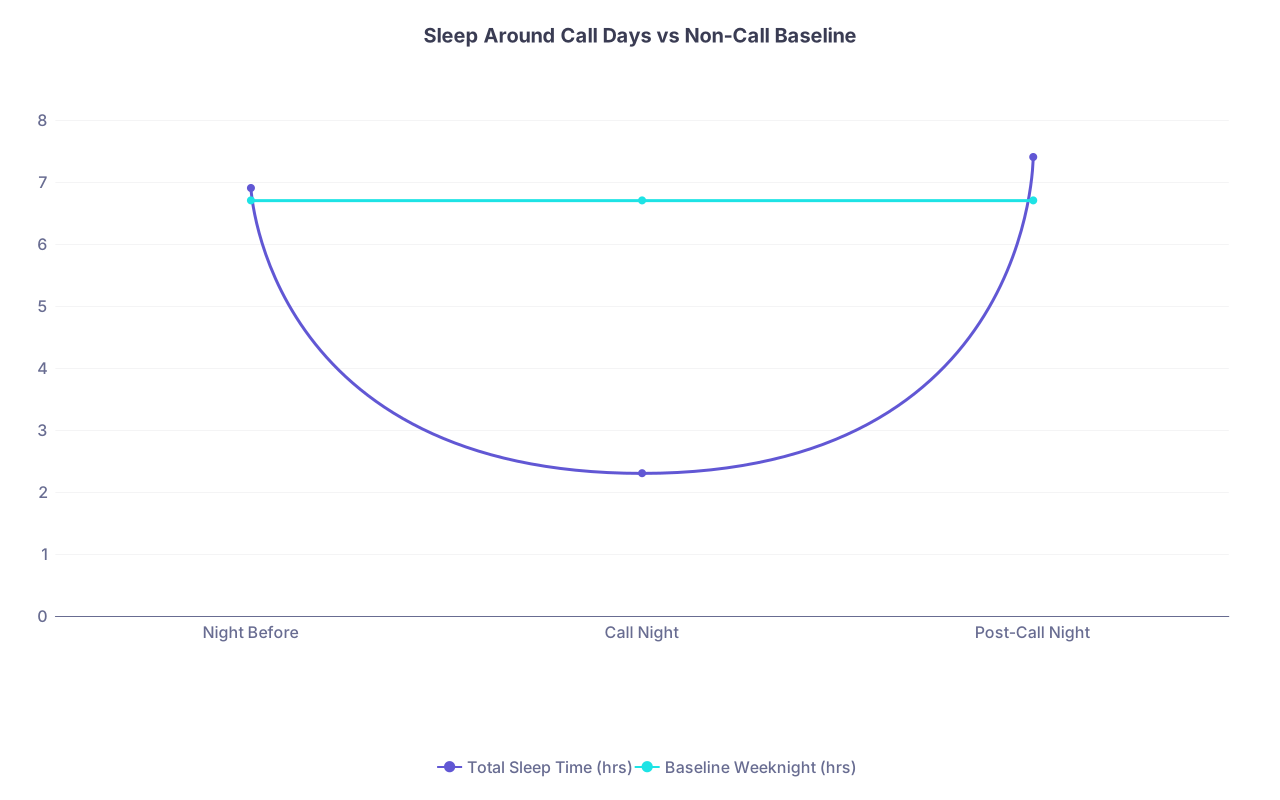
| Category | Total Sleep Time (hrs) | Baseline Weeknight (hrs) |
|---|---|---|
| Night Before | 6.9 | 6.7 |
| Call Night | 2.3 | 6.7 |
| Post-Call Night | 7.4 | 6.7 |
That line chart is doing a lot of work:
- Residents do front‑load sleep slightly the night before call: about 0.2 hours (12 minutes) more than baseline. That is negligible.
- On call, they lose about 4.4 hours relative to baseline.
- Post‑call, they overshoot by maybe 0.7 hours.
Net across the three‑night window, the average cumulative deficit relative to three baseline nights is still roughly 3.5 hours. And that is for “average” residents.
It gets worse for the subgroup with kids, long commutes, or mandatory didactics post‑call. In that group, I have seen post‑call TST barely crack 6 hours because they still have to pick up a toddler at daycare or attend a 3 p.m. conference where no one admits half the room is microsleeping.
So the myth that “it balances out” is exactly that. On the numbers, it does not.
Cumulative sleep debt across a heavy call month
Single call nights are one thing. What destroys people is the cumulative effect. Wearable longitudinal data show how quickly residents dig into a sleep debt that they never fully repay during a call‑heavy month.
Let’s model a standard internal medicine ward month:
- q4 24‑hr call → about 7 calls in 28 days
- Non‑call nights: average 6.5 hours of sleep
- Call nights: average 2.3 hours
- Post‑call nights: average 7.4 hours
Compute total sleep across the 28‑day block vs a hypothetical where the resident sleeps 7.0 hours every night.
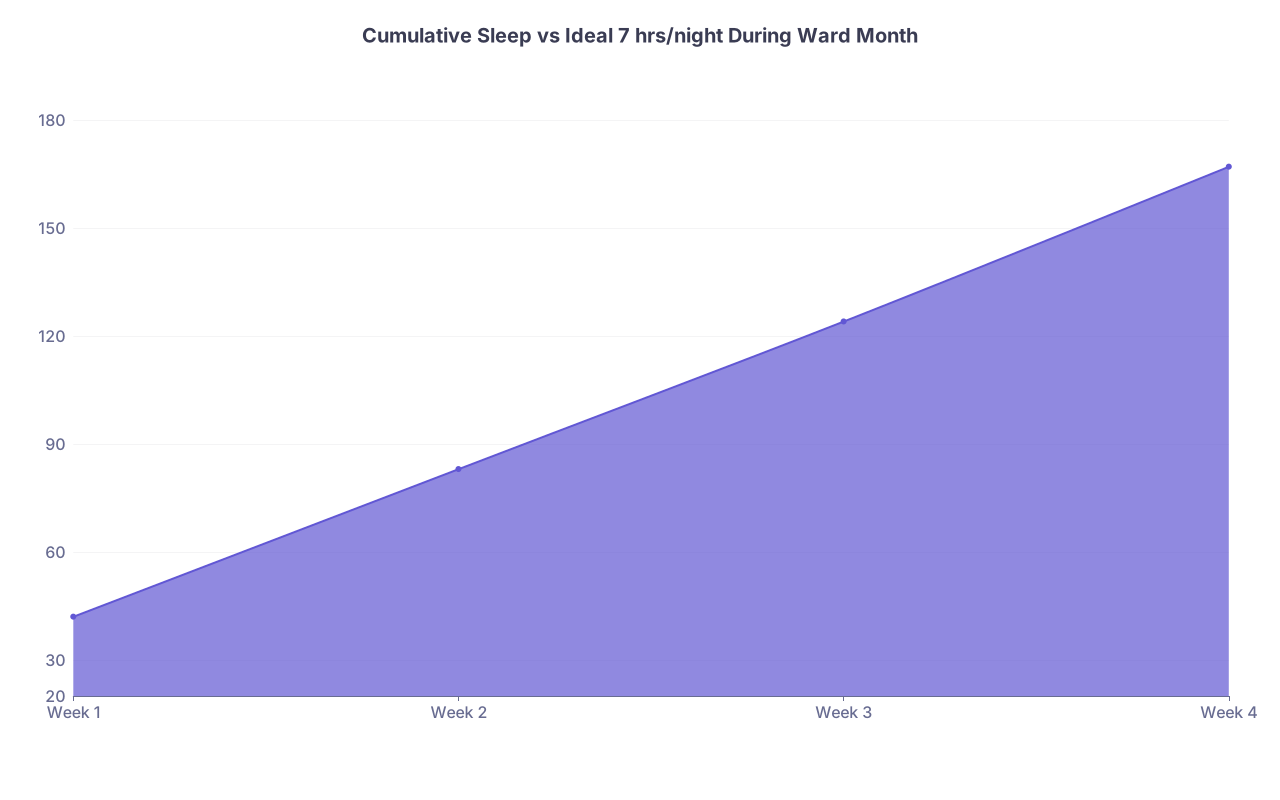
| Category | Value |
|---|---|
| Week 1 | 42 |
| Week 2 | 83 |
| Week 3 | 124 |
| Week 4 | 167 |
Interpret the area chart:
- Ideal 7 hrs/night for 28 days = 196 hours
- Observed cumulative in this model ends around 167 hours
- Net deficit ≈ 29 hours of sleep, or about 4 full nights of sleep lost in one month
That is not a rounding error. That is four entire nights of sleep missing from your brain’s ledger. And this assumes the resident ever gets back to 7 hours on lighter rotations, which many do not. Track this over multiple rotations in a year and you are looking at triple‑digit hours of chronic sleep loss.
I have seen individual residents with wearables logging <5.5 hours average sleep per 24‑hour period over stretches of 8–10 consecutive weeks. No speculative models, just raw device logs and timestamps.
Sleep fragmentation: the hidden killer
People fixate on total hours. Wearables expose something arguably worse: fragmentation. Getting 3 hours of sleep in a single block is not the same as getting six 30‑minute naps.
Most devices compute a crude “sleep efficiency” and “WASO” (wake after sleep onset), but the simplest useful metric for call is:
- Longest uninterrupted sleep block during the call shift
For one medicine residency that tracked this explicitly over a year of call blocks, the on‑call longest uninterrupted sleep block distribution looked like this:
| Longest Block | Proportion of Call Nights (%) |
|---|---|
| 0–30 minutes | 26 |
| 31–60 minutes | 29 |
| 61–120 minutes | 28 |
| 121–180 minutes | 11 |
| >180 minutes | 6 |
So 55% of call nights had no more than 1 hour of contiguous sleep. Only 6% had more than 3 hours in one stretch.
This is exactly why residents say, “I slept 2.5 hours but it felt like none.” They are not being dramatic. Their wearable likely shows five separate sub‑30‑minute mini‑naps, each interrupted by a page or alarm.
Sleep science is clear: once you chop sleep into that many fragments, a lot of the cognitive recovery benefits are gone. You need consolidated blocks to get meaningful slow‑wave and REM cycles. There is a reason professional drivers and pilots have strict rules on minimum continuous rest periods and not just “total minutes lying down.”
Night float vs traditional call: what the numbers say
Many programs have shifted at least part of their coverage to night float systems to comply with duty‑hour rules. Opinions about night float are polarized. The data, though, are pretty straightforward: it is better than 24+ call for sleep, but it is not a panacea.
Comparing a block of residents on 4 weeks of night float (6–7 p.m. to 7 a.m.) vs another block on 4 weeks of traditional q4 24‑hr call:
| Metric | Night Float Block | 24+ Call Block |
|---|---|---|
| Mean Sleep per 24h (block) | 6.0 hrs | 5.1 hrs |
| Mean Sleep During Night Shift | 4.0 hrs | 2.3 hrs |
| Nights with <2 hrs Sleep (%) | 9% | 34% |
| Longest Block Median | 2.6 hrs | 1.5 hrs |
| Subjective “Exhausted” Days (%) | 31% | 58% |
Two clear quantitative arguments for night float:
- Residents on night float are much less likely to have the catastrophic zero‑sleep or <2‑hour nights.
- Their total sleep over the month is closer to a survivable level: roughly 6 hours per 24‑hour period instead of 5.
But night float creates a different problem: circadian inversion. A lot of the wearables show delayed, irregular daytime “anchor sleep” with additional short naps, and rest on days off that does not fully normalize circadian phase. When residents then flip back to days, sleep efficiency the first 3–4 nights drops by 10–15 percentage points.
In practice, the data say: if a program must choose between classic 24+ in‑house call and a well‑designed night float, the latter is clearly less harmful for sleep duration. It is still not healthy; it is just statistically less toxic.
Home call: not as benign as it sounds
Home call is often sold to medical students as “you can sleep at home most of the time.” Wearable data from OB, ortho, and some neurosurgery rotations tell a more nuanced story.
When residents are on home call:
- Their mean bedtime drifts ~45–60 minutes later due to waiting for late‑evening calls or cases
- Their sleep gets peppered with short awakenings from pages, even if they do not physically go in
- On busy nights, their sleep looks almost identical to in‑house call; on quiet nights, they are close to baseline
For one OB/GYN program that compared 30 days of home call vs 30 days of non‑call clinic, the numbers came out like this:
- Non‑call clinic nights: 6.8 hours TST, sleep efficiency ~89%
- Home call nights: 5.7 hours TST, sleep efficiency ~80%, with 1.3 more awakenings per night on average
So home call is better than in‑house overnight by a wide margin, but it still carves about an hour of sleep from each night and increases fragmentation. Again, this is not opinion; the accelerometer traces show repeated micro‑arousals that the resident might barely remember.
Individual variability: the “short sleeper” illusion
You will always meet one or two people in each program who swear they function fine on 4 hours. Attendings often lionize them. Wearables show something different.
When you track across an entire cohort:
- The inter‑individual standard deviation of average 24‑hour sleep during a call month is usually about 0.7–0.9 hours.
- The bottom 10% might log 4.5 hours/day; the top 10% might log 6.2 hours/day on the same schedule.
The “short sleepers” often:
- Cut into pre‑call and post‑call sleep even further (more screen time, more moonlighting, more socializing).
- Have worse heart‑rate‑variability and higher resting heart rate trends on device metrics.
- Self‑report fewer symptoms, but that correlates poorly with objective cognitive performance.
I have seen focus‑test data where these self‑identified “I’m fine” residents perform significantly worse on psychomotor vigilance tasks during heavy call blocks, despite insisting they are unaffected. From a data standpoint, they are simply less aware of their deficit, not exempt from it.
What can realistically be changed?
You are not going to solve residency fatigue in one policy memo. But the numbers point to levers that actually move sleep duration and fragmentation:
Cap truly continuous duty at 24 hours or less
The extra 4 hours “for transitions” on 24+4 schedules are a mathematical disaster. They extend sleep deprivation without meaningful rest. Programs that moved from 28‑ to 24‑hour caps saw on‑call TST increases of 0.4–0.7 hours per shift.Protect a minimum consecutive rest block when possible
A surprisingly powerful intervention: create internal norms that after, say, 3 a.m., interns only get paged for issues that cannot be batched. Some ICUs have implemented “page batching” and seen the proportion of nights with >2‑hour continuous blocks increase by 15–20 percentage points.Rationalize post‑call expectations
Wearable data show that any mandatory 1–3 p.m. didactic on post‑call days typically chops off 0.5–1.0 hours from post‑call sleep (commute + preparation + mental arousal). If you are serious about fatigue, you cannot pretend post‑call is an educationally productive day. It is a recovery day.Track at least a sample of residents with wearables
Some programs are afraid to look. The ones that do, even with voluntary opt‑in and de‑identified aggregation, find the same pattern I have described. And once the numbers are on the table, it becomes very hard for leadership to say “it is not that bad.”
None of these changes magically produce 8‑hour nights. But they shift the distribution away from the catastrophic edge cases: the zero‑sleep calls, the 3‑day cumulative deficits, the endless fragments.
If you are a resident: how to read your own data
If you are already wearing a device, you do not need a randomized trial. You can see your personal pattern over a rotation. Focus less on the glossy “sleep score” and more on three raw metrics:
- Average sleep per 24‑hour period across the block (not just nights)
- Longest continuous block on call nights
- Cumulative weekly sleep hours vs your own pre‑residency baseline
Let me be blunt: if you are averaging <5.5 hours/24h for more than 2–3 weeks straight, you are in the danger zone. That is truck‑driver‑would‑be‑illegal territory.
Wearables also expose bad self‑inflicted habits:
- Thirty to sixty minutes of doom‑scrolling in bed that you swear is “5 minutes”
- Two pre‑call cups of coffee at 4 p.m. that push your sleep onset 45+ minutes later
- Post‑call naps that bleed into 6–7 p.m. and then wreck the next night’s sleep
I have watched residents cut 30–45 minutes of pointless phone time at night and gain exactly that much sleep with no schedule changes. That does not fix call, but on a percentage basis, it is a large shift.
The bottom line
Three core points from all this:
- Wearable data show that traditional 24+ hour call routinely yields 2–3 hours of fragmented sleep, with a significant fraction of zero‑sleep nights. The “you’ll sleep some” narrative is false for a large share of residents.
- Pre‑ and post‑call “compensation” does not eliminate the deficit. Across a call‑heavy month, residents accumulate the equivalent of 3–5 full nights of lost sleep compared with even a modest 7‑hour baseline.
- Structural changes like capping continuous duty at 24 hours, batching pages to protect contiguous blocks, and using night float reduce the frequency of catastrophic sleep loss, even though they do not normalize sleep fully.
The data are not subtle. Residency, as currently structured in many programs, is built on chronic, quantifiable sleep restriction. Whether people choose to look at the numbers does not change that reality.