

It’s late. Your rank list window is open, and your cursor is hovering over this new program you barely knew existed three months ago.
You liked the residents. The faculty seemed normal (which is saying a lot). The city’s… fine. But the program is only 2–3 years old. Or it just got initial accreditation. Or it’s never had a graduating class in your specialty.
And the thought in your head is:
“If I rank this and actually match here… did I just ruin my career?”
Let’s talk about that. Honestly. With all the worst-case scenarios you’re already replaying in your head.
What “New Program” Actually Means (And What It Doesn’t)
First, I want to separate what you feel from what’s actually happening on paper, because our brains love to catastrophize.
“New” can mean a few different things:
- Brand-new ACGME-accredited program with no graduates yet
- Recently expanded institution (e.g., they had IM, now they opened EM)
- Community site becoming its own program instead of a satellite
- Previously closed program that reopened under new leadership
In your head, “new” = untested, unstable, risky, maybe even “sketchy.”
In reality, I’d put programs into three buckets:
| Type of New Program | Typical Risk Level | Key Question |
|---|---|---|
| Brand-new program, first ever cohort | Moderate | Is leadership experienced elsewhere? |
| Spin-off from existing program/site | Lower | How solid was the parent site historically? |
| Reboot after loss of accreditation | Higher | What exactly went wrong last time? |
Everyone worries that “new program” = “my application will be garbage for fellowship / jobs.” This is usually exaggerated.
What “new” does NOT automatically mean:
- It does not mean bad training.
- It does not mean you won’t get a job.
- It does not mean fellowship programs will ignore you.
- It does not mean the program is going to close next year.
I’ve seen grads from very young programs match competitive fellowships and get great jobs. Program age is not the magic gatekeeper people think it is.
But yeah, there are risks. They’re just usually not the ones people obsess over.
The Real Risks of Ranking a New Program
I’ll be blunt: the risk isn’t “my career is over.” The risk is “I sign up for 3–7 years of chaos and growing pains.”
Here’s what you’re actually worried about (whether you’ve said it out loud or not):
- The program might be disorganized, with no systems in place.
- You might be the guinea pig cohort figuring out everything from schedules to curriculum.
- Faculty might not know how to teach at a residency level yet.
- You might have weaker fellowship/specialty connections.
- Worst nightmare: the program could lose accreditation.
Let me break those down with how often they actually matter.
1. Chaos and Growing Pains
Almost guaranteed to some degree. New programs are building:
- Rotation schedules
- Didactic structure
- Evaluation systems
- Residency culture
Translation: you’ll be part resident, part beta tester.
Is that fun? Not really. But is it fatal? No. It just means more frustration, more “this is the first time we’re trying this,” more meetings that feel like they should’ve been emails.
If you’re the type who needs everything to be polished and predictable, it’ll grate on you. If you’re okay with some mess and speaking up, it’s tolerable.
2. You’re the First Data Point
New program = no board pass rate history, no fellowship match list to stalk, no alumni network.
That’s uncomfortable. You’re used to numbers and PDFs proving a place is “good enough.”
Here’s the annoying truth: a lot of mature programs hide behind shiny stats while being miserable day to day. You just can’t see that on paper.
With a new program, you’re trusting:
- The institution’s general reputation
- The PD’s track record elsewhere
- The vibe you got from the residents and faculty
That’s unnerving because it’s less objective. But it doesn’t automatically equal “bad.”
3. Faculty Still Learning How to Be Faculty
I’ve seen this up close. Great clinicians. Zero clue how to give feedback or structure teaching.
With a new program, some faculty are:
- Fresh to GME
- Still figuring out expectations
- Overestimating how much scut is “normal”
This can affect:
- How protected your education time is
- How quickly problems get addressed
- How supported you feel when you’re drowning at 3 a.m.
This one matters. Not in a “you won’t become competent” way, but in a “you’ll be more stressed than you needed to be” way.
4. Weaker Fellowship / Job Connections
For competitive fellowships (GI, heme/onc, cards, derm, etc.), name recognition and letters matter.
A new program may not have:
- Famous faculty in your field
- A long-established pipeline to big-name places
- A proven research machine
Is that a problem? Maybe. But here’s how it usually plays out:
- If you’re solid (strong evals, decent research, okay scores), you still match somewhere good.
- Maybe not your dream top-3 “Instagram flex” fellowship, but good enough to do the job you want.
- You’ll probably have to hustle more for research and networking.
If you already know you want an ultra-competitive fellowship and your new program has basically no research or subspecialists, then yes, that’s a bigger risk.
The “Program Might Close” Fear (The Nuclear Option)
This is the catastrophic worry:
“What if I match here and then the program loses accreditation or shuts down?”
It happens. Not often, but enough that everyone has heard a horror story.
How bad is that scenario really?
If an ACGME-accredited program closes:
- They’re required to help residents transfer or complete training somewhere.
- Institutions scramble to protect residents—they do not want legal/PR nightmares.
- You do not just end up on the street with half a residency and no options.
Is it stressful? Absolutely. Does it feel like your life is on fire? For a while, yes.
Does it mean your career is dead? No.
The bigger issue is emotional and logistical chaos, not permanent career damage.
The risk of closure is highest when:
- There’s a history of accreditation issues
- Massive leadership turnover
- The hospital itself is financially unstable or merging/downsizing
If you saw none of that and the institution is otherwise strong? The chance of actual closure is low.
How to Judge a New Program Without Losing Your Mind
You can’t fully “know.” That’s what’s driving you nuts. So aim for “reasonable confidence” instead of certainty.
Here’s what I’d actually look for—and what I’d ignore.
Green Flags That Lower the Risk
These things make a new program feel a lot safer:
- It’s at a well-established hospital or part of a known system (think: big academic center, major community hospital that’s been a teaching site forever).
- The PD has a history of being PD or APD elsewhere with a decent reputation.
- Rotations rely on attendings who’ve taught residents or fellows before.
- They have clear answers about:
- Board prep
- Didactics schedule
- Mentorship and research
- Residents (even if only PGY-1/2) don’t look dead behind the eyes and can name actual strengths and weaknesses.
If they’re transparent about “we’re still building X, here’s our plan and timeline,” I trust that more than fake confidence.
Yellow/Red Flags That Should Make You Hesitate
These are the ones I’d take seriously:
- Hand-wavy answers to basic questions: schedule, call structure, supervision.
- Residents consistently using phrases like “we’re still figuring that out” for everything.
- No sign of subspecialists for the area you’re interested in.
- Leadership turnover already happening in the first couple years.
- The hospital itself feels chaotic, understaffed, or unsafe.
One or two yellow flags are fine. A cluster of them? I’d be cautious about ranking it highly.
But Doesn’t Program Age Affect Match / Fellowship / Jobs?
This is where people catastrophize the hardest.
Let’s separate what’s annoying from what’s fatal.
Fellowships:
- Young programs with strong faculty still get residents into good fellowships.
- You may have to knock on more doors for research and letters.
- If they literally have no one in the subspecialty you want and no research? That’s a problem.
Jobs:
- Community employers care more about: can you do the job, what your references say, and whether you’re a pain to work with.
- Academic jobs care more about: research output, subspecialty training, and who knows you.
Most attendings couldn’t tell you which programs in your specialty are “old vs new” unless they’re deeply involved in GME.
Is Harvard IM “safer” than a brand-new community IM? Obviously. But that’s not the choice you’re making. You’re usually deciding between:
- Solid but less prestigious older programs
- Newer ones attached to decent institutions
Between those, age alone shouldn’t be the deciding factor.
Where to Actually Put the New Program on Your Rank List
Here’s the part you’re obsessing about:
“Is it insane to rank this new place #1 or #2? What’s the risk really?”
Let me be direct:
- If you liked the culture, trusted the leadership, and the institution is stable → ranking it high is not reckless.
- If you had weird vibes, evasive answers, and no clear structure → I’d push it down.
The right way to think about it:
Rank programs by where you’d be most content to wake up on July 1st given everything you know now, not by worst-case hypotheticals that might never happen.
The match algorithm already favors your preferences. You do not get “extra safety” by artificially pushing a program down just because it’s new. All you’re doing is increasing the chance you end up at a place you liked less… for “safety” that doesn’t actually exist.
If the new program genuinely felt better to you than some older, more “established” places, it’s not crazy to rank it above them.
Quick Reality Check: What Actually Messes Up People’s Happiness
From watching people a few years out, you know what really makes or breaks residency for most?
Not whether the program is 3 years old vs 30.
It’s:
- How malignant or humane the culture is
- How supported you feel on your worst call nights
- How your co-residents are
- Whether leadership listens when things go wrong
- Where you live, who you’re near, whether you have any life outside the hospital
I’ve seen people miserable at “name-brand” big-name programs with perfect board pass rates. And I’ve seen people thriving, matching great fellowships, and actually liking life at smaller or younger places.
You’re not choosing a logo. You’re choosing a day-to-day existence.
A Simple Way to Gut-Check Your Anxiety
Try this mental exercise:
Imagine it’s July 1st and you matched at this new program.
- Do you feel mostly relieved with some “yeah, it’s new but we’ll figure it out”?
- Or do you feel sick, like you’d immediately start planning how to transfer?
If it’s the second one, don’t rank it high. Simple.
Your body usually knows before your brain finishes its pro/con spreadsheet.
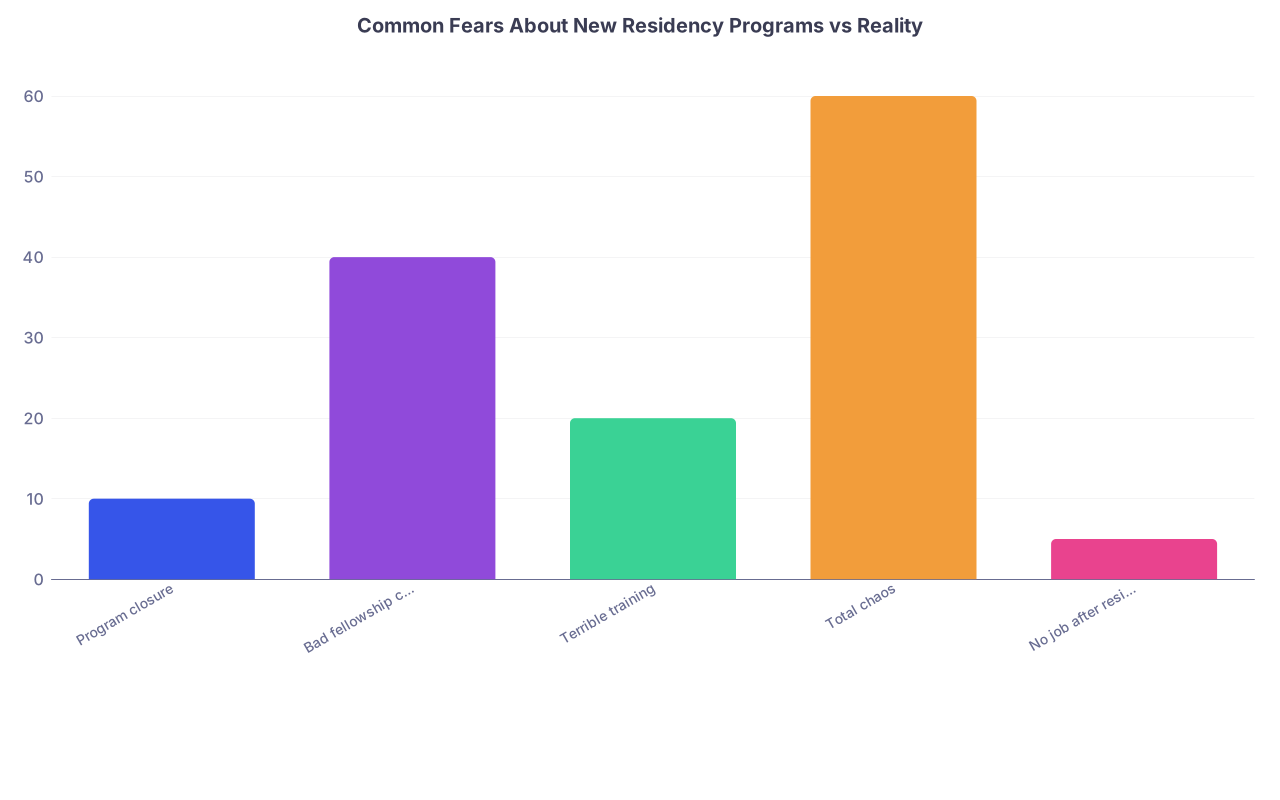
| Category | Value |
|---|---|
| Program closure | 10 |
| Bad fellowship chances | 40 |
| Terrible training | 20 |
| Total chaos | 60 |
| No job after residency | 5 |
(Rough sense: how often these are the real problem, from experience and patterns—not exact stats, but you get the idea.)

| Step | Description |
|---|---|
| Step 1 | New Program on Rank List |
| Step 2 | Rank low or not at all |
| Step 3 | Rank it higher |
| Step 4 | Rank below safer options |
| Step 5 | Institution stable? |
| Step 6 | Leadership trustworthy? |
| Step 7 | Residents reasonably happy? |
| Step 8 | Better gut feeling than older programs? |
FAQs (Exactly 5)
1. Is it dumb to rank a brand-new program #1?
Not automatically. It’s only dumb if your gut hated it, leadership seemed shaky, or the hospital felt unsafe/unstable. If you genuinely liked it more than your other options and the institution/PD seem solid, ranking it #1 is a reasonable, defensible choice. People do this every year and turn out fine.
2. Will a new program hurt my fellowship chances?
It can make things harder if the program has weak research, no subspecialists, and no mentorship in your area of interest. But if they have engaged faculty, some research infrastructure, and you’re willing to hustle, you can still match well. Fellowship directors care more about your performance, letters, and initiative than the age of your program alone.
3. What if the program loses accreditation while I’m there?
If that absolute worst-case scenario happens, ACGME rules kick in. The program and institution have to help you transfer or finish training elsewhere. It’ll be stressful and disruptive, but not career-ending. You won’t be left with “half a residency and nothing.” The real risk is emotional burn-out, not permanent professional damage.
4. Should I rank an older program I disliked above a new program I liked “just to be safe”?
No. That’s how people end up miserable for 3–7 years at places they knew were bad fits. The algorithm is built to honor your true preferences. If you liked the new program more, and the fundamentals (leadership, hospital stability, supervision) check out, rank it higher. “Older” and “safer” are not the same thing.
5. Are PDs and fellowship programs skeptical of new programs?
Some are cautious, sure—but they mostly judge you as an individual: your letters, your interview, your work, your reputation. If your PD and faculty advocate for you and you’ve done decent work, the fact that your program is 3 years old instead of 20 isn’t going to blacklist you. It might mean you explain your program a bit more on the trail, not that you’re automatically at a disadvantage forever.
Key Takeaways
- “New” doesn’t mean “bad”; it means “less proven” and “more variable.”
- The real risks are growing pains and occasional chaos, not career annihilation.
- Rank based on where you’d actually be willing to show up on July 1st—not on abstract fear of the word “new.”


