
Most people are either way behind or way ahead on retirement – and almost nobody knows which.
Let’s fix that. I’ll give you real checkpoints for age 30, 40, and 50, and a simple way to tell in 10 minutes if you’re on track or not.
We’ll skip the vague “save as much as you can” nonsense. You’ll get clear numbers, what they mean, and what to do if you’re off.
Step 1: The Simple Retirement “On Track” Formula
You don’t need a massive spreadsheet to know if you’re roughly on track. You need three numbers:
- Your annual spending (after tax, your lifestyle)
- Your investable assets (401(k), IRA, brokerage, HSAs invested, etc.)
- Your age
Forget income for a second. Retirement is about replacing spending, not salary.
The 25× Rule (Target Number)
A common, reasonably conservative rule of thumb:
- To retire securely, you want about 25× your annual spending invested.
- Spend $60,000/year? Long-term target is about $1.5M.
- Spend $100,000/year? Long-term target is about $2.5M.
That 25× comes from the “4% rule” (you can withdraw ~4% of your portfolio per year, adjusted for inflation, with a decent chance of it lasting 30+ years).
We’ll use this 25× target, then break it into age-based checkpoints.
Step 2: Age 30, 40, 50 – How Many “Times Your Salary” Should You Have?
People obsess over exact multipliers. Don’t. These are ranges, not a pass/fail test.
Better to be “in the zone” than perfect.
Here’s a clean rule-of-thumb table (assumes you want to retire ~65–67).
| Age | Solid Progress | Strong Position | Elite (Very Ahead) |
|---|---|---|---|
| 30 | 0.5× income | 1× income | 2× income |
| 40 | 1.5× income | 3× income | 5× income |
| 50 | 3× income | 6× income | 8–10× income |
Use “household income” if you share finances with a partner.
Are these perfect? No. Are they directionally very useful? Yes.
Age 30: Am I on Track for Retirement?
If you’re 30 and even thinking about retirement, you’re already ahead of most people.
Quick Check at 30
You’re in good shape if:
- You’ve saved about 0.5–1× your gross annual income in retirement and investment accounts.
- You’re saving 10–15% of your gross income toward retirement (including employer match).
- Your debt is under control (no massive credit card balances; student loans have a plan).
You’re behind but fixable if:
- You’ve saved less than 0.5× income, or started saving only in the past year or two.
- Your retirement savings rate is below 10%.
- High-interest debt is eating big chunks of your cash flow.
Example at 30
- Income: $80,000
- “On track” range: $40,000–$80,000 invested for retirement.
- Strong: ~$80,000+
- Elite: ~$160,000+
If you’re at $10,000 and panicking, relax. You still have 35+ years of compounding. The important thing at 30 is behavior, not perfection:
- Automatically save 15–20% into 401(k)/IRA.
- Invest in broad index funds.
- Keep lifestyle creep under control when income goes up.
Here’s the math you can’t see but need to trust: starting at 30, if you save 15% of an $80k salary (about $1,000/month) and earn a reasonable 7% before inflation, you can absolutely reach a seven-figure portfolio by your mid-60s.
Age 40: Is My Retirement Behind, On Track, or Ahead?
At 40, the “I’ll start later” fantasy is over. Compounding still helps, but not as much. The good news: your income is often higher, and you can save more.
Quick Check at 40
You’re in solid shape if:
- You’ve saved 1.5–3× your gross annual income.
- You’re saving 15–20% of income toward retirement.
- You have a coherent investment approach (not random stock picking and crypto roulette).
You’re red-flag territory if:
- You’ve saved less than 1× income for retirement.
- You’re still “planning to start saving more when things settle down” (they never do).
- Most of your net worth is tied up in home equity and not in investable accounts.
Example at 40
- Income: $120,000
- Solid: $180,000–$360,000 invested for retirement.
- Strong: $360,000+
- Elite: $600,000+
If you’re at $60,000 at 40, you’re behind. But it’s not catastrophic if you get serious now.
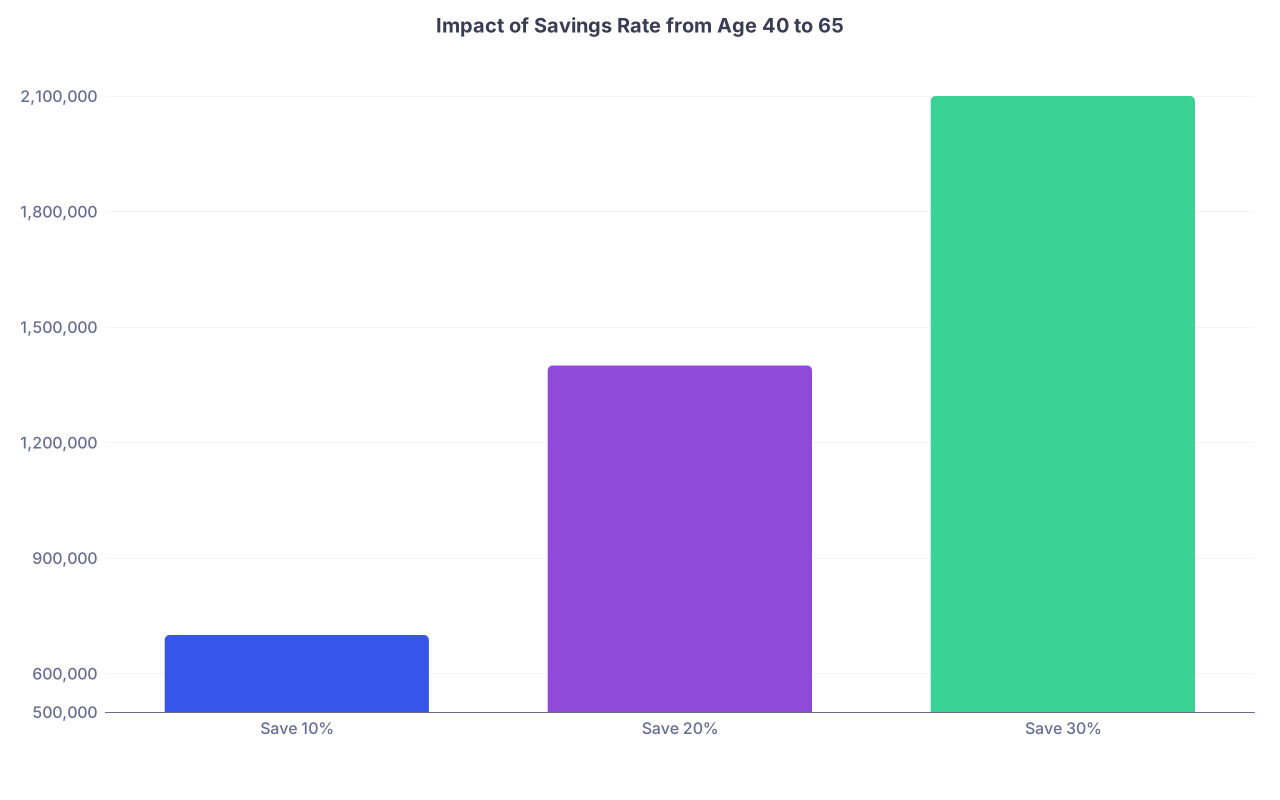
Real talk: at 40, the lever that matters is savings rate, not clever investment tricks.
To illustrate the tradeoff:
| Category | Value |
|---|---|
| Save 10% | 700000 |
| Save 20% | 1400000 |
| Save 30% | 2100000 |
(Assuming $120k income, 3% annual raises, 7% returns, just to give you scale.)
The point: going from 10% to 20% savings matters more than chasing an extra 1% investment return.
At 40, also check these “silent killers”
- Are you planning to pay for large parts of your kids’ college with no savings plan? That hits retirement hard.
- Is your mortgage reasonable, or did you max what the bank approved?
- Are you sitting on cash because “the market seems high”? That cash drag will hurt long term.
Age 50: Can I Still Get on Track for Retirement?
At 50, the story changes. Compounding still helps, but the main driver is what you do in the next 10–15 years.
Quick Check at 50
You’re in decent shape if:
- You’ve saved 3–6× your annual income.
- You can realistically save 20–30% of income for the next 10–15 years.
- Your major debts (credit cards, high-interest loans) are gone or nearly gone.
You’re in trouble if:
- You’ve saved less than 2× income and have no plan to downsize or change lifestyle.
- Health issues are limiting your work years and you have minimal savings.
- You’re “hoping for an inheritance” or a business sale as your main retirement plan.
Example at 50
- Income: $150,000
- Solid: $450,000–$900,000 invested for retirement.
- Strong: $900,000+
- Elite: $1.2–1.5M+
If you’re at $300,000 at 50 and want a comfortable 65+ retirement, you need aggressive but realistic moves:
- Max retirement accounts (401(k) + catch-up contributions, IRA if eligible).
- Consider working longer (to 67–70) and/or spending less.
- Plan to downsize housing or move to a lower-cost area.
Here’s what catch-up contributions can do, roughly:
| Age Group | Employee Limit | Catch-Up | Total Possible |
|---|---|---|---|
| Under 50 | $23,000 | $0 | $23,000 |
| 50+ | $23,000 | $7,500 | $30,500 |
(Using 2024 numbers; these move over time, but the point stands: 50+ gets extra room.)
If you and a spouse both push near max for 10–15 years, you can add hundreds of thousands even starting at 50.
Step 3: The 10-Minute “Am I on Track?” Test
Here’s the quick and dirty method I actually use with people:
Estimate your retirement spending
- Take current annual spending (not income).
- Assume retirement spending is 70–90% of that, depending on how much you’ll cut (no kids at home, no commuting, mortgage paid off vs. not, etc.). Example: You spend $80,000 now. Use $60,000–$70,000 as a retirement spending target.
Multiply by 25
- If target spending is $70,000 → long-term target = $1.75M.
Get your current “retirement multiple”
- Take current investable retirement assets (401(k), IRA, taxable investments).
- Divide by your current annual spending. Example: $300,000 saved / $80,000 spending = 3.75× spending.
Compare to age rough targets
Very rough but useful:
- Age 30: 0.5–1× spending
- Age 40: 1–2× spending
- Age 50: 2–4× spending
- Age 60: 4–8× spending
If you’re below these, you’re behind. Above them, you’re ahead.
Step 4: Legal & Account Structure Stuff People Ignore
You can be “on track” financially and still blow it legally or structurally. A few non-negotiables:
Use the right account types
401(k)/403(b): Use if offered, especially for employer match. That match is free money.
Traditional vs. Roth:
- Traditional: lowers taxes now, pay taxes later.
- Roth: pay taxes now, tax-free later. A common approach: earlier in career (lower income), favor Roth. Later (higher brackets), more Traditional. But mixed “tax buckets” in retirement is ideal.
IRA: Use if you don’t have a 401(k), or to add more tax-advantaged space (Roth IRA if income allows, backdoor Roth if higher income and appropriate).
HSA (Health Savings Account): Triple tax advantage, fantastic stealth retirement account if you can cash flow current medical costs.
Get the basic legal protections in place (by 40 at the latest)
- Updated beneficiary designations on all retirement accounts.
- A basic will.
- Durable power of attorney and healthcare proxy/advance directive.
- If you’re married or have kids, serious consideration of term life insurance to protect your family if you’re gone before retirement savings are complete.
Skip this stuff and you can create a financial mess for the people you care about, even if the account balances look great.
Step 5: What If I’m Behind at 30, 40, or 50?
Being behind isn’t a moral failure. It’s just information. Use it.
Here’s the hierarchy of fixes that actually move the needle:
Raise your savings rate
- Go from 5% to 15%. Or 10% to 20%.
- Easiest way: lock in all raises for a few years as increased savings, don’t inflate lifestyle.
Cut recurring big-ticket items
- Housing, cars, subscriptions, lifestyle creep.
- One refinance, one downsize, one car downgrade can free more than cutting 100 small expenses.
Extend your working years
- Even working part-time to 68–70 can massively reduce how much you need.
- Working 3–5 more years is often more realistic than magically finding $1M.
Invest sanely, not perfectly
- Low-cost index funds, mostly stocks when you’re younger (30s, 40s), gradually more bonds or safer assets later.
- The worst plan is perpetual cash because “the market feels scary.”
Right-size your expectations
- Maybe retirement is less “villa on the beach” and more “nice, sane life with travel every other year.”
- That’s not failure. It’s reality-based planning.
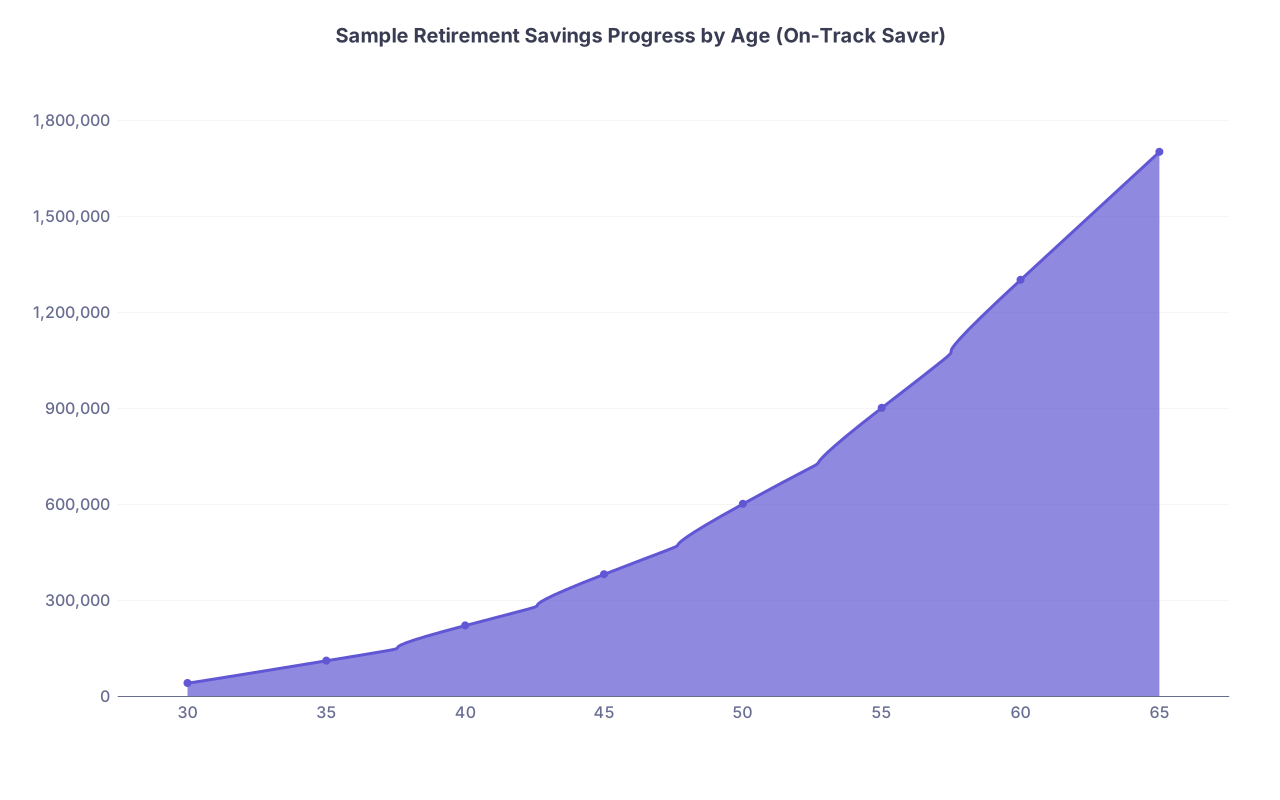
Visual: Rough Progress by Age
Just to orient your expectations:
| Category | Value |
|---|---|
| 30 | 40000 |
| 35 | 110000 |
| 40 | 220000 |
| 45 | 380000 |
| 50 | 600000 |
| 55 | 900000 |
| 60 | 1300000 |
| 65 | 1700000 |
This is one scenario (someone starting solidly in their mid-20s at a moderate salary with regular raises and 15–20% savings). Your line will be messier. That’s fine. Direction matters more than perfection.
Key Takeaways
- At 30, aim for 0.5–1× income saved and a 10–15% savings rate. The behavior matters more than the balance.
- At 40, aim for 1.5–3× income saved and 15–20% savings rate. If you’re below 1×, you need to get aggressive now.
- At 50, aim for 3–6× income saved, ramp up savings, and tighten your retirement expectations (age, lifestyle, location) so the math actually works.
FAQ (Exactly 7 Questions)
1. How much should I have saved for retirement by 30?
Ideally about 0.5–1× your gross annual income invested in retirement or brokerage accounts. If you’re at 0.25× or less, you’re behind but have lots of time. Focus on getting to a 10–15% savings rate and investing in broad, low-cost index funds.
2. I’m 40 and have nothing saved. Is it hopeless?
No, but it’s urgent. You’ll likely need to:
- Save 25–30% of your income going forward,
- Plan to work longer (into late 60s), and
- Consider a lower-cost retirement lifestyle (location, housing, spending).
You don’t have the luxury of procrastinating another 5 years. Get a concrete plan, automate savings, and ignore short-term market noise.
3. Should I prioritize retirement savings or paying off debt?
Kill high-interest debt (credit cards, personal loans) aggressively while still putting at least enough into retirement to get any 401(k) match. For lower-rate debt (mortgage, federal student loans), it’s usually smarter to contribute meaningfully to retirement (10–15%+) while paying those on schedule.
4. What investment mix should I use at 30, 40, and 50?
Rough guidelines many target-date funds use:
- 30s: 80–90% stocks, 10–20% bonds/cash
- 40s: 70–85% stocks, 15–30% bonds/cash
- 50s: 50–70% stocks, 30–50% bonds/cash
You don’t need to micromanage individual stocks—one good target-date fund or a simple 2–3 fund index portfolio is usually enough.
5. Should I count my home equity as retirement savings?
Partially. Don’t count the entire home value, because you still need a place to live. What matters is net equity you can realistically unlock by downsizing or moving. For planning, treat home equity as a secondary cushion, not your primary retirement funding source.
6. How do I factor Social Security into “on track” calculations?
Most people should assume Social Security will cover 20–40% of their retirement spending. You can roughly estimate your future benefit from SSA.gov. A conservative move is to ignore it while building your plan, then treat it as a bonus or margin of safety later.
7. How often should I check if I’m on track for retirement?
Once a year is plenty. Do a quick annual check:
- Update your total investable assets
- Compare to your income and to the age-based ranges
- Confirm your savings rate (percentage of income going to retirement)
Daily or monthly checking leads to bad emotional decisions. Yearly checkups, course corrections as needed—that’s how adults handle this.