
The typical physician needs fewer retirement accounts than you think—and more structure than you probably have right now.
Let me give you the straight answer first, then we’ll unpack it.
For most attendings, a clean, high-functioning setup looks like this:
- Employed doc: 3–5 accounts
- Private practice / partner / 1099-heavy: 4–6 accounts
Anything beyond that is usually complexity theater. It makes you feel busy, not rich.
Here’s the breakdown and how to decide what you actually need.
The Core Answer: The “Default” Number of Accounts
If you’re a W‑2 employed physician (hospital, large group, academic), this is the sensible target:
- Employer plan #1 – 401(k) or 403(b)
- Roth IRA (possibly via backdoor)
- Taxable brokerage account
Optional, depending on your situation:
- 457(b) (if offered and if it’s a good plan)
- HSA (if you’re in a high-deductible health plan and can afford to fully fund it)
So: most employed physicians will land at 3–5 retirement-related accounts.
If you’re in private practice, part-owner, or do substantial 1099 work, you might add:
- Solo 401(k) (for 1099 income) or practice 401(k) as owner
- (Sometimes) a defined benefit or cash balance plan
That pushes you into the 4–6 account range. Beyond that, usually not necessary.
Step 1: Know the Main Account Types (Without Getting Lost in Alphabet Soup)
You do not need every account your benefits guide mentions. You need the right mix of these main buckets:
| Account Type | Typical Use |
|---|---|
| 401(k) / 403(b) | Primary employer retirement plan |
| 457(b) | Extra deferral if available, often for hospital systems |
| IRA / Roth IRA | Personal tax-advantaged retirement space |
| HSA | Triple-tax-advantaged stealth retirement account |
| Solo 401(k) | For 1099 or side-gig income |
| Defined Benefit / Cash Balance | Extra pre-tax savings for high earners |
401(k) / 403(b)
This is usually your main retirement account as an employed doc.
- You almost always want this.
- You can contribute up to the IRS employee limit (e.g., $23,000 in 2024; plus catch-up if 50+).
- Some hospitals also add employer matches or non-elective contributions. Take them. It’s part of your compensation.
457(b)
Common at big hospital systems and universities.
Two flavors:
- Governmental 457(b) – generally safer, portable (you can roll it over when you leave)
- Non-governmental 457(b) – technically employer assets, subject to employer creditors
If it’s governmental and has good low-cost index options, it’s usually worth using. Non-governmental requires more caution and plan-specific analysis.
IRAs (Traditional + Roth)
As a high-income physician, you’re often over the income limit for direct Roth IRA contributions. So you’re looking at:
- Backdoor Roth IRA – contribute to traditional IRA (non-deductible), then convert to Roth
- Great for tax-free growth and flexibility later
Almost every attending should have a Roth IRA in their name. Same for spouse if married and eligible.
HSA
If you’re in a high-deductible health plan and can afford it:
- Contributions are pre-tax
- Growth is tax-free
- Withdrawals for qualified medical expenses are tax-free
And you can treat it as a long-term retirement account by investing it and not spending it now, then using it tax-free in retirement.
Solo 401(k)
If you do any 1099 work:
- Perfect for moonlighting, consulting, telemedicine, expert witness work
- Lets you stash both “employee” (if you haven’t maxed at your W‑2 job) and “employer” contributions from that 1099 income
- Much better than a SEP-IRA if you’re doing backdoor Roths (because SEP-IRA complicates the tax pro-rata rules)
Cash Balance / Defined Benefit Plan
This is the “I’m making a lot of money and need more pre-tax space” solution for practice owners or high-earning partners.
- High contribution limits, actuarially determined
- More administrative hassle, usually needs a third-party administrator (TPA)
- Good once you’re already maxing 401(k)/profit share and still have big surplus
This is not a first-step account. It’s a refinement for later in your career or for very high savers.
Step 2: Map This to Real Physicians (3 Common Scenarios)
Let’s run you through what this looks like in real life.
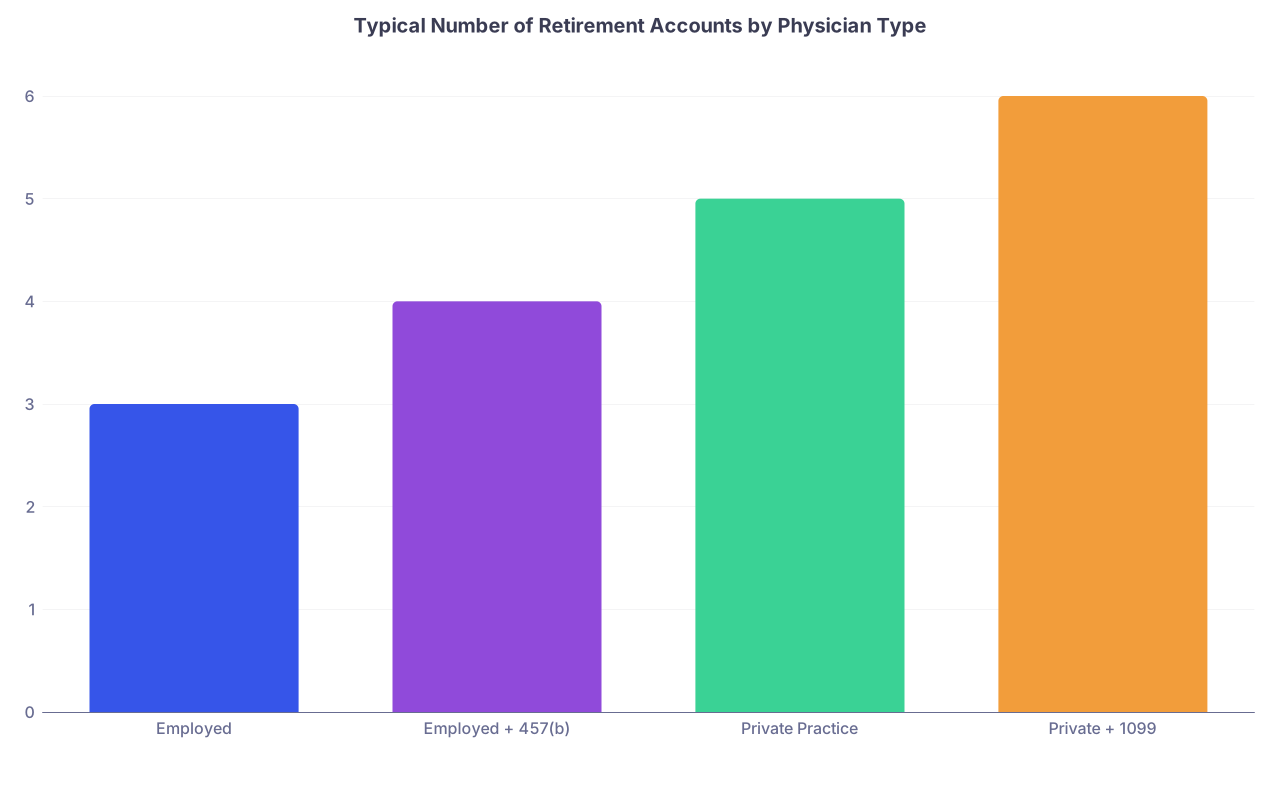
| Category | Value |
|---|---|
| Employed | 3 |
| Employed + 457(b) | 4 |
| Private Practice | 5 |
| Private + 1099 | 6 |
Scenario 1: Employed Hospitalist or Hospital‑based Specialist
W‑2, single employer, standard benefits:
- 403(b) or 401(k) – max this
- Roth IRA (via backdoor) – yearly
- Taxable brokerage – where extra savings go
Optional:
- 457(b) – if governmental and decent, you can also max this
- HSA – if you’re in a high-deductible plan and can handle the cashflow
Target: 3–5 accounts. You don’t need more.
Scenario 2: Academic Physician
You’ll often have:
- 403(b) – main retirement plan
- 457(b) – optional second big bucket
- Roth IRA – backdoor each year
- HSA – often available
- Old 403(b)/401(k) from residency or previous jobs
You’re functionally in the same boat: combine old employer plans where reasonable, keep one main 403(b), one 457(b), one Roth IRA, plus taxable, plus maybe an HSA.
Again: 4–6 accounts, tops, even with a long career.
Scenario 3: Private Practice / Partnership
Let’s say you’re in a small group, S‑corp/partnership, or own the practice:
- Practice 401(k) (maybe with profit sharing) – your primary engine
- Cash balance / defined benefit plan – if you’re a high earner and want more pre-tax
- Roth IRA – backdoor yearly
- Taxable brokerage – for flexible investing
- HSA – if your practice uses HSA-eligible plans
- Solo 401(k) – if you also have separate 1099 income outside the practice entity
You can hit 5–7 accounts, but the structure is still simple if you’re using the same investment philosophy (usually total-market index funds) across all of them.
Step 3: When Do You Have Too Many Accounts?
You’ve crossed the line from “organized” to “mess” when:
- You have more than 2–3 old 401(k)/403(b) accounts scattered from prior jobs
- You’re not sure where all your accounts are or how much is in each
- You can’t list your accounts from memory in under 30 seconds
- Your investment allocations are wildly different across accounts just because you forgot to standardize them
Common messes I see:
- One 401(k) from residency, one from fellowship, two from prior hospitals, current 403(b), plus two IRAs, plus an HSA. None rolled over.
- Multiple annuities or “advisors” set up random IRAs at different firms that you’ve never moved or consolidated.
- Roth IRAs at three different brokerages because of prior bank bonuses or advisor switches.
You do not get bonus returns for account count. If anything, the opposite.
Step 4: How to Consolidate Without Screwing Up
This is where many physicians hesitate. They know they’ve got clutter but worry about taxes and penalties.
Here’s the sensible consolidation playbook.

| Step | Description |
|---|---|
| Step 1 | List All Accounts |
| Step 2 | Consider Rollover to Current 401k |
| Step 3 | Decide - Keep, Roll, or Convert |
| Step 4 | Roll In |
| Step 5 | Roll to IRA |
| Step 6 | Avoid Pre Tax IRA - Use 401k |
| Step 7 | Can Consolidate to One IRA |
| Step 8 | Employer Plan or IRA? |
| Step 9 | Current Plan Low Cost? |
| Step 10 | Doing Backdoor Roth? |
What you typically consolidate
Old 401(k)/403(b) accounts → into:
- Your current employer plan (if it’s low-cost and flexible), or
- A single rollover IRA at a major brokerage (Vanguard, Fidelity, Schwab)
Multiple IRAs of the same type → combine at one custodian
Multiple HSAs → pick one good HSA custodian with solid investment options, roll the rest there
Where you need caution
Backdoor Roth users:
You want no pre-tax money in traditional/SEP/SIMPLE IRAs on 12/31 each year, or the pro-rata rule wrecks your backdoor Roth clean-up.
Solution: roll pre-tax IRA assets into an employer 401(k) or solo 401(k) when possible.Non-governmental 457(b):
These usually cannot be rolled into an IRA. You decide whether to keep contributing based on employer stability and plan rules, not consolidation convenience.Money with large surrender charges (annuities, loaded funds):
You may need a plan to exit over time; do not just yank the plug blindly. But you still aim to simplify.
Step 5: Tax Diversification vs. Account Sprawl
Some people justify 10+ accounts by saying they’re “tax diversified.”
Nice phrase. Misused constantly.
Real tax diversification is about having money in three main tax buckets:
- Pre-tax (401(k), 403(b), traditional IRA, cash balance plan)
- Roth (Roth IRA, Roth 401(k)/403(b))
- Taxable (brokerage account, invested HSA withdrawals if used non-medically after 65, etc.)
You can achieve excellent tax diversification with:
- One pre-tax employer plan
- One Roth IRA (and/or Roth sub-account in 401(k))
- One taxable account
You do not need four different Roth IRAs and five different 401(k)s to pull this off.
Step 6: A Simple Portfolio Across All Accounts
Here’s where the real efficiency lives: same basic asset allocation everywhere, adjusted slightly for account type.
Example: you decide on 70% stocks / 30% bonds overall.
You might implement:
- 401(k): mostly bonds + some stock index funds
- Roth IRA: all stock index funds (higher growth, tax-free)
- Taxable: tax-efficient stock index funds (total market, total international)
- HSA: 100% stock index funds if you’re treating it as long-term retirement money
The number of accounts matters less if:
- You’re using low-cost index funds
- Your overall allocation is controlled at the household level
- You automate contributions
But even then, fewer accounts means less maintenance and fewer chances to drift off-plan.
Red Flags That You’ve Been Oversold Complexity
I’ve seen these patterns way too often in physician finances:
- An “advisor” has you in multiple variable annuities plus several “strategies” at different firms
- You’ve got IRAs at 3+ custodians with overlapping, expensive active funds
- You can’t tell me in one sentence what your investment plan is (“Uh, well, I have a guy who does my stuff” is not a plan)
If any of that sounds like you, the problem isn’t just number of accounts. It’s ownership of your own strategy.
You want:
- One core plan
- A small handful of accounts executing that plan
- Enough simplicity that you can explain it to a co-resident in 60 seconds and they’d get it
Putting It All Together: What You, Personally, Should Have
Here’s a simple matrix you can use. Pick the row that sounds like you.
| Situation | Recommended Accounts |
|---|---|
| Employed, no 457(b) | 401(k) + Roth IRA + Taxable (+/- HSA) |
| Employed, good 457(b) | 401(k)/403(b) + 457(b) + Roth IRA + Taxable (+/- HSA) |
| Academic with prior jobs | Current 403(b) + 457(b) + Roth IRA + Taxable (+ HSA, consolidate old plans) |
| Private practice owner | 401(k) (with profit share) + Roth IRA + Taxable (+/- HSA, +/- Cash Balance) |
| Employed + 1099 side work | Employer 401(k)/403(b) + Solo 401(k) + Roth IRA + Taxable (+/- HSA, +/- 457(b)) |
If you’re way beyond that—eight, ten, twelve accounts—you’re probably carrying historical clutter you can safely consolidate.
, Early Attending, Mid-career (Ideal), Mid-career (Cluttered)](https://cdn.residencyadvisor.com/images/articles_svg/chart-physician-retirement-accounts-clutter-vs-ideal-3292.svg "Physician Retirement Accounts - Clutter vs Ideal")
| Category | Value |
|---|---|
| [Resident/Fellow](https://residencyadvisor.com/resources/retirement-planning-for-doctors/how-much-should-i-save-for-retirement-as-a-resident-vs-attending) | 2 |
| Early Attending | 3 |
| Mid-career (Ideal) | 4 |
| Mid-career (Cluttered) | 9 |
Quick Self-Check: Your Retirement Account Audit
Take 5 minutes and do this right now:
- Write down every retirement-related account you have: name, type, custodian, balance.
- Circle any account from a former employer.
- Circle any IRA that is pre-tax (traditional, rollover, SEP, SIMPLE).
- Ask:
- Can I consolidate this old employer plan into my current plan or a single IRA?
- Am I trying to do backdoor Roths and still holding a big pre-tax IRA (bad combo)?
- Do I have more than 5–6 accounts as a typical employed doc?
Your goal over the next 6–12 months: move toward one main employer plan, one Roth IRA, one taxable, plus a small number of justified extras (457, HSA, solo 401(k), cash balance).

FAQ (Exactly 7 Questions)
1. Is there such a thing as too many retirement accounts?
Yes. Once you’re above 5–6 accounts as a typical employed physician, you’re usually into unnecessary complexity. Old 401(k)s, redundant IRAs, and scattered HSAs clog the system. The goal isn’t to hit some magical minimum, but if complexity keeps you from actually managing and rebalancing your portfolio, you’ve gone too far.
2. Should I roll over old 401(k)/403(b) accounts or leave them?
In most cases, you either roll them into your current employer plan (if it’s good and low-cost) or into a single rollover IRA. Exceptions: if you’re actively using the backdoor Roth strategy and your employer plan is lousy, you might keep an old excellent plan. But the default for most physicians: do not leave a trail of tiny old accounts across five employers.
3. If I do backdoor Roth IRAs, what accounts should I avoid?
You want to avoid having pre-tax money in traditional, SEP, or SIMPLE IRAs on December 31 if you’re doing backdoor Roth conversions. That pre-tax IRA money triggers the pro-rata rule and messes up the tax efficiency. Instead, roll pre-tax IRA balances into an employer 401(k) or solo 401(k) when possible.
4. Is a 457(b) always worth using if my employer offers it?
No. Governmental 457(b) plans with good, low-cost funds are usually excellent. Non-governmental 457(b)s are a different animal—assets technically belong to the employer and are exposed to employer creditors. You evaluate those based on plan quality, employer stability, distribution options, and your comfort with that risk. Many physicians skip a bad non-gov 457(b) even if they could use more tax deferral.
5. How many accounts should my spouse and I have together?
Think in terms of a household plan. Each of you may have your own employer plan and your own Roth IRA, but you can share a joint taxable account. A typical dual-physician couple might have: two 401(k)/403(b)s, two Roth IRAs, one joint taxable, and possibly one or two HSAs and/or 457(b)s. That’s still only 5–7 core accounts, not 15.
6. When does a cash balance or defined benefit plan make sense for a physician?
These plans make sense for practice owners or partners who are: already maxing a 401(k)/profit share plan, have consistent high income, want more pre-tax space, and are willing to commit to recurring contributions for several years. They’re overkill for a new attending or someone with unstable income. Get one only after you have the basics dialed in.
7. What should I do today if I realize I have too many accounts?
Start with a consolidation plan, not a panic transfer. Make a list of all accounts, identify old employer plans, and call your current 401(k)/403(b) provider to ask if they accept roll-ins. Decide where your “home base” brokerage will be (Vanguard, Fidelity, Schwab). Then initiate one consolidation at a time: roll one old plan or one IRA, wait for it to settle, confirm, then move on to the next. Within a few months, you can cut your account count in half.
Open a blank note on your phone or laptop right now and list every retirement-related account you have by name and custodian—if you can’t do that in under 5 minutes, your first job is to clean that list up before you add even one more account.