
Most people get this backward: you usually should not wait to invest for retirement until your student loans are gone.
Let me be direct. If you have access to a retirement account with an employer match, and your loan rates are under roughly 7–8%, the default answer is:
You fund at least the match first, then attack loans with whatever intensity your situation allows.
There are exceptions. But they’re not as common as the internet makes them seem.
Below is the clean decision framework you actually need.
Step 1: Lock Down the Non‑Negotiables (Emergency + Minimums)
Before you argue about “loans vs retirement,” there are two things you do not get to skip:
- A minimal emergency buffer
- Minimum payments on all debts
If you’re in pure survival mode (credit cards maxed, no savings, behind on rent), that’s a different conversation. But assuming you’re at least paying your bills:
Aim for:
- $1,000–$2,500 starter emergency fund if you’re early career, renting, no dependents.
- 1–3 months of essential expenses if you have kids, own a home, or have unstable income.
You do this in cash or high‑yield savings. Not in your 401(k). Not in crypto. Cash.
And you always make minimum payments on student loans. No exceptions. You do not tank your credit and trigger collections to put more into retirement. That’s fantasy‑land advice.
Once that’s in place, then the real choice starts.
Step 2: Get the Employer Match—Almost Always, No Matter What
This is the part people underestimate. An employer match is not “nice to have.” It’s free money.
If your employer offers something like:
- “We match 50% of the first 6% you contribute”
or - “We match 100% of the first 3%”
You should almost never walk away from that. Even if you have student loans. Even if your loans are at 7%. Even if you “hate debt.”
Why? Because the match is an instant, risk‑free 50–100% return on your contribution.
Run a quick example.
Say you earn $70,000 and your employer matches 50% of the first 6%.
You contribute 6% = $4,200.
Employer kicks in 3% = $2,100.
That’s a 50% return on day one before we even talk about market growth or tax benefits.
Your student loan company isn’t charging you 50% interest. They’re charging you maybe 5–8%. The math is not even close.
The framework:
If you have an employer match:
Contribute enough to get the full match before paying extra on loans.If you do not have a match (common for some small businesses, 1099, or academic roles):
Then we do a more direct rate comparison between loans vs expected market return and your personal risk tolerance. But even then, many should still put something into retirement early.
Step 3: Compare Your Actual Loan Rate to Realistic Investment Returns
After the match (if any), the balance shifts to this question:
“Is my expected after‑tax investment return meaningfully higher than my guaranteed loan interest rate?”
You’re not going to earn 15% a year forever (ignore whatever Reddit thread you read). A reasonable, long‑term expectation for a diversified stock-heavy portfolio is closer to 6–8% before inflation, maybe 4–6% real after inflation. Could be better. Could be worse. But that’s a sane planning range.
Now compare that to your effective loan rate:
- Federal student loans: often 4–7%, sometimes more for grad/pro loans.
- Private loans: can be anywhere from 3–12%.
Here’s the basic rule:
If your loan rate is low (under ~4–5%)
→ Strong tilt toward retirement investing after minimum payments and employer match.If your loan rate is moderate (5–7%)
→ Balanced approach: invest (often more than the match) and pay extra on loans in parallel.If your loan rate is high (above 7–8%)
→ Aggressively pay those down after the match. They’re acting like a guaranteed negative return.
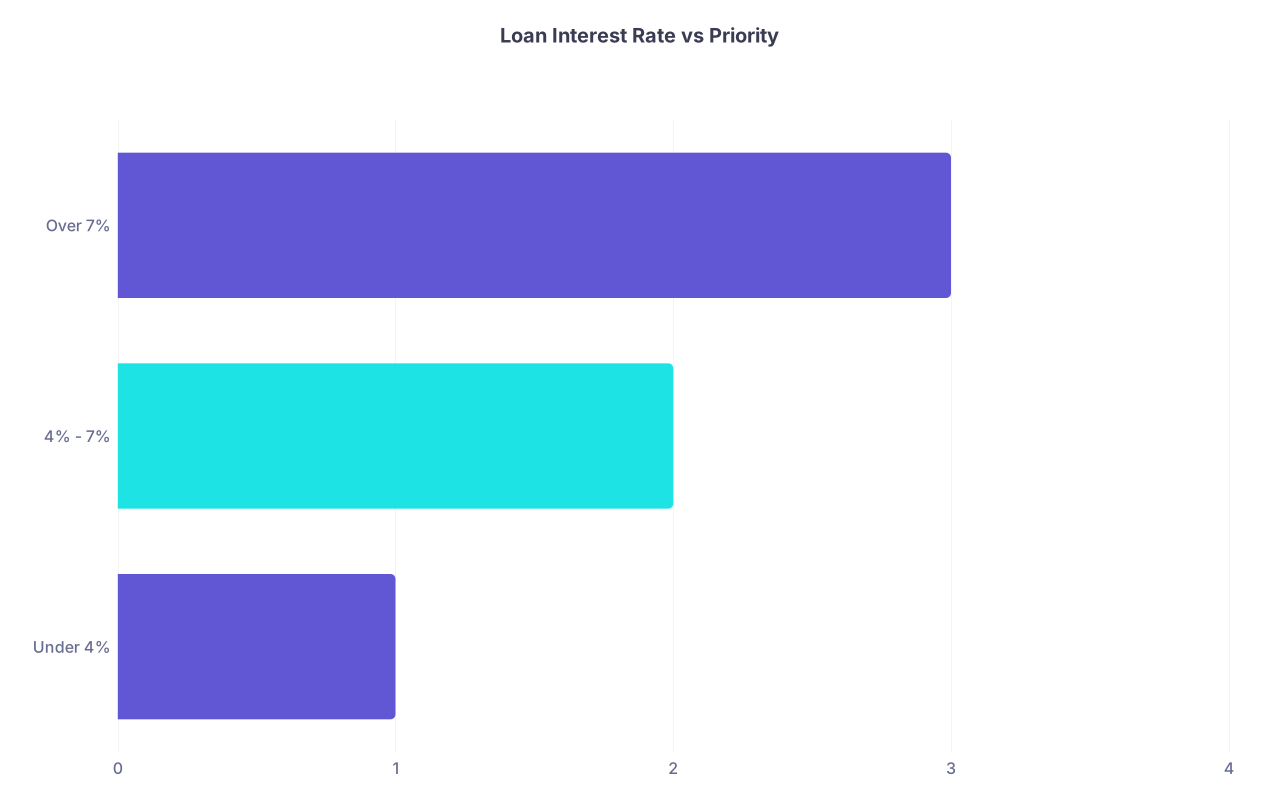
| Category | Value |
|---|---|
| Under 4% | 1 |
| 4% - 7% | 2 |
| Over 7% | 3 |
Think of that chart not as “good/bad,” but as priority levels: 1 = strongly favor retirement, 3 = strongly favor payoff.
Step 4: Factor in Tax Benefits and Protections
Retirement contributions and student loans both interact with taxes and federal protections. Ignoring that is a mistake.
Student loans:
- Federal loans come with income-driven repayment (IDR), deferment, forbearance, and potential forgiveness (PSLF and IDR forgiveness).
- Interest may be deductible up to a cap if your income is under a threshold.
- During periods like the CARES Act pause, federal loans have had 0% interest and no payments required—massively tilting in favor of investing.
Retirement accounts:
- Traditional 401(k)/403(b)/IRA: tax deduction now, tax later.
- Roth 401(k)/Roth IRA: no deduction now, tax‑free growth and withdrawals later.
- Contributions lower your taxable income (for traditional), and employer match is free money plus tax-sheltered growth.
If you’re in a high tax bracket, those retirement deductions are worth more. That again tilts things toward retirement contributions over extra loan payments, especially on low‑ to mid‑rate loans.
Step 5: Use a Simple Tiered Priority System
Here’s the practical stack I use with most people (adjusted for edge cases):
| Priority | Action |
|---|---|
| 1 | Build starter emergency fund |
| 2 | Pay minimums on all debts |
| 3 | Contribute to retirement up to full employer match |
| 4 | Pay off high-rate debt (credit cards, >8% loans) |
| 5 | Increase retirement savings (10–15%+ of income) |
| 6 | Pay off remaining student loans faster if desired |
This is not rigid doctrine. But it’s a reasonable default for 80–90% of people.
If you’re a physician with $300k at 6.8% and aiming for PSLF? Different rules. If you’re a teacher with PSLF-eligible loans and low salary? Different rules. But we’ll hit those nuances in a second.
Step 6: Situations Where You Actually Should Prioritize Loans First
There are real cases where throwing every extra dollar at loans makes sense.
You probably prioritize speedy loan payoff (after the match and emergency starter) if:
You have high‑rate private loans
Example: 9–11% private loans from a for‑profit school, no forgiveness options. Those are toxic. After grabbing any match, you attack these like your hair is on fire. Refinancing may help if you can get a lower fixed rate with a reputable lender.You’re extremely debt‑averse and it affects your life
Money is math plus psychology. If the existence of debt keeps you from sleeping or makes you freeze and avoid dealing with your finances, the emotional payoff of eliminating it faster may be worth slightly less optimized math.You’re close to payoff and it unlocks something big
Say you’re 1–2 years from being debt‑free, and paying it off lets you qualify for a mortgage you want or drop to part‑time. In that window, accelerating payoff over extra retirement contributions can be reasonable.
But “I just hate debt” is not always a good enough reason to sacrifice a 100% employer match. That’s like refusing free groceries because you don’t like coupons.
Step 7: When You Should Absolutely Not Rush to Pay Off Loans
On the flip side, here are scenarios where paying loans too aggressively is usually a mistake:
You are pursuing Public Service Loan Forgiveness (PSLF)
If you work for a qualifying employer (government, many nonprofits, academic hospitals) and are on an income‑driven plan, extra payments are basically lighting money on fire. PSLF forgives the remaining balance after 120 qualifying payments. Why pay extra if forgiveness will wipe the remainder?You’re on an IDR path where forgiveness is realistic
For very high debt‑to‑income situations (think $250k+ loans, $60–90k income long-term), IDR forgiveness after 20–25 years may be the rational route. In that case, you prioritize retirement and taxable investments because your loan payment is more of a tax than a true “debt” in the traditional sense.Your employer offers insane matching or profit sharing
Some employers effectively dump 8–10%+ of your salary into retirement if you contribute modestly. Turning that down to pay a 5–6% loan faster is just bad math.You have no or tiny retirement savings in your 30s or 40s
If you’re 35 with $0 in retirement and still have student loans, you can’t afford to wait another 10 years to start investing. Compounding time is the one thing you never get back.
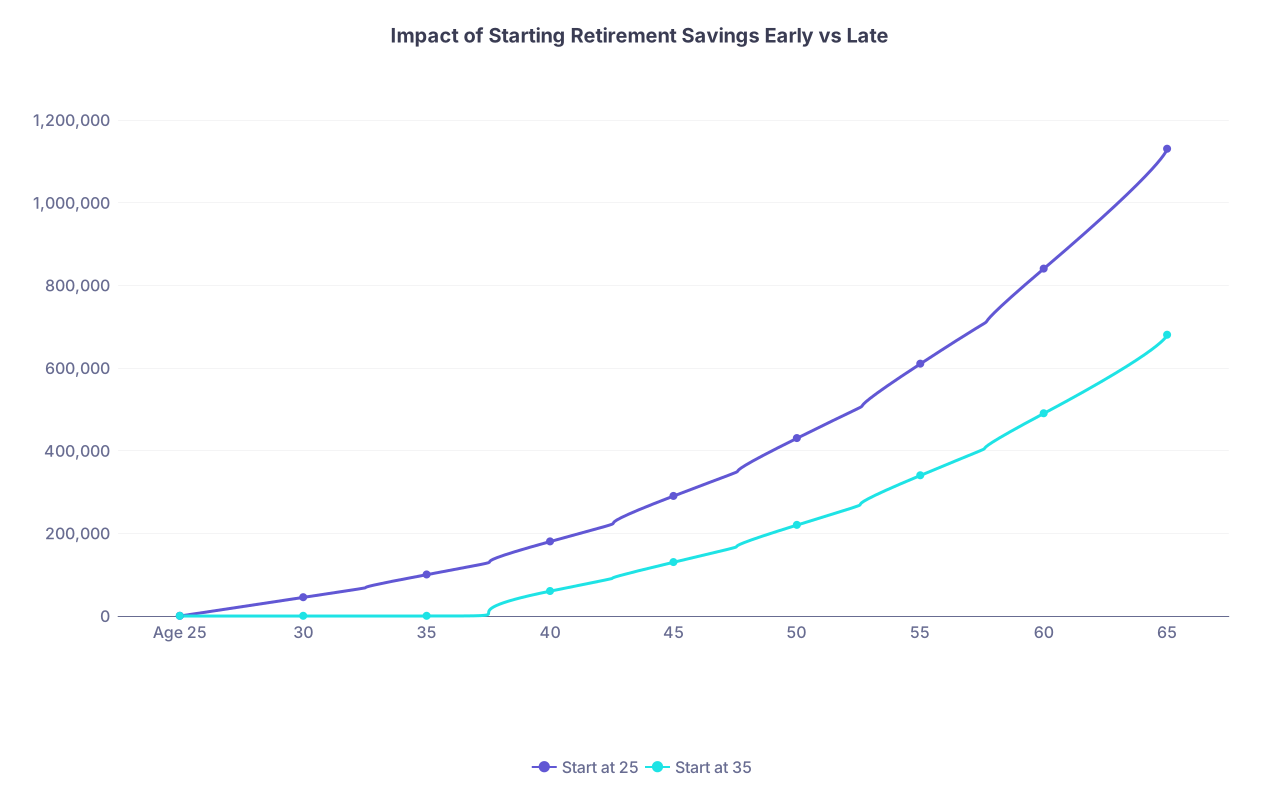
| Category | Start at 25 | Start at 35 |
|---|---|---|
| Age 25 | 0 | 0 |
| 30 | 45000 | 0 |
| 35 | 100000 | 0 |
| 40 | 180000 | 60000 |
| 45 | 290000 | 130000 |
| 50 | 430000 | 220000 |
| 55 | 610000 | 340000 |
| 60 | 840000 | 490000 |
| 65 | 1130000 | 680000 |
That chart is illustrative, not exact, but the gap is real. Starting 10 years later costs you hundreds of thousands in potential growth.
Step 8: How to Actually Split Dollars Month to Month
You don’t need a perfect equation. You need a rule you’ll actually follow.
Here’s a simple model that works for many:
- Get the full match.
- Then allocate your “extra” monthly cash like this:
- If loans <5%: 80–90% to retirement, 10–20% extra to loans.
- If loans 5–7%: 50–70% to retirement, 30–50% extra to loans.
- If loans >7–8%: 20–40% to retirement, 60–80% extra to loans (after match).
Make it automatic. Set your 401(k) contribution percentage and auto‑pay extra on loans. If you leave it to “see what’s left at the end of the month,” there will never be anything left.
Step 9: Example Scenarios
Let’s make it concrete.
Scenario 1: 28‑year‑old with moderate loans and a match
- Income: $80,000
- Loans: $40,000 federal at 5.5%
- Employer match: 4% dollar‑for‑dollar 401(k) match
Good plan:
- Build a $3,000 emergency fund.
- Pay minimums on loans.
- Contribute 4% to 401(k) to get 4% match.
- Next, push 6–8% more to retirement (total 10–12% of income), and throw any extra cash at loans if you want them gone sooner.
You do not wait until loans are gone to invest.
Scenario 2: 32‑year‑old teacher on PSLF track
- Income: $52,000
- Loans: $90,000 federal, all PSLF‑eligible
- Employer: Public school, qualifies for PSLF
- Employer retirement: Pension + optional 403(b) with small match
Plan:
- Make sure you are on an income‑driven repayment plan and certifying employment for PSLF annually.
- Pay only the required IDR payment—no extra.
- Contribute at least enough to get any match, plus probably more into a 403(b) or Roth IRA, since most of your loans will likely be forgiven.
Extra loan payments here are almost always a bad move.
Scenario 3: 26‑year‑old with high‑rate private loans, no match
- Income: $60,000
- Loans: $50,000 private at 9.5%
- Employer: No retirement match
Plan:
- Get a $1,500–$2,000 emergency fund.
- Pay minimums on all debts.
- Consider refinancing to a reputable lender if you can reduce rate materially (and you’re not sacrificing federal protections—though these are private already).
- Then, aggressively pay down loans, but still consider putting 5–10% into a Roth IRA if you can tolerate slightly slower payoff. If the high rate bothers you, you can reasonably go “all‑in” on payoff for a couple of years, then ramp savings aggressively.
Step 10: Do Not Ignore Non‑Financial Factors
Last piece—this isn’t just math.
I’ve seen people so obsessed with being “debt‑free by 30” that they:
- Skipped vacations for a decade
- Delayed having kids
- Put $0 into retirement until 35
- Then realized they bought themselves a nice zero‑debt life… with no assets and no compounding.
On the other hand, I’ve seen folks invest heavily while making minimum payments on 3–4% loans, retire in their 50s, and shrug off the fact that they technically carried “debt” for a long time. Because their net worth dwarfed it.
You have to pick the life you actually want, not the one that wins an internet argument.

| Step | Description |
|---|---|
| Step 1 | Start |
| Step 2 | Build emergency fund |
| Step 3 | Pay all minimum debts |
| Step 4 | Contribute to match |
| Step 5 | Skip to compare rates |
| Step 6 | Prioritize extra loan payoff |
| Step 7 | Split extra to retirement and loans |
| Step 8 | Reevaluate yearly |
| Step 9 | Employer match available |
| Step 10 | Loan rate over 7 |
Quick Summary
- Get a small emergency fund and pay all minimum loan payments.
- Almost always grab your full employer retirement match before paying extra on loans.
- Then let your loan interest rate, tax benefits, and forgiveness options guide whether you lean harder toward loan payoff or retirement savings.
FAQ (Exactly 7 Questions)
1. Is it ever smart to stop retirement contributions entirely to pay off student loans?
Yes, but rarely. If your loans are very high rate (usually private loans above ~8–9%) and you have no employer match, going “all‑in” on payoff for a couple of years can make sense. Otherwise, completely pausing retirement—especially in your 20s and 30s—is usually too costly in lost compounding.
2. What if I feel guilty investing while I still have debt?
That guilt is common, but not always rational. Investing with a match and reasonable loan rates is often the smarter move. Reframe it: you’re not “ignoring” debt, you’re running a two‑track plan—protecting your future self and handling your obligations.
3. Should I contribute to a Roth or traditional account if I still have loans?
If you’re early in your career and in a relatively low tax bracket, a Roth IRA or Roth 401(k) is often a good choice: you lock in tax‑free growth. If you’re in a high bracket now, traditional contributions can help lower taxable income, which may also reduce income‑driven loan payments slightly.
4. How much should I aim to contribute to retirement while I still have student loans?
A solid target is 10–15% of gross income to retirement, including any employer match. If you cannot get there yet, start with enough to get the match and increase 1–2% per year. You want that percentage rising over time, even if loans are still around.
5. Should I refinance my student loans before increasing retirement contributions?
If you have high‑rate private loans and can safely refinance to a lower fixed rate, yes, consider it. For federal loans, be extremely careful: refinancing kills federal protections and forgiveness options. I’d rarely refinance federal loans for a modest rate drop.
6. What if I plan to go back to school or change careers soon?
You may want a larger cash buffer and more flexibility. That might mean: match the employer retirement, keep extra cash instead of heavy loan prepayments, and wait until your new situation is clear before committing to an aggressive payoff or savings plan.
7. How often should I revisit my “loans vs retirement” decision?
At least once a year or with any major change—new job, big raise, marriage, kids, refinancing, or switching to/from PSLF. This isn’t a one‑time decision; it’s a slider you adjust as your income, loan rates, and goals evolve.