
What if buying into a practice actually delays your early retirement instead of accelerating it?
Let me be blunt: “Buying into the practice” is one of the most over-romanticized financial moves physicians make. It can either be a powerful wealth accelerant…or a golden handcuff that quietly pushes your financial independence date back by 5–10 years.
You said your main goal is early retirement. Good. That’s the right starting point. So the real question isn’t “Should I buy in?” but:
Does buying into this specific practice get me to financial independence faster, safer, and with more control than alternatives?
Let’s walk through that—like an actual decision, not a sales pitch.
Step 1: Know What “Early Retirement” Means for You
Before you touch the buy-in offer, you need real numbers, not vibes.
Define three things:
Your target FI (financial independence) number
How much invested wealth do you need so you don’t have to work?
A quick-and-dirty rule:- Annual spending x 25 = approximate FI target
Example: - You want to live on $180k/year → $180k x 25 = $4.5M invested.
- Annual spending x 25 = approximate FI target
Your timeline
- Are you aiming to retire at 45? 50?
- How many years from now?
Your current trajectory without buying in
- Current income (after tax)
- Current savings/investing rate
- What age you’re on track to hit your FI number if nothing changes
If you don’t know this, you’re negotiating blind. You can’t know whether a buy-in helps or hurts your early retirement unless you see how it changes your timeline vs. just staying employed or doing something like locums.
Step 2: Understand What You’re Actually Buying
Most doctors hear “partnership” and think “status + more money.” Not good enough.
You’re not buying status. You’re buying:
- A stream of future cash flows (profit distributions)
- A slice of practice equity (which may or may not actually be worth anything when you sell)
- A seat at the table (control, headaches, and legal responsibility)
Break it down into three buckets:
1. Income effect (does your annual pay really increase?)
Ask: “What is my realistic take-home as an owner vs as an employee?”
- Salary/draw
- Bonus/production
- Profit distributions
- Owner-only perks (health, retirement plan setup, pre-tax benefits)
Then subtract:
- Extra unpaid admin time
- Buy-in loan payments
- Higher malpractice or tail exposure
- Required capital calls or future buy-ins (building, ASC, EMR, etc.)
You care about net take-home after tax, after debt, after hassle.
If being an owner only adds, say, $40k/year but locks you in, that’s often not enough to justify the risk if early retirement is your top priority.
2. Equity value (is this actually an asset or just a mirage?)
You’re told “The practice is worth $2M,” or “Buy-in is 1x collections,” or some other black-box number.
You want to know:
- How was the value calculated? (independent valuation or partner fairy dust?)
- What are you buying exactly:
- Just the practice operations?
- Real estate?
- Ancillary services (ASC, imaging, PT, lab, med spa)?
- What did prior partners pay compared to you?
- How do partners get bought out, and at what formula?
If your eventual buy-out is based on book value or some arbitrary formula that gets capped, your equity may be more like a forced savings account than a real marketable asset.
3. Risk and liability
As an owner, you’re now closer to the line when:
- The practice gets sued (beyond individual malpractice)
- A payer claws back years of reimbursements
- A bad partner does something illegal or stupid
- Revenue tanks from a contract loss, regulatory change, or hospital opening a competing service line
If you’re trying to retire early, excess risk that doesn’t come with excess return is dumb. Period.
Step 3: Compare Scenarios: Employee vs Owner vs Alternative Path
This is where early retirement either moves closer…or slides further away.
Let’s oversimplify to show the logic.
Assume:
- You need ~$4M to hit FI.
- You have $1M now.
- You’re 40 years old.
- Investment return: 5–7% per year.
Scenario A: Stay as Employee
- Take-home: $320k
- You invest: $140k/year
Timeline to $4M: roughly 10–12 years.
Scenario B: Become Partner
- Take-home after all is said and done: $380k
- You invest: $200k/year
- Initial buy-in: $300k financed over 5–7 years
Timeline to $4M: maybe 8–10 years…if the numbers are real and stable.
Scenario C: Ditch the practice, go high-pay/lean lifestyle
- Example: 1.2–1.5x income via locums/high-need market + lower COL area.
- Take-home: $450k
- You invest: $260k/year
- No buy-in risk, but less stability, different stress.
Timeline to $4M: could be 6–8 years if you don’t inflate your lifestyle.
The point:
The buy-in only makes sense for early retirement if Scenario B clearly beats A and is competitive with other options like C once you adjust for risk and hassle.
If it doesn’t move your FI date forward meaningfully, why take the risk?
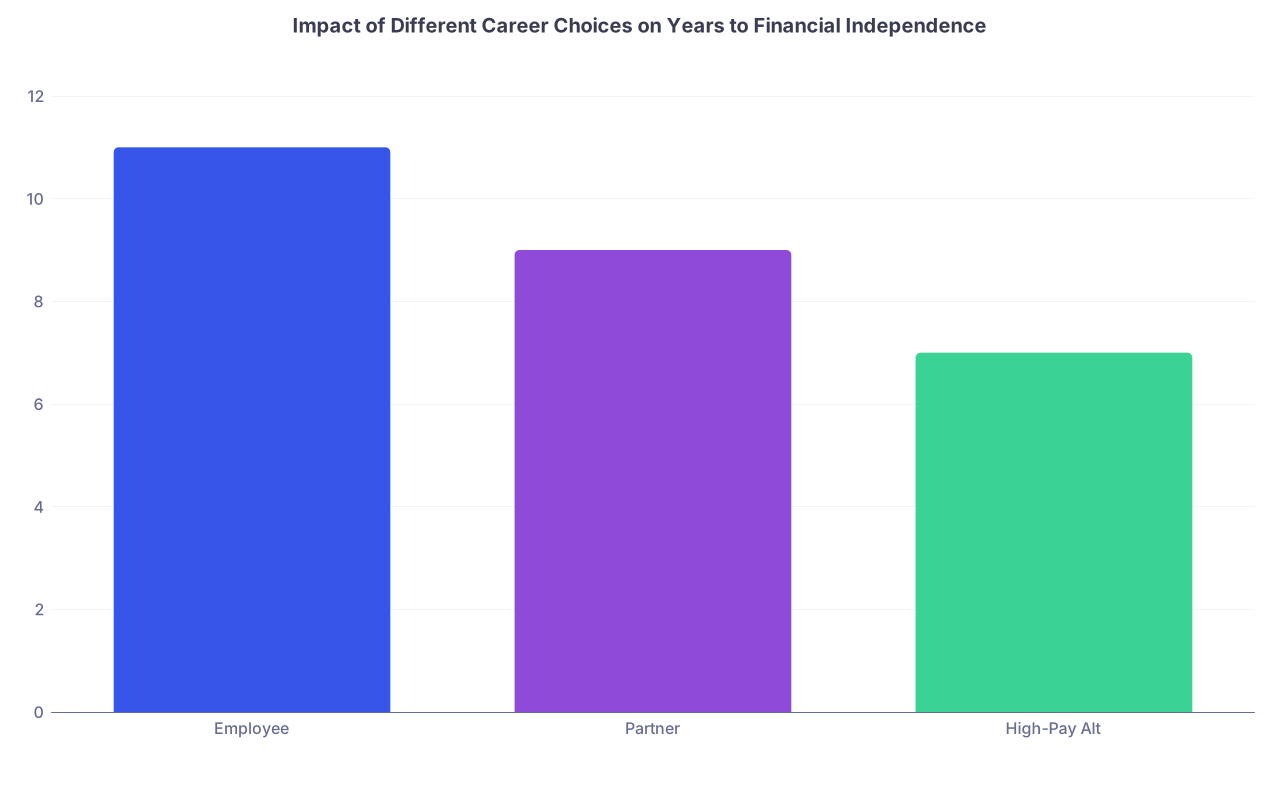
| Category | Value |
|---|---|
| Employee | 11 |
| Partner | 9 |
| High-Pay Alt | 7 |
Step 4: Red Flags If Early Retirement Is Your Priority
Certain practice setups are almost guaranteed to work against early retirement, even if they sound “prestigious.”
Here are the ones I’ve seen derail people:
Opaque or manipulative valuation
- “This is what we’ve always used.”
- “We don’t really share full financials, but trust us.” If you can’t see line-item revenue, expenses, and true partner comp, you’re being sold, not invited.
Long earn-in timelines or moving goalposts
- “We typically make people partner in 5–7 years” with no clear criteria.
- New “requirements” appearing right when your turn comes up.
That’s a delay tactic. And delay is the enemy of early retirement.
Low or shrinking margins
- Overhead 65–75%+
- Reliance on a single major payer contract
- Revenue heavily tied to one aging rainmaker partner who plans to retire
Owners in low-margin practices can end up working more for not much more money.
Buy-out terms that screw younger partners
- Senior partners get generous payouts funded by you working harder.
- Valuation is rich when you buy in, conservative when you cash out.
Classic trap: you subsidize someone else’s retirement instead of your own.
No flexibility for part-time or gradual downshift If the culture is “full throttle until you’re out,” that doesn’t pair well with early or phased retirement.
Step 5: When Buying Into a Practice Does Make Sense for Early Retirement
Now the upside.
Buying into a practice can absolutely accelerate FI when:
Owner comp is sustainably and meaningfully higher
- Not $20k more. More like $75k–$200k more per year, after all costs.
- Transparency shows those numbers hold across multiple partners, not just the founding one.
There are strong, durable ancillary income streams
- Ownership in an ASC, imaging, lab, real estate, or other profitable side arms.
- Actual distributions, not just hand-waving potential.
The buy-in is rational and fair
- Independent third-party valuation
- Reasonable multiple of earnings, not fantasy
- Buy-in payments structured so you’re still saving heavily during those years
The buy-out terms don’t cripple the next generation
- Formula is consistent and not weighted heavily toward older partners.
- The practice can afford buy-outs without crushing remaining partners.
The practice supports an exit or glide path
- Part-time options
- Phased ownership exits
- Ability to sell some or all of your stake on a reasonable schedule
If buying in boosts your free cash flow to invest by six figures and gives you an asset that’s reasonably likely to be monetizable at exit, that can shave several years off your working life.

| Step | Description |
|---|---|
| Step 1 | Goal - Early Retirement |
| Step 2 | Stay employee or explore alternatives |
| Step 3 | Buying in may accelerate FI |
| Step 4 | Does ownership raise net annual savings by enough? |
| Step 5 | Are buy-in and buy-out terms transparent and fair? |
| Step 6 | Is practice risk reasonable for extra return? |
Step 6: How to Analyze a Real Buy-In Offer (Concrete Checklist)
Here’s how I’d walk through an actual offer with someone who wants to retire early.
Ask for and review:
5 years of financials
- Practice income statement and balance sheet
- Partner K-1s (or equivalent) showing actual money in pocket
Partner compensation data
- Median and range of owner take-home in your specialty within the group
- Compare to MGMA/local benchmarks for employed roles
Valuation report and methodology
- Who did it?
- What was the multiple used?
- What assumptions about growth?
Operating agreement / shareholder agreement
- Entry terms
- Exit terms
- Non-competes
- Capital calls
- Voting / control
Your pro forma Model two or three scenarios:
- Stay as employee for X years, invest Y/year → FI at age ___
- Buy in, invest more (or less) per year after buy-in → FI at age ___
- Alternative: high-paying job or different practice → FI at age ___
If the ownership path doesn’t move your FI age significantly earlier or at least give you much more control with similar timing, it’s failing your own goal.
| Factor | Employee Role | Practice Owner |
|---|---|---|
| Upfront Cost | $0 | Buy-in (often $100k–$500k+) |
| Income Variability | Low–Moderate | Moderate–High |
| Control | Low | Higher (but with more responsibility) |
| Time for Admin | Minimal | Significant (meetings, HR, strategy) |
| FI Speed Potential | Moderate | Higher if margins and terms are good |
Step 7: How Your Personality and Tolerance Matter
Numbers aside, two personal traits matter a lot if early retirement is your target:
How much risk you can stomach Some physicians absolutely hate the idea of payroll stress, payer negotiations, and other ownership drama. If that’s you, you might hit FI faster with a high, steady salaried job and aggressive saving.
How badly you want control If what you really want is autonomy, not just early retirement, ownership might be worth it even if it doesn’t maximize pure dollars-per-year. Just don’t lie to yourself about which goal is primary.
You told me your main goal is early retirement. That means everything gets judged through that lens.

So, Should You Buy In?
Here’s the honest framework:
You probably should NOT buy into the practice if:
- Your additional net income as an owner is small or uncertain.
- The buy-in is large, opaque, or clearly overvalued.
- The practice margins are thin or trending down.
- The culture doesn’t support part-time work or phased retirement.
- You have realistic higher-earning, lower-risk alternatives (locums, W-2 at better pay, geographic arbitrage).
You should strongly consider buying in if:
- You can clearly see at least $75k–$150k+ of sustainable extra annual savings as an owner.
- The numbers and legal documents are transparent and fair.
- Ancillary and/or real estate ownership adds meaningful, diversified income.
- The exit path, including buy-out, looks rational and doesn’t depend on fantasy growth.
- You actually like the people and see yourself surviving there long enough to benefit.
Your main goal is early retirement. Treat this as a business investment decision, not an emotional promotion.
If ownership doesn’t move your FI age forward in a clear, quantifiable way, you’re probably buying a headache, not freedom.
FAQ (Exactly 5 Questions)
1. How big does the income bump from ownership need to be to justify buying in if I want early retirement?
If early retirement is your priority, I’d want to see at minimum a $50k+ net annual increase in money you can actually invest, and realistically more like $75k–$150k. That’s after buy-in payments, higher taxes, and extra unpaid work. Anything smaller than that and the risk/illiquidity often isn’t worth it. A $20k bump to own a big chunk of liability and admin? Hard pass.
2. Should I ever buy into a practice if I plan to retire in less than 10 years?
Sometimes, yes—but the bar is higher. If you’re <10 years from planned retirement, you need:
- A short, clear buy-in period
- Strong and immediate profit distributions
- A realistic, enforceable buy-out plan that doesn’t depend on you working another 15 years
If it’ll take you 5 years just to break even on your buy-in, and you want out in 8, that’s usually not smart.
3. Is practice real estate ownership worth it for early retirement?
Often, yes—more than the practice itself. Equity in a medical office building or ASC that throws off rent and can be sold on the open market can be a real asset, not just internal book value. But same rules apply: know the valuation, debt, tenant risk, and your exit options. Don’t blindly buy into a building just because “everyone else is doing it.”
4. What if the partners say I’ll be “left behind” if I don’t buy in?
That’s sales pressure, not analysis. You’re not “left behind” if you choose a path that gets you to FI faster and with less risk. You judge the offer by numbers and terms, not by FOMO or implied status. If the deal is truly good, you’ll see it in the math. If the appeal is mostly emotional—title, belonging, prestige—be careful, especially if your real goal is to work less, sooner.
5. Do I need a lawyer or financial planner to review the buy-in offer?
If there’s real money on the line (and there is), yes, you should use professionals—ideally both:
- A healthcare-focused attorney to dissect the operating agreement, non-compete, buy-in/out terms, and liability.
- A fee-only financial planner who understands physician compensation to run FI scenarios with and without ownership.
You’re effectively weighing a multi-hundred-thousand-dollar investment. Treat it like one.
Key takeaways:
- If ownership doesn’t clearly and materially move your FI date earlier, it’s not aligned with your goal of early retirement.
- Always model the numbers: employee vs owner vs alternative career path, in years to FI—not just gross income.