
It’s 10:30 pm after a brutal call. You’re scrolling through emails and see three new messages: a hospital “financial wellness” webinar, a colleague’s referral to a “doctor-only” wealth manager, and a Vanguard ad about low-cost target date funds. You pause and think:
“Do I actually need a separate financial planner for retirement, or can I just DIY this and be done with it?”
Here’s the answer you’re looking for:
Some physicians absolutely need a dedicated financial planner. Some absolutely do not. The trick is knowing which group you’re in—and how to avoid overpaying for hand-holding you don’t need or, on the flip side, sleepwalking into a multi-million-dollar mistake.
Let’s break this down in a way that respects your time and your brain.
The Core Question: What Problem Are You Trying To Solve?
Before you ask “Do I need a planner?” ask this instead:
“What specific retirement decisions am I struggling to make, and what’s the cost if I get them wrong?”
For physicians, the retirement planning pain points usually fall into a few buckets:
- Multi-account chaos: 403(b), 401(k), 457(b), 401(a), backdoor Roth IRA, HSA, brokerage, plus maybe a defined benefit plan.
- Complex compensation: RVUs, bonuses, call pay, partnership buy-in/buyout, equity, K-1s.
- Tax landmines: high marginal rates, state taxes, 457(b) risk, when to do Roth conversions.
- Student loans and retirement colliding: PSLF, private refinancing, timing contributions.
- Asset protection and legal: malpractice risk, entity structure, insurance, community property issues.
- Retirement timing and lifestyle: “Can I realistically walk away at 55?” and “How much is enough?”
If you read that list and thought, “I’ve got most of that handled or can learn it,” you might not need an ongoing planner.
If you thought, “I don’t even know what half of that means,” you probably should not be winging this on your own.
When Physicians Usually Do Not Need a Separate Planner
Let me be blunt. A lot of attendings pay 1% of assets annually for someone to do what a lazy Sunday afternoon with a cup of coffee and a few good books could accomplish.
You probably do NOT need a dedicated financial planner if:
You’re willing to learn the basics
You understand or are willing to learn:- What an index fund is
- The difference between Roth, traditional, and taxable accounts
- How to pick a reasonable asset allocation (e.g., 60/40, 70/30)
- How to automate contributions and rebalancing
Your situation is relatively straightforward
Example:- W-2 hospital job
- One or two retirement plans (401k/403b)
- No complicated practice ownership, no exotic investments, no huge side businesses
- You’re not doing anything fancy with trusts yet
You can be emotionally steady in markets
If you didn’t sell during COVID, 2022, or other major dips—or you know you won’t panic sell—then you’re already ahead of many people who hire planners just for “behavior coaching.”You’re comfortable with a simple, low-maintenance strategy
For many physicians, the following is enough:- Max workplace plans every year
- Do a backdoor Roth IRA if eligible
- Invest in broad index funds or a target date fund
- Carry appropriate insurance (term life, disability, umbrella)
- Don’t blow money trying to beat the market
This approach, consistently followed, gets most physicians to a very comfortable retirement without ever writing a check to a planner.
When Physicians Do Benefit From a Dedicated Financial Planner
Now the other side. I’ve watched too many physicians make six-figure errors trying to “save money” by avoiding professional advice.
You probably SHOULD have a dedicated financial planner—at least periodically—if:
You have practice or business ownership
Group practice, ASC investment, side business, locums LLC—this is where tax and retirement choices multiply:- Solo 401(k) vs SEP IRA vs defined benefit plan
- S-corp vs partnership vs disregarded entity
- Optimizing W-2 vs K-1 income
Getting this wrong can cost you tens of thousands annually in unnecessary taxes.
You have multiple retirement plans and don’t know how they fit
Many physicians juggle:- 401(k) or 403(b)
- 457(b) (governmental vs non-governmental—big difference)
- 401(a) or pension
- Backdoor Roth IRAs
- Taxable brokerage
Coordination matters: - Which to prioritize?
- Is your 457(b) safe or at risk if the employer fails?
- When to roll over vs keep employer plans?
If you’re guessing, that’s not great.
You’re within 5–10 years of retirement and have real money on the line
This is where your portfolio is often $1–5M+ and the decisions get heavier:- Sequence of withdrawal risk
- Social Security timing
- Roth conversion strategy in low-income years
- Pension vs lump sum
- How to structure investment withdrawals to manage taxes and Medicare premiums
A mistake here isn’t a $5,000 problem; it’s a $500,000 lifetime problem.
You have complex family or legal dynamics
Examples:- Second marriage, blended family, kids from prior relationship
- Special needs child
- High-risk specialty + real asset protection concerns
This bleeds into estate planning, trust structures, and beneficiary designations. A good planner coordinates with your attorney and CPA so nothing falls through the cracks.
You know yourself: you will not implement without external pressure
Some people need a coach, not more information.- You’ve been saying you’ll “set this up” for 3 years
- You read blogs, listen to podcasts, but your accounts are still a mess
If knowledge isn’t the problem, execution is. A planner can be the forcing function.
“Physician-Specific” Planner: Real Need or Marketing Gimmick?
The phrase “We specialize in physicians” gets thrown around to justify higher fees. Some of that is real value; some is pure branding.
Where physician-specific expertise actually matters:
- Understanding of:
- 457(b) nuances
- Physician-specific benefits: 403(b), 401(a), mega backdoor Roth (sometimes), HSA, pension
- Student loan strategy (PSLF, IDR, refinancing)
- The reality of call, burnout, and early retirement desires
- Familiarity with:
- Partnership tracks and buy-ins
- Hospital employment vs private practice dynamics
- Common insurance pitfalls (whole life, disability riders, etc.)
Where “physician-only” is mostly fluff:
- Generic asset allocation (any competent planner can do this)
- Basic index fund investing
- Standard Roth vs traditional decisions
So do you need a physician-only planner? Not necessarily.
You need a competent, fiduciary planner who has worked with complex, high-income professionals—and ideally has several physician clients so they aren’t learning on you.
How To Decide: A Simple Framework
Use this as a quick gut-check.

| Step | Description |
|---|---|
| Step 1 | Physician with retirement questions |
| Step 2 | Hire fee only planner |
| Step 3 | DIY with simple index approach |
| Step 4 | Hire planner at least for a one time plan |
| Step 5 | Hybrid - DIY plus periodic checkup |
| Step 6 | Willing to learn basics? |
| Step 7 | Complex situation? |
| Step 8 | Near retirement or business owner? |
If you land in E or H, you may not need an ongoing, separate planner.
If you land in C or G, trying to DIY purely to avoid fees is often false economy.
What Type of Planner (and Fee Model) Makes Sense for Physicians?
The “do I need a planner?” question is incomplete. You should be asking:
“If I hire someone, how do I avoid getting ripped off or sold garbage?”
Here’s the quick landscape.
| Model | How They Get Paid | Good Fit For |
|---|---|---|
| Commission-based | Product commissions | Almost never |
| AUM (1% of assets) | % of investments | High-touch, complex cases |
| Flat annual retainer | Fixed yearly fee | Ongoing holistic planning |
| Hourly / project | By the hour or project | DIYers needing checkups |
Commission-based (insurance and investment sales)
This is where you get pitched whole life insurance as “retirement savings,” expensive annuities in IRA accounts, loaded mutual funds. This is usually the worst setup for physicians. Conflicts everywhere.
AUM (Assets Under Management) – the classic “1% advisor”
Pros:
- Everything’s bundled: planning + investment management
- Easy to start, no big upfront cost
Cons: - Gets very expensive on large portfolios (1% of $4M is $40,000 per year… forever)
- Incentive to manage all your assets, even when a simpler, low-cost index approach would be fine
Flat annual retainer
Pros:
- Clear, predictable cost
- Better alignment: advice not tied to selling products or managing every dollar
- Works well for complex, high-income households
Cons: - You must vet quality carefully; “flat fee” does not equal “good”
Hourly/project-based
Pros:
- Perfect for DIYers who want a second set of eyes or a one-time, comprehensive retirement plan
- No ongoing fee drag
Cons: - You must do the ongoing implementation and maintenance yourself
- Easy to “forget” to check back every few years
For a lot of physicians, the sweet spot is:
- Hourly or project-based for a baseline plan and major transitions
- Possibly a flat-fee ongoing planner if your situation is complex (multi-business, big tax planning, approaching retirement)
Minimum Knowledge Every Physician Should Have (Planner or Not)
Even if you hire the world’s best financial planner, you should still understand a few basics so you can tell if their advice is garbage.
At a minimum, you should know:
- What you’re invested in:
- Stock vs bond percentage
- Domestic vs international
- Rough idea of expense ratios
- Your annual savings rate for retirement (how much, where it’s going)
- Your current net worth and rough retirement target (e.g., “we’ll be fine around $5M”)
- Whether:
- You’re using backdoor Roth properly (and not triggering pro-rata messes)
- You’re not stuck in high-fee products you don’t understand
- Your 457(b) is governmental (safer) or non-governmental (employer risk)
You don’t delegate driving just because you hired a mechanic. Same idea here.
How Often Should a Physician Use a Planner If Not Ongoing?
If you don’t want an ongoing relationship, here’s a sane rhythm:
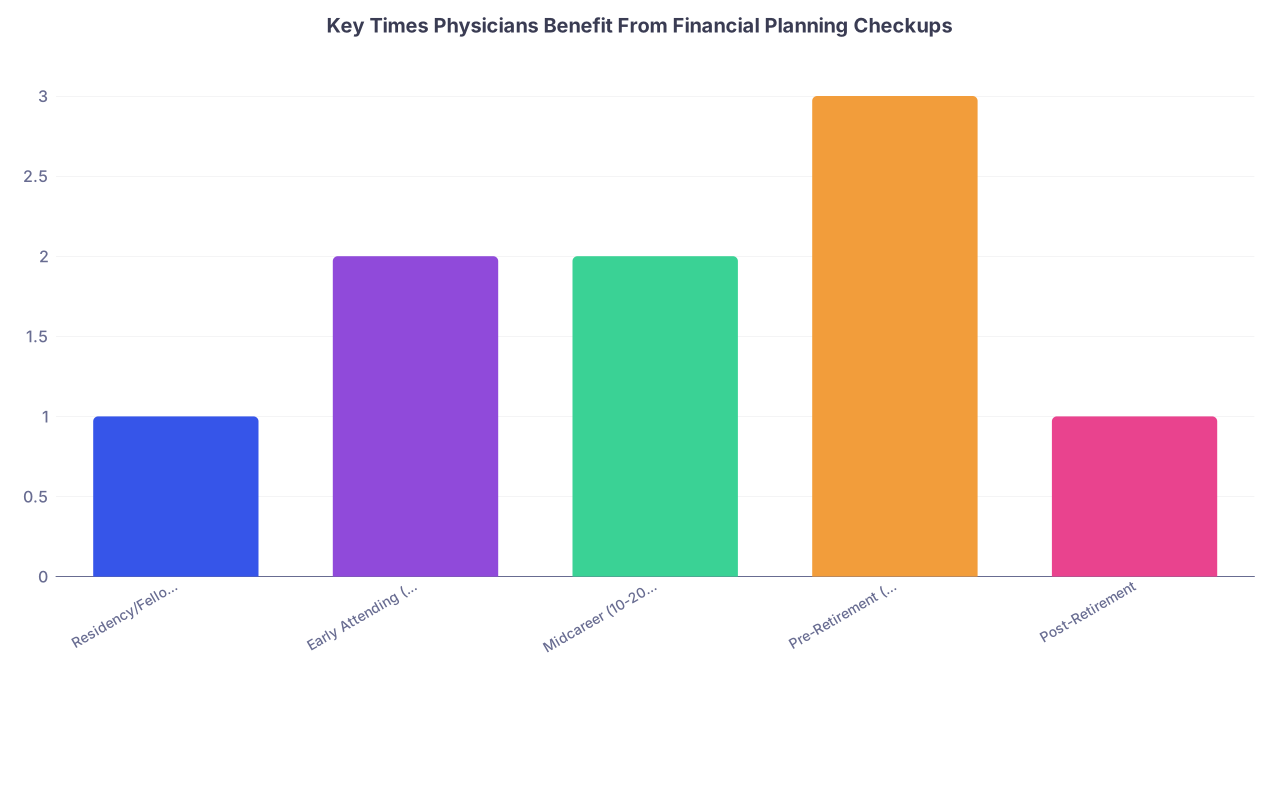
| Category | Value |
|---|---|
| Residency/Fellowship End | 1 |
| Early Attending (1-5 yrs) | 2 |
| Midcareer (10-20 yrs) | 2 |
| Pre-Retirement (5-10 yrs out) | 3 |
| Post-Retirement | 1 |
Roughly:
End of training / first attending job:
One good planning session to set your baseline (debt, insurance, retirement accounts, basic asset allocation).Early attending (1–5 years):
Maybe a check-in if you switch jobs, get married, have kids, or buy into a practice.Midcareer (10–20 years out):
One or two touchpoints, especially if you’re building serious wealth and doing more advanced tax planning.Pre-retirement (5–10 years out):
This is the big one. Sequence of withdrawals, Roth conversion strategy, Social Security, pension vs lump sum. If you’re ever going to pay for top-tier planning, this is the time.Early retirement:
One or two follow-ups to adjust based on reality vs projections.
This “punctuated consulting” approach often gives you 80–90% of the benefit at a fraction of the cost of a lifelong AUM advisor.
Signs You Should Fire Your Current Planner
If you already have a planner and you’re wondering if they’re actually helping, look for these red flags:

- You can’t clearly explain how they’re paid
- They dodge when you ask about total fees (including fund expenses, annuity costs, etc.)
- They push products you don’t understand, especially:
- Whole life / universal life as retirement savings
- Variable annuities inside IRAs
- Actively managed funds with high expense ratios
- Your investment statement is a zoo of random funds and you have no idea why
- They never talk about tax strategy, account location, or withdrawal planning for retirement
- The agenda is always about your investments, never about your life, goals, or actual retirement plans
If that’s you, you don’t just “need a planner.” You need a different planner—or none at all, depending on your comfort with DIY.
The Bottom Line: Do Physicians Really Need a Separate Financial Planner for Retirement?
Short answer:
- No, not every physician needs an ongoing, separate financial planner.
- Yes, many physicians will significantly benefit from at least targeted, high-quality retirement planning, especially near retirement or with complex finances.
- The real mistake is either:
- Blindly outsourcing everything to an expensive advisor without understanding what you’re getting, or
- Refusing to pay for help when your situation is clearly beyond your current expertise.
You’ve done harder things than understanding basic retirement planning. The key is being honest about when it’s time to pull in a pro.

FAQs
1. Is a 1% AUM advisor ever worth it for physicians?
Sometimes, but not often. If you’re very high income, have multiple businesses, and genuinely want to outsource everything, a top-tier 1% advisor who actually works as your family CFO can be worth it. The problem is most 1% advisors do very basic stuff you could get for a flat fee or DIY. If you’re paying 1%, the service better go way beyond picking mutual funds.
2. How much should a physician expect to pay for quality retirement planning?
For a comprehensive, one-time retirement plan, something in the $2,000–$6,000 range is common, depending on complexity. For ongoing flat-fee planning, $3,000–$10,000 per year is typical for high-income professionals. If someone’s charging you $30,000 a year because your portfolio hit $3M and they “manage 1%,” you should be asking what you’re really getting for that.
3. Can I just use a target date fund and skip a planner entirely?
If you’re W-2 employed, have no practice ownership, minimal tax complexity, and you’re saving aggressively, yes—a target date fund in your 401(k)/403(b) plus a simple three-fund portfolio in your IRA/taxable can be enough. The risk isn’t the target date fund; it’s ignoring everything else—insurance, estate planning, tax strategy, account types. That’s where at least one planning session can still be worth it.
4. Do I need a planner who is physically local to me?
No. For most physicians, virtual planning works perfectly fine. What matters more is:
- Fiduciary status
- Fee structure
- Experience with complex, high-income cases
- Communication style and clarity
I’d take a great virtual planner in another state over a mediocre local one you can meet in person.
5. If I’m behind on retirement, should I hire a planner or just increase savings?
You probably need both: higher savings rate and a clear plan. A good planner can help you prioritize: how much to save, which accounts, what retirement age is realistic, and what lifestyle changes might be necessary. But no planner can fix chronic undersaving. If you hire someone and then ignore the plan, you just paid for a fancy PDF.
6. What credentials should I look for in a financial planner as a physician?
Look for:
- CFP® (Certified Financial Planner) as a baseline
- Fee-only (not fee-based)
- Fiduciary commitment in writing
- Real experience with physicians or similar high-income professionals
Extra nice-to-haves: CPA (tax expertise), EA, or someone who routinely coordinates with your CPA and estate attorney. But if they’re pushing products and can’t explain fees clearly, credentials don’t save that.
Key points to walk away with:
- Not every physician needs an ongoing, separate financial planner—but every physician benefits from at least understanding the basics and getting targeted help when stakes are high.
- Complexity (business ownership, multiple plans, nearing retirement) is what justifies professional planning—not ignorance alone.
- If you do hire someone, fee-only, fiduciary, and physician-savvy beat “doctor-only branding” and high AUM fees every time.