
You’re post-call, half-running on caffeine, staring at your paycheck breakdown. You see the 403(b) section and the default 3% contribution you never changed. Now someone just told you, “You should be saving 20% of your income for retirement.” You laughed. Then you Googled. Now you’re here.
Let me give you the straight answer:
You do not save the same percentage as a resident and as an attending. And you should not feel guilty about that.
But you do need a plan. And some hard numbers.
The Core Answer in One Line
As a rough but very practical rule:
- As a resident: Aim for 10–15% of gross income if possible, with a hard minimum goal of at least $100–$500 per month into something.
- As an attending: Grow to 20–25% of gross income toward retirement and long-term investing as fast as you reasonably can.
Now let’s unpack that so it actually means something in your life.
Why Residents and Attendings Play by Different Rules
You already know this, but let’s quantify it.
Typical ranges (yes, it varies by region and specialty):
| Role | Annual Gross Income | Monthly Take-Home (Approx) |
|---|---|---|
| PGY1 | $60,000–$70,000 | $3,500–$4,200 |
| Senior Res | $70,000–$80,000 | $4,000–$4,600 |
| New Attnd | $220,000–$350,000+ | $10,000–$18,000+ |
Trying to save “25% for retirement” on $65k while paying $1,800 rent, $400 car, loans, and maybe childcare is unrealistic and honestly kind of dumb advice.
As a resident, your goal is positioning, not perfection:
- Start the habit
- Get some match if there is one
- Learn how accounts work
- Avoid big mistakes (like lifestyle creep beyond what future-you can support)
As an attending, the game changes. You finally have:
- Income that can outpace your fixed costs
- Room for aggressive retirement savings
- Margin to fix what you could not do during training
So your savings targets must jump when you finish training. If they don’t, you’ll feel wealthy for 3–5 years…then realize you’re way behind.
Resident: How Much Should You Actually Save?
Let’s be specific. Assume a PGY-2 making $70k, take-home roughly $4,000–$4,300/month.
I’ll give you tiers. You pick the one that fits.
Tier 1: “I’m drowning” – Bare Minimum
You’re barely breaking even. Loans are in REPAYE/SAVE. You have little to no emergency fund.
Your goal:
- $100–$200/month toward retirement.
Where to put it:
- If you have a match in your 403(b)/401(k):
Contribute up to the match first, even if that’s just 3–5% of income. - If no match and you’re in a low tax bracket (common for residents):
Strongly consider a Roth IRA (direct or backdoor if income slightly higher).
This doesn’t feel like much. Still worth it. You’re:
- Building the habit
- Getting tax-advantaged growth started early
- Learning to live on slightly less than you earn
Tier 2: “Tight but stable” – Solid Resident Target
You’ve got a basic emergency fund (1–2 months expenses), manageable rent, and no crazy car payment.
Your goal:
- 10% of gross income as a solid, realistic target
On $70k, that’s $7,000/year ≈ $580/month
Structure that like:
- First: Get any employer match in 403(b)/401(k)
- Next: Max (or partially fund) a Roth IRA (2025 limit is $7,000 under 50; adjust to current law when you read this)
- If you still have room: Add more to workplace plan (traditional or Roth depending on tax bracket)
Tier 3: “Low expenses, partner income, or military” – Aggressive Resident
You’re unusually fortunate for a trainee:
Maybe your spouse works, housing is cheap, or you’re in the military and not paying much for health coverage or housing.
Your goal:
- 15% of gross income or more if easily doable
On $70k, that’s $10,500/year ≈ $875/month
That often looks like:
- Maxing a Roth IRA
- Plus at least getting full match in your work plan
- Possibly even more in the 403(b)/401(k) if cash flow allows
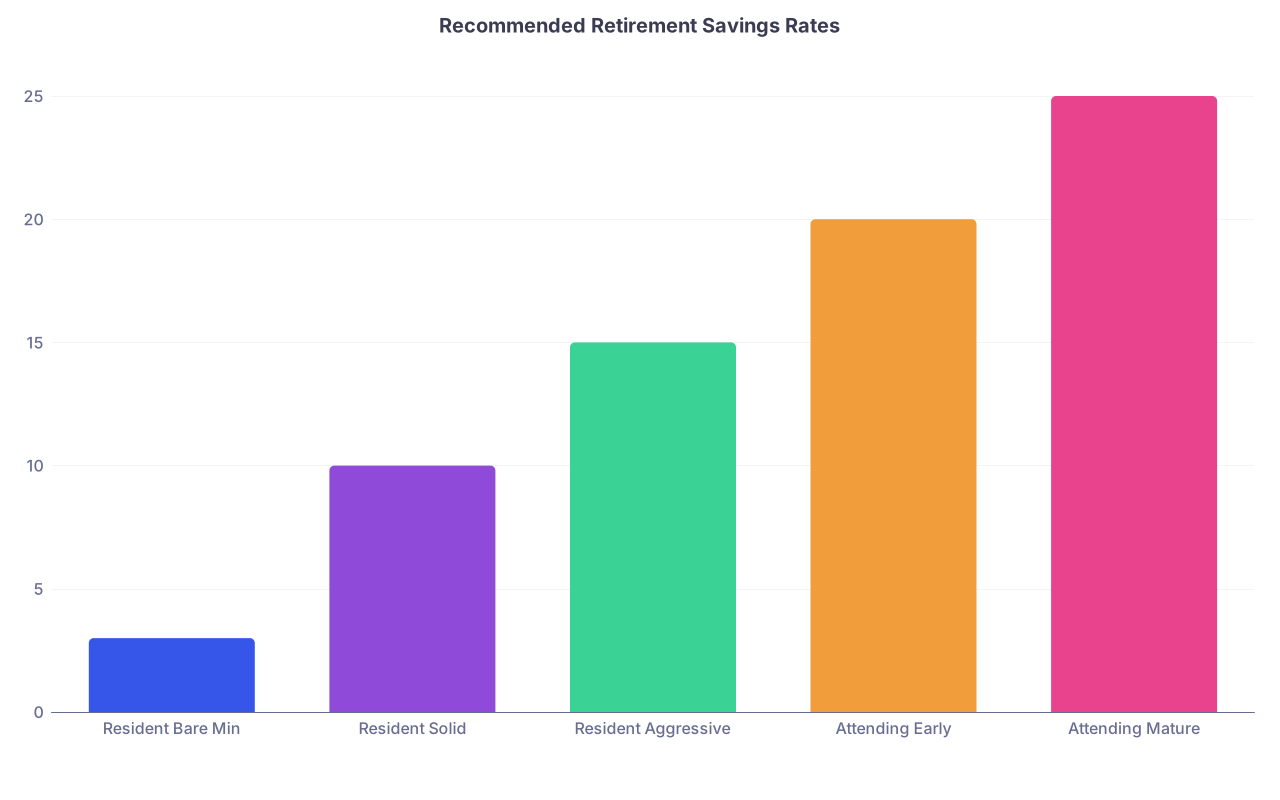
| Category | Value |
|---|---|
| Resident Bare Min | 3 |
| Resident Solid | 10 |
| Resident Aggressive | 15 |
| Attending Early | 20 |
| Attending Mature | 25 |
Attending: How Much Should You Save Once You Finish?
This is where I stop being gentle.
If you finish residency/fellowship and keep saving “resident numbers” (like $200/month to your Roth) while blowing the rest on lifestyle, you’re volunteering to work until 70.
General rule of thumb for physicians:
- Target 20–25% of gross income toward retirement and long-term investing.
On $300k, that’s:
- 20% = $60,000/year
- 25% = $75,000/year
You won’t get there on day one. But you should get close within 1–3 years of finishing training.
Attending Phase Targets by Year
Think of it like this:
| Year Out of Training | Target Savings Rate | Example on $300k |
|---|---|---|
| Year 1 | 15–18% | $45k–$54k |
| Year 2 | 18–22% | $54k–$66k |
| Year 3+ | 20–25% | $60k–$75k |
And no, that’s not just “retirement accounts.” I’m counting:
- 401(k)/403(b)/457(b) contributions
- Backdoor Roth IRA
- HSA (if used for future medical costs, not all spent yearly)
- Taxable brokerage investing specifically marked as retirement/long-term
If you save less than 15% for a prolonged period as a high-income doc, you’re going to have problems funding a standard “doctor lifestyle” in retirement.
How Much Is “Enough” By Age?
Most residents ask, “Am I behind?” The honest answer: almost all residents are “behind” by generic financial planning rules. And that’s fine. The training structure is weird.
But you do want to know what you’re aiming at long term.
Here’s a simple (and honest) framework for physicians:
| Age | Reasonable Goal for Many Physicians* |
|---|---|
| 30 | $0 to 1x income (you’re in training) |
| 35 | 0.5–1.5x income |
| 40 | 1.5–3x income |
| 50 | 3–6x income |
| 60 | 6–10x+ income |
*Includes all assets minus all debts, including loans and mortgage.
Notice: This allows you to still be at or near zero at age 30–32 and be fine, as long as you ramp up as an attending.
Balancing Retirement Savings vs Loans
This is the part people overcomplicate.
As a Resident
Priorities generally:
Basic safety
- Small emergency fund (1 month expenses is better than 0)
- Minimum payments on all debts on time
Retirement seed
- At least something monthly to Roth IRA or workplace plan
- Target 3–10% of income if you can
-
- If going for PSLF: max loan forgiveness by keeping payments low, do not overpay
- If not PSLF: usually just pay required minimums as resident, focus more as attending
You do not pause all retirement savings to throw every dollar at loans as a resident. That’s usually short-sighted.
As an Attending
Now you’ve got a choice. But there’s a hierarchy that works well:
- Get to 20% retirement savings fairly quickly.
- Attack high-interest debt (>6–7%) aggressively.
- Reassess loan plan: PSLF vs refinance and attack.
Often the best mix:
- Hit max in tax-advantaged retirement accounts (401k/403b/457, HSA, Roth IRAs)
- Direct extra above that toward loan payoff or taxable investing, depending on your interest rates and goals

| Step | Description |
|---|---|
| Step 1 | You are Resident or Attending |
| Step 2 | Build 1 month emergency fund |
| Step 3 | Contribute at least small amount to retirement |
| Step 4 | Increase to 10 to 15 percent if possible |
| Step 5 | You are Attending |
| Step 6 | Target 15 to 20 percent savings year 1 |
| Step 7 | Grow to 20 to 25 percent by year 3 |
| Step 8 | Then optimize loans and taxable investing |
| Step 9 | Resident? |
Practical Examples: What This Actually Looks Like
Let me walk through two realistic scenarios.
Scenario 1: Resident, $68k salary, no match
- Take-home: roughly $4,000/month
- Rent: $1,600
- Loans: on SAVE, $300/month
- Car + insurance: $400/month
- Other fixed: $500/month
- Groceries, variable spending: $900/month
- Leftover: about $600/month on a good month
What I’d do:
- Open a Roth IRA
- Auto-transfer $250/month into it
- Leave $350/month flex for true extra expenses, irregular costs, and tiny savings
That’s ~$3,000/year. Not perfect. But absolutely worthwhile.
Scenario 2: New attending, $280k salary
- Take-home: around $12,000/month after taxes, retirement contributions, benefits (varies by state)
- No longer living like a resident, but not going insane either
Year 1 targets:
- 401(k)/403(b): ~$23,000 (check current limits)
- 457(b) if available: additional ~$23,000
- Backdoor Roth IRA: ~$7,000
- HSA (family): ~$8,000 (if eligible and mostly saved, not fully spent)
That’s already over $60k/year, or >20% of income, just through standard accounts. You can still have a good life on the remaining $9k+ per month in take-home cash.
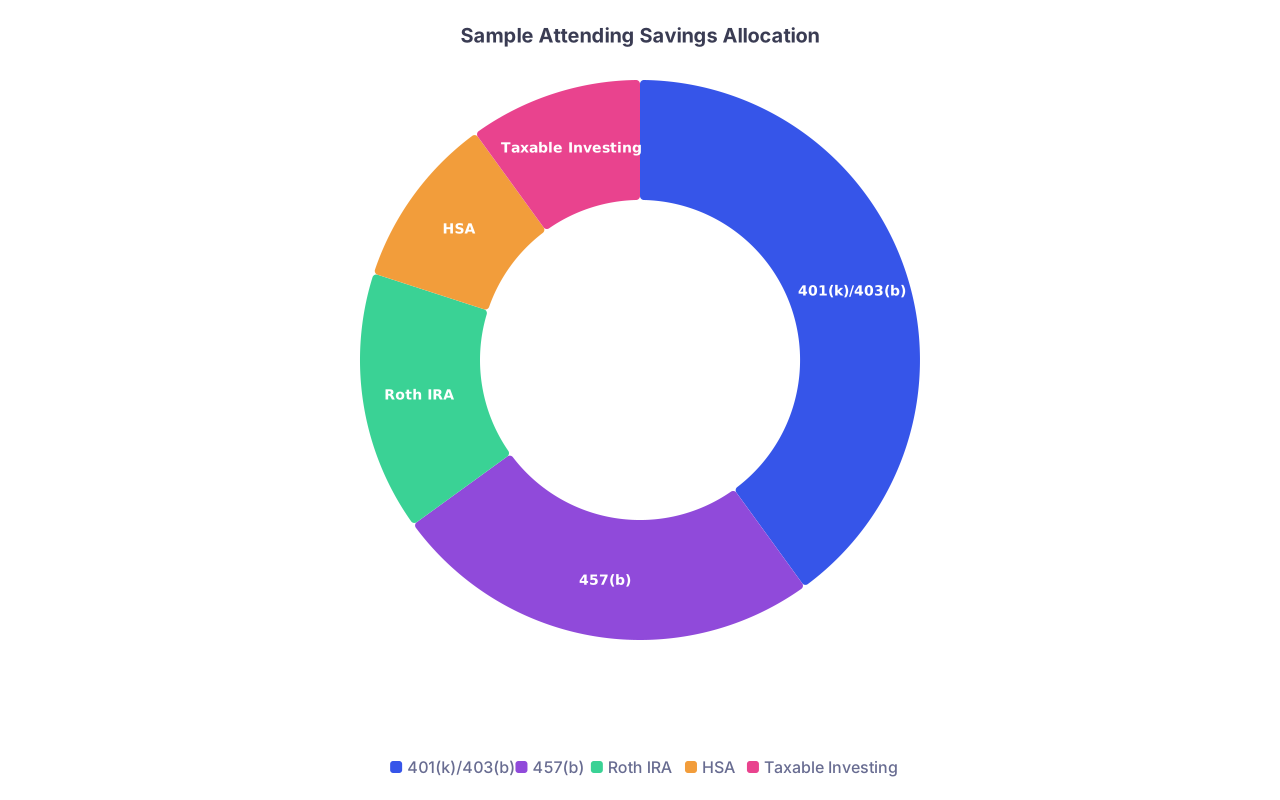
| Category | Value |
|---|---|
| 401(k)/403(b) | 40 |
| 457(b) | 25 |
| Roth IRA | 15 |
| HSA | 10 |
| Taxable Investing | 10 |
Where to Put Retirement Savings (Order of Operations)
Assuming you’re either a resident or early attending and want a simple sequence:
Free money first
- Get the full employer match in your 401(k)/403(b). Always.
Roth IRA or Backdoor Roth
- Residents: often ideal because you’re in a relatively low tax bracket
- Attendings: use backdoor Roth if income is too high for direct Roth
Max workplace plans
- As an attending, aim to max your 401(k)/403(b), and if available, 457(b).
- Residents with generous plans can still do this, but cash flow may not allow it.
HSA (if you have a high-deductible plan)
- Treat it as another retirement account, not just a yearly spending account.
Taxable brokerage account
- For overflow once tax-advantaged accounts are filled, or for earlier financial independence.

Common Mistakes I See Residents and New Attendings Make
Let me be blunt about a few:
Residents contributing 0% because “I’ll catch up later.”
You probably will catch up—if you’re disciplined. But you lose the habit and early compounding for no good reason. Even $100/month is better than nothing.New attendings keeping resident-level savings while tripling lifestyle.
Classic. New car lease, big house, private school…still putting $200/month into a Roth because “that’s what I did as a resident.”Ignoring employer match.
This is leaving free money on the table. I’ve seen people leave $2–3k/year sitting there because they “never got around to enrolling.”Killing loans at the expense of any investing.
Aggressive loan payoff feels good emotionally. But if it delays getting money into tax-advantaged accounts for 5–7 years, you’ve probably overcorrected.Waiting for ‘when things calm down’ to start.
They don’t. Medical career path: busy, busier, burned out, retired. Automate anyway.

FAQ: Retirement Savings as Resident vs Attending
1. I truly can’t afford much as a resident. Is $50–$100/month even worth it?
Yes. Two reasons. First, habit. You become the kind of person who saves automatically, and you’ll simply increase the number later. Second, compounding: $100/month for 5 years at 7% turns into real money by retirement, especially when added to later higher savings. Imperfect > nothing.
2. Should I do Roth or traditional as a resident?
Most residents are in a relatively low tax bracket compared with their attending years. That makes Roth very attractive: pay lower taxes now, get tax-free growth later. Workplace plans: if they offer Roth 403(b)/401(k), that’s often a good choice during residency. As an attending, you’ll more often favor pre-tax (traditional) accounts to reduce a higher current tax bill, but it depends on your whole picture.
3. How fast do I need to ramp up to 20–25% after training?
You do not need to hit 25% the day you sign your first attending contract. But I’d push for within 1–3 years. Year 1: at least 15%. Year 2: 18–20%. By Year 3: solidly in the 20–25% range. If by year 5 you’re still below 15%, you’re behind where a high-income physician should be.
4. Does my student loan payment “count” as retirement savings?
No. Debt payoff is good. But it’s not investing. Retirement savings means money that’s being put into accounts intended to grow for your future—401(k), 403(b), 457(b), Roth IRA, HSA (if saved), taxable brokerage earmarked for long-term goals. Loan payoff reduces future obligations but does not build assets by itself.
5. What if my employer doesn’t offer a 401(k)/403(b) as a resident?
You still have options. Use a Roth IRA as your main retirement vehicle. Open it at a low-cost brokerage (Vanguard, Fidelity, Schwab). Set up automatic monthly contributions. If you later get a job with a workplace plan, you can adjust, but the Roth IRA remains a powerful, flexible core piece of your portfolio.
6. I’m a late-career attending who started late. Is 25% still enough?
Maybe. Maybe not. If you’re starting serious saving at 45 or 50, you may need to go well above 25% for a while, depending on your planned retirement age and lifestyle expectations. The more behind you are, the more you have to either save, work longer, or lower your future spending expectations. The math is unforgiving—but higher physician income gives you options if you actually use it.
Key takeaways:
- Residents: do not try to save like an attending, but do not settle for zero. Aim for something—ideally 10–15% if you can, bare minimum some monthly contribution.
- Attendings: your real target is 20–25% of gross income toward retirement and long-term investing, reached within a few years of finishing training.
- The combo that works: live reasonably, automate savings, grab every employer match, and ramp your savings rate with each promotion and raise instead of your lifestyle.