
The most dangerous week of a light-interview match cycle is the 7 days after it ends. Most people either freeze, panic-apply blindly, or waste the only window where they still have leverage.
You are not done. The game just changed.
Below is a day‑by‑day plan for the first 7 days after a weak or interview‑light match cycle ends, focused on positioning yourself for SOAP, reapplication, or alternative paths without blowing up your chances.
Big Picture: Your First 7 Days, At a Glance
At this point you should stop thinking in “months until next match” and start thinking in “what do I control in the next 48–72 hours.”
| Day | Primary Focus | Secondary Focus |
|---|---|---|
| 1 | Reality check, outcome scenarios | Emotional triage, key data review |
| 2 | SOAP vs reapply decision tree | Program list strategy |
| 3 | Document and letter updates | Contacting mentors |
| 4 | SOAP prep (if eligible) | Gap year structure planning |
| 5 | Targeted outreach | Logistics (loans, visas, housing) |
| 6 | Backup plans | Skill-building and work options |
| 7 | Finalize next 90‑day plan | Communication clean‑up |
And because you are the “Timeline person,” here is the mental model for this week:
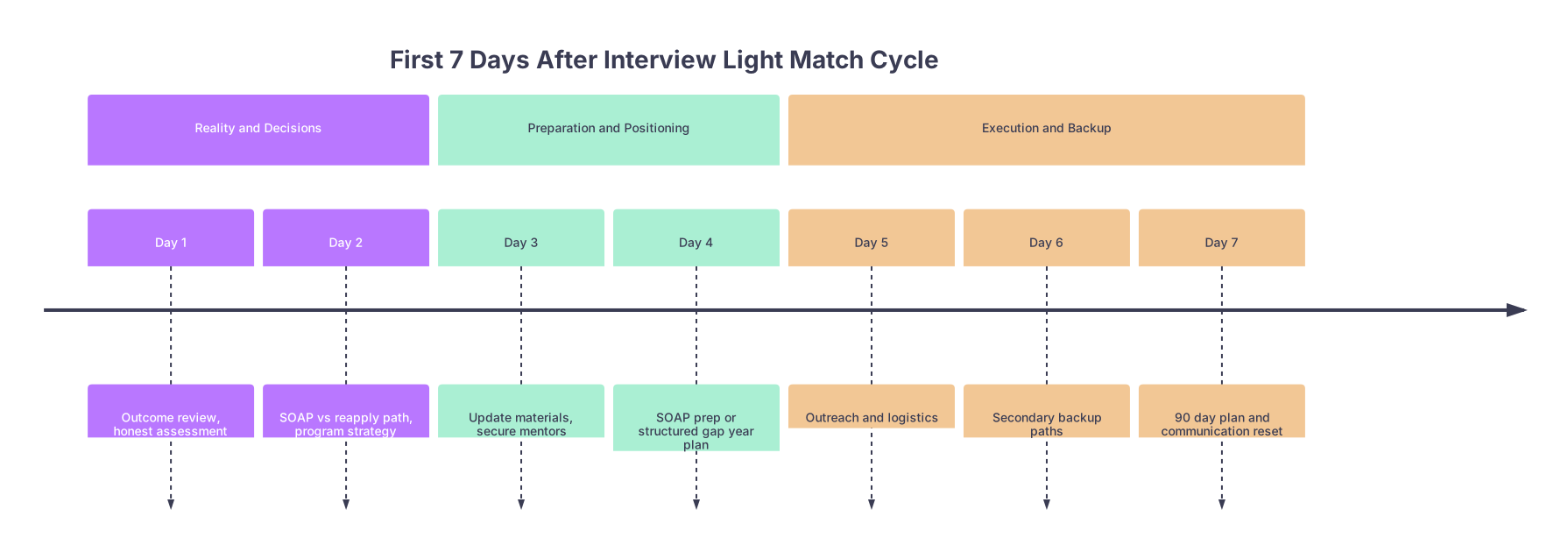
| Period | Event |
|---|---|
| Reality and Decisions - Day 1 | Outcome review, honest assessment |
| Reality and Decisions - Day 2 | SOAP vs reapply path, program strategy |
| Preparation and Positioning - Day 3 | Update materials, secure mentors |
| Preparation and Positioning - Day 4 | SOAP prep or structured gap year plan |
| Execution and Backup - Day 5 | Outreach and logistics |
| Execution and Backup - Day 6 | Secondary backup paths |
| Execution and Backup - Day 7 | 90 day plan and communication reset |
Now, step by step.
Day 1 – Stop Guessing, Get Concrete
At this point you should stop doom‑scrolling Reddit and open your own spreadsheet.
1. Clarify your exact situation
You need a brutally honest snapshot:
- Number of interviews actually completed
- Types of programs:
- University vs community
- Categorical vs prelim / transitional
- Geographic spread
- Specialty competitiveness:
- Derm, ortho, ENT, plastics — different world
- IM, peds, FM — lighter competition but still program‑dependent
- Your stats:
- USMD / DO / IMG
- Step 1 (P/F) and Step 2 CK
- Number of attempts
- Red flags (LOA, professionalism issue, failed course, visa needs)
Write this down. Not in your head. On screen or paper.
2. Define realistic outcome buckets
You should now name the three actual paths you are looking at:
- Match likely
- ≥ 8–10 interviews in a less competitive specialty
- Mostly categorical spots, strong feedback
- Toss‑up
- 4–7 interviews
- Mix of categorical + prelim
- Some marginal stats or red flags
- High risk for not matching
- 0–3 interviews total
- Only prelim / outside desired specialty
- IMG without strong home support
- Multiple exam attempts
Do not sugarcoat. SOAP strategy depends on this categorization.
3. Emotional triage (yes, that matters)
You are not going to make decent strategic decisions while in absolute free fall.
For today:
- Tell 1–2 trusted people your numbers and your concern
- Decide who you will not talk to about details (gossipy classmates, random relatives)
- Block social media match threads for a week if they spike your anxiety
You are stabilizing, not solving, on Day 1.
Day 2 – Decide Your Path: SOAP, Reapply, or Pivot
At this point you should turn anxiety into branching decisions.
1. Map yourself against SOAP realities
Here is what I have actually seen in SOAP: people overestimate what SOAP can fix.
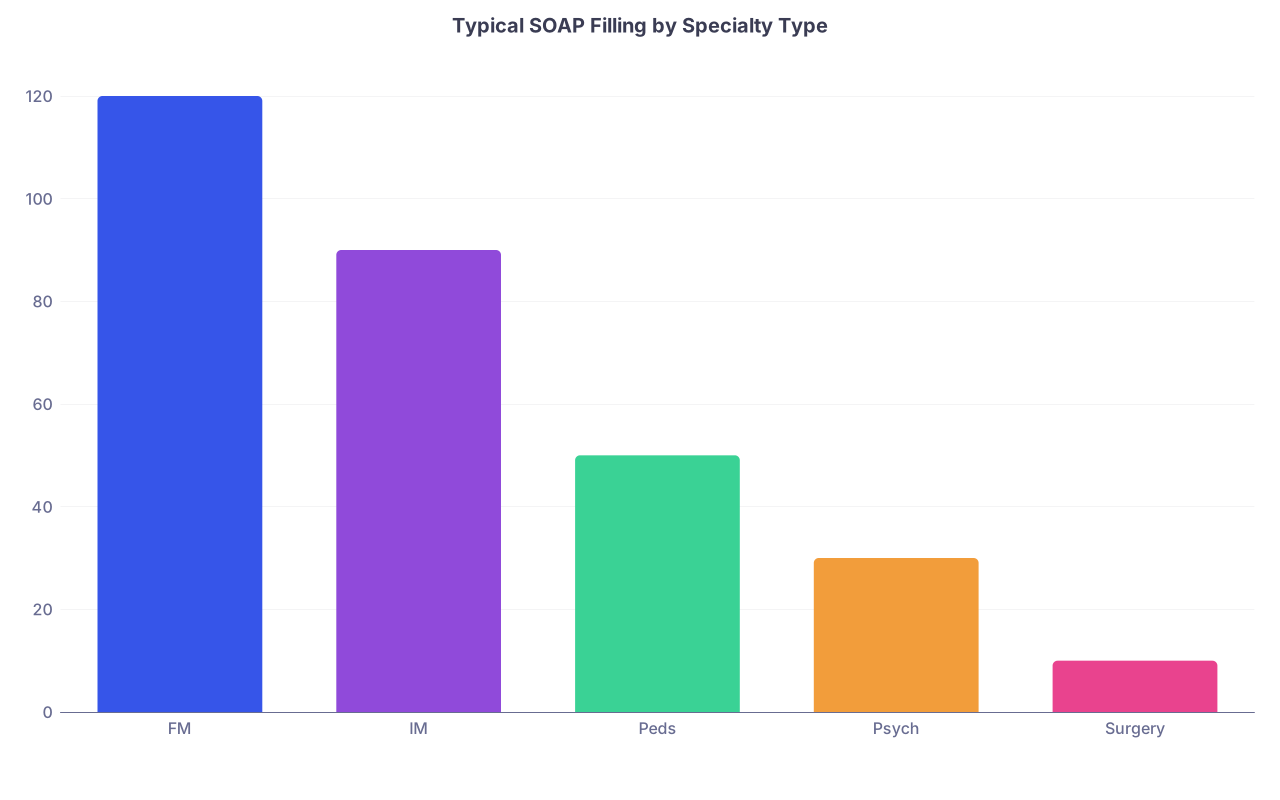
| Category | Value |
|---|---|
| FM | 120 |
| IM | 90 |
| Peds | 50 |
| Psych | 30 |
| Surgery | 10 |
These numbers are illustrative but the pattern holds: SOAP is heavy on primary care and prelim IM, light on competitive fields.
You must ask:
- Are you willing to switch specialty in SOAP if your primary does not appear?
- Are you willing to take a prelim year with real risk of needing to reapply?
- Do you have visa or financial constraints that make "take any accredited spot" your priority?
If you cannot accept those tradeoffs, SOAP is not a magic solution. It is one tool.
2. Decide your primary lane
By end of Day 2, you should have your primary and secondary plan defined:
Primary lane A – Aim to match this cycle via SOAP
- You are high‑risk for not matching
- You are willing to adjust specialty or take prelim
- You have no better alternative for the coming year
Primary lane B – Accept likely reapplication, use SOAP only selectively
- You prefer to reapply in your desired specialty rather than lock into a poor‑fit prelim
- You can financially tolerate a gap year
- You have reasonable Step scores and can strengthen your file
Secondary lane is whichever one you did not choose as primary. You are not closing doors. You are choosing where to put most of your energy.
Write this in one sentence:
“If I do not match, my primary goal is ______. I am/ am not willing to SOAP into ______ or take a prelim.”
That sentence will guide the rest of the week.
Day 3 – Fix the Paper: CV, Personal Statement, Letters
At this point you should stop obsessing over interviews you already did and start fixing the documents you will need in days to weeks.
1. Update your core documents
Even if you do not touch ERAS again this season, you will need this for reapplication, research jobs, or observerships.
Today, clean up:
- CV
- Add any recent rotations, sub‑Is, presentations, QI projects
- Quantify: “Presented 2 posters at ACP Texas 2026” instead of vague fluff
- Personal statement variants
- One for your main specialty
- A short, focused version for a backup or SOAP specialty if you are leaning that way
- ERAS experiences descriptions
- Tighten the worst offenders: long, generic paragraphs that say nothing
- Emphasize impact, not just tasks (“Implemented X that led to Y”)
Do not overthink perfect prose. Focus on clarity and concrete content.
2. Line up letters of recommendation (for reapply or SOAP)
If you had:
- Old letters only from preclinical or unrelated fields → you are handicapped
- Faculty who liked you on recent rotations → they are your leverage
Today:
- Make a list of 3–5 potential letter writers (attendings, PDs, research mentors)
- Draft a short, honest email template you can tailor:
- Acknowledge match uncertainty
- Ask if they would be comfortable supporting a reapplication, SOAP, or both
- Attach updated CV and personal statement
You will send some of these on Day 3 or Day 4 depending on your relationship.
Day 4 – SOAP Mechanics and Gap Year Structure
At this point you should move from “maybe SOAP” to “ready for SOAP if needed.”
1. If you might enter SOAP
You need to be logistically ready before Match Week chaos.
Today:
- Verify NRMP and ERAS logins actually work
- Confirm your medical school admin contact:
- Who will certify your SOAP applications?
- Who coordinates transcripts / MSPE if updates are needed?
- Create a SOAP specialty hierarchy:
- Specialty you actually still want (if positions appear)
- Secondary specialties you can live with (FM, IM, peds, psych, etc.)
- Prelim categories you will or will not consider (IM vs surgery vs transitional)
You are not choosing individual programs yet. You are building your rule‑set.
2. If you are leaning toward reapplication / gap year
You should not drift for 12 months. Structure is your defense against spiraling.
Today, sketch a rough 12‑month framework:
Options that actually help applications:
- Clinical:
- Research fellowships in your specialty
- Hospitalist scribe or clinical research coordinator in your desired field
- Home institution sub‑I repeats if allowed
- Academic:
- Dedicated research with expectation of abstracts/manuscripts
- Formal grad programs are often overkill unless strategic (e.g., MPH for academic IM)
- Exams:
- Step 3 (for grads) if you have bandwidth and it will reduce risk next cycle
Write down 2–3 realistic configurations:
- Example A: “1‑year research in cardiology + part‑time scribe, plan for 2 abstracts and 1 poster”
- Example B: “Community FM clinic work + strong PD connection + Step 3 by month 6”
You are not choosing yet. You are outlining serious options to evaluate.
Day 5 – Controlled Outreach, Not Desperate Spamming
At this point you should start talking to people, but with a script, not raw panic.
1. Contact your core mentors
Today, reach out to:
- Home program director(s) in your chosen field
- At least one attending who saw you clinically and liked your work
- A dean or advising office person if your school has them
Your email or meeting should include:
- Your honest numbers:
- “I had 3 categorical IM interviews, 1 prelim, and 1 FM interview. I am concerned I will not match.”
- Your preliminary plan:
- “If I do not match, primary goal is to reapply IM with stronger application; I would consider FM SOAP only if no IM options.”
- A specific ask:
- “Can you give me a frank assessment and help identify concrete steps in the next 3–6 months?”
Do not ask “Will I match?” Ask “What would you do in my position?”
2. Very limited program outreach (if appropriate)
If you had very few interviews and your home PD thinks a particular program might still be a long‑shot fit:
- You can consider 1–3 targeted, respectful emails to PDs where:
- You have a genuine connection (rotated there, strong geographic tie)
- Your profile is not wildly out of range
The email:
- Briefly restates your interest in their program
- References any prior contact or rotation
- Is sent before rank list deadlines (if timeline allows; if not, skip this)
If rank lists are already certified, pestering PDs is mostly noise. Do not spam 30 programs with generic pleas.
Day 6 – Backup Plans Beyond SOAP
At this point you should accept that “what if I do not match” is not pessimism; it is preparation.
1. Financial and logistical planning
Today, you sort the unglamorous pieces that will hit hard if you do not match:
- Loans
- Look up grace period end dates
- Identify income‑based repayment or deferment options
- Housing
- If you signed a lease assuming July 1 residency start, what are your exit options?
- Visa (if applicable)
- Talk to your international office or an immigration‑savvy advisor
- Know whether you can stay as a researcher, student, or observer
This is not about giving up. It is about not being blindsided in April.
2. Identify “bridge work” options
If you end up unmatched, you will need income and structure.
Create a shortlist of realistic roles:
- Clinical research coordinator in your specialty of interest
- Scribe in ED or specialty clinic
- Telemetry monitor tech, MA, or similar roles if your license status allows
- Short‑term fellowships (e.g., 6–12 month research slots at academic centers)
Rank them by:
- Proximity to physicians who could later write letters or advocate for you
- Flexibility to attend interviews next cycle
- Visa compatibility if relevant
You are not applying yet (unless you already know you are high‑risk and want to start early). You are identifying good targets so you are not job‑hunting blind in April.
Day 7 – Lock Your 90‑Day Plan and Clean Up Communication
At this point you should move from “emergency week” to “deliberate quarter.”
1. Build a 90‑day concrete plan
Break the next 3 months into simple, trackable objectives.
Example structure:
By Day 30
- Finalized updated CV, PS, and ERAS entries
- Confirmed 3–4 strong letter writers with verbal agreement
- Scheduled at least 2 meetings with mentors / PDs for strategy
By Day 60
- Secured 1 clinical or research position for potential gap year
- Drafted 1 abstract or manuscript with a mentor
- Planned Step 3 study timeline (if appropriate)
By Day 90
- Submitted at least 1 conference abstract or paper
- Completed a new QI or research project proposal
- If unmatched by then, fully transitioned into bridge work role
Write this on a single page. This is your working roadmap.
2. Decide your communication rules
You are about to go into a noisy, emotional period (Match Week). You will function better with pre‑decided boundaries.
Today:
- Choose who gets detailed updates: 2–3 people only
- Choose standard language for everyone else:
- “It is a competitive year; I will know more after Match Week and may explore additional training options next year.”
- Decide what you will not discuss in real time:
- Your exact number of SOAP applications
- Every rejection or non‑response
This protects your bandwidth.
3. Mental reset
The point of this week was not to predict your fate. It was to ensure that whatever happens on Match Day, you are not starting from zero.
Tonight, you should be able to answer, without flinching:
- If I match: I know what I will cancel, what I will keep, and who I will thank.
- If I do not match: I have a SOAP rule‑set, a 90‑day plan, and at least 2 mentors engaged.
That is a very different place than where you were 7 days ago.

The Three Things You Must Get Right This Week
- Brutal clarity, not denial. Know your numbers, your risk category, and your actual options. No fantasizing. No catastrophizing. Just data.
- Defined lanes, not vague hope. Decide your primary plan (SOAP vs reapply vs pivot) and your acceptable compromises before panic hits.
- A real 90‑day roadmap. Updated documents, engaged mentors, and a structured next quarter put you in the small minority who are actually ready for whatever Match Day gives them.