
The worst way to start a private practice is to quit your job and “figure it out.”
You ramp up a practice the same way you manage a septic patient: staged, monitored, and with clear thresholds for escalation. This is a stepwise, time-based plan to move from side‑gig to full‑time practice without blowing up your finances, your relationships, or your sanity.
Big Picture Timeline: 18 Months from First Idea to Full Time
You are aiming for a gradual, controlled transition. Think in three broad phases:
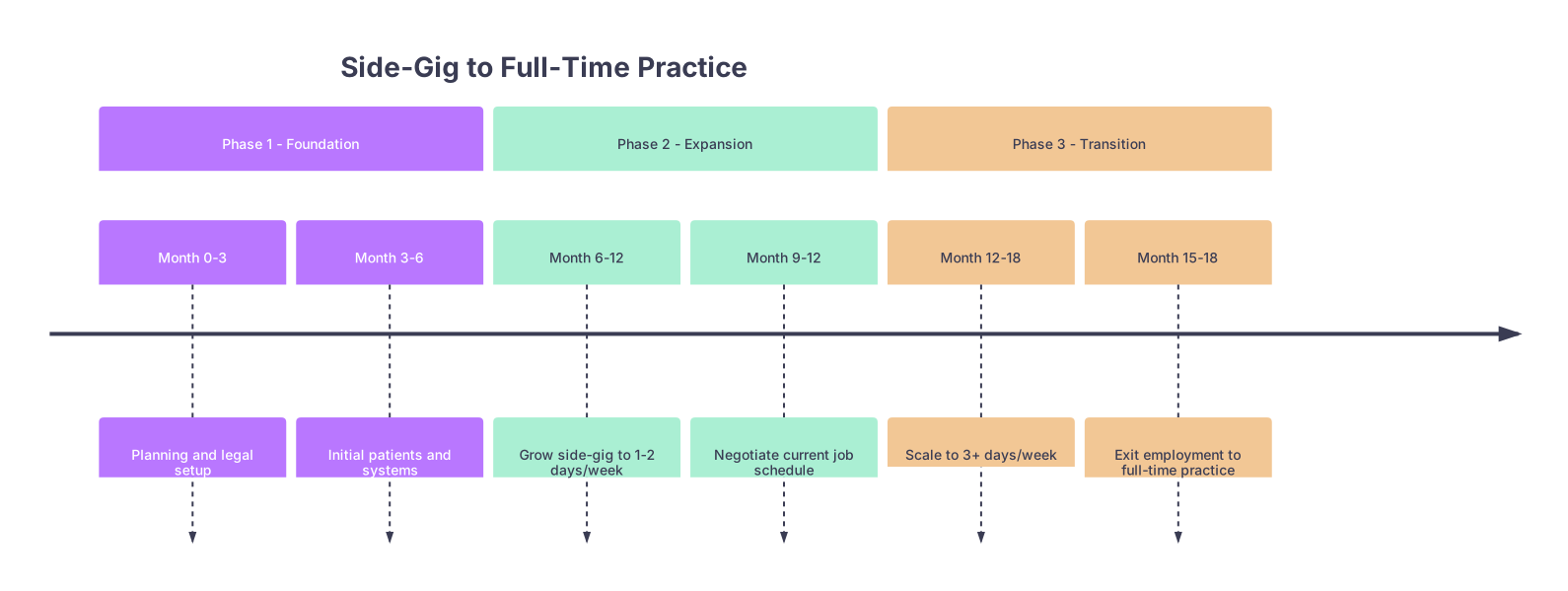
| Period | Event |
|---|---|
| Phase 1 - Foundation - Month 0-3 | Planning and legal setup |
| Phase 1 - Foundation - Month 3-6 | Initial patients and systems |
| Phase 2 - Expansion - Month 6-12 | Grow side-gig to 1-2 days/week |
| Phase 2 - Expansion - Month 9-12 | Negotiate current job schedule |
| Phase 3 - Transition - Month 12-18 | Scale to 3+ days/week |
| Phase 3 - Transition - Month 15-18 | Exit employment to full-time practice |
At each point, you should know:
- How many clinic sessions you are running in your practice.
- Your monthly revenue trend.
- Your cash reserves and runway.
- Your precise trigger for dropping hours or leaving your employed job.
Let us walk month-by-month, then zoom into what each quarter should look like.
Months 0–3: Planning While Fully Employed
At this point you should still be 100 percent in your job. All “practice work” happens evenings and one weekend half‑day.
Week 1–2: Define the Practice You Are Actually Building
Before you file an LLC or buy an EMR:
Choose your clinical model:
- General outpatient (e.g., IM, FM with panels).
- Procedure-focused (derm, pain, cards testing, psych with TMS/ketamine).
- Concierge or membership.
- Telemedicine‑only or hybrid.
Define your constraints:
- Max commute time from home.
- Which insurances you will accept (or cash-only).
- Whether you will see your current employer’s patients (often contract‑restricted).
At this point you should be able to write a 3–4 sentence description of your practice that a non‑physician spouse or friend can repeat back.
Week 2–4: Legal, Financial, and Contract Reality Check
Now you set the guardrails.
Employment Contract Review (Do not skip this)
- Check:
- Non‑compete radius and duration.
- Moonlighting / outside practice clauses.
- Intellectual property / branding restrictions.
- Have a healthcare attorney spend 60 minutes on this. Cheap compared to getting threatened later.
- Check:
Entity and Banking
- Form your entity (often PLLC or PC depending on your state).
- Get:
- EIN.
- Business bank account.
- Business credit card dedicated to practice expenses.
Basic Financial Plan
- Determine:
- Household baseline monthly expense number.
- Cash emergency fund (aim for 3–6 months of total expenses before you go full time).
- How much you can invest monthly into the practice while fully employed.
- Determine:
Create a simple projection with three revenue levels for your future practice:
| Scenario | Monthly Revenue | Take-Home After Expenses | Notes |
|---|---|---|---|
| Conservative | $5,000 | ~$2,500 | 1 half-day/week, slow ramp |
| Moderate | $15,000 | ~$7,500 | 1–1.5 days/week, modest volume |
| Aggressive | $30,000 | ~$15,000 | 2 days/week, efficient systems |
You now know what “financially safe to drop a day” actually looks like.
Week 4–8: Infrastructure and Insurance Decisions
At this point you should:
- Have your entity and bank account.
- Have checked your contract for landmines.
- Be ready to start assembling the practice skeleton.
Decide: Insurance vs Cash vs Hybrid
- If you will take insurance, start:
- NPI, CAQH profile updated.
- Identify 3–5 key payers in your market.
- Prepare credentialing packets.
- If cash‑only:
- Design simple pricing.
- Draft membership tiers if concierge.
- If you will take insurance, start:
Pick Core Systems (do not overthink this) You need:
- EMR (simple, cloud-based; not the giant hospital one).
- E‑fax and phone (VoIP or virtual system).
- Online scheduling and payment processor.
- Basic website with online intake forms.
Make quick decisions. You can switch in year two. The first year is about volume and proof of concept, not perfect software.
- Malpractice and Compliance
- Get malpractice coverage that explicitly covers:
- Part‑time private practice.
- The states where you will see patients (especially telemedicine).
- Confirm:
- HIPAA‑compliant tools (email, texting, telehealth).
- Get malpractice coverage that explicitly covers:
By the end of Month 2, you should be legally and operationally able to see one patient if they walked in tomorrow.
Months 3–6: First Patients and Side‑Gig Reality Check
At this point you are still full time in your job, but your practice should exist on paper and be minimally functional.
Month 3–4: Launch Quietly, One Session at a Time
Your goal here is not revenue. It is friction testing.
At this point you should:
- Open 1 recurring clinic session per week:
- Example: Wednesday 5–8 pm or Saturday 9–12.
- Limit capacity:
- Cap at 6–8 visits per week at first.
- Start with:
- Existing social network.
- Professional colleagues.
- A minimal website and Google Business listing.
Track, every week:
- How many slots were booked.
- No‑show / late cancellation rate.
- Time per patient including charting and admin.
Red flag: If the admin work is burying you at this volume, your systems are wrong. Fix now, not at 30 patients/week.
Month 4–6: Decide If the Model Works Before Scaling
By the end of Month 6, you want data, not vibes.
At this point you should have:
- 10–30 unique patients seen at least once.
- A clear dominant visit type (wellness, chronic disease, med management, procedures).
- A rough idea of:
- Average revenue per visit.
- Average visits per patient over 3 months.
Here is what a healthy early side‑gig practice looks like:
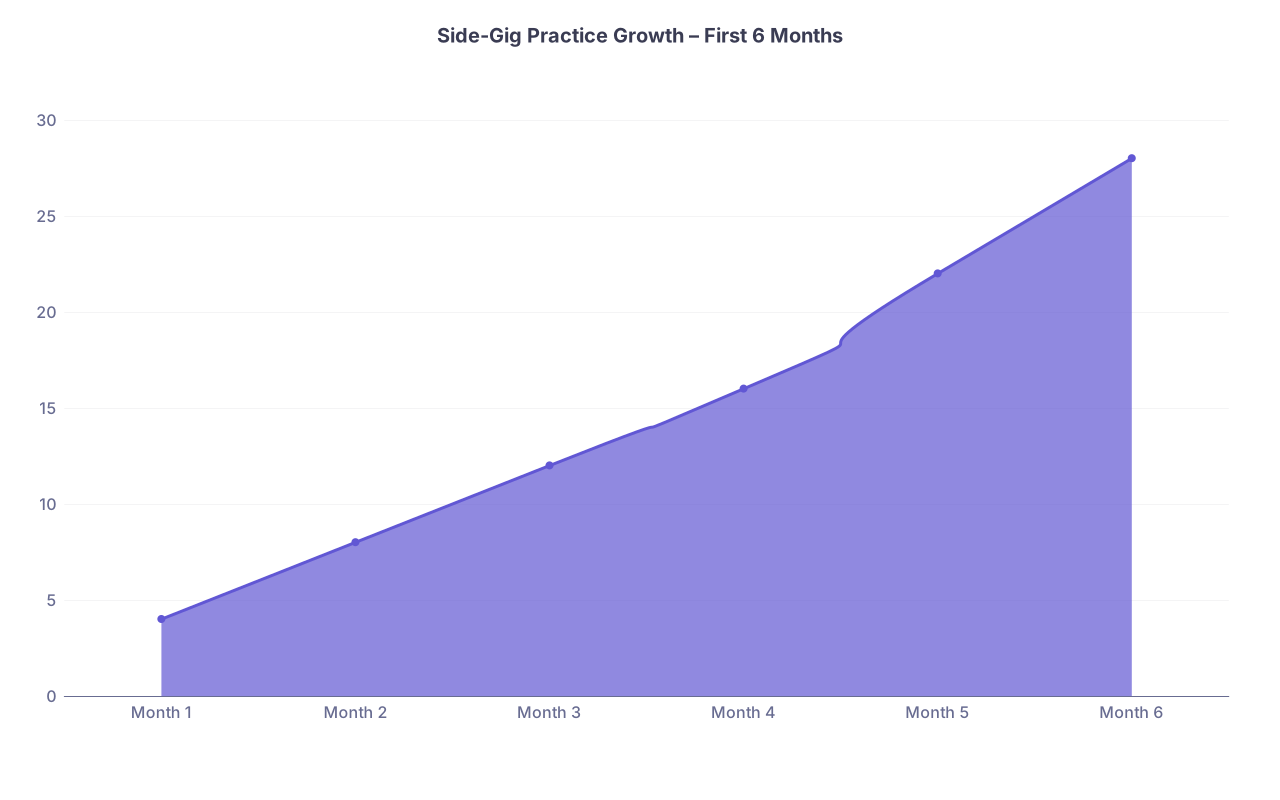
| Category | Value |
|---|---|
| Month 1 | 4 |
| Month 2 | 8 |
| Month 3 | 12 |
| Month 4 | 16 |
| Month 5 | 22 |
| Month 6 | 28 |
If your line is flat at 4–6 visits per month by Month 6 and you are actually trying to grow, something is off:
- Messaging.
- Access (bad hours).
- Location.
- Or you are not telling anyone you exist.
This is the moment to decide:
- Double down and fix bottlenecks.
- Or accept this as “nice hobby” and not a replacement for employment.
Months 6–12: Structured Expansion While Reducing Employed Time
If you have any traction by Month 6, the next phase is controlled aggression: more sessions, more visibility, slow reduction of your employed role.
You are still primarily employed, but you are now intentionally shifting the center of gravity.
Month 6–9: Go from “Tiny Side‑Gig” to “Serious Second Job”
At this point you should:
- Increase to 2 weekly sessions (e.g., one evening + one Saturday, or two evenings).
- Clean up your workflows:
- Templates and order sets in your EMR.
- Standardized intake, follow‑ups, refills, and messaging policies.
- Decide early:
- Do you personally answer messages?
- Do you want a VA or part‑time admin by the time you hit 10–15 patients/week?
Operationally, your weekly time split may now look like:
| Activity | Hours/Week |
|---|---|
| Employed job (clinical + admin) | 40–50 |
| Side-gig clinical sessions | 4–8 |
| Side-gig admin / business work | 2–4 |
| Family / personal time | Everything left over |
This phase is tiring. That is normal. It should be time‑limited.
By Month 9, you want:
- 25–50 active patients (depending on specialty).
- A monthly revenue trend that is clearly rising.
- At least 1 month of your household expenses already in savings, specifically earmarked as “runway” for practice transition.
Month 9–12: Start Negotiating and Shifting Your Employed Role
Now you test the real transition.
At this point you should:
Know Your Numbers Cold (No Hand‑Waving)
- Average monthly revenue from the practice (last 3 months).
- Fixed overhead (rent, software, malpractice, staff).
- Net income from the practice.
- Your minimum household number.
Set Your First Clear Trigger: Drop from Full‑Time to 0.8 or 0.6 Common rule of thumb:
- When your side‑gig practice consistently covers:
- 25–40 percent of your current take‑home pay
- For 3+ consecutive months
- And you have:
- 3 months of household expenses saved
→ You request a reduction in hours at the employed job.
- 3 months of household expenses saved
- When your side‑gig practice consistently covers:
Examples:
- Hospitalist moves from 7 on / 7 off to 0.7 FTE and uses 2–3 “off” days each block in clinic.
- Outpatient employed primary care cuts to 3 days/week and runs the practice the other 2 days.
- Initiate the Conversation with Your Employer (Month 9–10)
You approach with a clear proposal:
- Specific FTE you want (0.6, 0.7, etc.).
- Proposed schedule.
- Reassurance about coverage and patient continuity. You do not lead by framing your private practice as the reason, if that will trigger reflexive resistance. Frame it as workload, career blend, or academic / teaching goals, depending on local politics.
If they say no outright, you still have information. Now you know you may need a more decisive jump later, but you do not leave yet. You keep growing the practice until it can replace your job.
Months 12–18: From Majority Side‑Gig to Full-Time Practice
This is where the ramp‑up becomes a ramp‑off from traditional employment.
By now, if the model is viable, most physicians can see the endgame clearly on a 6–12 month horizon.
Month 12–15: Majority Practice, Minority Employment
At this point you should:
- Be at reduced FTE in your job or at least have:
- A specific date when your contract ends.
- An explicit plan for what happens next.
Clinically, in your practice, you are targeting:
- 3–4 clinic sessions per week (e.g., two full days + one evening).
- 50–100 active patients, or procedure volume equivalent.
- Monthly practice revenue that is:
- ~50–70 percent of your current job’s take‑home pay.
Your financial criteria for leaving employment fully should be explicit. For many, a workable threshold looks like:
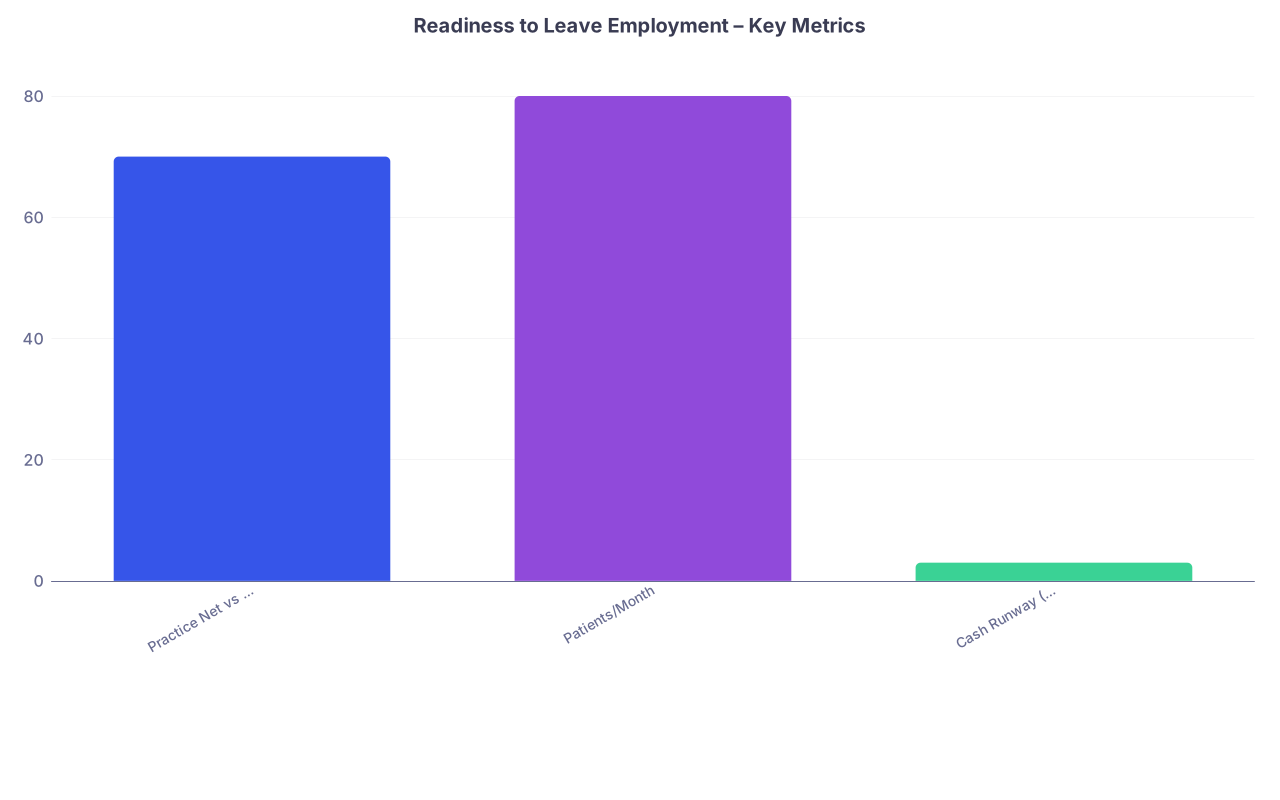
| Category | Value |
|---|---|
| Practice Net vs Take-Home | 70 |
| Patients/Month | 80 |
| Cash Runway (Months) | 3 |
Translation:
- Practice net income is consistently at or above 70 percent of your current take‑home pay.
- You are seeing at least 80 visits per month (or equivalent procedure volume) with capacity to add another 30–40 percent just by opening schedule.
- You have at least 3 months of full household expenses in cash.
If you are not close to these numbers by Month 15, your path may still be viable, but the timeline stretches. Adjust expectations rather than jumping blind.
Month 15–18: The Actual Transition to Full Time
Now you move from “test phase” to “this is my real job.”
At this point you should:
Lock in Your Exit Date
- Align with:
- Contract notice requirements (60–180 days is common).
- School calendars, spouse job changes, or relocation if relevant.
- Give written notice, keep it professional, avoid burning bridges. Medicine is a small village.
- Align with:
Expand Practice Capacity Before Your Last Employed Paycheck
- Add:
- Extra half‑day or full day of clinic two months before you leave.
- Additional support (VA or part-time front desk) if you are nearing admin overload.
- Open:
- Online scheduling more widely.
- A waitlist if appropriate.
- Add:
Communicate Like a Grown Business
- Announce expanded hours and availability to:
- Existing patients (email, portal, in‑person).
- Referring clinicians.
- Professional network (local groups, LinkedIn, alumni).
- Update:
- Website.
- Google Business.
- Any insurance directories (if paneled).
- Announce expanded hours and availability to:
Your job in these last 3 months is simple:
- Maximize smooth continuity in your old role.
- Aggressively but professionally fill your new schedule.
Weekly and Daily Routines During the Ramp‑Up
Macro timeline is useless if your weeks are chaos. Let me spell out what your time blocks should roughly look like during key phases.
Typical Week at Month 3–6 (Tiny Side‑Gig)
- Mon–Fri:
- Full‑time job.
- One evening (e.g., Wed 5–8 pm):
- Side‑gig clinic.
- Sat AM (2 hours):
- Admin: billing, charting, system tweaks.
Focus:
- Learning systems.
- Fixing friction points.
- Gathering feedback from early patients.
Typical Week at Month 9–12 (Growing Side‑Gig, Still Full-Time Job)
- Mon–Thu:
- Employed job.
- Friday:
- Half or full day in your practice, if job flexibility allows.
- One evening:
- Extra practice session.
- Sunday (2–3 hours):
- Review financials, tidy charts, plan marketing/referral touches.
Focus:
- Volume and efficiency.
- Beginning to feel the practice as a “real second job.”
Typical Week at Month 15–18 (Reduced FTE, Practice Majority)
- Two–Three days:
- Private practice clinic.
- One day:
- Employed job (if still 0.2–0.4 FTE).
- Half-day:
- Business operations: metrics, staff management, process improvement.
- Remaining time:
- Flex buffer for overflow and life.
Focus:
- Smoothing the patient experience.
- Converting new patients into stable follow‑up panels or procedure streams.
Guardrails and Hard Stops: When Not to Jump
Ambition is good. Financial self-sabotage is not.
Here are clear red lights. If these are true, you delay the full-time leap:
- Your practice has not grown in 3–4 months despite serious effort.
- Your average monthly net from the practice is under 40 percent of your current take‑home, and you have less than 2–3 months expenses saved.
- Your home life is already under strain from your side‑gig, and you have not yet stabilized systems or support.
- You are about to have a major life event: new baby, relocation, partner changing jobs. You reschedule your leap to avoid stacking stressors.
I have watched more than one physician bail out of a toxic job too early, only to recreate the same desperation in their “dream practice.” Do not do that. Give yourself runway and options.
Final Summary: What You Should Have at Each Stage
Keep it simple. Three anchors.
First 6 Months: Foundation and Proof of Concept
- You stay fully employed.
- The practice is legal, functional, and seeing a small but growing number of patients weekly.
- You know your numbers: revenue per visit, basic overhead, early demand.
Months 6–12: Real Side‑Gig With Intentional Shift
- You increase practice time to 1–2 days/week.
- You either negotiate reduced hours or clearly plan for that conversation.
- Your practice begins covering a meaningful percentage of your take‑home pay.
Months 12–18: Majority Practice and Full-Time Transition
- The practice covers 50–70 percent of your previous take‑home before you quit.
- You have at least 3 months of living expenses in cash.
- You set a specific date, expand capacity, and step into full-time practice with a real runway, not blind hope.
Follow that timeline, and your side‑gig does not just become a job replacement. It becomes a real, durable practice you control.