
The hardest place to start a practice is exactly where you’re most needed: a small rural town.
If you’re thinking about starting a small rural practice right out of residency—or jumping from an employed job to solo or small-group in a rural area—you are not crazy. But you are walking into a situation where most generic “start a practice” advice is borderline useless.
This is the playbook people do not hand you.
1. First reality check: is this town actually viable?
Do not start with a logo. Start with numbers and infrastructure.
Here’s what you need to figure out before you sign anything.
How many patients are really there?
You’re not just asking “how many people live here?” You’re asking: “How many people can actually become my patients and how fast?”
Call the county health department, local hospital, and state office of rural health. You want:
- County population and age breakdown
- Number of practicing clinicians (MD/DO/NP/PA) and their specialties
- Nearest urgent care, FQHC, or big health system clinic
- Hospital usage data if you can get it (ED visits per year, admissions, etc.)
Then do some rough math. Rural isn’t like suburban. Capture rates can be huge if you’re the only show in town.
As a rough, very rough, starting point:
- A full-time primary care doc can safely panel 1,200–1,800 patients in a rural setting if you’re doing broad scope.
- If there are 4,000–6,000 people within a 30–45 minute radius and no real primary care, this is usually viable.
- If the hospital CEO literally says, “We’re begging for another doc, our ED is full of primary care,” that’s usually real demand, not sales pitch.
What’s already there?
Here’s where rural is weird: you may have an FQHC 15 miles away, a corporate clinic 30 miles away, and a hospital-owned primary care across the street from your dream office.
Do a windshield survey. Drive around. Walk into waiting rooms. Look at:
- Parking lot at 10 am on a Tuesday – packed or empty?
- How far out are new patient appointments? Call as a “new patient” and ask.
- What’s the vibe? Corporate-churn, or “we’ve known them for 30 years”?
You’re not trying to avoid all competition. You’re trying to see if there’s a niche they’re obviously failing at: access, continuity, procedures, care for farmers and working poor, after-hours.
2. Decide your practice model before you get seduced by “shiny”
Most rural practices fail on the business model, not the medicine.
You have to pick how you’ll get paid—and it has to match your town.
Start by asking: “Who actually lives here, and how are they insured?”
Call the local hospital’s billing office or the state insurance commission and get rough payer mix for the county. Typically, you’ll see a blend of:
- Medicare
- Medicaid
- Commercial (often narrow-network plans tied to one system)
- Uninsured / underinsured
- Maybe large employer-based coverage (factory, school system, farming co-op)
Now, model options:
| Model Type | Best When... | Landmines |
|---|---|---|
| Traditional insurance | Mixed payer, hospital nearby | Credentialing delays, AR issues |
| Direct primary care (DPC) | Underinsured, high deductibles | Scaling in low-income areas |
| Hybrid (DPC + insurance) | Mixed income, flexible demand | Complexity, messaging confusion |
| Hospital-affiliated solo | Strong local hospital | Loss of autonomy, politics |
| RHC/FQHC-style (eventual) | High Medicare/Medicaid | Heavy regulation/admin burden |
If more than 50–60% of your community is on Medicare/Medicaid, a pure DPC model will struggle unless you’re near a wealthier commuter population.
If the town is full of self-employed farmers, tradespeople, and small business owners with junk insurance and $8k deductibles, DPC or a low-overhead cash membership model can be gold.
You need to choose early. Everything else—space, staffing, tech—flows from this.
3. Land, building, and “this old house” syndrome
Urban practices rent a suite in a medical building and call it a day. Rural docs are often choosing between:
- A small standalone building on a state road
- A former bank / dentist office / insurance agency
- A space attached to a pharmacy or grocery
- A cheap but ancient building that will bleed you dry in renovations
Here’s how to not get crushed.
Lease vs. buy
If you’re fresh out of residency and not sure you’ll love this town, lease. Even if everyone says, “You should buy, it’s so cheap.” Cheap becomes expensive when the roof, HVAC, and septic go in the same year.
If you’re confident you’re staying 10+ years and the building is medically functional with minor work—buying can be a strong move, especially if you split it into condo-type units and rent out unused space later (mental health, PT, dentistry).
Don’t underestimate buildout
Rural contractors can be either amazing or impossible. Timelines slip. Materials are late. You’re low-priority compared with big barn or highway jobs.
Get two bids, minimum. Put penalty clauses or at least clear dates in writing.
For most small primary care practices:
- 3 exam rooms, 1 procedure room, 1 provider office, small lab space, waiting/reception, 2 staff workstations is enough to start.
- You do not need a showpiece lobby. You need functional airflow, plumbing, and a layout that doesn’t have staff walking miles per day.
Also: check internet. This sounds stupid. It is not. Rural broadband is a mess. If you can’t get reliable cable/fiber, you may need business-grade cellular or satellite. Without internet, your EHR, e-prescribing, and telehealth are dead.
4. Staffing when the talent pool is five people deep
Here’s where rural practice either runs beautifully or breaks you.
You will not have a huge pool of medical assistants who’ve worked at three other clinics. You may have:
- A former CNA from the nursing home
- Someone who worked front desk at the local dentist
- A cousin of the pharmacist who “has done some medical office work”
You’ll be training. A lot.
Hire for attitude, not resume
In a small town, one bad hire poisons the whole practice. I’ve watched one toxic front-desk person drive patients back to the hospital clinic in six months.
Look for:
- Reliability (they’ve held one or two jobs for several years)
- Kindness and discretion (people will tell them everything)
- Comfort with basic tech—even if they haven’t used an EHR, can they handle email, basic software, tablets?
Pay a bit above the local norm. Word spreads fast. Being “the doc that pays fairly and treats staff well” is one of the best marketing strategies you can have in a rural community.
Start lean. For a one-doc primary care rural clinic:
- 1 front-desk/biller hybrid
- 1 MA/LPN who rooms, does vitals, injections, phlebotomy if possible
- You
You can cross-train. You can outsource complicated billing. But don’t staff like a suburban group—it will just eat your margin.
5. Tech and EHR: pick the right size hammer
The hospital may push their EHR on you. The big health system 40 miles away might, too. Be very careful.
You need:
- Low upfront cost
- Cloud-based (you don’t want a server in your back closet)
- Good support and training for small practices
- Integrated e-prescribing, e-labs, and clearinghouse for claims
- Not 14 layers of clicks for every simple order
You do not need:
- A full enterprise suite designed for a 400-bed hospital
- A custom-built local solution from “my brother’s IT company”
- The fanciest population health dashboards in the region
Set a budget in your head. Under $800–$1,200/month for a single-doc setup with EHR + practice management + clearinghouse is realistic in 2026 for many cloud systems. Demo at least three. Ask blunt questions like:
- “How many one- or two-provider rural practices are you supporting?”
- “What is your average time to answer a support ticket?”
- “If my internet drops, what can I still do?”
Telehealth: rural patients actually use it, especially in bad weather or for chronic care follow-ups. But you have to set expectations: initial visits in person, then telehealth as appropriate.
6. Money, cash flow, and not going broke in the first 6 months
Your biggest risk window is the first 6–12 months. You have minimal revenue, lots of startup costs, and payer credentialing that moves at a glacial pace.
Here’s the brutal sequence:
- You sign a lease / buy a building.
- You buy basic equipment and software.
- You hire minimal staff.
- You apply for payer credentialing.
- For 60–180 days, you see patients with little to no reimbursement from some payers.
- You panic.
Avoidable? Not fully. Manageable? Yes.
Build a realistic runway
Do a monthly budget: rent/mortgage, utilities, EHR, malpractice, staff salaries, payroll taxes, internet/phone, supplies, insurance, your own bare-minimum living expenses.
Multiply your monthly burn by at least 6–9. That’s your target runway in savings, spouse income, or line of credit.
You can trim startup gear. You can start with basic otoscope sets, a used exam table, and a smaller autoclave. But you cannot trim payroll or rent much once you open.
Charge fairly and clearly
In a rural practice, you must talk about money directly. People are used to hating surprise medical bills.
Post your self-pay pricing. Make it simple. Consider:
- Flat new-patient visit price
- Follow-up rates
- Simple procedure bundles (sutures, abscess I&D, joint injections, etc.)
If you’re doing DPC or a membership model, keep tiers limited. One or two tiers max. Confusion kills trust.
7. Work with the local hospital (even if you don’t like them)
Most rural towns orbit a hospital, critical access hospital, or regional system.
You might be tempted to be “independent” and pretend they don’t exist. That’s a mistake.
You need:
- Lab and imaging agreements
- ED communication loop (“this is our shared patient”)
- Referral pathways to specialists
- Possibly call coverage agreements if you still do inpatients or OB
Walk in and introduce yourself to:
- CMO or medical director
- ED director
- Lab director
- Radiology lead
- Case management/social work
Say something like: “I’m opening a small primary care clinic in town. I want to keep people out of your ED unnecessarily and coordinate care. How can we make that easy?”
They may offer you:
- Medical directorships (for nursing homes, hospice, ED)
- Part-time hospitalist work
- On-call pay
Do not jump at everything. You’re starting a practice, not collecting hats. But one or two well-structured side contracts can stabilize your income while patient volume grows.
8. Rural malpractice, scope, and when to say no
You’ll be pressured to do everything. “Doc, can you take this mole off?” “Doc, can you deliver my baby?” “Doc, can you manage my chemo?” Sometimes, you should say yes. Sometimes, absolutely not.
The tension in rural medicine: you are often the only person within 30 miles who can do even basic procedures. But you still have to practice within your training and comfort, and with backup realistically available.
Set your scope deliberately:
- List what you’re fully comfortable doing: lacerations, basic fracture care, joint injections, minor skin procedures, Nexplanons, etc.
- List what you’ll do with backup on speed dial: complex wound care, advanced fractures (with ortho on phone), high-risk OB (if you’re trained).
- List what you will not do: major surgeries, chronic chemo, uncontrolled complex psych if you truly have no resources.
Malpractice premiums can be lower in rural primary care than in big cities, but they spike if you’re doing OB or procedures without clear backup. Talk with a broker that actually understands rural and small practice, not just big city groups.
And document everything. Especially why you transferred or referred out.
9. Community trust is your real marketing plan
Rural marketing is not SEO and Google Ads as much as it is: “Do people believe you’re here to stay and that you care about them?”
Practical steps:
- Show up early. Sponsor a local high school sports team for peanuts. Put your logo on the banner.
- Attend one or two key events: county fair, farmers’ breakfast, local chamber of commerce. Don’t hard sell, just be present.
- Visit the pharmacy. Ask the pharmacist, “What do people complain about most with local medical care?” Then shut up and listen.
Your website can be basic, but it must be:
- Accurate (hours, address, phone, new patient info)
- Simple online forms or at least downloadable new patient packets
- Clear statement of what insurances you take and what you don’t
Online reviews matter more than you think, even in rural areas. But you don’t need 500. You need a small handful of patients who say, “They listened. They explained. I didn’t wait 3 hours.”
If you answer the phone with a human, keep your word on appointment times, and call people with results—you will already be wildly above average.
10. Day-to-day operations that actually work in a small town
Let’s talk about the grind once you’re open.
Scheduling that respects how people live
Farmers, shift workers, and teachers don’t live in 9–5 clinic land.
You’ll win a ton of loyalty if you:
- Open early one day a week (7 am slots)
- Stay late one day (til 6 or 7)
- Reserve same-day or next-day urgent slots for established patients
Avoid stacking your day with 10-minute visits from day one. In year one, you need time to talk. To win trust. To untangle 20 years of unaddressed issues.
You can always tighten templates as you fill up.
Handling walk-ins
In many rural minds, medicine is still “I go to the doctor, I wait, I’m seen when it’s my turn.” Appointments are… fluid.
You have three options:
- No walk-ins, appointment only. Strict, but may frustrate locals.
- Open walk-in blocks (e.g., 8–10 am daily for simple issues).
- Hybrid: you accept walk-ins but triage and may schedule them same-day or next-day.
What you absolutely must not do: let walk-ins completely wreck your schedule to the point that booked patients wait 2 hours. You will lose the group that prioritizes planning (teachers, nurses, parents with multiple kids).
11. Local solutions for rural-specific headaches
Here’s where you think creatively, not like a big city doc.
Transportation barriers
Patients live 45 minutes away with one car in the family and no gas money. Solutions:
- Cluster follow-ups for people from the same distant area on the same day.
- Coordinate with churches or community groups that do ride programs.
- Offer occasional telehealth for stable chronic disease visits so they don’t burn 3 hours and a tank of gas.
Pharmacy deserts
If there’s no local pharmacy or it closes early:
- Use e-prescribing strategically to the nearest 24-hour or late pharmacy.
- Keep a small stock of commonly needed meds (sample closet) and low-cost generics if your state allows.
- Work with mail-order or delivery-pharmacies that understand rural logistics.
Broadband and tech literacy
A patient portal is useless if half your patients don’t have internet or a smartphone.
So:
- Use SMS (text) reminders if allowed by your system. People with flip phones often still have basic text.
- Don’t make portals mandatory for basic things like refills or lab results; offer voicemail and call-backs.
- Use simple paper handouts with clear instructions and phone numbers.
12. Don’t burn out trying to save the whole county
This part gets ignored.
Rural docs are at high risk of burnout because:
- They’re often on 24/7 in some form, formally or informally.
- Their patients are also their neighbors, their kids’ teachers, their church members.
- There’s constant emotional pull: “No one else will help this person.”
You need boundaries early or you’ll hate the practice you built.
Some guardrails:
- Clear after-hours policies: who they call, when you respond, what constitutes an emergency.
- Hard rules about texting your personal phone. Don’t let the line blur.
- A minimum number of days off per quarter that you actually take, even if it’s just staying home and turning off the phone.
Find at least one peer, even remotely, who’s also in rural practice. Text them. Vent. Trade solutions. You will need someone who gets it.
13. A quick startup sequence you can actually follow
Here’s a simple roadmap—not perfect, but grounded.
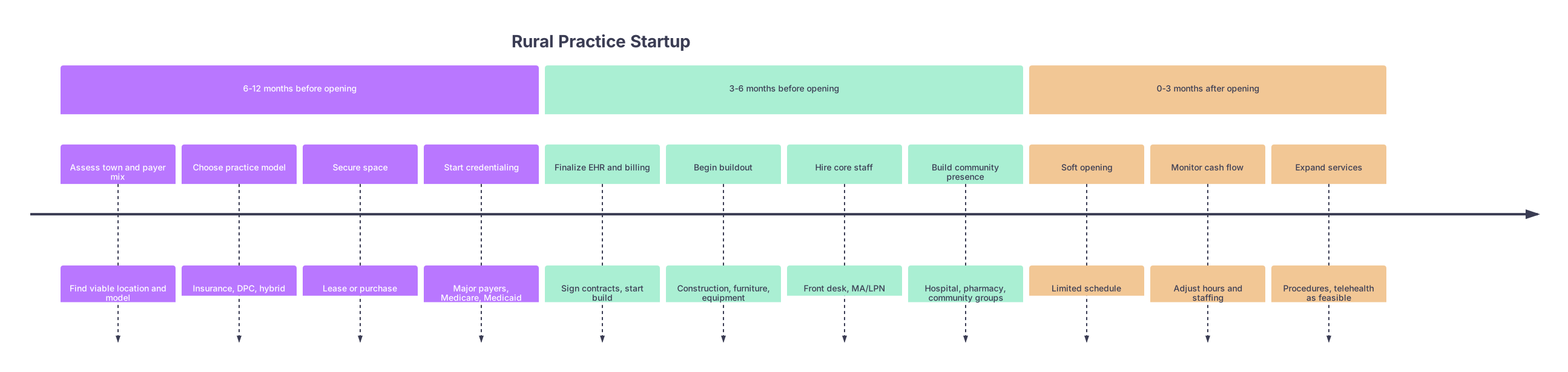
| Period | Event |
|---|---|
| 6-12 months before opening - Assess town and payer mix | Find viable location and model |
| 6-12 months before opening - Choose practice model | Insurance, DPC, hybrid |
| 6-12 months before opening - Secure space | Lease or purchase |
| 6-12 months before opening - Start credentialing | Major payers, Medicare, Medicaid |
| 3-6 months before opening - Finalize EHR and billing | Sign contracts, start build |
| 3-6 months before opening - Begin buildout | Construction, furniture, equipment |
| 3-6 months before opening - Hire core staff | Front desk, MA/LPN |
| 3-6 months before opening - Build community presence | Hospital, pharmacy, community groups |
| 0-3 months after opening - Soft opening | Limited schedule |
| 0-3 months after opening - Monitor cash flow | Adjust hours and staffing |
| 0-3 months after opening - Expand services | Procedures, telehealth as feasible |
Expect everything to take longer than promised. If something happens early, treat it as a bonus.
14. When to pivot or pull the plug
Not every rural practice should keep going at all costs. A few hard benchmarks:
You should seriously reevaluate if, after 18–24 months:
- Your active patient panel is under 600–800 despite sustained effort
- You can’t pay yourself a basic salary without ongoing debt
- Local political or hospital dynamics are sabotaging referrals and access
- The emotional/mental toll is wrecking your life
Pivot options:
- Sell or merge with the local hospital or FQHC while retaining some autonomy
- Bring on a PA/NP and reposition yourself as a specialist niche within primary care (procedures, addiction, women’s health)
- Transition to a different model (e.g., move to DPC if you have enough interest, or the reverse if DPC demand is weak)
Letting go of a struggling model isn’t failure. Staying in a model that’s grinding you into dust is.
Starting a small rural practice is not a cute lifestyle project. It’s advanced medicine, advanced logistics, and advanced politics wrapped in one. But if you get the fundamentals right—viable town, sane business model, lean operations, deep community trust—you can build a practice that’s both sustainable and badly needed.
Once the doors are open and the waiting room has actual people in it, your challenges will shift: scaling without losing your soul, teaching staff to handle more, deciding whether to bring in a partner or midlevel, maybe even expanding to a second site. That’s the next phase of the story—but first, get this first clinic standing, steady, and truly part of the town it serves.