
It’s January of your dedicated period. Step 1 is pass/fail. Your group chat is split between people doing three UWorld blocks a day and people “vibing” with Anki and Netflix. Your advisor says, “Just pass.” Reddit says, “Treat it like it’s still scored.” You’re sitting there thinking: how hard am I actually supposed to go?
Here’s the answer: you should study hard enough that your probability of failing is boringly low, but not so hard that Step 1 nukes your mental health, Step 2 prep, or your third-year performance.
Let’s make that concrete.
Big Picture: What Step 1 Means Now (And What It Still Controls)
Step 1 being pass/fail did not make it irrelevant. It changed what it’s doing for you.
Step 1 now is:
- A gatekeeper: programs will absolutely screen out fails.
- A trust signal: “Can this person handle large volumes of material and pressure?”
- A foundation exam: everything in clerkships, Step 2, and specialty choice sits on this base.
What it is not anymore:
- A precise ranking tool for PDs to stack you from 1–500.
- The single dominant metric deciding if you’re competitive.
But here’s the quiet reality no one tells you clearly:
Failing Step 1 once is a big red flag. Failing twice is brutal. Even with pass/fail, that hasn’t changed.
So your study intensity should be built around avoiding a fail with a wide safety margin and building a usable knowledge base, not around chasing some imaginary 260 that no longer goes on ERAS.
The Core Framework: Where You Fall on the “Risk Curve”
Forget vibes. Here’s how to decide how hard you should study.
Ask yourself three questions honestly:
- How strong is my foundation?
- How high is my anxiety about failing?
- How ambitious are my specialty goals?
Let’s turn that into something practical.
| Student Type | Goal Intensity | Daily Dedicated Hours | UWorld Pass Target |
|---|---|---|---|
| Strong foundation, low anxiety | Moderate | 6–7 | ≥ 70% |
| Average foundation, typical anxiety | Moderately high | 7–9 | 60–70% |
| Weak foundation or high anxiety | High (smart, not brutal) | 8–10 | 55–65% |
Here’s how I’d interpret that:
If you’ve consistently scored well on school exams, didn’t cram your pre-clinicals, and your NBME practice is solid early:
You do not need to grind 12 hours a day. You need consistent, focused 6–8 hour days with strong resources.If you’re middle of the pack:
You probably need 7–9 real hours, not fake 12s where half of it is scrolling.If you struggled in pre-clinicals, barely passed some systems, or have test anxiety that’s not under control:
Yes, you probably need the higher end of hours and a longer dedicated. But the solution is better structure, not pure suffering.
What “Studying Enough” Actually Looks Like
Let’s make this concrete so you’re not guessing.
1. Your Goal Is a Safe Pass, Not a Heroic Score
If Step 1 were still scored, I’d tell you to aim high. Now? Different game.
Your working target is:
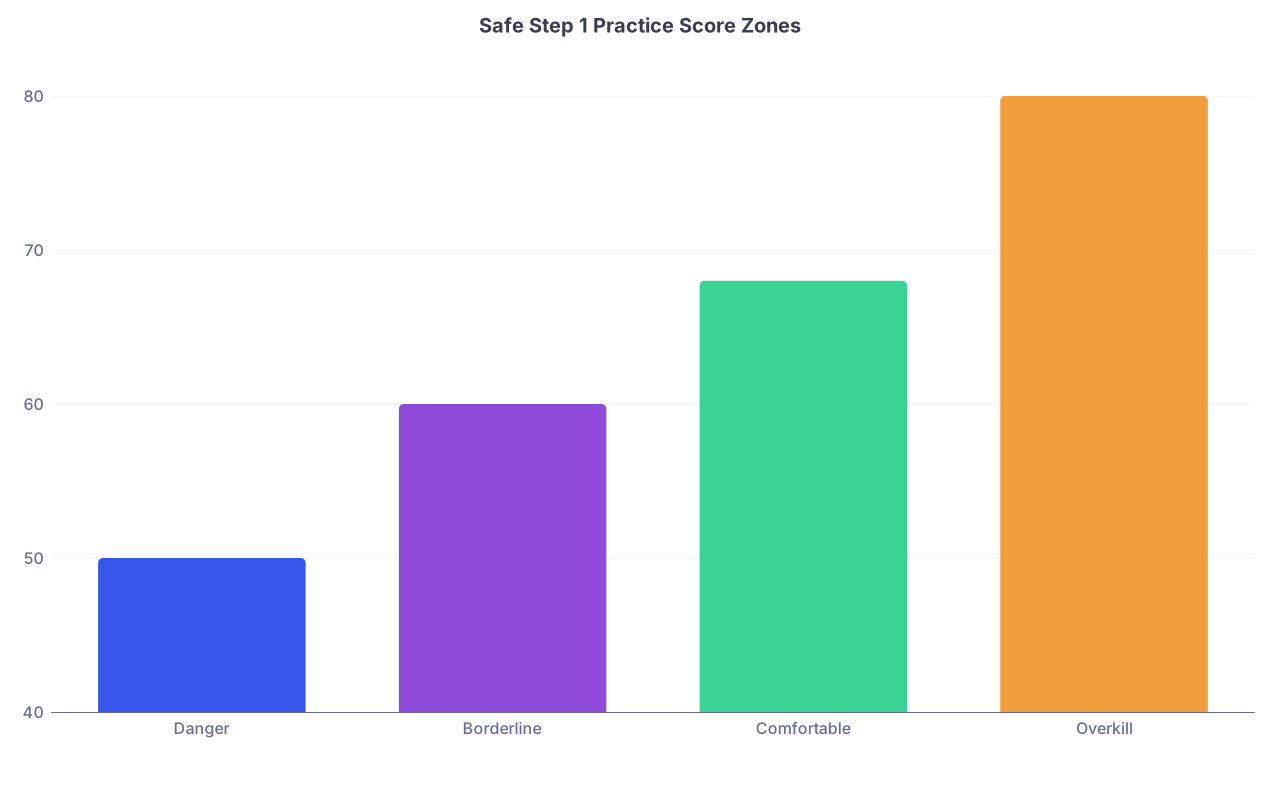
- NBME practice exams comfortably above the passing range (I like ≥ 65%+ correct on recent NBMEs as a safety zone).
- UWorld overall 60–70% is usually plenty, especially if your NBMEs agree.
Anything beyond that isn’t wasted, but there are diminishing returns. Better to carry that extra gas into Step 2.
| Category | Value |
|---|---|
| Danger | 50 |
| Borderline | 60 |
| Comfortable | 68 |
| Overkill | 80 |
If your NBMEs are repeatedly under ~60%, you’re not “almost there.” You’re not ready. You need more time, better strategy, or both.
2. Your Day Needs These Non‑Negotiables
For most students aiming for a safe pass with sanity:
- 1–2 UWorld blocks/day (timed, random, mixed by the second half of dedicated)
- 1–2 hours of review per block (this is where you actually learn)
- 1–2 hours of targeted content review (First Aid / Boards & Beyond / Sketchy / Pathoma)
- 30–60 minutes of Anki (IF you’ve been using it; don’t start from zero in dedicated)
That usually shakes out to a 6–8 hour “real work” day. Not counting meals, zoning out, or staring at your phone.
If your “10-hour days” are really 5 hours of work and 5 hours of guilt, you’re studying wrong, not too little.
How to Push Hard Without Burning Out
You don’t burn out just from hours. You burn out from unsustainable mismatch: constant pressure, no wins, no recovery.
1. Pick an Hours Range You Could Sustain for 6 Weeks
Key word: sustain.
Ask yourself: “Could I do this 6 days a week for 6 weeks without losing my mind?”
- 7–8 hours of focused work? Most people can.
- 10–12 hours? Some can, briefly, but most crash. And when they do, they crash hard.
If your school gave you 6–8 weeks of dedicated, a very sane schedule is:
- 6 days on, 1 real day off
- 7–9 focused hours per study day
Yes, a real day off. No UWorld “just to check something.” No First Aid “light review.”
Your brain needs full off days to convert short-term to long-term memory. I’ve watched plenty of students climb out of a months-long slump after they finally gave themselves permission to rest.
2. Set Hard Boundaries
You won’t like this, but it works:
- Pick a daily stop time (e.g., 8 pm). After that, you’re done. No more questions.
- Protect sleep like it’s an exam. 7–8 hours, not “I’ll sleep when it’s over.”
- One day off per week. Non-negotiable unless you’re right before the exam and you want to compress.
Studying to exhaustion every day feels virtuous. It’s not. It’s just bad planning with a Halo effect.
How Practice Scores Should Dictate Your Intensity
Your practice exams are your reality check. Use them.
Very Rough Guide
Below ~55% on NBMEs early in dedicated:
You need to fix your system: how you’re reviewing, your content gaps, maybe push the exam.60–65% mid-dedicated:
On track for a pass. Keep the same or slightly increased intensity. Don’t relax yet.65–75% close to exam:
You’re in a healthy safety zone. You do not need to suddenly double your hours because a classmate got a 78%.75%+ repeatedly:
You’re in “I would have scored very well in the old system” territory. You can:- either maintain current intensity for confidence
- or trim an hour or so a day and protect your sanity

| Step | Description |
|---|---|
| Step 1 | Take NBME |
| Step 2 | Increase structure and hours |
| Step 3 | Consider pushing exam |
| Step 4 | Maintain or slightly increase hours |
| Step 5 | Focus on weak systems |
| Step 6 | Maintain current plan |
| Step 7 | Option to reduce hours slightly |
| Step 8 | Score below 55 |
| Step 9 | Score 55 to 65 |
| Step 10 | Score above 65 |
If you’re consistently scoring high and still pushing 10+ hour days because you’re terrified of being “the one who fails,” that’s anxiety, not rational planning. Different problem, different solution.
How Your Specialty Goals Actually Change the Equation
This is where the discourse gets messy. People say, “Step 1 is pass/fail, just chill,” while also telling you they want derm or ortho. Those two ideas don’t match.
Let me be clear:
For ultra-competitive specialties (derm, plastics, ortho, neurosurgery, ENT):
Your Step 2 will now take the hit that Step 1 used to. Programs need some way to rank.For moderately competitive fields (EM, gas, rads, some IM programs):
A fail on Step 1 will hurt you. A strong Step 2 helps a lot.
So what does that mean for how hard you study for Step 1?
- You do not need to grind Step 1 like it’s still scored.
- You do need to build a rock-solid foundation so Step 2 can be your star.
Translated: aim for over-prepared to pass, not “maximally squeezed.”
You want to leave dedicated with two things:
- A safe pass
- Enough understanding that Step 2 content doesn’t feel like a foreign language
If you show up to third year completely burned out, hating medicine, and with foggy recall because you overcrammed? Your shelf exams and Step 2 score will pay for it.
Signs You’re Studying Too Hard (In a Bad Way)
Here’s when I tell students: your problem isn’t too little work; it’s too much, badly managed.
Red flags:
- You regularly fall asleep on questions.
- You’re rereading First Aid but not retaining anything.
- You’re doing third/half-hearted UWorld blocks you barely review.
- Your mood is tanking, you’re crying most days, and the thought “maybe I should just quit” shows up more than once a week.
- Practice exams are flat or dropping despite more hours.
That’s not discipline. That’s a system failure.
If any of these are happening:
- Cut 1–2 hours of “fake studying” from your day.
- Replace some passive reading with active work: questions, teaching concepts aloud, blank-page recall.
- Protect 1–2 non-academic things per week that make you feel human (gym, walk with a friend, cooking, whatever).
You’re not weak for doing this; you’re extending your battery life.
A Sample “Enough But Not Insane” Dedicated Schedule
Let’s say you have 6 weeks of dedicated, average foundation, aiming for a safe pass and a solid Step 2 foundation.
A typical day (Mon–Sat):
- 8:30–10:30 – UWorld block 1 (timed, random)
- 10:30–12:00 – Review block in depth
- 12:00–1:00 – Lunch + mini-break
- 1:00–3:00 – Content review (system or topic-based using FA/Boards & Beyond/Sketchy)
- 3:00–3:30 – Break, walk, snack
- 3:30–5:30 – UWorld block 2 or mixed practice (or half-block + review)
- 5:30–6:30 – Review / Anki / flashcards
- 6:30 onwards – Dinner, light review if you want, then off
That’s about 7–8 real working hours. For most students, that’s exactly the level where you pass comfortably without wrecking yourself.
Sunday:
Off. Or at most: 1–2 hours of light review if you’re restless, but zero guilt if you do nothing.
What To Do Today: Quick Self-Assessment
You want a direct answer to “How hard should I study?”
Do this now:
Write down:
- Your most recent NBME %
- Your UWorld overall %
- Your real focused hours per day (not what you tell people)
Ask:
- Am I truly at risk of failing?
- Or am I overshooting out of fear?
Adjust:
- If your metrics are weak: improve structure first, then add hours.
- If your metrics are solid: cap your hours and protect your mental health.
The right amount of work is the point where your risk of failure is comfortably low, you’re not chronically miserable, and you still have gas left for third year and Step 2. That’s the bar.
FAQ: Pass/Fail Step 1 and How Hard to Study
What NBME score should I aim for before I sit for a pass/fail Step 1?
I like to see at least mid-60s on the newer NBMEs going into your final 1–2 weeks, with no recent exam below ~60%. That puts you in a zone where a bad day is unlikely to tip you into failing. If you’re repeatedly under 60%, especially late, I’d be seriously considering a delay and a change in strategy.Is 10–12 hours of studying per day necessary now that Step 1 is pass/fail?
For almost everyone, no. What matters far more is high-yield hours than raw volume. Most students can do extremely well—and pass very safely—with 7–9 focused hours. When people claim 12–14 hours daily, a lot of that is unfocused, low-yield misery. If you can truly handle 10 hours of high-quality work without burning out, fine, but that’s not a requirement and often not smart.Can I still match a competitive specialty if I only “aim to pass” Step 1?
Yes, because “aim to pass” for you should still mean “study hard, build a strong base, and pass with margin.” Programs will look much harder at Step 2, clinical grades, research, and letters. What will hurt you is a Step 1 fail, not a pass without some mythical score. So study seriously, but shift your perfectionism to Step 2, where the score actually shows up.How many UWorld questions should I finish for a pass/fail Step 1?
I still recommend doing the entire UWorld Step 1 bank once, thoughtfully reviewed. For most students, that’s the backbone of their prep. A second pass can help if you start early and have time, but for pass/fail, I’d prioritize one careful pass (with thorough review and notes) over racing through multiple sloppy passes.What if my practice scores aren’t improving even though I keep adding more hours?
That’s a classic sign you’re hitting a wall. More hours won’t fix a broken process. You likely need to:- Change how you review questions (focus on reasoning, not memorizing explanations).
- Identify specific weak systems and hit them with targeted content review.
- Improve sleep and take real breaks so your brain can consolidate.
Sometimes, cutting 1–2 hours of low-yield grind actually improves your scores.
Is it okay to take 1 day off per week during dedicated, or is that risky?
Not only is it okay, I think it’s smart for most people. One protected day off per week doesn’t tank your performance; it helps preserve it. The risk isn’t one rest day—it’s chronic fatigue, emotional breakdowns, and losing motivation halfway through dedicated. Your brain is a biological organ, not a hard drive. It needs off-time.How do I know if I should delay my Step 1 exam?
Consider delaying if:- Your last 2 NBMEs are both <60% and the test is <2 weeks away.
- Your scores are flat or dropping despite honest effort and decent structure.
- Your mental health is in crisis territory (e.g., panic attacks daily, can’t function).
A short, intentional delay with a new strategy is better than pushing through to a likely fail. If you’re in the gray zone (low 60s, anxious), it’s a judgment call, but talk to someone who can be blunt with you: advisor, mentor, upperclassman who knows your work.
Open your calendar and your most recent NBME score report. Today, adjust your daily hours and days off so that they match your actual risk—not your fear. If your plan looks impossible to sustain for 6 weeks, fix the plan, not yourself.