
It’s 11:47 p.m. You’re staring at your Step 2 CK Qbank dashboard, and instead of focusing on the question in front of you, your brain is replaying one sentence on loop:
“I didn’t really go that hard for Step 1.”
You remember the pass/fail announcement. Everyone said, “Relax, it’s fine now, just pass and move on.” You did what you needed to pass. You didn’t grind like the people who still talk about their UWorld reset strategies from M2 winter. You never saw a 270 practice score because… you never chased one.
Now Step 2 is looming. It’s scored. Programs care. People whisper that Step 2 is “the new Step 1.” And you’re wondering if your “chill” Step 1 era is about to punch you in the face.
So now you’re here. Wondering if the fact that you didn’t crush a pass/fail exam is going to haunt your Step 2 CK and screw your residency chances.
Let me be blunt: you’re not the first one to have this panic spiral. I’ve watched this exact anxiety play out in group chats, in library corners, and in those late-night “I can’t sleep, can we talk” calls.
Let’s pick this apart like an NBME question.
What “Not Grinding” for P/F Step 1 Really Did (and Didn’t) Do
First, you need to separate the narrative you’re telling yourself from what actually exists.
There are three different things people mean when they say “I didn’t grind for Step 1”:
You truly did the bare minimum
Like: watched some vids, did a few blocks, skimmed First Aid, crammed near the end, and walked in praying for a pass. Weak foundations. Gaps everywhere.You studied but not “hardcore”
You did UWorld once, watched relevant videos, reviewed high-yield stuff, maybe didn’t memorize every enzyme in biochem. You passed comfortably but never aimed for a theoretical 260.You did a decent job but now you’re catastrophizing
You passed, your school’s shelf exams weren’t terrible, you somewhat understood material, but because you weren’t locked away for 10 weeks doing 80 questions a day, your brain is rewriting history as “I slacked.”
Only the first category is truly dangerous for Step 2. And even then, “dangerous” doesn’t mean doomed. It just means Step 2 prep will feel like learning medicine from the ground up instead of refining it.
Not grinding for Step 1 did not:
- Put a permanent ceiling on your Step 2 score
- Mark you in ERAS as “lazy forever”
- Brand you as less capable than the people who became Anki robots M2 year
What it did do, if we’re being honest:
- Probably left some basic path/phys gaps
- Made Step 2 prep less of a “review” and more of a “rebuild + apply”
- Gave you less of that smug “oh I’ve seen this 10x before” feeling on early Step 2 blocks
Annoying? Yes. Fatal? No.
The Ugly Truth: Step 2 Is Not Just Step 1, Part 2
Here’s where your fear is half-right: Step 2 does build on Step 1.
If you never really understood:
- Why certain drugs cause specific side effects
- Those core path mechanisms (starling forces, acid–base, renal weirdness, neuro tracts)
- How to connect mechanism → disease → presentation → management
Then yeah, Step 2 will feel more painful in certain areas.
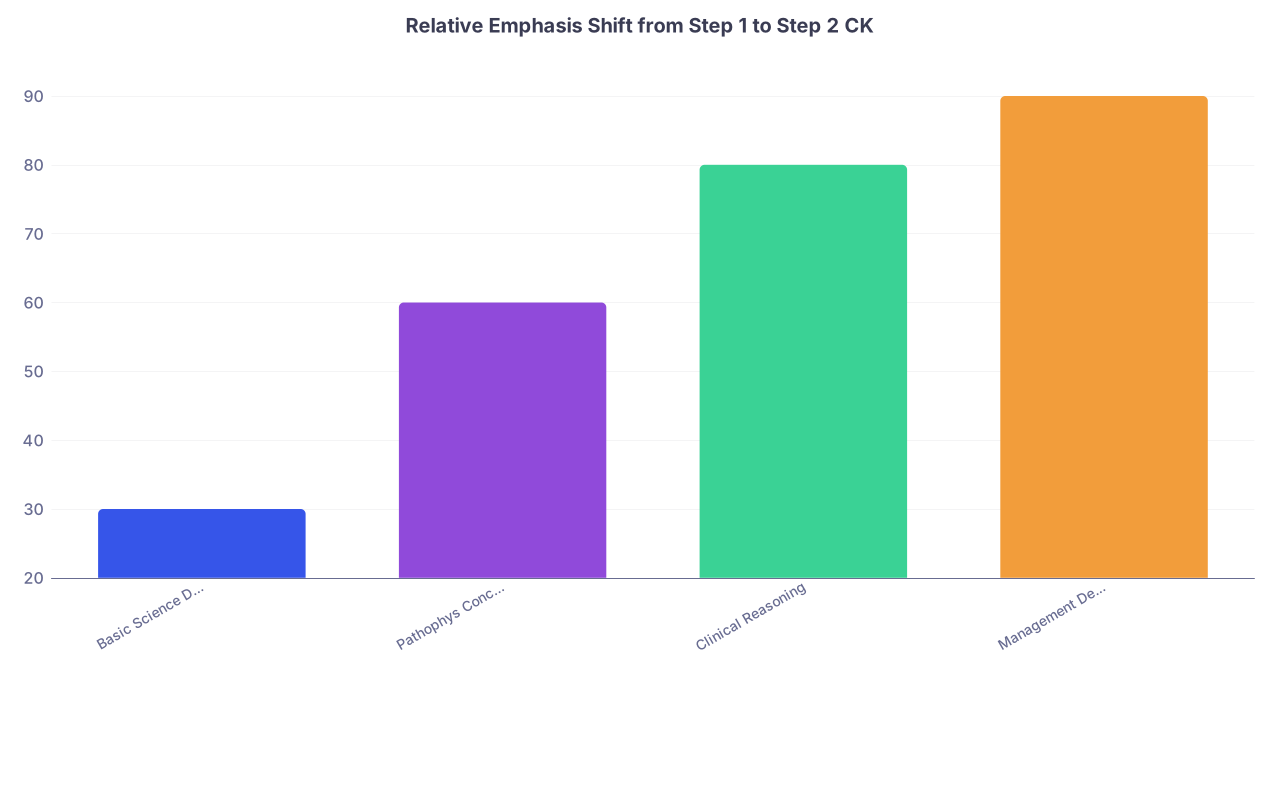
But Step 2 CK is not a pure basic science exam. It’s clinical. It cares more about:
- “What’s the next best step?”
- “What’s the most likely diagnosis given these labs + imaging + story?”
- “What do you treat with first-line and what do you absolutely not do?”
It’s less “memorize the complement pathway” and more “okay, this kid has signs of immunodeficiency, now what do you test and how do you manage.”
So if you didn’t obsess over biochem for Step 1, you’re fine. If you never deeply got comfortable with something like cardiac physiology, you’ll feel that more. But again, this is fixable.
Here’s the part that nobody wants to admit out loud:
I’ve seen people who over-ground Step 1 and then get blown up by Step 2 because they never learned to think clinically. They memorized random facts and pathways, but they freeze when a question is 18 lines long and hides the diagnosis under vague wording and lab subtleties.
You’re scared you didn’t do “enough” for Step 1. Some of those people did “too much” of the wrong thing.
| Category | Value |
|---|---|
| Basic Science Detail | 30 |
| Pathophys Concepts | 60 |
| Clinical Reasoning | 80 |
| Management Decisions | 90 |
How Programs Actually See You in the P/F Step 1 Era
Here’s the piece that usually gets twisted by rumor and group chat panic.
Programs are dealing with this reality:
- Step 1 is pass/fail.
- They used to lean heavily on Step 1 to screen.
- Now they use Step 2 CK scores more than ever, especially for competitive specialties.
What they don’t see: “Ah yes, this person passed Step 1 but obviously didn’t grind.”
ERAS doesn’t list how many hours you studied. Or how many UWorld questions you did. Or how much you slacked during M2.
They see:
- Step 1: Pass
- Step 2 CK: numerical score
- Clinical grades
- MSPE comments
- Research, leadership, letters
Your fear is:
“Because I treated Step 1 like a pass/fail hoop instead of a life-or-death grind, programs will secretly judge me.”
They won’t. They literally can’t see that. What they will see is if you show up with a mediocre or weak Step 2 score and no other redeeming data points.
The real haunting isn’t “I didn’t grind before.”
It’s “I don’t change anything now and then expect some magical Step 2 performance.”
P/F Step 1 didn’t curse you. But if you repeat the same casual approach for a scored exam, yeah, that will haunt you.
How Much Does a Weak Step 1 Foundation Actually Matter for Step 2?
Let me be annoyingly honest here.
If your Step 1 “prep” was:
- No real Qbank
- Just passive watching, almost no active recall
- Constant punting of hard concepts (“I’ll get it later”)
Then Step 2 will feel like:
- Confusion on basic mechanisms behind diseases
- Constantly guessing between 2–3 answer choices
- Getting wrecked by multi-system questions (shock, acid–base, renal failure, neuro deficits)
But here’s the flip side a lot of people underestimate:
Step 2 CK content overlaps a lot with your third-year shelf exams.
If you’ve been:
- Actually reading UpToDate / AMBOSS for patients
- Taking shelves somewhat seriously
- Doing clerkship-specific Qbanks (UWorld, AMBOSS, NBME)
Then you’ve already been “backfilling” the gaps you left during Step 1.
I’ve watched:
- People who half-assed Step 1 but did strong on shelves → crush Step 2
- People who aced Step 1 but coasted through clerkships → get smacked by Step 2
So ask yourself honestly (no drama, no self-hate):
Were you also casual on the wards and shelves?
Or did you quietly build clinical skills without calling it “grinding”?
Your Step 2 risk is about total foundation (Step 1 + shelves), not just one exam.

Okay, So What Do I Do Now If I’m Behind?
This is the part where your brain wants some kind of magical guarantee:
“If I do X, Y, and Z, I’ll get at least a 250+.”
No one can promise you that. Anyone who says otherwise is selling something.
But I can tell you what actually moves the needle when your Step 1 prep wasn’t ideal.
You need to do three things:
Decide you’re not going to repeat your Step 1 approach
If Step 1 was:- Mostly passive
- Last-minute
- Without a real calendar or strategy
Then Step 2 cannot be that. If you keep repeating “but that’s just how I am,” you’re choosing the same outcome. At some point you either change your behavior or you accept your score ceiling. Harsh, but real.
Use Step 2 prep to fix your Step 1 gaps — on purpose
Not randomly. Intentionally.Every time a question exposes a weak Step 1 concept (renal phys, cardio hemodynamics, acid–base, endocrine pathways), you don’t just say “ugh, I’m dumb” and move on. You stop. You patch the hole.
That might look like:
- Watching a focused ~15–20 minute phys/path video on the topic
- Reading a short, high-yield explanation in AMBOSS
- Drawing a crappy diagram in your notebook until it actually clicks
Is it slow and slightly painful at first? Yes.
But those are the exact concepts that show up over and over on Step 2.Let questions be your primary teacher this time
If Step 1 was heavy on lectures and light on Qbanks, flip that.For Step 2, your backbone is:
- UWorld Step 2 CK (full pass, reviewed seriously)
- NBME practice tests / UWSAs spaced out
- Maybe AMBOSS questions if you need more volume or explanations
You don’t need 17 resources. You need depth with the big ones.
| Aspect | Step 1 (P/F Era) | Step 2 CK (Scored) |
|---|---|---|
| Core Focus | Basic science | Clinical reasoning |
| Stakes | Just pass | Score heavily matters |
| Qbank Role | Helpful | Absolutely central |
| Shelf Exams Impact | Indirect | Direct foundation |
| Resource Count | Often bloated | Better if streamlined |
The Worst-Case Scenarios You’re Playing in Your Head
Let’s just say them out loud, because they’re already screaming in your brain:
- “What if my weak Step 1 foundation means I can’t score high on Step 2, no matter what I do?”
- “What if I study hard now and still end up average and programs think I’m lazy or dumb?”
- “What if everyone else is ahead because they took Step 1 seriously and I’m permanently behind?”
Here’s my take.
There is a point where foundation matters. If you never actually learned core med school content and you’re trying to brute force Step 2 in 4 weeks, yeah, that probably won’t end well.
But you’re not writing this because you don’t care. You’re writing it because you care a lot — maybe too much — and you’re terrified you already ruined everything.
You didn’t.
The real worst-case scenario isn’t “I didn’t grind for Step 1.”
It’s:
“I use that as a shame story that paralyzes me instead of a data point that shapes how I approach Step 2.”
You can’t fix past you. You can absolutely decide that for Step 2, you:
- Start earlier than feels comfortable
- Treat question review like your job, not an afterthought
- Use performance data (NBMEs, UWSAs) to shape your schedule, not your self-worth
Programs don’t see your inner drama. They see your score and your trend.
If your story is:
- Step 1: Pass
- Clerkships: solid
- Step 2: strong score
No one’s digging into, “But did you grind hard in M2?”
They just won’t.
If You’re Already in Dedicated and Panicking
If you’re currently in Step 2 dedicated and spiraling about your weak Step 1:
Do this tonight or tomorrow, not “sometime soon”:
Take a practice test (NBME or UWSA — whatever’s next in your plan).
Not to feel good. To see reality.Look at the breakdown, not just the 3-digit score.
Notice the pattern of:- Repeated weak systems (renal, neuro, endocrine, heme/onc, etc.)
- Repeated question types you miss (management, diagnosis, ethics, stats).
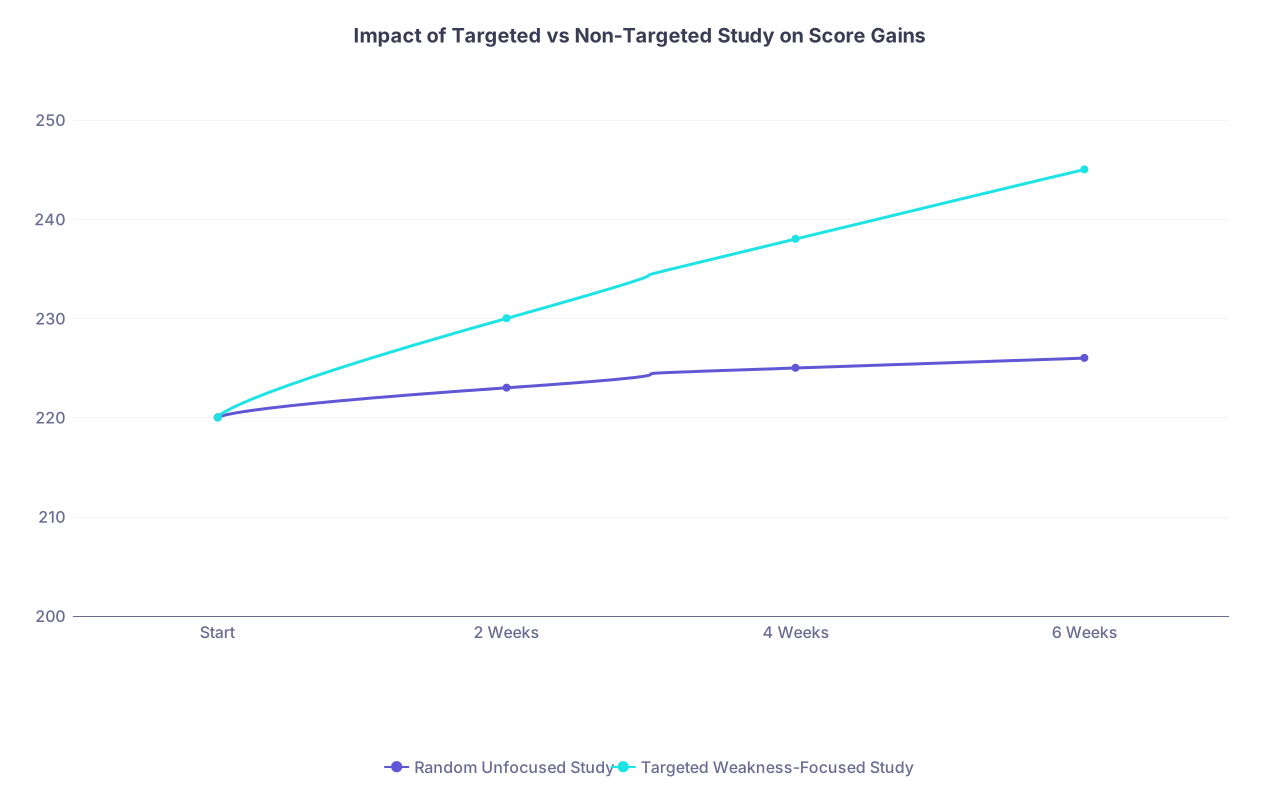
Pick 2–3 high-yield weak areas and go hard on them for the next 5–7 days.
That means:- Targeted Qbank blocks in those systems
- A concise review source (video or text) to actually re-learn the concepts
- Writing or teaching the topic out loud until it makes sense
Stop trying to fix your entire medical education in two weeks. That’s not how this works. You win Step 2 in chunks.
| Category | Random Unfocused Study | Targeted Weakness-Focused Study |
|---|---|---|
| Start | 220 | 220 |
| 2 Weeks | 223 | 230 |
| 4 Weeks | 225 | 238 |
| 6 Weeks | 226 | 245 |
Final Reality Check
You’re scared that “not grinding” for Step 1 pass/fail is some kind of permanent black mark.
It’s not.
But here’s what is true:
- Step 2 CK matters. A lot.
- If your Step 1 prep was half-hearted, you are starting Step 2 from a different baseline than some of your classmates.
- That means you have to be more intentional now. More structured. Less wishful thinking.
None of that equals “doomed.”
If you want three things to walk away with, it’s this:
- Step 1 being P/F didn’t curse your Step 2 — only repeating the same approach will.
- Use Step 2 prep to deliberately patch old Step 1 gaps, not to shame yourself for having them.
- Programs will judge you on your Step 2 CK score and clinical trajectory, not on how intensely you studied for a pass/fail exam you already passed.
You can’t rewrite your Step 1 story. You absolutely can rewrite what comes next.