
The biggest lie MS1s tell themselves now is this: “Step 1 is pass/fail, so I can relax.” That mindset quietly kills future residency applications.
Step 1 going pass/fail did not lower the bar. It shifted it. Programs still need ways to separate the top 20% from the middle 60%, and they are not shy about what they look at: Step 2 CK, pre-clinical performance trends, and your ability to generate credible signals (research, letters, and leadership) that you are serious and reliable.
So here is the reality: MS1 is where you front‑load the infrastructure that makes MS2 and MS3 brutal but controllable instead of brutal and chaotic.
I am going to walk you month‑by‑month through MS1 with a clear answer to one question at every point:
“At this point, what should I be front‑loading now that Step 1 is pass/fail?”
Big-Picture Priorities Across MS1
Before we go chronologic, you need the hierarchy. In the Step 1 pass/fail era, MS1 priorities stack like this:
| Priority Rank | Focus Area |
|---|---|
| 1 | Systems-level understanding & clinical reasoning |
| 2 | Step 2 CK foundation (internal medicine, pathophys, pharm) |
| 3 | Research & mentorship pipeline |
| 4 | Professional reputation (faculty, deans, peers) |
| 5 | Efficient board-style study habits & resources |
You are not “studying for Step 1” anymore. You are:
- Building habits and frameworks that make Step 2 CK your weapon.
- Stacking relationships and experiences that will matter when everyone’s Step 1 transcript just says “Pass.”
Now let’s walk MS1 in order.
Before MS1 Starts (0–2 Months Out)
At this point, you should set the scaffolding, not start grinding questions.
6–8 Weeks Before Orientation
Front‑load:
Basic tool decisions (and stop there)
You do not need a full armory of apps. You need a minimal, coherent setup:- One spaced repetition system (Anki or a similar tool).
- One question bank that matches your school’s level, if available.
- A note system you will actually maintain (OneNote, Notion, plain folders).
Wrong move: buying every commercial resource and “saving” them. You will never use half.
Realistic time budget
Build a rough weekly template:
- 25–35 hrs / week: required curriculum (lectures, labs, small groups).
- 10–15 hrs / week: active studying (Anki, concept consolidation).
- 0–5 hrs / week: “future self” work (research outreach, curiosity reading, shadowing).
Do not start research yet if you cannot handle your schedule. But know this “future self” slot exists. Protect it.
Early specialty exploration
In the pass/fail era, students panic‑pivot into hyper-competitive specialties way too late. Avoid that.
In these weeks:
- Make a 3‑column list: “Obvious interest,” “Mild curiosity,” “Hard no.”
- Obvious interest or curiosity → identify 1 faculty or resident per area on your school website.
You are not choosing a specialty. You are choosing where to observe.
Orientation Month (August-ish): Don’t Waste the Soft Start
At this point, you should maximize visibility and systems, not study more content.
Week 1–2: Social and Structural Front-Loading
Get in front of people who will remember your name
Minimum:
- Introduce yourself (in person) to your:
- course director or small-group leader,
- faculty in charge of research/Scholarly Projects,
- student affairs dean or equivalent.
What you say is simple:
“I am excited to be here. I am particularly curious about X/Y, and I want to make the most of MS1. Are there people you recommend I talk to this semester?”You are planting seeds for mentorship, letters, and early projects. This is how serious students signal early.
- Introduce yourself (in person) to your:
Set your daily rhythm in stone
Within the first 2 weeks, lock in:
- A consistent wake/sleep time.
- Fixed “non-negotiable” blocks:
- 2 blocks per day for active studying (review + questions).
- 1 block 1–2 times per week for research/mentorship/outreach.
If you do not defend blocks now, the curriculum will expand to fill every hour.
Run a pilot of your study system
Do a 7–10 day test:
- After each lecture:
- Summarize in 5–10 bullet points.
- Create 5–15 high-yield Anki cards (not 50).
- End of each day:
- Clear all due cards.
- Spend 20–30 minutes on mixed basic questions (if your school provides them).
The goal is not mastery. It is proof of concept: does your system handle today’s content before tomorrow hits?
- After each lecture:
Early MS1 (Months 1–3): Foundations You Will Reuse for Step 2 CK
At this point, you should front‑load understanding and habits, not raw volume.
Month 1: Learn to Learn “Forwards,” Not “For the Test”
You are building the mental scaffolding that your MS2/Step 2 self will rely on.
Translate every course into systems and mechanisms
Whether you are in anatomy, biochemistry, or cell biology:
- Always ask: “How will this break in a real patient?”
- For any new concept, add:
- Normal: what does this pathway / structure / receptor do.
- Broken: 1–2 diseases, 1–2 drugs, 1–2 clinical signs.
Example: RAAS pathway
- Normal: regulates blood pressure and volume.
- Broken: renovascular hypertension, ACE inhibitor use, hyperkalemia.
This is Step 2 CK brain from day one.
Start early with question-style thinking
You do not need a full commercial Step 1 bank in Month 1. But you do need exposure to board‑style stems:
- Use:
- School-provided or third-party “basic science” style questions.
- Short blocks: 5–10 questions after a few lectures.
- Always do:
- Read the explanation for every option, right or wrong.
- Write down (briefly) what tricked you.
You are training pattern recognition, not memorizing trivia.
- Use:
Protect your reputation
With Step 1 pass/fail, professionalism incidents matter more. Faculty remember:
- Chronic lateness.
- Disengagement in small groups.
- Complaints from standardized patients.
Decide now: clean record, consistent engagement. That shows up subtly in Dean’s letters and informal conversations.
Month 2: Build the Research and Mentorship Pipeline
At this point, you should front‑load relationships and low-intensity projects, not heavy data analysis.
Secure at least one credible mentor connection
Aim to have by the end of Month 2:
- 1 research mentor (even if project not defined).
- 1 career/academic mentor (could overlap, but usually should not).
How:
- Email 3–5 faculty whose work intersects your interests:
- Brief intro (who you are).
- One sentence on why their work caught your eye (specific paper/area).
- Ask for a 15–20 minute meeting to learn about their work and where a student could help.
You need only 1 “yes” that turns into something real. But that yes usually comes from multiple attempts.
Start an actually feasible project
For MS1, you want:
- Case reports.
- Chart reviews.
- Education projects. Not a basic science bench project that needs 12 months of training before a figure appears.
Good sign: your mentor can articulate a discrete next step you can do in <2–3 hours per week.
Track your academic performance trend
Step 1 no longer gives programs a clean standardized metric. They look for:
- Strong basic science performance.
- An upward trend if you start slowly.
Build a simple log:
- Each quiz/exam → score + 1–2 lessons: “What cost me points?”
Then fix process: - Poor recall → improve spaced repetition.
- Misread questions → slow down and annotate stems.
- Weak integration → do more mixed practice across topics.
Month 3: Commit to Board-Style Study Habits (Light but Consistent)
At this point, you should cement a sustainable Step-like routine, not burn out.
Standardize your weekly pattern
Example weekly structure:
- Mon–Fri:
- Morning: classes / labs.
- Afternoon: 1–2 hours cards + 30–60 minutes consolidation.
- 2–3 days per week: 10–15 board-style questions after study.
- Sat:
- Half-day: catch up on weak points + 20–30 questions.
- Sun:
- Lighter review / rest.
The exact numbers can flex. The consistency cannot.
- Mon–Fri:
Add one higher-level resource — but only if you are stable
If your school exams are going well and your routine is solid:
- Introduce:
- A single “board-like” text or video source aligned to your current block (e.g., a systems-based pathophys resource).
- Use it to:
- Tie your school content into clinical reasoning.
- See patterns across diseases.
Do not binge-watch. Target specific topics that feel fuzzy.
- Introduce:
Mid MS1 (Months 4–7): Building the Step 2 CK Engine
Here, most students coast. That is a mistake. At this point, you should front‑load the conceptual depth that will make MS2 and clinicals easier.
Month 4–5: Systems Thinking Becomes Non-Negotiable
Turn each organ system into a map
For every block (cardio, pulm, renal, etc.), build:
- One “normal” one-page map:
- Anatomy, physiology, key regulatory hormones, major feedback loops.
- One “broken” map:
- 6–12 core diseases.
- For each: pathophys, classic presentation, must-know labs, 1st-line treatment.
This is tedious. It is also what top CK scorers rely on later. You are pre-paying the cost.
- One “normal” one-page map:
Begin tracking your question performance like a resident
You are not doing giant blocks yet, but by Month 5 you should:
- Aim for ~40–60 board-style questions per week (mixed, block-matched if possible).
- Track:
- Percent correct.
- Category of error:
- Did not know.
- Knew but misapplied.
- Rushed / misread.
The numbers matter less than the trend:
- Are you seeing the same mistakes weekly?
- Are you fixing them systematically?
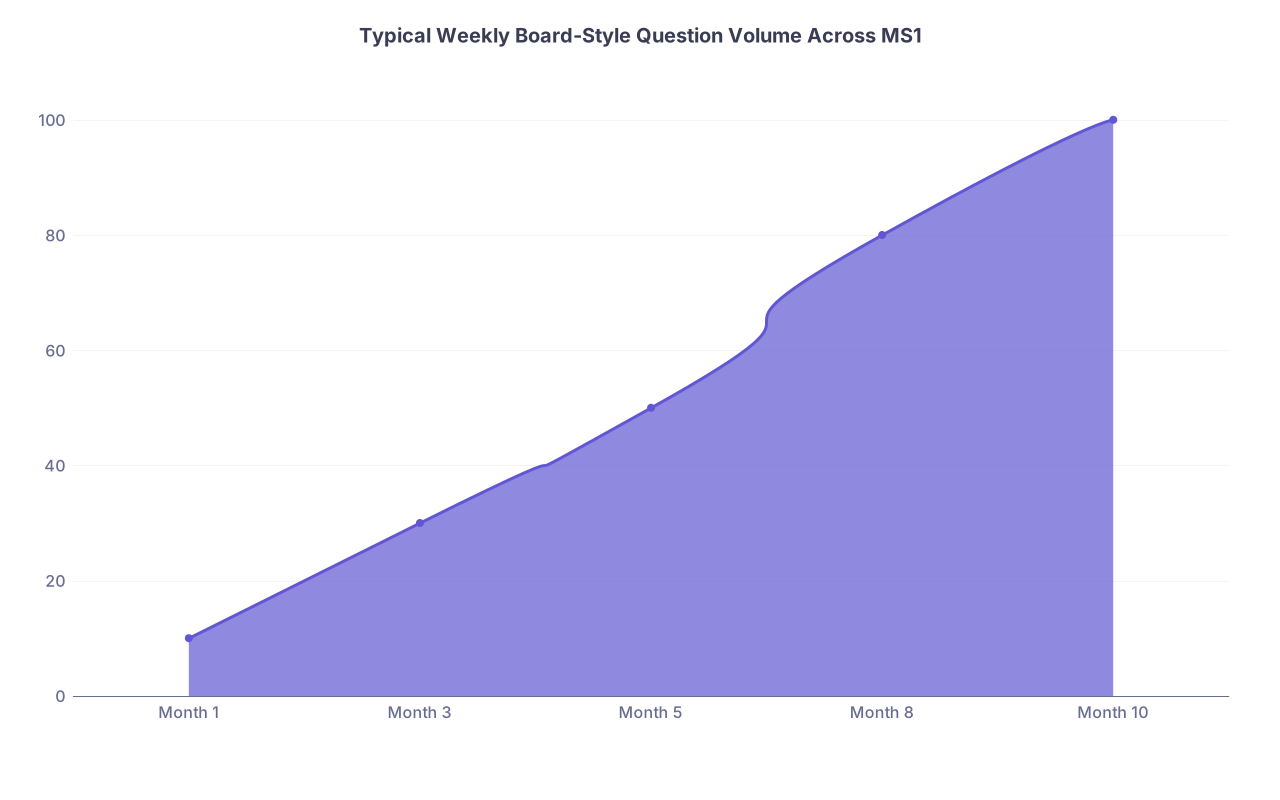
| Category | Value |
|---|---|
| Month 1 | 10 |
| Month 3 | 30 |
| Month 5 | 50 |
| Month 8 | 80 |
| Month 10 | 100 |
Deepen research involvement without drowning
By Month 5, your goal:
- Be actively doing something concrete:
- Abstract draft,
- Data extraction,
- Case report writing,
- Survey design.
If months are passing with “We are still planning the project,” be blunt with your mentor. Ask where you can contribute something tangible this semester.
- Be actively doing something concrete:
Month 6–7: Professional Identity and Signals
At this point, you should front‑load your future signals: the parts of your story that residency PDs will actually see.
Choose 1–2 lanes to be visibly invested in
Example lanes:
- Global health.
- Medical education.
- Health policy.
- Community outreach in a specific population.
- Specialty interest group with real activity (not just membership).
Depth beats breadth. Better:
- 1 ongoing involvement where your name is on something real (a project, a curriculum, a program), than
- 6 email lists and no substance.
Start shaping your Step 2 CK mindset
Even now:
- When you see a disease, ask:
- How will this show up on a shelf exam?
- What would change management?
- Which lab/test or drug actually matters?
Step 1 pass/fail shifted the weight to:
- Clinical reasoning.
- Management decisions.
- Test-taking at the MS3 level.
You are rehearsing that way of thinking early.
- When you see a disease, ask:
Reality‑check your specialty leanings
Around Month 7:
- Revisit your “Obvious interest / Curious / Hard no” list.
- Ask:
- Have I talked to anyone in these fields yet?
- Have I shadowed even a single clinic or OR session?
Schedule:
- 2–3 half‑days of shadowing in fields you keep thinking about. This is not to lock in a specialty; it is to avoid fantasy careers built from YouTube vlogs.
Late MS1 (Months 8–10): Setting Up MS2 and Dedicated Time
This is where smart students quietly separate themselves. At this point, you should front‑load your MS2 strategy and patch holes before they harden.
Month 8: Honest Audit and Course Correction
Academic audit
Look back at:
- Course grades.
- NBME-style or cumulative exams (if your school uses them).
- Question performance logs.
Identify:
- 2–3 truly weak foundational areas (e.g., renal phys, immunology, biostats). Not 10. Just the big structural weaknesses.
Plan:
- 4–6 weeks of low‑intensity repair:
- Short focused videos,
- Targeted questions,
- A handful of new cards.
Resource simplification
Late MS1 is where resource bloat kills people. Do this:
- List every resource you “intend to use.”
- Cross out anything you have not touched in 2 months.
Your MS2 self needs:
- One main reference per domain (pathophys, pharm, question bank, Anki).
- Not five half-finished subscriptions.
Month 9–10: Designing Your MS2 / Step 2 CK Trajectory
At this point, you should front‑load planning, not just hope you will “figure it out later.”
Map your MS2 year by blocks
For each upcoming MS2 block:
- Note:
- Start and end dates.
- Related board-heavy systems (e.g., IM, neuro, micro).
- Decide:
- Which question bank sections you will align with each block.
- When you will increase question volume.
- Note:
Clarify your Step 2 CK timing strategy
Programs increasingly care:
- They may want a Step 2 CK score in hand by ERAS opening.
Talk with:
- Your academic dean or advising office.
- A couple of MS4s who matched in fields you care about.
Determine:
- Are you likely to take Step 2 CK:
- Early MS4,
- Late MS3,
- Or on a compressed timeline after core clerkships?
Then work backwards:
- What does that mean for your MS2 learning pace?
- How aggressive do you need to be with questions in MS2?
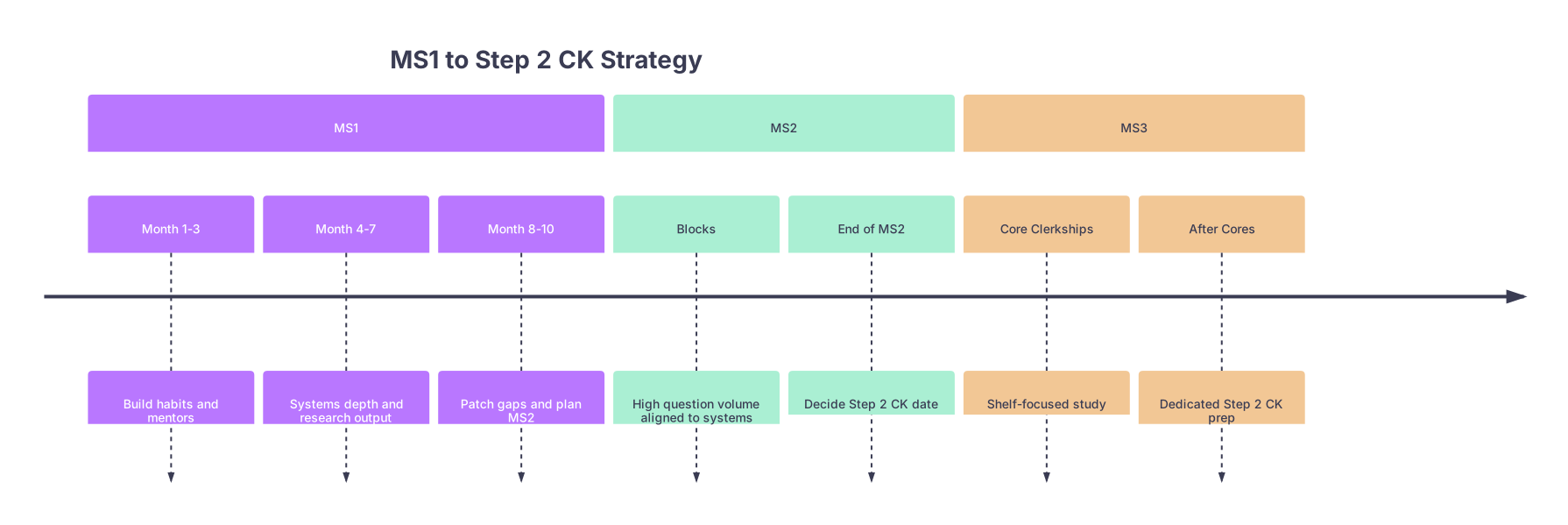
| Period | Event |
|---|---|
| MS1 - Month 1-3 | Build habits and mentors |
| MS1 - Month 4-7 | Systems depth and research output |
| MS1 - Month 8-10 | Patch gaps and plan MS2 |
| MS2 - Blocks | High question volume aligned to systems |
| MS2 - End of MS2 | Decide Step 2 CK date |
| MS3 - Core Clerkships | Shelf-focused study |
| MS3 - After Cores | Dedicated Step 2 CK prep |
- Lock in at least one tangible output
By end of MS1, you want something you can name:
- A poster accepted.
- A manuscript submitted (even if not accepted yet).
- A structured ongoing role (e.g., co-leader of a longitudinal clinic initiative).
This is not about padding a CV with nonsense. It is about showing:
- You start things.
- You finish things.
- You do not vanish after the first month.
Final Stretch of MS1 (Months 11–12): Clean-Up and Positioning
At this point, you should front‑load your transition into a more clinically oriented mindset.
Solidify clinical reasoning basics
Use:
- Simple case books.
- School case conferences.
- Online case platforms.
Aim for:
- Once per week: work through a short case from chief complaint to diagnosis and initial management.
You are doing reps on the mental move from “fact recall” to “What do I do next?”
Meet with mentors intentionally
Before MS1 ends, schedule:
- A 20–30 minute check-in with:
- Your research mentor.
- Your academic/career mentor.
Topics:
- What you learned this year about your interests.
- What is realistically on deck for MS2.
- Where they think you can add more value.
- Whether there are opportunities you might be missing.
You want alignment now, not a vague sense of “I am doing some stuff.”
- A 20–30 minute check-in with:
Set 3 concrete MS2 goals
Not “do well.” Actual, checkable goals, for example:
- Complete X% of a major question bank by the end of MS2.
- Submit 1 manuscript and 1 abstract.
- Take and score ≥Y on a comprehensive exam that predicts CK.
Write them down. Share them with at least one mentor or trusted classmate. External accountability works.
A Quick Reality Check

You will see classmates who:
- Ignore long-term planning.
- Chase every student group.
- Treat Step 1 pass/fail as an excuse to float.
Some of them will land fine. Many will not, especially in competitive specialties. Program directors are not sentimental. They care about:
- Step 2 CK.
- Clinical performance.
- Tangible productivity.
- Professionalism.
MS1 is when you quietly build the machinery that delivers those later.
Key Takeaways
- Step 1 going pass/fail did not make MS1 easier. It made long‑term planning and early habit building non‑optional.
- At each phase of MS1, front‑load something specific: early on it is systems and mentors, mid‑year it is depth and research output, late it is patching gaps and planning MS2/CK.
- Your MS1 goal is simple: arrive at MS2 with strong foundations, active projects, a clean reputation, and a clear plan. That combination is what still stands out in the Step 1 pass/fail era.