
The biggest mistake MS2s make in the pass/fail era is clinging to Step 1 like it is still the main event. It is not. Step 2 is quietly becoming the real filter, and if you pivot too late, you will feel it on the interview trail.
Let me walk you month‑by‑month through MS2 and show you exactly when and how to shift from “classic Step 1 grind” to a Step 2–centered strategy that actually matches the modern game.
Big Picture: The New Reality for MS2s
Before we zoom into months and weeks, you need the frame: Step 1 is now pass/fail. Programs are already compensating by leaning harder on Step 2 CK and clinical performance.
Here is how your MS2 and early clerkship year actually matter now:
| Factor | Old Era (Pre-Pass/Fail) | Step 1 Pass/Fail Era |
|---|---|---|
| Step 1 | Primary screen | Basic competency only |
| Step 2 CK | Secondary differentiator | Primary score filter |
| Preclinical grades | Minor signal | Still minor signal |
| Clerkship evals | Important | Critically important |
If you still prep like Step 1 is the major league and Step 2 is an afterthought, you will be misaligned with what PDs actually care about now.
So the core question for an MS2:
At what point in second year do you stop acting like you are a Step 1 student and start acting like a future Step 2 test taker and junior clinician?
The answer is not “after Step 1.”
The pivot starts months earlier.
August–October MS2: Build Foundations, but Stop Thinking Organ‑Only
Assuming a traditional curriculum (MS2 starts late summer, Step 1 early summer), here is your job early MS2.
August–September: You’re still Step 1‑first… mostly
At this point you should:
- Treat foundational content as Step 1–oriented, but structure your studying so it scales into Step 2.
- Break the “organ system silo” habit. Start linking everything back to clinical vignettes, not just fact lists.
Your daily structure in early MS2 should already have Step 2 DNA:
- 60–70%:
- Systems + pathophys + pharm
- Anki or some spaced repetition deck
- Boards‑style questions tied to your current block (UWorld Step 1, AMBOSS, etc.)
- 30–40%:
- Long‑stem clinical vignettes
- Questions that force you to think in terms of:
- Next best step in management
- Initial vs definitive therapy
- Risk stratification and guidelines
You can still use “Step 1” resources, but you should consciously prefer explanations that talk about management and prognosis, not only mechanism.
At this point, you should avoid:
- Memorizing obscure biochem or molecular minutiae that only show up in trivia questions.
- Spending hours on low‑yield minutiae in immuno/genetics/biostats that almost never change your management choice.
If your school exams are heavily Step‑1‑style, fine. Use them to pass. But your question bank habits must start looking more like Step 2: long stems, multiple plausible answers, clinical decisions.
November–December MS2: Start the First Mini‑Pivot
By mid‑fall, you have enough foundation that you can stop pretending Step 2 is some distant future. This is the first deliberate pivot.
At this point you should:
Run a reality check on your path:
- Interested in competitive specialties (derm, ortho, ENT, plastics, rads, neurosurg)?
- Your Step 2 ceiling matters a lot.
- Leaning primary care, psych, peds, IM?
- Step 2 still matters, but you can be slightly less aggressive.
- Interested in competitive specialties (derm, ortho, ENT, plastics, rads, neurosurg)?
Shift your question mix slightly:
- If you are still doing 100% Step 1 QBank:
- Move to 70% Step 1–oriented questions / 30% Step 2‑style questions or cases.
- If your school provides NBME‑like integrated questions, prioritize those.
- If you are still doing 100% Step 1 QBank:
Practice “Step 2 thinking” once a week:
- Choose 1–2 evenings per week for a timed block of 10–20 long vignettes that:
- Include labs, imaging, and “what is the next best step?” prompts.
- Force yourself to articulate:
- Diagnosis
- Most important immediate action
- Required follow‑up
- Choose 1–2 evenings per week for a timed block of 10–20 long vignettes that:
This is also when you should start looking at a Step 2 resource index. Not to study yet. Just to know the landscape:
- UWorld Step 2 CK (main engine, later)
- Online MedEd / Boards & Beyond clinical vids / similar
- NBME practice exams for CK (for later scheduling)
Think of this as installing Step 2 drivers in the background while still running the Step 1 operating system.
January–February MS2: Step 1–Heavy, But Your Strategy Must Change
Early calendar year is crunch time for many MS2s. Your school ramps up pace, and Step 1 feels closer.
Most students panic and double‑down on pure Step 1 minutiae. That is a mistake now.
At this point you should:
Week‑by‑Week Structure (Jan–Feb)
Weekly targets:
- 5–6 days per week:
- 40–60 Step 1–oriented questions per day
- 10–15 clinically heavy / Step 2‑style questions per day
- 1 day per week:
- Dedicated “clinical integration” day
What the “clinical integration” day looks like:
- 1 block (20–25 Qs) of:
- Multi‑system vignettes
- Step 2–style next‑best‑step questions
- After each question, ask:
- “If this was a real patient at 2 a.m., what order would I put in first?”
- “What do I actually need to rule out immediately?”
You are still primarily doing Step 1 prep, but your reasoning style must now match Step 2. You cannot afford to hit clerkships thinking in terms of “what enzyme is missing” instead of “who dies if I miss this.”
Where many students go wrong in Jan–Feb
I have watched students:
- Spend 90 minutes “learning every glycogen storage disease detail” while missing the big picture of how to actually manage DKA or sepsis.
- Obsess about sketchy mnemonics but never practice reading an ABG or EKG in context.
In the pass/fail era:
- High‑yield = concepts that also appear on Step 2 and in real clinical work.
- Low‑yield = facts that never influence a management decision.
Your filter must change.
March–April MS2: Major Pivot Begins (Around 10–14 Weeks Before Step 1)
This is the true pivot window. If you ask “when should I start thinking Step 2,” the honest answer is: seriously, right here.
Most schools give you a 4–8 week dedicated Step 1 period. Count backward 10–14 weeks from your Step 1 date. That is your pivot start.
At this point you should:
1. Audit your knowledge like a Step 2 test writer
Look at your weak areas and ask:
- Does this topic reappear in clerkships and Step 2?
- Yes (DM, HTN, ACS, COPD, PNA, psych disorders, OB complications, pediatric infections, etc.) → Non‑negotiable.
- No (extreme enzyme defects, ultra‑rare neoplasms, arcane molecular markers) → Low priority now.
2. Change how you review systems
Example: Cardio block review in March
Bad MS2 approach:
- Memorize every cardiomyopathy mutation.
- Re‑read all murmurs in a table.
Modern approach:
- Still know core murmurs and pathology.
- But focus your time on:
- Chest pain workup
- Stable vs unstable arrhythmias
- When to cath vs stress vs CT angiography
- Immediate management of STEMI, NSTEMI, HFrEF exacerbation
Notice the pattern: you are studying Step 1 facts through a Step 2 lens.
3. Question bank split target (March–April)
At this point, a reasonable daily blend:
- 60–70% Step 1 QBank (especially if you still have major content gaps)
- 30–40% Step 2‑style questions and longer vignettes
If you feel very solid on Step 1 content already (rare but it happens):
- You can move to a 50/50 split without hurting your Step 1 outcome.
This is also the time to start lightly previewing high‑yield Step 2 topics:
- OB triage (bleeding, hypertensive disorders, fetal distress)
- ER triage logic (ABCs, unstable vs stable algorithms)
- Outpatient chronic disease management (A1c targets, BP goals)
Not in depth yet. Just familiar.
Dedicated Step 1 Period (Usually 4–8 Weeks Before Exam)
Everyone asks: “Should I touch Step 2 during dedicated Step 1?”
My answer: Yes, but carefully.
During dedicated, your primary mission is simple: Pass Step 1 on your first try.
Failure here creates chaos for your Step 2 timing and residency apps.
At this point you should:
Core focus (80–90% of time)
- Step 1 QBank (UWorld, etc.), full throttle
- NBME practice exams for Step 1
- Targeted reviews of:
- Pathology
- Pharm
- Physiology
- Micro relevant to common diseases
Strategic Step 2‑friendly work (10–20% of time)
Once or twice a week:
- Do a single 20‑question block of Step 2‑style questions:
- Timed
- Mixed subjects
- Long stems
- Use it to:
- Maintain stamina for long clinical vignettes
- Keep management thinking active
Do not:
- Start a full Step 2 curriculum.
- Obsess about Step 2 scores now.
- Spend hours watching Step 2 videos while your Step 1 QBank still has 1,000 unfinished questions.
Think of Step 2 during dedicated as keeping future doors open, not opening them fully yet.
The Exact Moment: The Week You Take Step 1
This is the turning point. Once Step 1 is done, your strategy must flip rapidly.
At this point you should:
Week 0 (Exam week)
- Day of exam: finish, decompress, sleep.
- Next 48–72 hours:
- Do not touch question banks.
- Do normal human things and let your brain reset.
After that brief reset, you enter a short “transition phase” before clerkships (for most schools).
2–4 Weeks Post Step 1: Full Pivot to Step 2 Strategy
This is where I see a clear divide: the students who treat this window as vacation vs those who quietly start building a Step 2 engine. The latter group almost always outperform on CK.
At this point you should:
Week 1 Post‑Step 1
Set up Step 2 infrastructure:
- Activate UWorld Step 2 CK.
- Choose 1 core video/lecture platform (Online MedEd, Boards & Beyond clinical, etc.).
- Download or create a concise note system for:
- Internal medicine
- OB/GYN
- Surgery
- Peds
- Psych
Light engagement only:
- 10–15 Step 2 Qs/day, untimed.
- Focus on reading explanations carefully. Get used to:
- Risk stratification
- Screening guidelines
- Management algorithms
Week 2–4 Post‑Step 1 (Pre‑Clerkship, if you have that gap)
Now you really lean in.
Target:
- 20–40 Step 2 CK questions per day, mixed topics.
- 1–2 hours/day of:
- Internal medicine or OB core content.
- Start building a list:
- “Things I always get wrong or feel uncertain about.”
You are no longer “a preclinical student previewing Step 2.”
You are now building your Step 2 and clerkship brain.
Here is where it helps to visualize the arc:
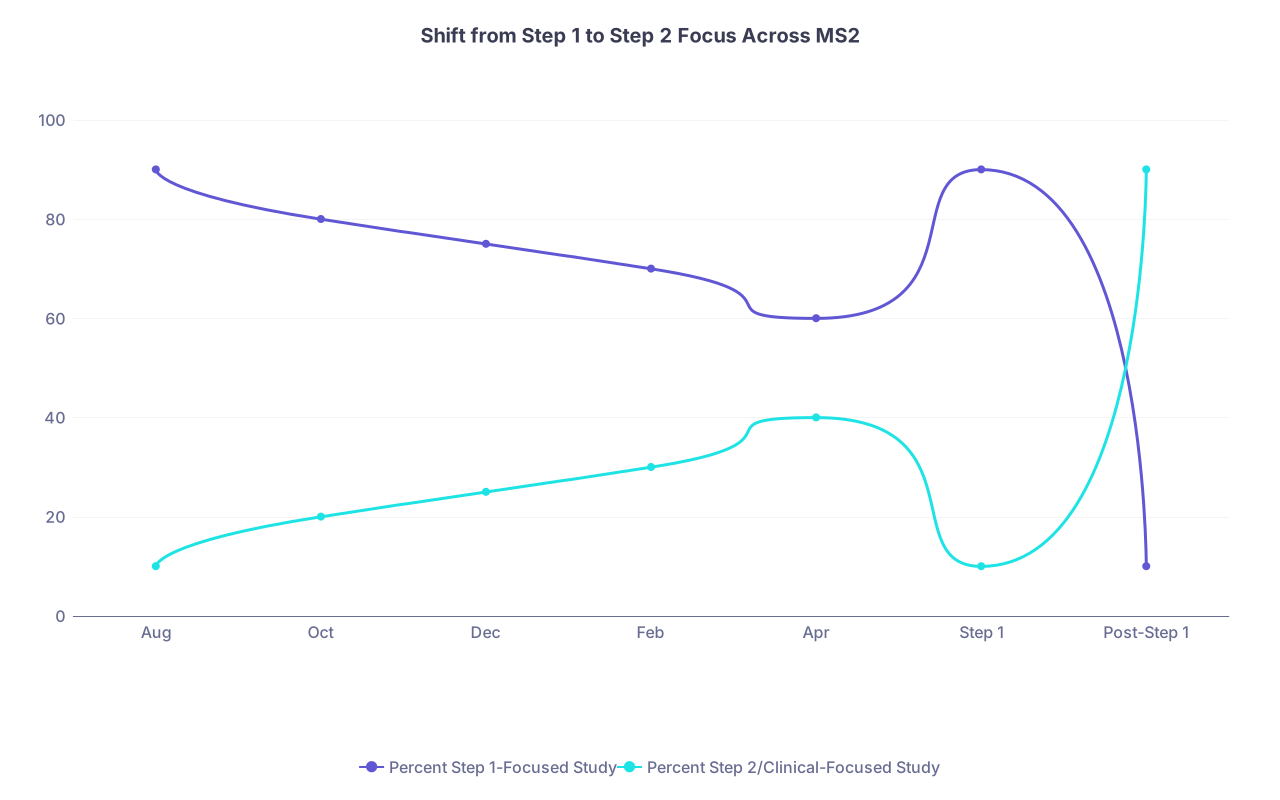
| Category | Percent Step 1-Focused Study | Percent Step 2/Clinical-Focused Study |
|---|---|---|
| Aug | 90 | 10 |
| Oct | 80 | 20 |
| Dec | 75 | 25 |
| Feb | 70 | 30 |
| Apr | 60 | 40 |
| Step 1 | 90 | 10 |
| Post-Step 1 | 10 | 90 |
You see the clear pivot: not sudden, but deliberate.
Early Clerkships (MS3 Start): Step 2 Becomes the Default
Once clerkships start, your Step 2 prep is no longer “extra.” It becomes the structure underlying your rotations.
At this point you should:
Global weekly structure (on a typical rotation)
- On a lighter rotation (psych, outpatient peds, etc.):
- 30–40 Step 2 questions per day on weekdays.
- 60–80 per day on one weekend day.
- On heavier rotations (surgery, inpatient IM):
- 15–25 questions per weekday.
- 60–80 on one weekend day.
Tie your questions to your rotation:
- On IM:
- Focus blocks on cardiology, pulm, GI, ID, renal, endocrine.
- On OB:
- Hypertensive disorders, antepartum care, FHR tracings, postpartum complications.
- On surgery:
- Trauma, pre/post‑op management, acute abdomen, hernias.
Also, use your real patients as Step 2 prompts:
- Every call night: pick 1–2 patients, read their UWorld equivalents.
This is where Step 1 content truly matures into Step 2 performance. The pivot is complete; you are no longer in a Step 1 mindset at all.
Visual Timeline: When You Pivot, Month by Month
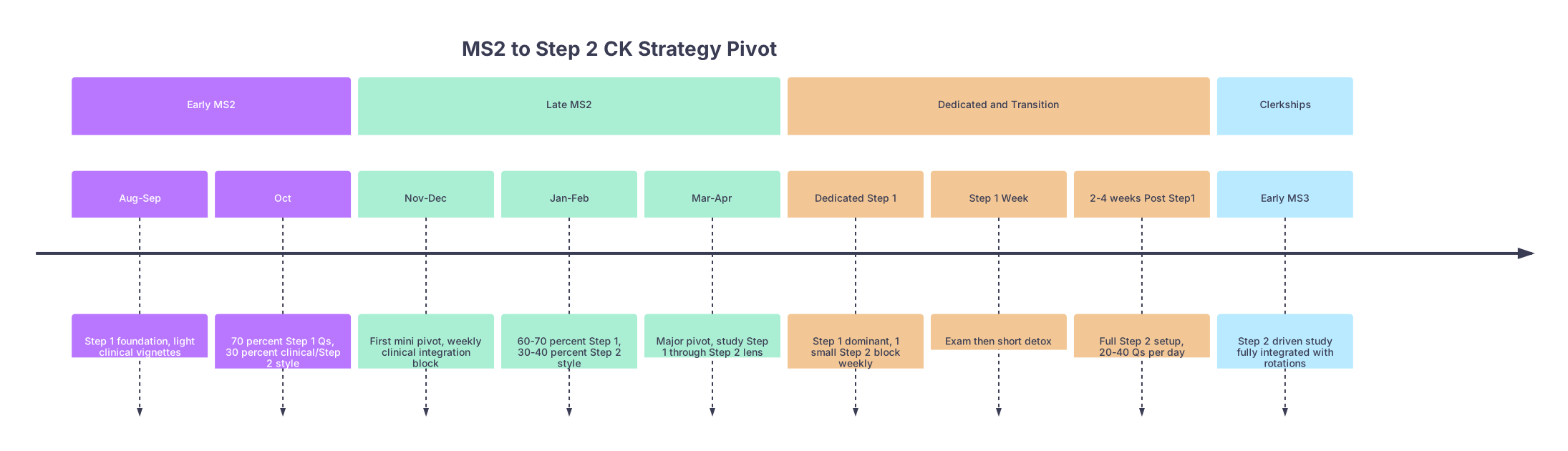
| Period | Event |
|---|---|
| Early MS2 - Aug-Sep | Step 1 foundation, light clinical vignettes |
| Early MS2 - Oct | 70 percent Step 1 Qs, 30 percent clinical/Step 2 style |
| Late MS2 - Nov-Dec | First mini pivot, weekly clinical integration block |
| Late MS2 - Jan-Feb | 60-70 percent Step 1, 30-40 percent Step 2 style |
| Late MS2 - Mar-Apr | Major pivot, study Step 1 through Step 2 lens |
| Dedicated and Transition - Dedicated Step 1 | Step 1 dominant, 1 small Step 2 block weekly |
| Dedicated and Transition - Step 1 Week | Exam then short detox |
| Dedicated and Transition - 2-4 weeks Post Step1 | Full Step 2 setup, 20-40 Qs per day |
| Clerkships - Early MS3 | Step 2 driven study fully integrated with rotations |
If You Want a Blunt Take
- If you are still 100% Step 1‑focused by March of MS2, you are already late on your Step 2 mindset.
- If you spend your entire post‑Step 1 window “finally relaxing” and do not at least set up a daily Step 2 habit, you will regret it around the time you see your first NBME CK practice score.
- The students who crush Step 2 in the pass/fail era are not magical. They just pivoted early and consistently.
Key Takeaways
- The pivot from Step 1 to Step 2 starts in mid‑MS2, not after Step 1. By March–April, you should already be studying Step 1 content through a Step 2, management‑focused lens.
- Your post‑Step 1 2–4 week window is prime real estate. Light but consistent Step 2 work here sets the tone for clerkships and makes CK prep vastly easier.
- During clerkships, Step 2 is the default framework. Question banks, real patients, and shelf exams all feed the same goal: a strong CK score that actually matters in the pass/fail era.