
Last week a third‑year from a true pass/fail, no‑rank school called me in a near panic. “My dean’s letter literally says our school doesn’t rank. That’s it. How are programs supposed to know I’m any good?” She’d just scrolled Reddit for three hours. Bad idea. Every thread made it sound like no rank + P/F was a career death sentence.
If you’re reading this, I’m guessing your brain is doing the same math: Step 1 pass/fail + no class rank = residency programs think I’m average at best. Let’s walk through this like two people staring down the same nightmare.
The Core Fear: “If They Can’t Rank Me, They’ll Ignore Me”
Here’s the ugly thought we both know is in your head:
“If there’s no Step 1 score and my school doesn’t rank, I’m basically invisible. Programs will default to people with numbers and AOA and I’ll get tossed.”
Let me be very clear: programs care a lot less about “no rank” than you think. What scares you looks normal to them now.
Residency directors have already been forced to change how they evaluate applicants because:
- Step 1 went pass/fail
- Many schools moved to P/F pre‑clinicals
- A growing number dumped quartiles or internal ranking
- Some schools don’t even have AOA anymore
Your file isn’t some weird outlier. You’re one of thousands with a similar structure.
What they actually do is stack you against others from your own school and from similar schools. They’ve seen your MSPE template a hundred times. They know the exact boilerplate language your school uses for “we don’t rank” and how to read between the lines.
But yeah, I know. That doesn’t make the anxiety go away. So let’s break down where programs will look when there’s no rank to grab onto.
Where Programs Look When There’s No Class Rank
You’re terrified they’ll see a blank where the rank should be and move on. That’s not how this works. Here’s what quietly replaces “rank” in their heads.
| Area They Look At | What They’re Actually Asking |
|---|---|
| Clerkship Grades | How did you perform with real patients? |
| Narrative Comments | Would attendings trust you with their service? |
| Step 2 CK | Can you handle boards‑level knowledge? |
| MSPE Language | Are there coded signs you’re top tier / concerning? |
| Home Letters | Do people who know you well go to bat for you? |
1. Clerkship Grades = Your Real “Ranking”
Programs take your clinical grades much more seriously than your P/F pre‑clinicals. Things like:
- How many Honors in core rotations
- Where you honored (IM vs Surgery vs Psych)
- Patterns: all High Pass vs mixed vs some Pass only
You and I both know some grading systems are insane. At some schools, “Honors” basically doesn’t exist. Program directors actually know this too.
They keep unofficial “translation guides” in their heads:
- “Oh, School X rarely gives Honors. A High Pass there is like Honors elsewhere.”
- “School Y has crazy grade inflation—everyone is High Pass or Honors; we need to read comments harder.”
So yes. Your grade pattern matters more than whether some admin office assigns you a class percentile.
2. Narrative Comments = The Hidden Rank System
If your school doesn’t rank, the MSPE (Dean’s Letter) and clerkship evaluations become the substitute. This is where programs hunt for subtext.
Things they scan for:
- “Among the top students I’ve worked with” → That’s code for top tier
- “Performed at the expected level” → Usually middle of the road
- “Needed more guidance than peers” → This is a yellow flag
- “Joy to work with, strong work ethic, self‑directed learner” → Programs love this
I’ve watched PDs literally circle phrases with a pen. They’re not just skimming for “good job.” They’re mapping you against their mental benchmark of other students from your school.
No rank doesn’t mean they’re blind. It just means they use words instead of a number.
3. Step 2 CK Just Got a Lot Heavier
With Step 1 pass/fail, Step 2 CK turned into the one remaining big number. Programs lean on it heavily, especially when:
- Your school is pass/fail
- Your school doesn’t rank
- There’s no AOA
They’re trying to answer: “Can this person survive our boards pass rate expectations and exam‑heavy residency?”
So if you’re thinking, “Do I have to crush Step 2 CK now?” — not necessarily “crush,” but:
- A solid score can compensate a ton for no rank
- A mediocre score isn’t fatal if the rest of your app is strong
- A low score can hurt, but again, context: strong narratives and letters still matter
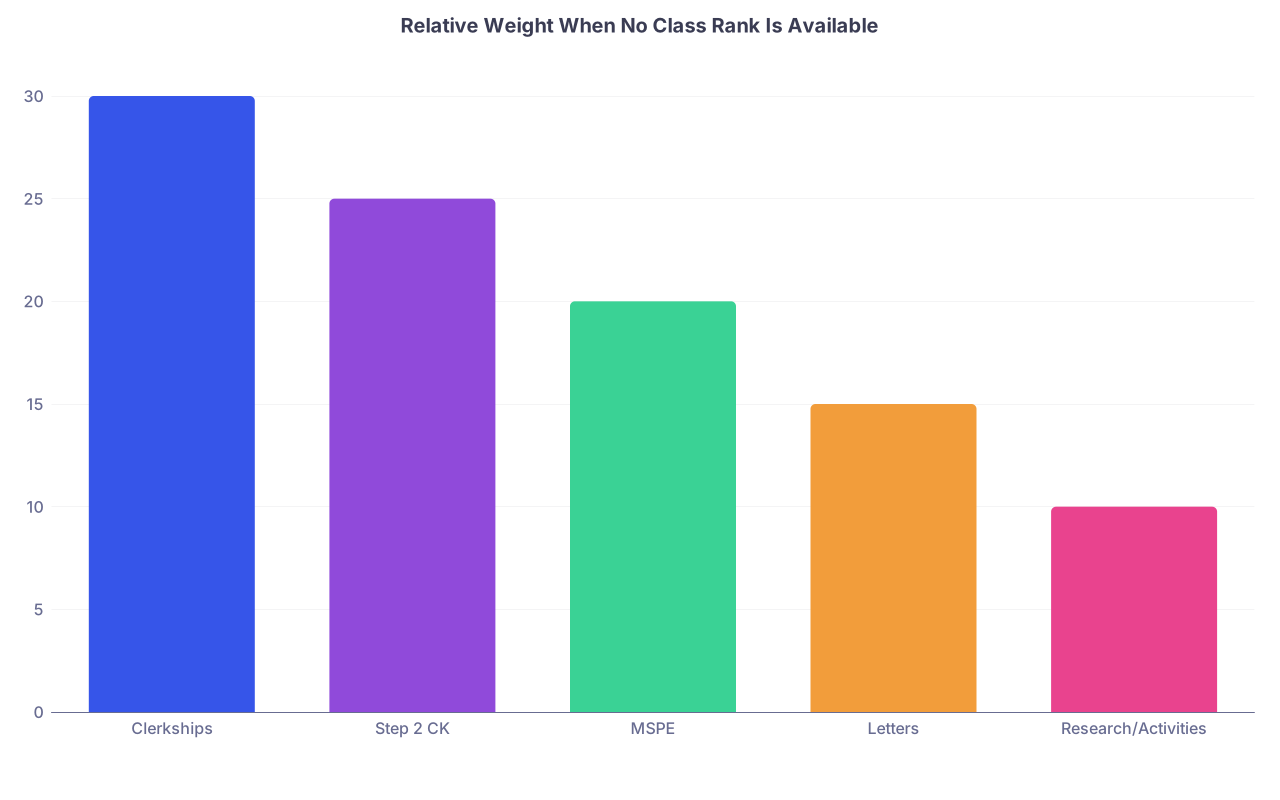
| Category | Value |
|---|---|
| Clerkships | 30 |
| Step 2 CK | 25 |
| MSPE | 20 |
| Letters | 15 |
| Research/Activities | 10 |
Is this exact math? No. But directionally, this is how PDs are thinking in a P/F + no rank + Step 1 P/F era.
“But Doesn’t No Rank Make Me Look Average?”
Here’s the nightmare: you imagine a stack of applications and yours looks like:
- Pass/Fail pre‑clinical
- No rank
- No AOA
- Step 1: Pass
And you think: “There’s literally nothing here that says I’m better than average.”
That’s not actually true. You’re just counting the wrong things.
Programs look at:
- Rigor of your school – A pass from a brutal school outshines an Honors from a diploma mill–style program.
- Clerkship narratives – “Top 10%” isn’t written, but “best student I’ve worked with this year” is.
- Home institution signal – If your home program interviews you, that sends a message to others: “Our own PD likes this person.”
- Continuity of performance – No rank, but consistent strong comments across 3rd year? That’s a story.
The truth: “No rank” does not equal “average.” It equals “they’ll have to read more than one line of your MSPE to figure you out.” Annoying? Yes. Fatal? No.
Schools That Don’t Rank: Are You At a Disadvantage?
Let’s be a little blunt. There are scenarios where “no rank” + P/F stings more.
You’re at a newer or less‑known school
If your school is:
- Brand new
- Located somewhere obscure
- Not yet sending grads into competitive programs regularly
Then yes, lack of rank removes one potential quantitative reassurance for programs who don’t know how to interpret your transcripts.
BUT. This is where other pieces become twice as critical:
- Strong Step 2 CK score
- Away rotations (auditions) where people can see you in person
- Letters from well‑known faculty at your home or away sites
You’re aiming for a hyper‑competitive specialty
Derm, Ortho, ENT, Neurosurg. These programs are control‑freak level about risk. They like numbers and objective markers because they feel “safer.”
Without rank, they’ll lean hard on:
- Step 2 CK
- Research productivity (and where it’s done)
- Reputation of your school and mentors
- Away rotation impressions
If that’s your lane, you don’t get to coast on “my school doesn’t rank.” You have to build a spike in something else.
Concrete Things You Can Do If Your School Doesn’t Rank
I can already hear your brain: “Okay, fine, but what do I do now, today, with this mess?” Let’s make this less abstract.
1. Treat Clinical Years Like Your New GPA
You don’t have rank. So your third‑year performance becomes your unofficial class standing.
That means:
- Pick rotations strategically – don’t stack your three hardest rotations back‑to‑back if you can avoid tanking all of them.
- Take feedback seriously early in each block – ask: “What can I do to be an Honors‑level student on this service?”
- Show up as the reliable person – never disappear, follow up on tasks, read on your patients. Attending comments are 50% clinical skill, 50% attitude and reliability.
2. Plan Step 2 CK Like It Really Matters (Because It Does)
You don’t need a 270. But you do need a score that says, “I am not a liability.”
Roughly:
- Aim for strongly above your specialty’s average if you want something competitive
- At least solidly in range for core fields like IM, peds, FM, psych, EM
Don’t delay this decision until after you’ve bombed NBME practice tests. Start building a realistic timeline now.
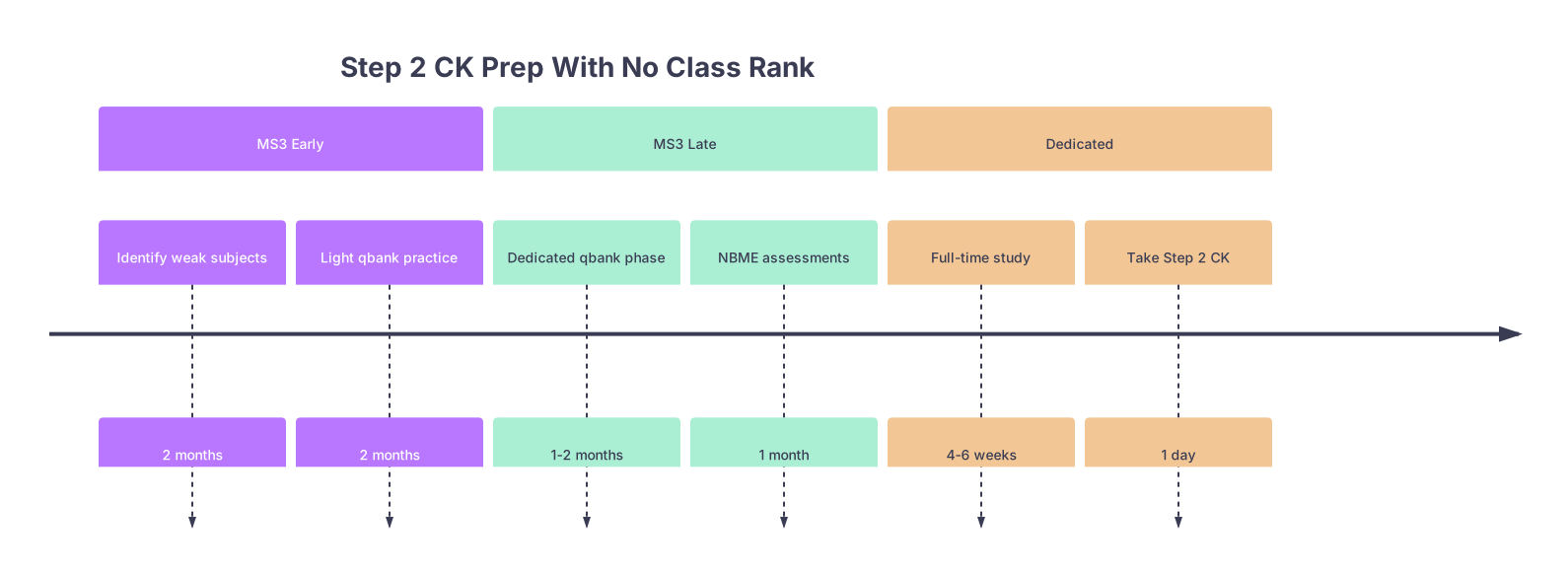
| Period | Event |
|---|---|
| MS3 Early - Identify weak subjects | 2 months |
| MS3 Early - Light qbank practice | 2 months |
| MS3 Late - Dedicated qbank phase | 1-2 months |
| MS3 Late - NBME assessments | 1 month |
| Dedicated - Full-time study | 4-6 weeks |
| Dedicated - Take Step 2 CK | 1 day |
3. Engineer Your Letters of Recommendation
If you don’t have rank, your letters are your ranking.
You want at least one or two letters that clearly position you at the top of your cohort without using the word rank:
- “One of the best students I have worked with in recent years”
- “Easily in the top tier of students rotating on our service”
- “I would be delighted to have them as a resident in our program”
How to help that happen:
- Pick letter writers who actually know you and saw you on good days, not just “big names.”
- Ask directly: “Do you feel you can write me a strong letter for [specialty]?”
- Give them a short CV and a 1‑paragraph “here’s how I worked on your service and what I’m aiming for.”
4. Clarify Your School Context in Your Application
Don’t assume programs understand your school’s quirks. You can:
- Use the MSPE “school profile” section (this is written by your school, but you can sometimes advocate for clarity)
- Briefly mention in your personal statement or experiences if there’s something unusual (e.g., “Our pre‑clinical curriculum is fully pass/fail without internal ranking; my main opportunities to distinguish myself were in clinical rotations and research, where I sought out…”)
Short, not whiny. Context, not excuse.
5. Use Aways and Your Home Program Wisely
Without rank, direct observation becomes gold.
- Away rotations let programs see you raw: work ethic, team behavior, how fast you learn
- Your home program interviewing you sends a strong positive signal to other programs in that specialty
- A stellar away letter can outweigh a lack of rank, especially in surgery, EM, or ortho

What Program Directors Are Actually Saying About No Rank + P/F
I’ve sat in rooms where PDs talk about this. No one is thrilled, but they’re adapting. Typical things you hear:
- “We can’t rely on Step 1 anymore, and half of them don’t have rank, so we read the MSPE harder.”
- “I only worry about no rank if there’s ALSO vague comments and a weak Step 2 CK.”
- “Some of the best residents I’ve had came from schools that don’t rank and have pure P/F.”
Notice the pattern? No one says:
“School doesn’t rank → reject.”
They say:
“No rank + weak Step 2 + bland comments → concern.”
Your job is not to magically conjure a rank. It’s to make sure those other pieces are strong or at least clearly positive.
When To Actually Worry (And What To Do If You’re There)
Let’s not sugarcoat everything. There are situations where you should pause.
Red flag combo:
- School doesn’t rank
- Mostly Pass or low tier grades in core clerkships
- Step 2 CK clearly below average for desired specialty
- Weak or generic letters
If that’s you, your best move isn’t denial. It’s strategy:
- Shift to a less competitive specialty where your profile is actually solid
- Strongly consider a transitional year, prelim year, or a back‑up field
- Talk to your school’s advising office and ask for brutal honesty, not fluff
You’re not doomed. But blasting 80 applications at derm with that combo? That’s how you end up matched to nothing.
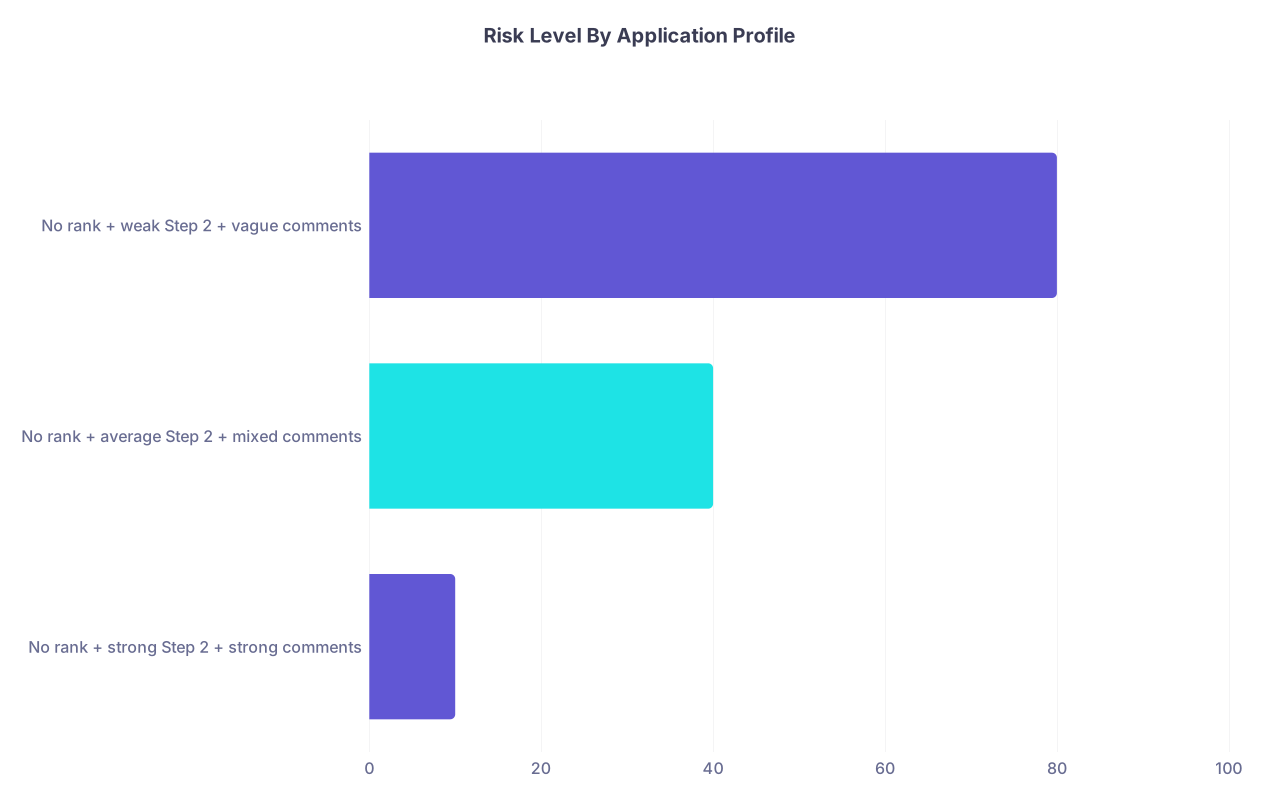
| Category | Value |
|---|---|
| No rank + strong Step 2 + strong comments | 10 |
| No rank + average Step 2 + mixed comments | 40 |
| No rank + weak Step 2 + vague comments | 80 |
Risk doesn’t mean “zero chance.” It means “don’t play this on hard mode without a backup plan.”
Reality Check: You’re Not the Only “No Rank” Applicant
This is the part your anxiety keeps ignoring: programs are flooded with people like you.
You’re not that special.
And that’s actually comforting. Because if PDs didn’t learn how to read P/F + no rank files, they literally wouldn’t be able to fill their spots.
So instead of spiraling about the fact your school doesn’t rank, start asking:
- Are my clerkship comments strong?
- Is my Step 2 CK plan real or wishful thinking?
- Do I have at least 1–2 letters that say I’m top tier in some context?
- Does my application tell a clear story or just “random med student who did the usual stuff”?
Those questions you can actually control.
FAQ: P/F + No Rank Panic Questions
1. Does being at a no‑rank, P/F school hurt me compared to schools that still rank and give Honors?
Not automatically. You’re judged in context. A strong student at a strict P/F, no‑rank school with great clerkship comments and a solid Step 2 CK can absolutely beat a mediocre student from a ranked, graded school. The danger isn’t the structure; it’s if your application is bland and your performance is middle of the pack with nothing else to signal excellence.
2. Should I explain in my personal statement that my school doesn’t rank?
You don’t need a whole paragraph on it. Programs already know many schools don’t rank. If there’s something especially unusual (like no Honors given at all, or unique rotations), a one‑sentence context line is fine. Don’t sound defensive. Don’t rant about your school. Just give quick context and move on to what you did with the system you had.
3. If my school doesn’t rank, is AOA my only way to show I’m top of the class?
If your school even has AOA, yes, it can be a clear signal. But it’s not the only one. Strong Step 2 CK, multiple Honors in key clerkships, glowing narrative comments, and powerhouse letters are all signals. Programs rarely look at one metric in isolation. Think portfolio, not single badge.
4. Should I choose a school that ranks over one that doesn’t, if I’m still deciding on med schools?
If you’re pre‑med reading this, pick the school where you’re most likely to thrive, not the one with the fanciest ranking system. A lower‑ranked school where you can be at the top clinically and have strong mentorship will help you more than a prestige school where you’re average and miserable. Rank vs no rank is noise compared to how well you’ll actually perform there.
5. What’s one thing I can do this week if I’m already stuck in a no‑rank, P/F system and freaking out?
Email one attending from a recent or current clerkship who liked you and say: “I really enjoyed working with you on [service]. I’m starting to think ahead to residency and would really value any honest feedback on how I performed compared to other students and what I can focus on improving.” You’ll get data, not Reddit speculation. That’s how you start turning panic into a plan.
Open your MSPE draft or your clerkship evaluations right now—no stalling, no “I’ll do it later.” Read the narrative comments as if you were a program director seeing you for the first time. Then jot down three concrete things you can strengthen over the next six months (Step 2 prep, one key letter writer, one away rotation, etc.). That list is your antidote to the “no rank” spiral.