
It’s 10:45 p.m. on a Tuesday. You’re finally home post-call, half-scrolling through Reddit threads about Step 1 pass/fail while reheating cold Thai food. Somewhere, in a windowless office two floors below the wards, a program director is also awake — not stalking your social media, not analyzing your “grit,” but staring at a spreadsheet thinking one thing:
“I really miss that damn three‑digit Step 1 score.”
They won’t say that in public. On panels they talk about “holistic review,” “growth mindset,” “wellness,” and “reducing anxiety.” But behind closed doors, at CCC and ranking meetings, the tone is different.
Let me walk you through what they actually say. And how they’ve quietly rebuilt their selection process now that Step 1 is pass/fail.
Why PDs Actually Liked Numeric Step 1 (Even When They Pretended Not To)
First truth: most PDs hated the culture around Step 1, but they loved what that number did for them.
Not because they thought it measured clinical skill. It doesn’t. Not because they believed a 250 is twice as good as a 225. They know it’s not that linear.
They liked it because it made one impossible job slightly less impossible: filtering 3,000+ applications into 300 interviews without losing their minds.
Here’s what Step 1 really did for them:
Instant screening tool
In the old world, an IM program with 3,000 applicants could say: “We auto-screen below 220 unless special circumstances.” That cut the pile in half, sometimes more. It wasn’t fair. It was blunt. It was fast.
Now? No Step 1 number. That same program is drowning.
Perceived “objective” reassurance
When a PD is about to fight their chair to rank a candidate from a lesser-known school above someone from Hopkins or UCSF, having a 255 vs 228 gave them cover.
I’ve literally heard:
“Look, I get that they’re from [insert offshore or new DO school], but their Step 1 is 250. They can clearly grind. They’ll be fine.”That’s gone. Now they have to lean on softer metrics and gut feelings. PDs hate that more than they admit.
Internal risk management
Programs live in fear of:
- Residents failing Step 2 CK
- Failing boards during residency
- Causing accreditation headaches
Numeric Step 1 was predictive enough for them to sleep a bit better. They knew not every 230 would pass boards. But they also knew a 180 was a red flag you couldn’t ignore.
Sorting within the “good” pile
Here’s a secret: at competitive programs, many applicants already had stellar everything — research, honors, glowing letters. Step 1 was the tiebreaker.
I sat in on a pre-pass/fail ranking meeting where they had 40 applicants for the last 5 IV spots. On the board:
- “All great. No behavior issues. No professionalism flags.”
Then someone said:
“Sort by Step 1 and Step 2 and just start from the top. We don’t have time to split hairs.”
No one objected.
That’s what PDs secretly miss: a seemingly neutral way to justify choices when everyone looks good on paper.
- “All great. No behavior issues. No professionalism flags.”
What Changed Immediately When Step 1 Went Pass/Fail
The day Step 1 flipped, PDs didn’t magically discover compassion. They discovered panic.
They lost their main filter and had no replacement ready. So they did the obvious thing: they shifted the pressure elsewhere.
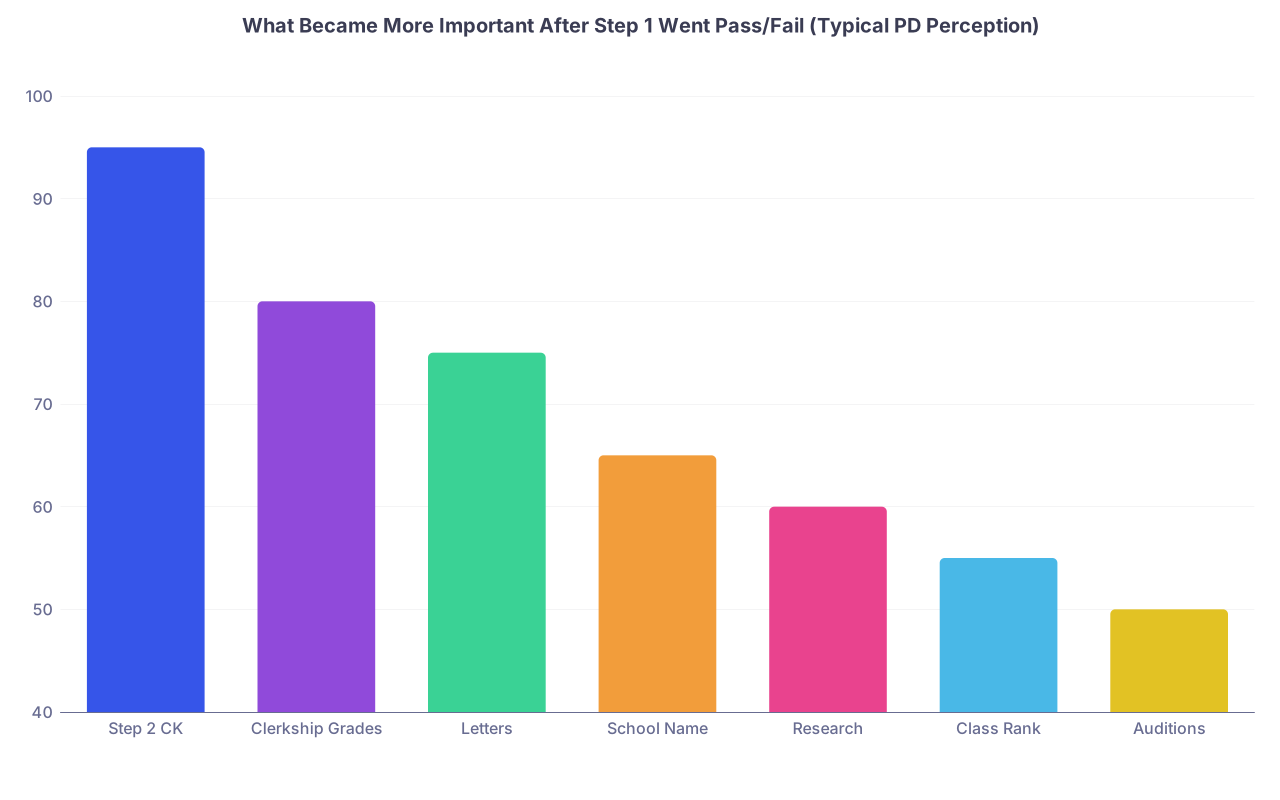
| Category | Value |
|---|---|
| Step 2 CK | 95 |
| Clerkship Grades | 80 |
| Letters | 75 |
| School Name | 65 |
| Research | 60 |
| Class Rank | 55 |
| Auditions | 50 |
Here’s what happened behind the scenes in the first 1–2 cycles.
Step 2 CK quietly became the new Step 1
They’ll say: “We don’t require Step 2 for interview.”
Reality: a huge number of programs now soft require it to be competitive, especially if your school isn’t a household name.
I’ve heard variations of this more times than I can count:
- “No Step 2 by interview season? Automatic lower tier bin unless they’re from a school we know well.”
- “If they don’t give us a number, we can’t stick our necks out for them.”
Plenty of PDs now use Step 2 like they used to use Step 1 — same mental cutoffs, just shifted a bit higher. They just don’t advertise it because it defeats the wellness narrative.
Clerkship grades and MSPE suddenly mattered a lot more
The problem? Clerkship grading is a dumpster fire of subjectivity.
- Some schools give Honors to 60% of the class.
- Others cap it at 10–15%.
- Some don’t have Honors at all.
Still, PDs leaned into whatever they could:
- “Any passes or low passes in core clerkships? Especially IM, surgery, peds — that’s a discussion.”
- “Pattern of ‘Meets Expectations’ with no ‘Exceeds’? Weak compared to others from the same school.”
Here’s what they do that students underestimate: they normalize you against your own institution. If they know your school gives Honors easily, your 6 Honors don’t impress them the way you think. They compare you to prior applicants from your school.
Brand name bias got worse, not better
Program leadership will swear this change promotes equity. In theory. In practice?
Removing a standardized number magnifies existing biases:
- PDs default more heavily to school reputation.
- They trust “known” pipelines: home program, same region, long-standing feeder schools.
- Unknown DO and IMG schools get less benefit of the doubt.
I watched one committee sort a list into three silent mental buckets:
- “Top-tier MD / known DO” → more likely to interview with fewer data points.
- “Middle-of-the-road MD / less known DO” → Step 2 and clerkships heavily scrutinized.
- “New DO / offshore / IMG” → need something exceptional to break through (Step 2, research, or a letter from someone the PD personally knows).
Step 1 used to be the escape hatch from that structural bias if you crushed it. That exit is narrower now.
The New Screening Stack: How PDs Actually Adjusted
Programs did not all adapt the same way. But patterns are very clear across medicine.
Let me show you the common filters they use now, in the real order many of them apply — even if they never write this down.

| Step | Description |
|---|---|
| Step 1 | All Applications |
| Step 2 | Early Reject |
| Step 3 | Hold / Lower Priority |
| Step 4 | Borderline Bin |
| Step 5 | Invite Pool |
| Step 6 | School Tier / Visa / Failures |
| Step 7 | Step 2 CK Available |
| Step 8 | Step 2 CK Above Internal Cutoff |
| Step 9 | Clerkship Pattern OK |
| Step 10 | Letters or Research Standout |
Let’s break down the levers they quietly dialed up.
1. Step 2 CK: “We’re not saying it’s required, but…”
Many PDs have an internal mental range they won’t publicly admit. They talk in coded language like “competitive for our pool” or “in line with past residents.”
What they actually have is something like this:
| Program Tier | Silent Step 2 CK Comfort Zone |
|---|---|
| Top 20 academic | 245–255+ |
| Strong university/regionally known | 235–245+ |
| Solid community | 225–235+ |
| Less competitive / unfilled risk | 215–225+ |
Are there exceptions? Yes. Are these hard cutoffs? No. But if you’re under those zones, they start looking for compensating strengths. If you’re way above, they forgive a lot.
And behind closed doors, you’ll hear:
- “He’s at 260. I don’t care that his preclinicals were borderline. He’ll pass boards.”
- “She has a 220. That’s going to be a problem with the chair unless she has something spectacular.”
2. Normalizing clerkship grades and rank
Without Step 1, PDs started obsessing over patterns:
- Are there any failed or repeated clerkships?
- Are critical core rotations (IM, surgery, peds, OB) solid?
- Any narrative red flags like “requires more supervision” or “needs improvement in professionalism”?
Many programs quietly created internal school profiles:
- “From School X, Honors in IM and Surgery = top 15% roughly.”
- “From School Y, getting mostly High Pass is average.”
When your dean’s letter says “top third,” “top quarter,” or uses coded language like “outstanding intern prospect,” that now carries more weight than before. PDs lean on these relative signals much more.
3. Letters: from background noise to tiebreaker
Letters used to be nice but secondary to Step 1. That’s over.
Now PDs hunt for:
Specificity, not fluff.
“Among the top 5 students I’ve worked with in ten years” moves the needle.
“Pleasure to work with, will be a fine resident” is death by faint praise.Name recognition.
Unequal but real: a generic-sounding letter from a nationally known faculty can outweigh a glowing letter from someone they’ve never heard of. PDs explicitly say:
“I know her. If she’s saying this kid is top tier, that means something.”Hard comparisons.
“Top 5%,” “top quarter,” “top student this year” — those phrases get highlighted and repeated in ranking meetings.
Letters are also where borderline applicants get rescued. I’ve seen a PD say:
- “Their Step 2 is lower than we like, but this letter from our alum is gold. Let’s bring them in.”
4. Research: not about prestige — about signal
No, not everyone needs a Nature paper.
But in the post-Step 1 world, research does two things for PDs:
- Shows you can start something hard and finish it (manuscript, poster, abstract).
- Gives external validators — coauthors, mentors, PIs — who can vouch for you.
What PDs actually care about:
- Did you finish anything? (Published, accepted, presented. Not just “in progress.”)
- Does your story make sense? “Four disconnected low-effort summer things” looks worse than “two serious, sustained projects with real outcomes.”
- Is the research relevant to the specialty? For competitive fields, yes, this matters now more than before.
Specialty Differences: Who Misses Step 1 the Most?
Not everyone is equally nostalgic. Some specialties relied heavily on Step 1. Others barely cared.
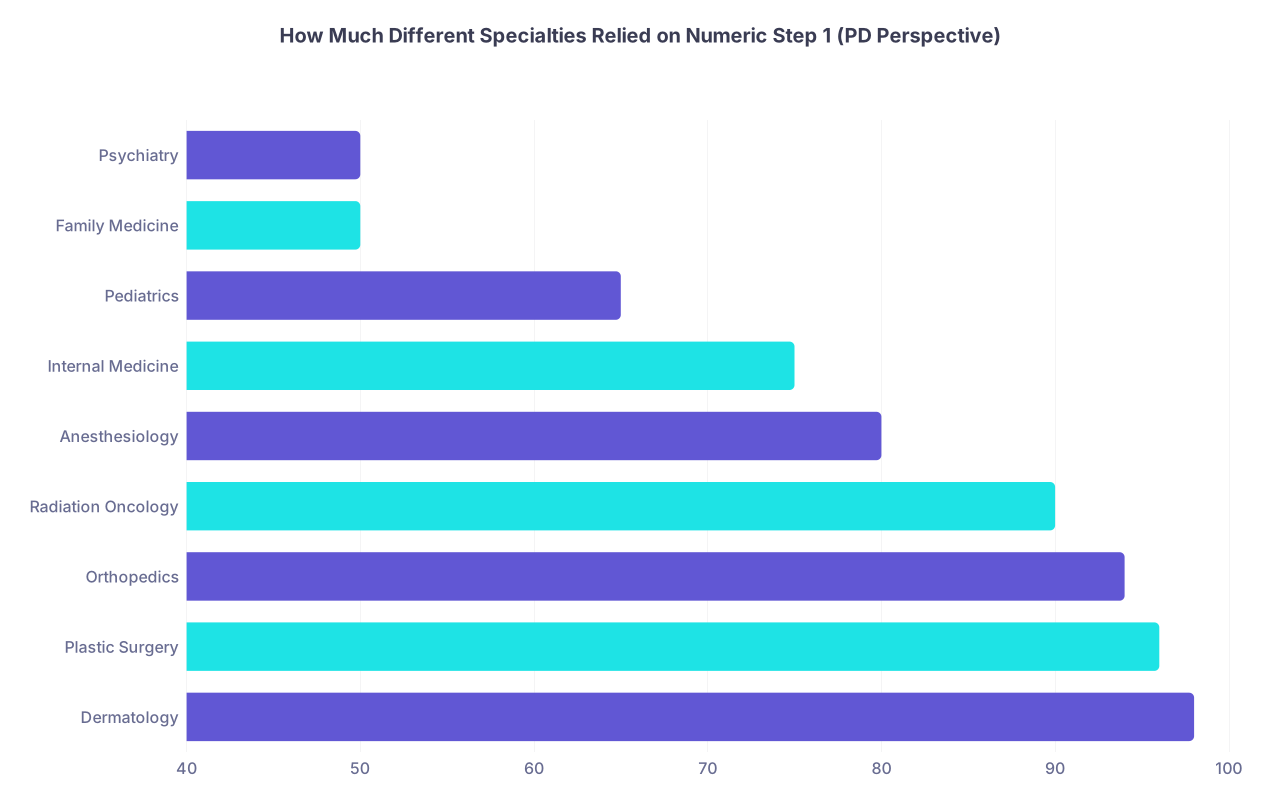
| Category | Value |
|---|---|
| Dermatology | 98 |
| Plastic Surgery | 96 |
| Orthopedics | 94 |
| Radiation Oncology | 90 |
| Anesthesiology | 80 |
| Internal Medicine | 75 |
| Pediatrics | 65 |
| Family Medicine | 50 |
| Psychiatry | 50 |
The hyper-competitive fields: Dermatology, Ortho, Plastics, ENT
These programs practically built a religion around Step 1 numbers. Why? Because they were flooded with:
- High-achieving students from top schools
- Massive research portfolios
- Honors-loaded transcripts
They needed a numeric tiebreaker.
Now:
- Step 2 CK is king.
- Research volume and quality are scrutinized more.
- Home-advantage and away rotations (auditions) became huge.
Privately, I’ve heard:
“I can no longer justify taking a chance on the 240 Step 2 guy from a new school over the 260 from Penn who also has three publications.”
So they don’t.
Primary care and less competitive specialties
Here, PDs miss Step 1 less. They still appreciate Step 2, but they’re more flexible:
- More open to late bloomers.
- More weight on narrative, fit, regional ties.
- More comfortable interviewing without Step 2 in hand if everything else looks solid.
But even in FM, Peds, Psych, there’s been drift toward: “We’d sure prefer to see Step 2 before we rank.”
How PDs Talk About This When Students Aren’t in the Room
You want the real PD perspective? Listen during off-the-record faculty meetings, not applicant Q&A sessions.
Here are actual patterns of comments I’ve heard:
- “We say we’re holistic, but with 4,000 applications ‘holistic’ means 15 seconds per file unless they’re flagged.”
- “I miss Step 1, not because I think it was fair, but because now every decision takes longer and feels squishier.”
- “Since Step 1 went pass/fail, we’re getting more borderline candidates from schools we don’t know asking us to ‘take a chance.’ I’m not going to risk a board failure because ERAS took a number away.”
They also complain about something you probably haven’t considered: time.
Without a numeric Step 1, they:
- Spend longer on each application they do read.
- Have more faculty involved in screening — which they hate, because it eats teaching and clinical time.
- Implement crude pre-filters: home school first, regional schools second, everyone else last.
Holistic review didn’t free them. It buried them. And human beings under pressure lean on shortcuts, even if they won’t admit it.
What This Means For You (And How to Play the New Game)
You cannot bring back numeric Step 1. But you can understand how PDs adapted and position yourself intelligently.
Here’s the distilled playbook tailored to the new reality.
1. Treat Step 2 CK as non-negotiable — and early
If you’re aiming at anything remotely competitive:
- Take Step 2 CK early enough that scores are back before most interview invites go out.
- Do not assume “I’m from a good school, they’ll trust me without it.” Many won’t.
- If your Step 1 was marginal pass, Step 2 is your redemption. PDs absolutely look for that upward trend.
2. Build a coherent story in your clerkships
You want your record to say:
- “Solid to strong in core rotations”
- “No professionalism concerns”
- “Improvement over time or consistently high performance”
If you have a weak clerkship:
- Own it in your dean’s letter narrative or personal statement if appropriate.
- Make sure you have strong letters from rotations that went well, especially in the specialty you’re applying into.
3. Get letters that actually say something
Stop chasing titles. Chase people who:
- Saw you work closely.
- Respect you as a clinician in the making.
- Are willing to write specifics and rankings, not just “hard-working and kind.”
A shorter, brutally specific letter beats a long, generic one every time.
4. If you’re from a lesser-known school, you need at least one spike
In the old system, a monster Step 1 could be your spike. Now you need one (or more) of:
- Strong Step 2 CK
- Very strong home or away rotation performance with correspondingly strong letters
- Serious, credible research output, ideally with someone known in the field
- Real connection to the program’s region or people (they absolutely favor students they know or feel tied to)
If you have none of those spikes, you’re betting on luck and charisma alone. That’s generous at best, delusional at worst.