
Last week, a fourth‑year sat across from me in the library, eyes red, voice shaky. “My story is…kind of a mess,” she said. “What if I put it in my personal statement and every PD just thinks I’m unstable and throws my app out?”
You know that feeling where your cursor blinks at the top of the document, and all you can think is: “If I tell the truth, I’m screwed. If I don’t, I sound fake.” That’s what we’re talking about.
You’re scared your personal story is too messy. Too complicated. Too “much.”
Good. That means you actually have one.
Let’s talk about how to frame it so program directors don’t see “unstable” or “risk,” but instead see exactly what you bring that the perfect‑on‑paper robots don’t.
First: What You’re Secretly Afraid Of (Let’s Say It Out Loud)
Let me guess, your brain is running through some version of these:
- “If I mention my leave of absence, they’ll assume I can’t handle residency.”
- “If I talk about depression or burnout, I’ll get labeled as a problem.”
- “If I explain my bad Step score, it’ll just draw attention to it.”
- “If I mention family trauma, it’ll sound like I’m asking for pity.”
- “If I say I switched specialties, they’ll think I’m flaky.”
- “If I admit I failed a course/rotation, they’ll think I’m incompetent.”
And underneath all of that is this:
“What if my whole life looks like a red flag?”
Here’s the uncomfortable truth: most PDs don’t care about “messy.” They care about two things:
- Can you do the work?
- Are you going to cause problems?
Messy is fine. Unstable, evasive, or blame‑shifting is not.
The whole game is: same facts, different framing.
The Line Between “Honest” and “Too Much”
There’s a spectrum:
- At one end: The fake, polished “Ever since I was four I wanted to be a [insert specialty]” nonsense.
- At the other end: A raw trauma dump disguised as a personal statement.
Both get ignored. For different reasons.
What works lives in the middle: honest, specific, but disciplined.
Here’s how I think about it:
- If your story helps them understand who shows up on day 1 of residency → relevant
- If your story makes them worry that day 1 might never happen, or that you’re still in crisis right now → danger zone
You’re not writing a therapy note. You’re writing an explanation of how you became a stronger, more reliable future resident.
So for every “messy” piece, you need to answer three questions:
- What actually happened — in one line, not a novel?
- What did you do about it (actions, not vibes)?
- How is that experience a current strength, not a fresh wound?
If you can’t convincingly answer #3 yet, that part probably doesn’t belong in your personal statement.
How PDs Actually Read “Messy” Stories
PDs are not sitting there stroking a cat thinking: “How do I punish anyone with imperfect lives?”
They’re thinking:
- Will this person show up?
- Will they learn?
- Will they be safe with patients?
- Will they make my life harder?
They’ve seen everything. Divorce during MS3, parents dying, severe depression, cancer during rotations, failed boards, remediation, switching careers at 35. You are not going to shock them.
What worries them isn’t:
- “She had depression.”
- “He failed Step 1.”
- “They took a leave after a family death.”
What worries them is:
- You never address obvious issues in your application
- Or you address them in a way that screams: still in chaos
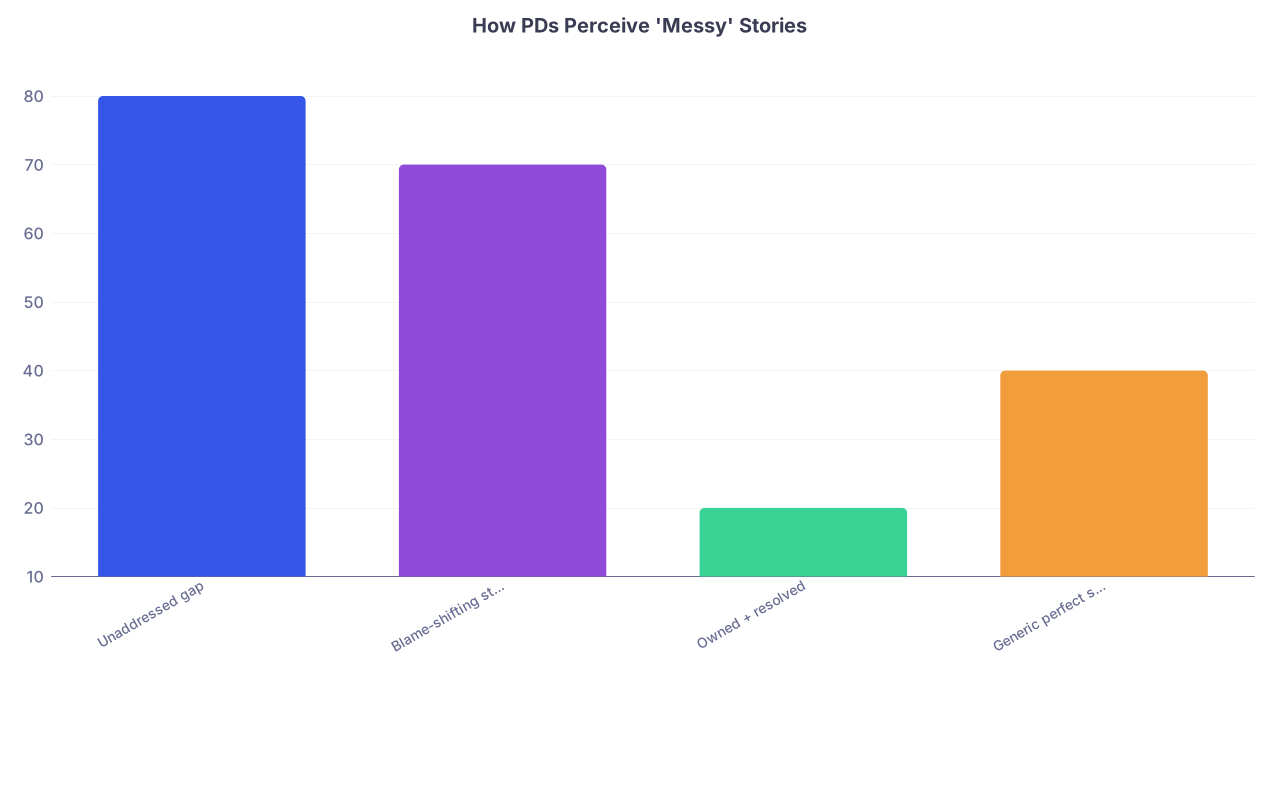
| Category | Value |
|---|---|
| Unaddressed gap | 80 |
| Blame-shifting story | 70 |
| Owned + resolved | 20 |
| Generic perfect story | 40 |
Those numbers aren’t from a specific study; they’re what PDs say over and over: a well‑owned, well‑framed “mess” worries them less than a black box.
So hiding things isn’t safe. Strategic honesty is.
How To Frame A “Messy” Story Without Setting Yourself On Fire
Here’s the structure I push people to use. It works across most scenarios.
1. Name the thing. Briefly.
One or two sentences. No graphic detail.
Bad:
“I descended into a deep, dark depression, crying every night, unable to function…”
Better:
“During my second year I struggled with depression that significantly affected my academic performance.”
You’re not lying. You’re editing.
2. Anchor it in time
PDs want to know: past problem, or current problem?
So add clear containment:
“During my second year…”
“Over a three‑month period…”
“Before I began my clerkships…”
You’re saying: this happened then, not now.
3. Show what you did, not just what you felt
This is where most people mess it up. They talk about insight and “growth,” but don’t show any action.
Concrete examples:
- Sought treatment / therapy / medication
- Met regularly with a dean or advisor
- Built a study schedule with [specific resource]
- Repaired a failed rotation with honors later
- Changed support systems, living situation, coping strategies
PDs care much more about behavior than poetry.
4. Proof of stability and improvement
You can’t just say “I’m better now.” You need receipts:
- Improvement in grades after the event
- Strong Step 2 after a poor Step 1
- Solid clerkship comments after a rough pre‑clinical period
- Consistent clinical performance with no further leaves
Example format:
“Since returning, I’ve completed all remaining clerkships on time, earning [X/Y] honors and strong clinical evaluations, and I’ve had no further leaves of absence.”
That one sentence does a lot of heavy lifting.
5. Connect it directly to who you are as a resident
This is the part people underplay because they’re scared it’ll sound like spin. But you have to translate:
- Struggled with mental health → now better at recognizing burnout in yourself and others, advocating for help early, practicing sustainable habits
- Failed an exam → learned how to adjust study strategies, seek feedback, tolerate failure and keep going
- Family trauma → learned to set boundaries, manage emotional intensity, remain functional under stress
You’re not saying “trauma made me better than everyone.” You’re saying: “I’ve actually been stress‑tested already. I know how I respond. I adjusted. I’m still here.”
Concrete Examples: Messy vs Framed
Let me show you what this looks like in real life.
Example 1: Leave of Absence for Depression
Messy version (what you’re terrified you’ll write):
“I took a leave of absence due to a severe depressive episode. I was overwhelmed, couldn’t study, and isolated myself. It was the lowest point in my life and I still struggle sometimes…”
Framed version:
“Midway through my second year, I developed depression that significantly affected my academic performance. In consultation with my dean, I took a one‑semester leave of absence to focus on treatment and recovery. During that time, I engaged consistently in therapy, adjusted my support system, and worked with an academic coach to rebuild my study approach. Since returning, I’ve completed all remaining coursework and clerkships on schedule, with strong clinical evaluations and no further interruptions. Having gone through this, I’m much more attuned to early signs of burnout in myself and my colleagues, and I approach residency with realistic insight into how to maintain my performance over the long term.”
Same facts. Different signal.
Example 2: Failed a Course / Remediation
Pure panic version:
“I failed medicine because my attending didn’t like me and my evals were unfair. It was a really toxic environment…”
Framed version:
“During my internal medicine clerkship, I struggled early with clinical reasoning and was required to remediate the rotation. Initially, I focused too much on data gathering and not enough on synthesizing and articulating plans. For remediation, I met weekly with a faculty mentor, practiced daily case presentations, and created structured notes to organize my thinking. When I repeated the clerkship, my evaluations highlighted clear, organized presentations and improved diagnostic reasoning. That experience fundamentally changed how I approach feedback: I now ask for it early, implement it visibly, and view it as an essential part of my growth rather than a judgment of my potential.”
The second one shows risk managed, not risk hiding.
What Absolutely Does NOT Belong In Your Personal Statement
Let me be blunt for a second. Some things you’re tempted to write will torpedo you.
Red‑flag writing patterns:
- Graphic details of trauma, self‑harm, or hospitalization
- Venting about “toxic” attendings, schools, or systems
- Blaming everyone but yourself
- Describing yourself as “still struggling,” “still unstable,” etc.
- A play‑by‑play of every bad thing that’s ever happened
Your personal statement is not:
- A place to prove how much you’ve suffered
- A confessional booth
- A request for accommodations or sympathy
If you can’t talk about something without slipping into raw, unresolved emotion, it probably belongs in a therapist’s office, not in ERAS.
That doesn’t mean you’re weak. It means you’re human, and residency applications are a brutal, narrow slice of your humanity.
You’re allowed to keep some things for yourself.
Where To Put What: PS vs Experiences vs PS Addendum vs LOR
Not everything has to live in your personal statement. Sometimes it’s actually better not to.
| Situation | Best Place To Address It |
|---|---|
| Short gap, minor issue | Brief ERAS entry / not at all |
| LOA with good recovery | Personal statement + MSPE comment |
| Step fail/repeat | Brief paragraph in PS or addendum |
| Major health/mental health history | Tightly framed PS or not addressed |
| Personality/professional growth | LOR comments + PS reflection |
And visually, the flow often looks like this:

| Step | Description |
|---|---|
| Step 1 | Identify issue |
| Step 2 | Address briefly in PS or addendum |
| Step 3 | Frame in PS with growth and stability |
| Step 4 | Leave out of PS |
| Step 5 | Visible on transcript/MSPE? |
| Step 6 | Directly affects readiness? |
If it’s clearly on your transcript (LOA, failed course, repeated year), pretending it didn’t happen is worse than a clean, short explanation.
If it’s not visible and doesn’t affect your current functioning? You don’t owe ERAS your entire life file.
How To Start Drafting When You’re Afraid You’ll Overshare
Here’s what I’d do if I were you and stuck staring at a blank page, heart pounding.
Open a completely separate document and word‑vomit the real story. No filter.
Walk away for a few hours.
Come back and highlight:
- One sentence that describes what happened
- Three sentences that describe what you actually did about it
- Two sentences that show evidence you’re now stable/stronger
- One sentence that connects it to who you are as a resident
Copy only those into a new doc. That’s your “core” story.
Trim out anything that’s:
- Blaming
- Graphic
- Still raw and unresolved
Then ask someone who is not your best friend (advisor, faculty, resident) one specific question:
“Does this make you more confident or less confident in me as a future resident?”
If they hesitate or say, “It’s a lot,” that’s your signal to cut or tighten.
The Hard Part: Believing You’re Not Ruined
I know the deeper layer of all this. You’re not just asking “How do I frame this?” You’re also quietly asking:
“Am I permanently damaged goods in this process?”
No.
I’ve seen applicants:
- Match IM at solid university programs with a Step 1 fail and a repeated year
- Match psych with a documented, well‑treated mental health history and an LOA
- Match surgery after switching from another specialty late, with a decent explanation
- Match peds after a remediation in clinical skills, with strong performance later
Did every single program overlook it? No. Some passed. Some always will.
But your goal is not to trick all PDs. Your goal is to help the right ones see you clearly enough to say: “Yeah. This one’s been through stuff and came out stronger. I’ll take that over the perfect paper applicant who’s never been tested.”
You’re not applying as a sanitized avatar. You’re applying as a future colleague who has already survived some storms.
You just have to write like someone who’s already on the other side of the storm, not still in the middle screaming for help.
FAQ (Exactly The Stuff You’re Still Worried About)
1. Should I mention my mental health diagnosis specifically (depression, anxiety, etc.), or keep it vague?
If naming the diagnosis helps make sense of a LOA or clear performance dip, you can name it briefly. But you don’t need to list DSM codes. It’s enough to say something like: “I experienced depression that significantly affected my performance.” What matters more than the label is: clear treatment, time‑limited episode, evidence of stability since, and how you function now. If you’re actively unstable or still in crisis, that’s a different issue — that needs real support first, not packaging for ERAS.
2. I failed Step 1 / Step 2. Do I actually put that in my personal statement or just hope they ignore it?
If you failed a board exam, they’re not ignoring it. It’s right there. A short, direct acknowledgment plus clear evidence of improvement is better than silence. One tight paragraph is enough: what went wrong (briefly), what you changed, and how your later performance reflects that change. Do not write an essay about the test itself being unfair, the conditions, the stress, etc. That’s where people drift into excuse territory and hurt themselves.
3. What if my “messy” story is still ongoing — like a chronically ill family member or my own chronic illness?
Ongoing doesn’t automatically mean disqualifying, but you have to be extremely careful. PDs need to believe you can meet residency demands. If you mention ongoing issues, the emphasis must be on the systems you’ve built to remain functional and reliable: backup plans, support networks, realistic expectations. If you can’t convincingly show that, you might be better off not centering that story in your PS and instead working with a trusted dean to decide what, if anything, belongs in your application narrative.
4. I have multiple “messy” things — LOA, failed course, family trauma. Do I talk about all of them?
Probably not in detail. Pick the one that most directly explains a visible issue in your application (LOA, fail, major gap) and frame that cleanly. You don’t need to catalog your entire hardship history. More is not better here. If you pile everything in, it starts to feel like chaos rather than resilience. Your personal statement should leave PDs with one clear, strong take‑home message about who you are now, not a list of every bad thing that ever happened to you.
Open your personal statement draft — or a blank doc if you’ve been too scared to start — and write one honest, controlled paragraph about the “messiest” thing you’re thinking of including, using the five‑step framing above. Don’t worry about the rest of the essay yet. Just get that one paragraph to a place where, if a PD read only that, they’d think: “They’ve been through it. And they’re ready.”