
You’re staring at your ERAS “Experiences” section and it hits you: that research box is basically empty. Maybe you have one little poster from MS1 you barely remember. Maybe you’ve got nothing. No PubMed hits, no abstracts, no “Smith J, Doe A, et al.”
And now your brain is going:
“I’m screwed. Everyone else has 5 publications. I’m not matching. They’re going to look at my application and laugh.”
Let’s talk about what actually happens if your research is weak or nonexistent. Not the fantasy world version where everyone applying to residency spent 3 years in a wet lab at Harvard. The real version, program by program, specialty by specialty.
Because yes, research matters. But it does not matter the same way for every field, and it’s not an automatic death sentence if your section is bare.
It just changes the game you’re playing.
How Much Does Research Really Matter? (More or Less Than You Think)
Here’s the blunt version: research is a sliding scale of importance that depends heavily on specialty, program tier, and sometimes geography.
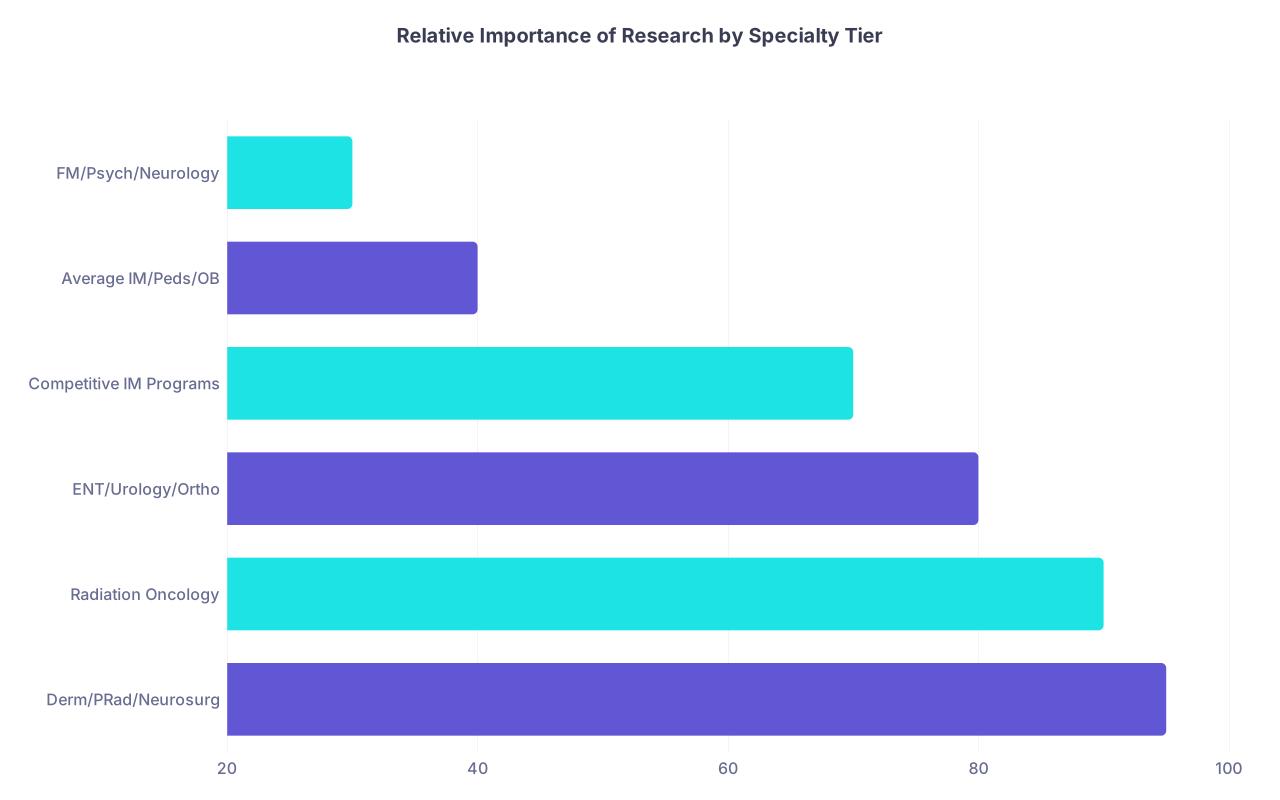
| Category | Value |
|---|---|
| Derm/PRad/Neurosurg | 95 |
| Radiation Oncology | 90 |
| ENT/Urology/Ortho | 80 |
| Competitive IM Programs | 70 |
| Average IM/Peds/OB | 40 |
| FM/Psych/Neurology | 30 |
If you have weak or no research, your situation falls into one of a few buckets:
- For hyper-competitive research-heavy specialties (derm, rad onc, neurosurg, plastics, some ortho, some ENT): no research is almost always a serious problem at academic programs. You’re not “out” everywhere, but you’re heavily handicapped.
- For internal medicine at big academic places (Mayo, MGH, UCSF, Hopkins): research is highly valued. Not having much will significantly limit your chances there.
- For most community and many mid-tier academic programs in IM, peds, psych, FM, neurology, anesthesia, EM, OB/GYN: research is nice, but it’s not the gatekeeper. Scores, letters, clinical performance, and “not being weird” matter more.
- For community-heavy specialties like FM and many psych/IM programs: plenty of residents match every year with zero research. Literally none.
So the actual question isn’t “Can I match with no research?” It’s “Where can I realistically match with no research, given my specialty and the rest of my app?”
That second part—“the rest of my app”—is what people conveniently ignore when they spin themselves into panic.
Let’s Be Specific: Who’s in Real Trouble and Who Isn’t
You probably want someone to just tell you plainly: “Am I screwed?”
So I’m going to be that person.

Category 1: You’re Not Doomed, You’re Just Not Going Ivy League
If you’re going into:
- Family medicine
- Psychiatry (non-ivory-tower programs)
- Pediatrics (especially community or regional programs)
- Community internal medicine
- Many neurology, OB/GYN, anesthesia, EM programs outside the super-academic big names
…and you otherwise have:
- Reasonable Step 2 (or equivalent)
- Solid clerkship evaluations
- At least a couple good letters
- Normal, functioning-human personal statement
Then weak or nonexistent research is usually not a dealbreaker.
Yes, some programs talk a big game on their websites about “strong interest in scholarly activity.” That doesn’t always translate to “we reject everyone with no research.” Many of those same programs have residents who’ve never seen SPSS in their lives before intern year.
What it does mean is:
- You may not be competitive for the ultra-academic university programs that churn out subspecialty fellows and NIH grants.
- You’ll need to lean harder on clinical performance, letters, and fit.
Is that ideal? No. Is it survivable? Absolutely.
Category 2: You’re Pushing Uphill Without Hiking Boots
If you want:
- Dermatology
- Plastic surgery
- Neurosurgery
- Radiation oncology
- Interventional radiology
- Some ortho / ENT / rad-diagnosis at academic powerhouses
And your research is basically zero (no abstracts, no posters, no real projects of any kind)… I’m not going to sugarcoat it: that’s a big problem.
These fields are flooded with people who took research years, did 10+ projects, and are name-dropping PIs on interview day. Programs use research as an easy sorting mechanism because there are just too many applicants.
Can someone match derm with no research? On this planet? Rare, but technically yes, especially at less academic or more network-driven programs. But you’re betting your entire future on being the improbable exception.
If you’re in this camp and still early in your timeline (late MS2 or early MS3), the honest play is usually:
- Strongly consider a research year OR
- Reevaluate specialty choice before you sink everything into a very uphill battle
Category 3: You’re in the Gray Zone
This is probably most people.
You’re aiming for:
- Internal medicine and you would love a shot at academic programs/fellowship down the line
- OB/GYN or EM or Anesthesia at reasonably competitive programs
- Psych at bigger-name academic institutions
And you have:
- Maybe one poster / one low-impact project / one case report in progress
- No big papers, no fancy R01 lab time, no “first-author in JAMA” badge
Here’s the truth: you’re not dead in the water at good programs. I’ve watched people match into well-known IM programs (think: strong university names, strong fellowship pipelines) with 1–2 posters and not much else—because they had strong letters, strong Step 2, honors in medicine, and were normal human beings on interview day.
Would more research have helped? Yes. Does your current situation mean “give up”? No.
It just means you need to be realistic about your list. Less “top-10 or bust,” more “balanced list with programs I’d actually match at.”
What Programs Actually See When They See Weak/No Research
You’re imagining the PD clicking “Application” → “Research” and immediately hitting reject.
That’s not how it works.

| Step | Description |
|---|---|
| Step 1 | Review Application |
| Step 2 | Research is Major Filter |
| Step 3 | Research is Minor Factor |
| Step 4 | Compare to Applicants with Stronger Output |
| Step 5 | Lower Priority Unless Exception |
| Step 6 | Focus on Scores, Letters, Fit |
| Step 7 | Specialty & Program Type |
| Step 8 | Any Research? |
They’re scanning your whole application. They’re asking:
- Does this person look like they can handle our clinical workload?
- Do they have red flags?
- Are their letters strong?
- Do they fit our vibe (community vs academic, research vs clinical)?
Research feeds into a couple of those questions:
- At academic programs: “Will this person contribute to our publications / QI / presentations?”
- For people talking big about fellowship: “Have they shown any scholarly initiative at all?”
But absence of research doesn’t automatically scream, “Lazy and unmotivated.” Especially if the rest of your app shows you’ve been doing other meaningful things—work, family responsibilities, leadership, volunteering, teaching.
Where it can hurt you is if your file otherwise looks thin. No research, plus average or weak clinical grades, plus lukewarm letters, plus nothing else that stands out. Then the lack of research becomes part of a general pattern of “meh.”
How to Compensate: If You’re Late in the Game
You’re probably thinking, “Okay nice, but it’s September and I’m not magically generating a PubMed ID in 2 weeks.”
Right. So here’s what you actually have control over now.
1. Stop Trying to Fake a Research Persona
Programs can smell it when your entire personal statement is you pretending you’ve dreamed of bench research since childhood, and your “Research” section is one poster you can barely describe.
If your research is weak or nonexistent, don’t oversell it. Don’t lie, don’t inflate, don’t pad minor chart reviews into “major retrospective clinical trials.”
You’ll get caught the second someone asks in an interview, “So what was your role in this project?” and you panic.
2. Lean into What You Actually Bring
If research isn’t your strength, then something else has to be. Programs need people who:
- Are clinically strong and safe
- Work hard and don’t melt down on call
- Get along with others
- Take feedback without becoming defensive
So you highlight those pieces.
You make sure your ERAS experiences and personal statement actually tell a coherent story:
- “I worked throughout med school to support my family, which limited my time for research but gave me X and Y skills.”
- “I realized I’m most fulfilled by direct patient care and team-based work, so I focused on clinical excellence, teaching, and QI rather than traditional research.”
That’s not an excuse. That’s framing. And it’s honest.
3. Get Your Letters to Do the Heavy Lifting
A program director will choose the applicant with zero publications and a letter that says “Top 5% resident I’ve worked with in the last decade” over the applicant with 6 papers and generic letters, every time.
You want letters that:
- Speak to your clinical ability
- Emphasize reliability, work ethic, and growth
- Are from people who actually know you, not just big names
If someone can say, “This student will thrive in a busy, clinically demanding residency,” that directly counters any anxiety a PD has about your lack of research.
4. Fix Whatever Else You Can
You can’t rewrite your research history two weeks before ERAS, but you can:
- Clean up your ERAS to avoid fluff and repetition
- Make sure your personal statement doesn’t sound like ChatGPT 0.1 wrote it
- Practice interviews so you don’t sound panicked or defensive when someone mentions research
- Strategically build your program list so you’re not sending 80% of your apps to institutions whose websites basically scream “NIH dollars or bust”
If You Still Have Time Left in Med School
If you’re earlier in the process (MS2, early MS3), weak or no research is fixable—if you stop procrastinating.
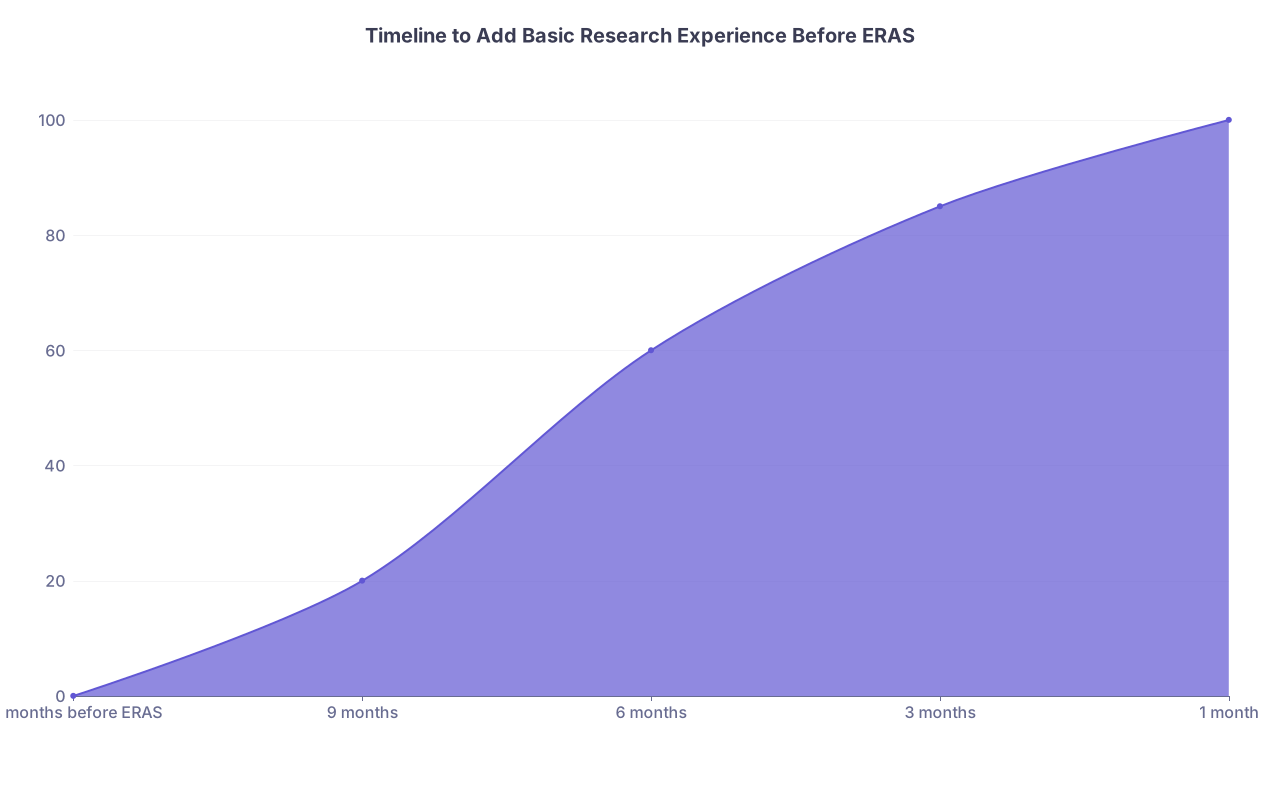
| Category | Value |
|---|---|
| 12 months before ERAS | 0 |
| 9 months | 20 |
| 6 months | 60 |
| 3 months | 85 |
| 1 month | 100 |
Rough translation of that chart: the earlier you start, the more “real” the experience will be by ERAS. If you wait until the last 3 months, you’re mostly just getting your name onto “data collection ongoing” projects.
If you’ve got time:
- Ask residents/attendings about existing QI or chart review projects you can help with. These are faster and more realistic than basic science from scratch.
- Aim for completion of something small over starting 5 “maybe” projects. A single poster + abstract is better than five half-baked “contributed to ongoing database” blurbs.
- Try to get on things that have a defined endpoint before ERAS—like a local poster, a regional meeting, or an internal presentation.
But don’t quit your life to chase research just because someone on Reddit said “no one matches psych without publications now.” That’s nonsense.
Community vs Academic: Your Realistic Playing Field
This is where expectations matter.
| Program Type | Typical Research Expectation |
|---|---|
| Top 10 academic (IM, neuro, etc.) | Multiple projects, maybe pubs |
| Mid-tier academic university | Some research or clear effort |
| Community with university ties | Nice to have, not required |
| Pure community (FM, psych, IM) | Very flexible, often minimal |
| Hyper-competitive specialties | Strong research is near-mandatory |
Are there exceptions to this table? Of course. But I’ve seen this pattern repeat over and over.
If your research is weak or nonexistent, your strategy becomes:
- Apply broadly
- Prioritize programs that emphasize clinical training over academic output
- Be honest about where you’ll actually be competitive
And yes, that might mean adjusting your dream a little. Maybe not “MGH categorical IM,” but a solid community program with good fellowship match. Maybe not “UCSF psych,” but an underrated midwestern university that actually trains great clinicians and doesn’t care if you’ve never opened REDCap.
How to Talk About Your Lack of Research in Interviews
You will probably get asked, directly or indirectly, about research or scholarly activity. The worst thing you can do is panic and start word-vomiting excuses.

A straightforward script you can adapt:
- Acknowledge it briefly
- Give a real reason (not a dramatic sob story, just context)
- Pivot to what you did do and how you see yourself engaging in scholarly work as a resident
Something like:
“I know my research section isn’t as strong as some applicants’. During med school, I prioritized clinical experiences and [family responsibilities/working part-time/leadership roles]. I did contribute to a small QI project on [topic], and while it didn’t lead to a publication, it showed me I like projects that improve day-to-day patient care. As a resident, I’m really interested in getting involved in [QI, education projects, or realistic research in that program’s setting].”
No drama. No self-flagellation. Just a calm explanation and a forward-looking plan.
That tone—steady, grounded—is more important than you think. PDs notice applicants who are constantly apologizing for themselves. It reads as insecurity.
Reality Check vs Catastrophizing
Your brain loves all-or-nothing thinking:
- “No publications = no match.”
- “If I don’t have research, I’ll only match at terrible programs.”
- “Everyone else has multiple first-author papers.”
None of that is true.
What is true:
- Research is a real filter for certain specialties and certain programs.
- It matters a lot more in some fields than others.
- You can match into good, solid programs—and build a good career—without a pretty PubMed page.
- Your time is better spent strengthening what you can control than spiraling about the past.
If you’re shooting for a research-heavy specialty with zero research and ERAS is in a month, yeah, your anxiety is actually telling you something useful: your odds aren’t great. That’s not bullying, that’s reality.
But if you’re applying to more clinically oriented specialties or a mix of program types, weak or nonexistent research is just one data point in a much bigger picture.
Quick Takeaways
- Weak or no research is not an automatic death sentence for most clinically oriented specialties and community or mid-tier academic programs.
- It is a serious handicap for research-heavy, hyper-competitive specialties and top-tier academic programs—but that’s about the specific targets, not your entire career.
- Your best move now is to stop catastrophizing, be honest about your profile, double down on your strengths, and build a smart, realistic program list that matches who you actually are—not who Reddit says you should be.