
The popular line that income-driven repayment is just “kicking the can down the road” is mostly wrong. And in a surprising number of cases, it is exactly the opposite of procrastination—it is the mathematically optimal move.
Let me be blunt: people toss that phrase around when they haven’t done the math. Or when they’re trying to sell you something (refi, coaching, whatever). The data from federal programs, CBO reports, and real borrower outcomes paint a different picture.
You want evidence, not slogans. So let’s go through what actually happens to people who use income-driven repayment (IDR), where the “kicking the can” criticism is valid, and where it is just financial bravado masquerading as wisdom.
What “Kicking the Can” Is Supposed to Mean
When people sneer at IDR as “kicking the can,” they usually mean one of three things:
- You’re just delaying the inevitable and will pay more interest in the long run.
- You’re avoiding responsibility instead of “being an adult” and paying your debt aggressively.
- You’re betting on forgiveness and government policy staying stable, which they think is naïve.
Sound familiar? I hear this in attendings’ lounges, from older relatives, and from finance bros who’ve never looked at PSLF statistics in their life.
But here’s what those takes miss:
- Income-driven plans are not one thing. PAYE, REPAYE, SAVE, IBR, ICR—each has different subsidy rules, caps, and forgiveness structures.
- “Pay more interest over time” is not automatically bad. It’s a trade-off, and sometimes a very good one.
- The federal system is explicitly designed to share risk with borrowers. Using that design is not “gaming” anything; it is using the product as intended.
If you judge IDR using the same mental model as a 5-year car loan, you’re going to get the wrong answer.
What the Evidence Shows About IDR and Forgiveness
Let’s start with hard numbers, not vibes.
Public Service Loan Forgiveness (PSLF)
The early PSLF headlines were ugly—single-digit approval rates—but that was almost entirely due to technical issues, ineligible loans, wrong repayment plans, and servicer incompetence. Once you filter to people who actually did it correctly, the story changes.
From Department of Education reports:
- Over $60 billion in PSLF and related waivers has already been forgiven.
- The approval rate for properly qualifying PSLF applications (correct loans + correct plan + 120 payments) is high; the early 1–2% horror numbers were dominated by people who never actually met the rules.
- Median forgiveness amount is often well into the six figures for physicians, lawyers, and other advanced degrees.
Translation: for borrowers who actually understood and followed IDR + PSLF, the “can” was not kicked. It was picked up and thrown in the trash at year 10.
IDR Forgiveness (20–25 years)
For non-PSLF borrowers, long-term IDR forgiveness is still early because these programs started in the late 2000s and early 2010s. But we already have:
- The first waves of IDR forgiveness (non-PSLF) happening under IBR and PAYE.
- The new SAVE plan explicitly designed to shift more borrowers into successful forgiveness, with built-in interest subsidies.
- CBO projections showing that a significant fraction of graduate borrowers—especially in low-paying fields or with very high debt—are expected to receive substantial forgiveness.
If IDR were just “kicking the can,” we wouldn’t be seeing tens of billions actually forgiven. The can is getting crushed. Slowly, yes. But very real.
Interest, “Growing Balances,” and Why That Isn’t Automatically a Failure
One of the most emotional triggers around IDR is watching your balance grow. You pay for years, and the number goes up. Feels wrong. Feels like you’re drowning.
But feelings are not a financial plan.
Under the new SAVE plan in particular:
- If your required IDR payment does not cover monthly interest, the unpaid interest is not added to your balance. That means no negative amortization. Your balance will not balloon just because your payment is low.
- For undergrad loans, payments are based on 5% of discretionary income; for grad loans, roughly 10% via the weighted formula. That is deliberately generous.
So the old horror story of someone making payments for 10 years and owing more than they started with? Much harder to replicate under SAVE, especially for people whose income isn’t exploding.
And even if the balance does grow? That doesn’t necessarily mean you did something wrong. It depends on your endgame:
- If you’re on a forgiveness track (PSLF or 20–25-year IDR), your total dollars paid and your taxable event at the end matter far more than what the statement shows in year 6.
- The balance is an accounting entry, not a moral judgment.
This is where the “kicking the can” narrative falls apart. The question is not “Did the balance ever go up?” The question is “What is the lowest-risk, lowest-total-cost strategy given your career, goals, and risk tolerance?”
When IDR Is Actually Optimal (And Not Procrastination)
Let’s walk through where IDR is likely the smartest move, based on data and typical income/debt scenarios.
High Debt, Moderate Income, PSLF Candidate
Think of a pediatrician with $280k in federal loans, starting salary $190k at a 501(c)(3) hospital.
They:
- File taxes separately, choose an IDR plan (now usually SAVE or a legacy plan depending on timing).
- Keep payments as low as legally allowed for 10 years.
- Get full PSLF on the remaining balance.
Total out-of-pocket can end up in the low to mid–six figures, with $150k–$300k forgiven, depending on raises and plan choice.
If that same physician ignores IDR, aggressively pays $4–5k/month to get rid of the loans in 7 years “like an adult,” they might pay more out-of-pocket and get zero forgiveness.
Aggressive payoff in that setting is not virtuous. It’s just expensive.
Very High Debt, Non-PSLF, But Not Huge Income
Social workers, lower-paid attorneys, PhDs, non-profit staff outside PSLF rules, and yes, some physicians in private practice with incomes that aren’t stratospheric.
Typical pattern:
- Debt: $150k–$400k
- Income: $60k–$200k, with modest growth
- No qualifying PSLF employer or unstable career path
For these borrowers, the CBO and independent modeling have shown:
- A substantial percentage will pay less under long-term IDR + forgiveness (even with potential future tax on forgiveness) than they would pounding away aggressively.
- The opportunity cost of huge payments in their 20s and 30s—no emergency fund, delayed retirement saving, no down payment fund—is often worse than the extra interest they’d avoid by being aggressive.
You don’t get points for being debt-free at 32 if you hit 45 with no retirement savings and no compounding behind you.
IDR in these cases is not delay. It’s risk management.
When the “Kicking the Can” Critique Has Teeth
Now, I’m not going to pretend IDR is perfect or that the criticism is always nonsense. There are real failure modes.
1. Wrong plan, wrong assumptions, no monitoring
I’ve seen borrowers:
- On the wrong IDR plan (e.g., old IBR when PAYE or SAVE would be cheaper).
- Never recertify income properly.
- Ignore PSLF certification forms for years.
- Assume future forgiveness without checking if their employer actually qualifies.
That is not the plan’s fault. That is user error. But it creates the illusion of “I was on IDR and now I’m screwed.”
If you pick an IDR plan and then go on autopilot for 15 years, yes, you’re kind of kicking the can. You’re outsourcing your financial thinking to a servicer whose incentive is to keep you paying as long as possible.
2. High-income borrowers who absolutely will pay everything back
Let’s say you’re an orthopedist or dermatologist:
- Debt: $300k
- Income: $500k+ by year 3–4
- Private practice or income well above IDR benefit range
Here, long-term IDR probably does lead to higher total paid versus refinancing to a lower interest rate and crushing the debt in 5–7 years. You’ll get little or no meaningful forgiveness; the required payments will be huge anyway; interest adds up.
But notice the nuance: the cost difference between “aggressive payoff on refi” versus “IDR then big prepayments” may not be enormous in the grand scheme for someone clearing >$400k yearly. The bigger mistake for many of these folks is not IDR per se; it’s carrying high federal rates longer than necessary when they’re ineligible for useful forgiveness.
So yes, for very high earners with stable jobs who will unambiguously pay everything back, staying in federal IDR forever can be a kind of expensive procrastination—especially if they never run the numbers.
3. Psychological denial
There’s another group: people who choose IDR but treat it like a magic eraser.
They:
- Don’t look at their income trajectory.
- Don’t plan for future tax on forgiveness (if that ever materializes; right now forgiveness through 2025 is tax-free federally, and policy may extend that).
- Don’t save a dime toward that potential tax bomb even when it’s clearly likely 15–20 years out.
For them, IDR becomes a shield against anxiety, not a strategy. That is “kicking the can” in the pure psychological sense: avoiding discomfort now, setting up panic later.
The fix is not to abandon IDR. The fix is to pair IDR with an intentional plan: investing, saving, career moves, and periodic recalculation.
The Myth of “Just Pay It Off Fast and Be Free”
The loudest critics of IDR usually push a different religion: pay everything off aggressively, live like a resident, use every spare dollar to kill the debt.
There’s a place for that mindset, especially for:
- Lower-debt borrowers ($20k–$80k)
- High, stable incomes with no realistic shot at forgiveness
- People who genuinely sleep better debt-free and are disciplined enough to invest aggressively afterward
But here’s what the “just crush it” crowd consistently ignore:
1. PSLF and SAVE are changes to the game board
The federal system in 2024 is not what it was in 2004. Or even 2014.
- PSLF is now a mature, tested program with well-documented pathways to success.
- SAVE neutralizes interest growth for many borrowers and dramatically cuts payments for lower and moderate incomes.
- Waivers and account adjustments are retroactively crediting past payment periods that used to be thrown away.
Pretending you still live in the era of standard 10-year or old-school IBR is like using 1990s match data to talk about competitiveness of specialties. It is professional malpractice.
2. Time value of money exists
If you have:
- Loans at, say, 5–6% federal
- A clear shot at employer matching in a 401(k)/403(b)
- Reasonable access to PSLF or partial forgiveness
It can be financially smarter to:
- Make the minimum required loan payments under IDR,
- Grab all available retirement matches and tax advantages,
- Build an emergency fund,
- Then decide how much extra, if any, to throw at loans.
The math is not ambiguous over multi-decade horizons: early retirement contributions and compound growth frequently beat slightly lower interest paid on student loans—especially if some of that loan balance is forgiven later.
What the Data-Driven Strategy Actually Looks Like
Let’s strip this down to what evidence-based planning around IDR should focus on.
| Scenario | More Often Optimal Strategy |
|---|---|
| High debt + PSLF-eligible job | IDR + PSLF (maximize forgiveness) |
| High debt + moderate income, no PSLF | Long-term IDR + investing / tax planning |
| Low to moderate debt + high income | Aggressive payoff / possible refi |
| Very high income, no forgiveness angle | Refi + fast payoff (IDR mainly a safety net) |
| Uncertain career path early on | Start in IDR, reassess every 1–3 years |
And the process to avoid real “kicking the can” is straightforward:
- Clarify whether you are realistically in the forgiveness zone (PSLF or 20–25 years) or in the “I’m definitely paying this all back” zone.
- Choose your plan based on that, not on vibes.
- Recheck every couple of years as your income, family status, and laws change.
- If forgiveness looks likely, stop obsessing about the growing balance and start planning for taxes and aggressive investing.
- If forgiveness looks unlikely, shift toward interest-rate minimization and faster payoff.
To visualize that decision path:
None of this involves closing your eyes and hoping. It’s math and periodic recalibration. That is the opposite of kicking anything down the road.
The Policy Risk Argument: Is Betting on Forgiveness Dumb?
A lot of the “kicking the can” rhetoric these days is really “you’re dumb to trust the government.” Reasonable concern. But oversimplified.
A few reality checks:
- Changing terms retroactively for existing borrowers is politically radioactive. Most changes—PAYE, REPAYE, SAVE, PSLF waivers—have made the system more generous over time, not less.
- PSLF’s biggest problems were administrative, not Congress nuking it. With the recent waves of waivers and account adjustments, the direction has again been toward leniency.
- If Congress did someday restrict forgiveness, they’d almost certainly grandfather existing borrowers or at least give generous transitions. Why? Because screwing over millions of highly educated voters is a bad reelection strategy.
Is there some policy risk in an IDR/forgiveness-based plan? Of course. But there’s also risk in banking on constant high income, perfect health, no career disruption, and the ability to throw $4k/month at loans indefinitely.
You don’t eliminate risk. You choose which risk you want to own.
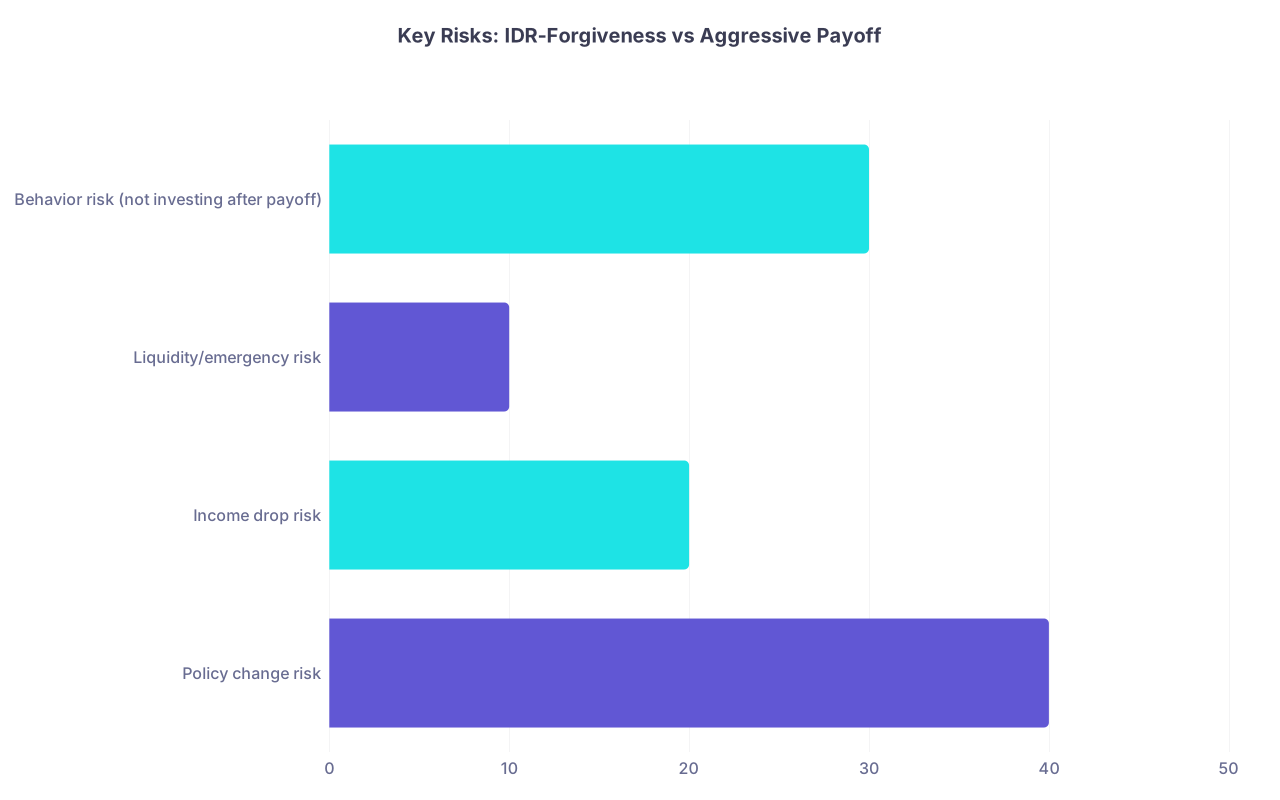
| Category | Value |
|---|---|
| Policy change risk | 40 |
| Income drop risk | 20 |
| Liquidity/emergency risk | 10 |
| Behavior risk (not investing after payoff) | 30 |
(Think of these numbers not as exact percentages, but as relative weight: aggressive payoff doesn’t magically avoid risk; it just shifts it.)
So, Is IDR “Kicking the Can” or Not?
Here’s the honest bottom line.
For many high-debt, moderate-income, or PSLF-eligible borrowers, IDR is not procrastination—it is the best available risk-adjusted strategy, backed by actual forgiveness data and program design.
The real “kicking the can” problem is not using IDR; it’s using IDR without a plan—wrong plan choice, no recalculation, magical thinking about forgiveness, or zero preparation for taxes and investing.
The macho “just pay it off fast” narrative works well for a narrow slice of borrowers, and disastrously for many others. If you don’t run the numbers for your exact situation, you’re not being responsible. You’re gambling and calling it discipline.