
The advice to “just live like a resident” after training is lazy financial guidance dressed up as wisdom.
It sounds disciplined. It sounds virtuous. It also ignores math, policy, specialty differences, location, family realities, and how federal loan programs actually work. I’ve watched too many new attendings follow this mantra blindly, only to realize five years later they optimized for the wrong goal.
You do not have a budgeting problem. You have a six‑figure, policy‑driven, interest‑compounding problem. Treating it like a latte issue is nonsense.
Let’s dismantle this.
Where “Live Like a Resident” Actually Comes From
The original idea had a narrow, reasonable core: when your salary jumps from $65k as a resident to $250k+ as an attending, do not immediately inflate your lifestyle. Hold spending closer to your resident level for a few years, hammer the loans, then relax.
In 1998, that was almost sane advice.
Back then:
- Tuition was lower.
- Many doctors owed $100k–150k, not $350k–500k+.
- Income‑Driven Repayment (IDR) and Public Service Loan Forgiveness (PSLF) did not exist.
- Refinancing to 3–4% fixed was common when rates dropped.
Fast‑forward to now: $300k–600k loan balances, 6–8% federal interest, complex IDR rules (SAVE, PAYE, IBR), a functioning PSLF program with real data, and a much more variable attending income distribution.
But the slogan stuck. People keep repeating it on forums and at noon conferences without updating for the modern rulebook.
The Myth: “If You Just Live Like a Resident for 3–5 Years, You’ll Be Fine”
No, not necessarily. Sometimes that plan is optimal. Often it’s mediocre. Occasionally it’s financially destructive.
The myth rests on several bad assumptions:
- That your main lever is lifestyle, not program selection (PSLF vs private vs SAVE).
- That faster payoff is always better than strategic forgiveness.
- That all specialties and geographic situations can realistically “live like a resident.”
- That your risk tolerance and life timeline are irrelevant compared to some abstract payoff date.
Let’s put numbers behind it instead of vibes.
What the Data Actually Shows About Debt Loads
Recent AAMC data: median debt for medical school graduates hovers around $200k–$220k. That “median” hides the problem. Plenty of grads are walking out with $350k–500k+, especially from private or out‑of‑state schools, and especially if they capitalized interest during forbearance instead of using IDR in training.
Now layer on interest.
At 7% interest:
- $400k accrues about $28k of interest per year if unpaid.
- That’s over $2,300 per month. Just in interest.
So when someone says, “Just live like a resident and throw $5k a month at it,” they’re really saying: send $2,300 to stand still and $2,700 to the principal. That’s not “we’re crushing it,” that’s “we’re barely nudging the needle on an overleveraged asset” unless you hit it hard and consistently for many years.
Example: Three Different Strategies with the Same Debt
Let’s run a simplified but realistic example: $400k in federal loans at 7%, single borrower, no spouse income, graduating residency and starting as an attending at $260k.
Strategy 1: “Live Like a Resident” and Pay Off in 5–7 Years
Strategy 2: Maximize PSLF at a 501(c)(3) hospital
Strategy 3: Use SAVE for 20–25 years and accept taxable forgiveness
I’m not going to drown you in every formula, but here’s the rough comparison ballpark.
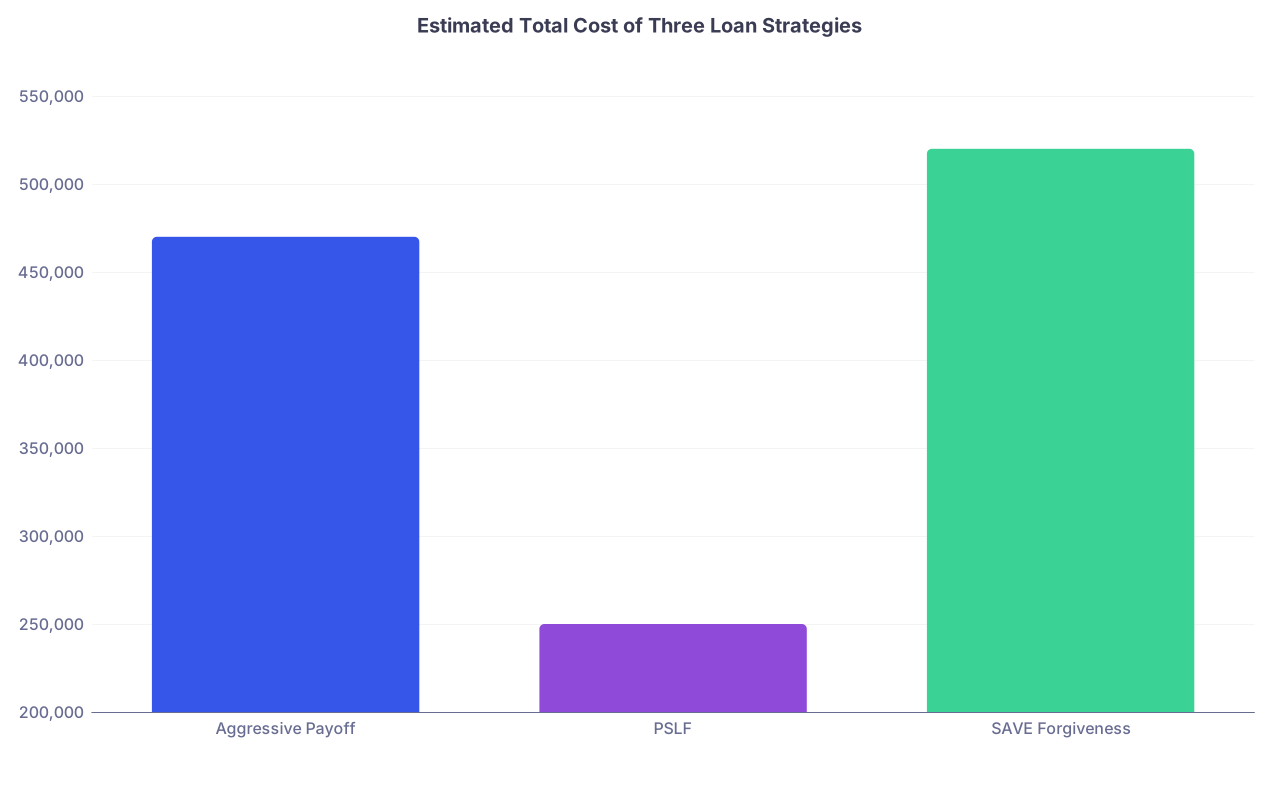
| Category | Value |
|---|---|
| Aggressive Payoff | 470000 |
| PSLF | 250000 |
| SAVE Forgiveness | 520000 |
Those numbers are indicative, not exact to the dollar, but the pattern is consistent across many case studies:
- Aggressive payoff: you might pay something like $450k–500k total (principal + interest), but you’re debt‑free in ~5–7 years. Requires sending $6k–$8k/month early on.
- PSLF: 10 years of qualifying payments; if you stay in a nonprofit system and your income is average for primary care or hospital employment, your total out‑of‑pocket could be dramatically lower than paying in full. Sometimes less than principal. Yes, really.
- SAVE forgiveness: more years; higher total paid than PSLF but potentially less than raw “pay to zero” if you stay closer to IDR minimums, especially with lower‑paying specialties.
Here’s the point: in many real cases, PSLF or strategic SAVE is mathematically superior to “live like a resident and annihilate your loans,” especially for primary care, peds, psych, or anyone sticking to academic/nonprofit settings.
But people keep telling new grads: “Just suck it up, live like a resident five years, then you’re free.” That’s not neutral advice. That’s encouraging you to reject a federal subsidy worth six figures in some scenarios.
PSLF vs “Live Like a Resident”: The Non‑Sexy Truth
Public Service Loan Forgiveness isn’t hypothetical anymore. We have thousands of real physicians who have had six‑figure balances wiped out.
Basic structure:
- 120 qualifying payments (10 years) on a qualifying IDR plan, working full‑time for a 501(c)(3) or government employer.
- Remaining balance forgiven, tax‑free.
Let me give you the pattern I keep seeing:
Hospitalist making $230k at a big nonprofit health system. $350k in loans. Uses REPAYE/SAVE through residency, then continues on IDR as an attending, making $1,200–$2,000/month payments early, rising over time. After 10 years, balance forgiven. Total out‑of‑pocket maybe $200k–250k. Tax‑free.
Meanwhile, their co‑resident – same debt, same first job – got spooked by the political noise, refinanced to private at 4.5%, and “lived like a resident” sending $6k/month. Pays off in 7 years, total maybe $450k–480k.
Same starting point. Opposite outcomes. The PSLF doc spends far less total, with far more flexibility. The “disciplined” doc burns an extra $200k for the virtue of being debt‑free faster.
Was that worth the extra scrimping and years of resident‑level lifestyle? That’s a personal value judgment. But financially? It’s not even close.
“Live like a resident” completely misses the biggest driver of cost: whether you’re in a forgiveness‑eligible situation and how much subsidy those programs are quietly giving you.
Where “Live Like a Resident” Actually Makes Sense
Now let me be fair. There are cases where this advice is dead on.
- High‑earning procedural specialties, especially in private practice or non‑PSLF‑eligible groups.
- People who already refinanced to private loans at a low fixed rate and have no forgiveness path.
- Docs who absolutely hate debt and will sleep better paying it off, even if it costs them more mathematically.
If you are an anesthesiologist making $450k in a private group with $250k in loans at 4.5% after refinancing, yeah, living closer to a $70k lifestyle for 3–4 years and nuking the loans is perfectly rational. You can be done fast, then redirect $8k–$10k/month to investing.
But that is not the typical profile for new grads drowning in $400k+ at 7%. For them, “live like a resident” might be an expensive way to feel virtuous.
The Psychological Trap: Martyrdom Instead of Strategy
There’s a social script in medicine: suffering equals moral worth. Cue the attending who boasts, “We lived in a one‑bedroom with the two kids for five years to pay off the loans. No vacations. You can do it too.”
I’ve talked to people who followed that path and quietly admitted: “I wouldn’t do it that way again.”
They delayed kids. Or home ownership. Burned through their 30s in chronic deprivation, only to realize later that early investing and a balanced IDR strategy would have left them wealthier and less miserable.
Financial advice isn’t just about the math; it’s about life design. Front‑loading 5–7 years of hyper‑frugality might sound noble, but if you’re leaving a six‑figure PSLF subsidy on the table or ignoring the value of early retirement contributions, you’re just glorifying struggle.
The Bigger Miss: Retirement and Opportunity Cost
Here’s the part almost everyone conveniently ignores on the “just pay it off fast” side: money used to kill debt cannot also be invested during your highest-earning, highest‑compounding years.
If you’re throwing an extra $4,000/month at loans for 7 years, that’s $336,000 of principal contributions you didn’t invest. Invested at a modest 7% for 25 years, that could be close to $1.8 million.
No, you don’t pick one or the other in reality. You balance them. But huge overpayments early while underfunding retirement and ignoring employer matches is a common, quiet disaster.
The right question isn’t “How fast can I get to zero?”
It’s “What combination of loan strategy + investing + lifestyle gives me the best overall life and net worth?”
“Live like a resident” ignores that optimization problem and focuses on one metric only: debt‑free date. That’s not sophisticated planning. That’s tunnel vision.
Where Lifestyle Actually Matters (But Not Like You Think)
I’m not saying lifestyle doesn’t matter. It does. You can absolutely sabotage every smart loan strategy by spending like a manic influencer.
The problem is the direction of advice.
The usual script:
- Step 1: Ignore PSLF/IDR math.
- Step 2: Convince yourself your only job is to minimize spending.
- Step 3: Overpay loans blindly.
- Step 4: Wake up realizing you missed out on matching contributions, early Roth opportunities, and probably six figures in forgiveness.
The more rational script:
- Decide whether you’re going to be PSLF‑eligible long enough to matter. Be honest about job plans, not fantasy versions.
- Choose a loan framework: PSLF path, long‑term SAVE forgiveness, or full payoff/refinance.
- Then decide how “resident‑like” your lifestyle needs to be to hit your chosen plan without wrecking the rest of your life.
Sometimes you’re better off living somewhat like a resident, funding retirement properly, and paying calculated amounts on IDR than you are going full ascetic warrior and dropping $8k on loans every month.
The Constraints No One Talks About
A few real‑world problems with glib “just live like a resident” advice:
- Geographic distortion. In a HCOL city (Bay Area, NYC, Boston), a resident lifestyle with kids might already be $90k–100k/year just to exist. You’re not “upgrading” much as an attending.
- Delayed family and burnout. I’ve seen people push off kids, fertility treatments, even basic time off because “we can’t, we’re in payoff mode.” Some regret that more than the debt.
- Job lock. If you commit to PSLF but then someone lectures you into refinancing and living like a resident, you might be forcing yourself into higher‑paying, worse‑fit jobs just to keep up with aggressive payments.
Money is flexibility. The best plan gives you more options, not fewer.
Boiling It Down: What You Should Actually Do
Here’s the stripped‑down, grown‑up version of what the data and real cases support:
First, you pick the system:
- If you will likely spend 10 years at a nonprofit or academic center, you run the PSLF numbers first. Often, that wins.
- If you’re going private or high‑income without PSLF, you compare long‑term IDR (SAVE) vs refinancing and paying to zero. Now “live like a resident” can be a serious contender.
- If your situation is messy (dual‑high incomes, mixed federal/private, uncertain career path), you hold off on irreversible moves (like refinancing federal loans) until the picture sharpens.
Then, within that system, you adjust lifestyle. Not blindly. Intentionally.
Sometimes that looks like: attending in a PSLF‑eligible job, paying IDR minimums, maxing 401(k)/403(b)/HSA, living slightly below attending norms, and letting forgiveness do the heavy lifting.
Sometimes it looks like: private practice surgeon, no PSLF, refinance to 4.5%, live on $80k for 4 years, obliterate $300k in loans, then ramp lifestyle and investing.
Both are coherent plans. “Just live like a resident” is not a coherent plan. It’s one knob (spending) turned to max while ignoring all the other controls.
Quick Summary: Why the Slogan Fails
Three things to walk away with:
- “Live like a resident” is not a strategy; it’s a spending stance. Without first choosing the right loan framework (PSLF, SAVE, refinance), it can easily cost you six figures.
- Math and policy beat bravado. For many nonprofit/academic attendings, PSLF or structured IDR is objectively cheaper than aggressive payoff, even if it feels less virtuous.
- Your life is not a morality play about debt. Optimize for total net worth, flexibility, and sanity—not just the earliest possible “$0” balance on your loan statement.