
What would you choose if the debt fairy erased every dollar of your student loans overnight—would your specialty change?
If your honest answer is “yes,” you’ve probably internalized one of the most persistent myths in medical training: that large student loans permanently choke your specialty options and lock you into “high-paying” fields you may not even like.
Let me ruin that story with data.
The Myth: Debt Dictates Specialty Choice Forever
You hear this from MS1 onward:
- “I’d love peds but I have $400k in loans, so that’s not realistic.”
- “Primary care is financially irresponsible with six-figure debt.”
- “If you graduate with huge loans, you have to* do derm/ortho/gas/rads or you’re screwed.”
This sounds logical on the surface. Big debt, modest income? Bad combo.
The problem: when you actually run the numbers—with real repayment plans, real tax rules, and real specialty salaries—the “debt traps you in high-paying specialties” narrative mostly falls apart. Not completely. But mostly.
Debt absolutely affects how stressful your life feels. It affects your cash flow in the early years. What it usually does not do is:
- Make primary care or lower-paying specialties financially impossible
- Force you into a single “financially safe” specialty long-term
- Guarantee you’ll be poorer than your classmates forever
What it does is punish people who:
- Ignore repayment options
- Use the wrong plan for their career path
- Try to pay like a dentist on a resident salary
If you understand how federal loans, income-driven repayment (IDR), and forgiveness actually work, the “I can’t choose that specialty” story starts looking more like anxiety than math.
Reality Check #1: Your Repayment Plan Matters More Than Your Debt Number
Most med students obsess over the wrong variable: total debt instead of monthly payment under different scenarios.
Two grads, both with $350k in federal loans at ~7%:
- One does dermatology, makes $450k+ eventually
- One does pediatrics, makes ~$190k–220k
The myth: the peds doc is doomed financially, the derm doc is free.
Reality: depending on repayment strategy, the peds doc can be less stressed about loans, especially with PSLF.
Let me show you why.
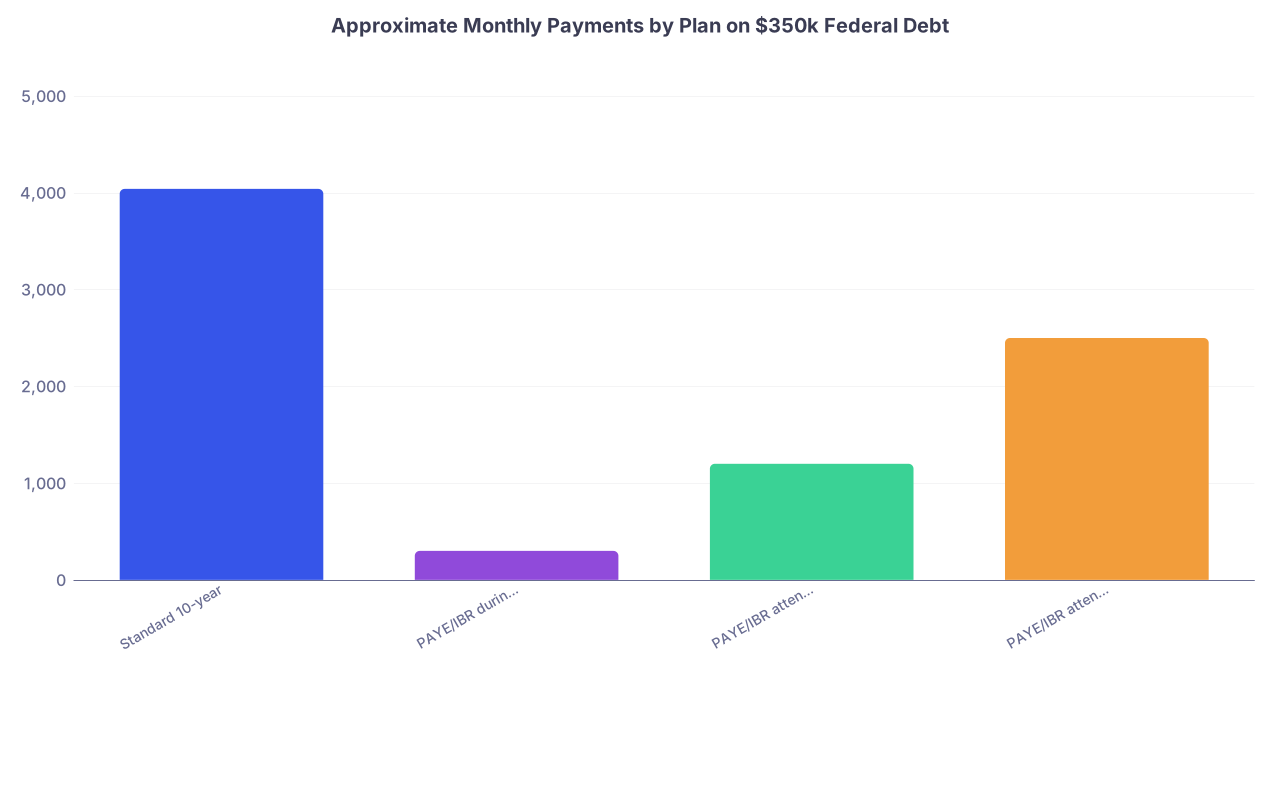
| Category | Value |
|---|---|
| Standard 10-year | 4040 |
| PAYE/IBR during residency | 300 |
| PAYE/IBR attending (Peds) | 1200 |
| PAYE/IBR attending (Derm) | 2500 |
Those are rough but realistic ballpark numbers (using typical incomes):
- Standard 10-year: suicidal for most residents and new attendings
- IDR in residency: a few hundred a month, sometimes less
- IDR as attending: scales with income—yes, derm pays more, but also owes bigger checks
Debt doesn’t kill careers. Wrong plans do.
The real lever: federal IDR + forgiveness
For almost any non-surgical, non-high-earning specialty (and even many high earners at high-debt levels), the most powerful tools are:
- Income-driven repayment (SAVE, PAYE, IBR depending on when you borrowed)
- Public Service Loan Forgiveness (PSLF) if you stay in qualifying employment
- Long-term IDR forgiveness (20–25 years) if you do not
What matters financially is:
- How many qualifying PSLF years you can stack during residency + fellowship
- Whether you stay employed by 501(c)(3) / government entities after training
- How fast your income ramps vs how aggressive you want payments to be
Debt level changes the stakes. It does not rewrite the math of these programs.
Reality Check #2: Numbers, Not Vibes – Can “Low-Paying” Specialties Work With Huge Debt?
Let’s run a realistic scenario, because that’s where the myth really falls apart.
Say you graduate with:
- $400k in federal loans at ~7%
- You’re considering:
- Pediatrics (academic, PSLF-eligible job) vs
- Anesthesiology (private practice, non-PSLF)
Most students think: “$400k? Peds is financial suicide. Anesthesia or bust.”
Let’s compare the 10–15 year trajectory, not just the first attending paycheck.
| Factor | Pediatrics (Academic, PSLF) | Anesthesia (Private, No PSLF) |
|---|---|---|
| Residency years | 3 | 4 |
| Income in residency | ~$65k–75k | ~$65k–75k |
| Post-training starting income | ~$190k–210k | ~$370k–420k |
| Repayment approach | IDR + PSLF | Refi + aggressive payoff |
| Years to effective “freedom” | 10 (PSLF) | 7–10 (if disciplined) |
| Total personal out-of-pocket on loans | Often less than principal | Often near or above principal + interest |
No, these are not exact numbers. Markets shift, rates shift, PSLF rules tweak. But directionally, this is what we see in real plans:
- The peds doc, using IDR + PSLF + low early payments, often pays back less than their principal over 10 years and is done.
- The anesthesia doc makes more, yes—but often writes massive checks in the first 5–7 years after refinancing, easily $4k–7k/month, to get clear.
So is anesthesia “financially safer”? Higher income, yes. Less loan stress? Not automatically.
Here’s the part almost nobody says out loud: at $350k–$500k of federal debt, PSLF often makes primary care and academic specialties look very reasonable compared to some higher-paying private paths that do not qualify.
Reality Check #3: What Actually Correlates With Regretted Specialty Choice
I’ve sat with residents who hated their jobs and tried to blame debt.
The patterns are pretty consistent:
- People who chose a specialty mostly for money tend to burn out harder
- People who chose trying to “optimize” finances but ignored lifestyle fit and personality pay later
- People who built a repayment strategy that matched their career goals rarely say, “Debt forced me here”
Regret correlates more with:
- Mismatch of personality and day-to-day work
- Toxic training environments
- Unrealistic lifestyle expectations
- Lack of autonomy, schedule control, or academic vs procedural fit
Debt is the scapegoat. The “I had to pick this for the money” line is psychologically convenient. It avoids the harder admission: “I didn’t really know what I wanted and I over-weighted income.”
Does money matter? Absolutely. But pretending it’s the only or even the primary constraint for most U.S. med grads with federal loans is lazy analysis.
Reality Check #4: Where Debt Does Bite Hard
Now let’s be fair. There are scenarios where big loans legitimately constrain you. Just not necessarily the ones you’ve been warned about.
Debt creates real pressure if:
- You have high private loans at high rates without flexible terms
- You commit to an expensive lifestyle too early (big house, luxury car, kids in private school at PGY-1–3 or new attending level with no plan)
- You refuse to use IDR because “I don’t want forgiveness” but also don’t want $5k/month payments
- You pick a lower-paying specialty + avoid PSLF-eligible jobs + refuse to move or adjust expectations
That last one is the sleeper issue: not “peds vs ortho,” but “peds in a high-cost city at a small private group that doesn’t qualify for PSLF, while living like your private practice anesthesiologist classmates.”
Same specialty, different choices. Very different financial reality.
Here’s the pattern I see over and over:
- Debt limits lifestyle choices in the first 5–10 years much more than it truly limits specialty choice
- People who are flexible on geography, employer type, and early lifestyle can almost always make the specialty they like work financially
- People who want maximal lifestyle and maximal location freedom and minimal payments are the ones who feel “trapped”
That’s not a loan problem. That’s a math problem.
Reality Check #5: Your Peak Earning Window Is Long. Training Is Not the Whole Story.
Another myth: “If I don’t pick a high-income specialty, I’ll never catch up.”
This ignores a basic fact: your earning runway isn’t 3–5 years. It’s 25–30.
Yes, an orthopedic surgeon making $700k from age 35–65 has an obvious edge over a family physician at $240k. But that difference can be:
- Blunted by PSLF and tax-advantaged investing
- Wasted by lifestyle creep, divorce, failed businesses, terrible investing
- Narrowed when primary care or outpatient fields add side income (urgent care, telehealth, admin roles, etc.)
And here’s the twist: “big money” specialties often come with:
- Longer training (more years of low income while interest compounds)
- Higher burnout and early retirement in some fields
- Bigger malpractice premiums or practice overhead if going solo
- More pressure to keep up a demanding volume to maintain income
Your lifetime wealth is not just specialty × salary. It’s:
- How long you work
- How fast you grow spending relative to income
- How consistently you save and invest
- Whether you leverage forgiveness smartly when appropriate
A primary care doc who starts saving early, chooses PSLF strategically, and avoids massive lifestyle inflation can beat a poorly managed high-earning specialist on net worth by mid-career. I’ve seen it in actual numbers.
Not just “in theory.” On real balance sheets.
Reality Check #6: The IDR + PSLF “Unfair Advantage” for Lower-Paying Fields
Here’s the part that makes high-earning non-PSLF attendings quietly jealous: IDR + PSLF is often regressive. It favors lower-income, high-debt people.
The higher your income, the more:
- Your IDR payment rises
- Your PSLF “subsidy” per dollar of payment falls
- Your case for private refinance becomes stronger—but then you lose forgiveness options
With $400k of debt, the math often looks like this:
Academic/PSLF-eligible primary care or peds:
- 10 years of modest payments, balance forgiven tax-free
- Effective cost well below nominal total plus interest
High-earning private specialist:
- Best move usually: refinance privately, pay off in 5–10 years
- Huge cash outflow early, but much higher income long-term
Both paths can work. But the “lower-paying” PSLF track often gets to emotional freedom from loans earlier with less financial gymnastics.
So when someone says, “I have $400k in loans, so I can’t do peds,” what they often mean is:
- “I don’t understand PSLF/IDR well enough to trust it.”
- “I want peds income but a non-PSLF lifestyle and job structure.”
- “I’m more scared of big forgiven balances than big cash payments.”
All solvable with information and honest priority setting—not some iron law that debt = no lower-paid specialty.
So Does Big Debt Limit Specialty Choice Long-Term?
Here’s the blunt answer:
- If you understand and correctly use federal repayment and forgiveness programs, large student loans rarely force you into any one specialty long-term.
- What they definitely do is force you to:
- Be deliberate about job type (PSLF-eligible vs not)
- Be intentional with lifestyle creep
- Actually run numbers instead of going by vibes
The real trap is not picking psychiatry or family med with $350k in loans.
The real trap is picking anything—cards, ortho, EM, neurosurg—while ignoring the repayment mechanics and then waking up 5 years out wondering why you feel cornered.
So if you’re still in the decision phase, ask different questions:
- “What kind of day-to-day work will I tolerate for decades?”
- “Am I willing to align my first 5–10 years of job choices with a smart loan strategy?”
- “Is my fear of debt based on actual math or just the raw number?”
Run the scenarios. Learn how IDR, PSLF, and refinance actually work. Stop treating your loans like some mysterious curse and start treating them like a very large—but very manageable—line item in a long career.

| Step | Description |
|---|---|
| Step 1 | Graduate With Large Loans |
| Step 2 | Refinance and Aggressive Payoff |
| Step 3 | Use IDR + PSLF |
| Step 4 | Use IDR then Refi / Long Term IDR |
| Step 5 | Specialty Choice Based on Fit |
| Step 6 | Federal or Private? |
| Step 7 | PSLF Eligible Job Acceptable? |
Because decades from now, you won’t remember the exact balance on your loan portal. You’ll remember whether you could stand walking into work every day—and whether you let a scary six-figure number, instead of clear math, make that choice for you.