
The horror stories about “loan forgiveness tax bombs” for doctors are wildly overstated—and in many cases, flat‑out wrong.
If you’re a high‑income physician, the real risk is not that a tax bomb will ruin you. The real risk is that fear of a hypothetical tax bomb pushes you into terrible repayment decisions that cost you hundreds of thousands of dollars unnecessarily.
Let’s walk through what actually happens, with numbers, not vibes.
The Myth: “Forgiveness Will Trigger a Giant Tax Bill That Destroys You”
Here’s the narrative I hear constantly:
- “If I go for IDR forgiveness, I’ll owe a $300k tax bill in my 40s.”
- “I’m a high earner, so I can’t risk a tax bomb.”
- “Better to refinance and just pay it all off quickly.”
This story blends three different concepts and gets all of them partially wrong:
- Public Service Loan Forgiveness (PSLF) – 10 years, no tax bomb.
- IDR 20/25‑year forgiveness (PAYE, SAVE, IBR, etc.) – potentially taxable, but with nuance.
- State and federal tax law – changing quickly, with temporary exemptions.
The panic comes from people treating “possible taxable event one day” as “certain financial catastrophe,” then extrapolating from a few scary case examples that never apply cleanly to your situation.
Let me be blunt: for most high‑income physicians, the “tax bomb” either never happens, or it’s a manageable, fully predictable lump sum you can plan for years in advance.
The real mistake is using the fear of a future tax bill to justify massively overpaying your loans now.
PSLF vs 20/25‑Year Forgiveness: Completely Different Animals
First distinction that gets butchered on blogs and in Facebook groups: PSLF is not the same as 20/25‑year IDR forgiveness.
| Feature | PSLF | 20/25-Year IDR Forgiveness |
|---|---|---|
| Years of payments | 10 (120 qualifying) | 20 or 25 |
| Employment requirement | Nonprofit / government | None |
| Tax on forgiven amount | No (federally) | Yes* after 2025 (current law) |
| Typical doc use case | Academic / hospitalist | Private practice / locums |
*Assuming current temporary federal tax exemption expires after 2025.
If you qualify for PSLF and stick with it:
- Your forgiven amount is not taxable under federal law.
- Many high‑tax states also do not tax it, and even where they do, it’s relatively minor compared to the total forgiven.
So if you’re a hospital-employed cardiologist at a 501(c)(3), or an academic neurologist at a state university hospital, and you stay there 10 years: the “tax bomb” is a myth. Full stop.
Where the tax bomb conversation does show up is for:
- High-debt physicians in private practice
- Docs who refinance out of federal loans and then try to come back (bad idea)
- Or those using SAVE/PAYE as a long-term low-payment strategy outside PSLF
That’s where 20- or 25-year forgiveness comes in.
What the Law Actually Says About Taxing Forgiveness
Let’s stop hand-waving and talk statute.
Under current federal law:
- PSLF forgiveness is permanently tax-free.
- IDR forgiveness (SAVE, PAYE, IBR, ICR) is federally tax‑free through 2025 due to the American Rescue Plan (ARPA).
- After 2025, under current law, forgiven balances return to being taxable as ordinary income at the federal level, unless Congress extends or changes the rule again.
States are a patchwork:
- Some follow federal treatment and exclude forgiven student debt.
- Some partially conform.
- A few tax it no matter what.
This is where you see commentators getting dramatic. They’ll take a hypothetical OB‑GYN with $600k forgiven in 2045, slap a 37% federal rate on it, and scream “$222k tax bomb!”
They’re doing three things wrong:
- Assuming today’s tax brackets and laws 20+ years out.
- Ignoring that your income, deductions, filing status, and state all matter.
- Ignoring that you have two decades to plan for an entirely predictable event.
The “bomb” metaphor is misleading. Bombs are sudden, unpredictable, and uncontrolled. A tax bill scheduled for roughly 2045, under rules you can model in Excel today, is not a bomb. It’s a balloon payment you can prepare for.
For High-Income Physicians, the Bigger Risk Is Overpaying, Not the Tax Bill
Here’s where the contrarian part comes in: for many high‑income physicians, obsessing over a possible future tax bomb leads to financial self-harm.
Typical pattern I see:
PGY-2, 3, 4:
- $400–600k federal loans at 6–7%
- Enrolled in PAYE or SAVE during residency
- Payments are very low relative to debt; interest ballooning
Attending year one:
- Income jumps to $350k–$500k
- Panic reading blogs about “interest,” “negative amortization,” “tax bomb”
- Doctor refinances privately and commits to a 5–10 year payoff
Outcome: yes, no forgiveness, no tax bomb. Also: they just paid $150k–300k more over their career than necessary compared with an optimized IDR + investment strategy or PSLF if eligible.
Now, can you justify that overpayment emotionally? Maybe. You value being debt‑free early. Fine. But don’t pretend “the tax bomb forced me to.” That was a choice.
How Big Is the Tax Bomb Really? Let’s Run Actual Numbers
Time to stop hand‑waving and use numbers.
Say you’re a dermatologist with:
- $500k federal loans at 6.5%
- You use SAVE or PAYE and do not qualify for PSLF (full private practice career)
- Household AGI: starting around $400k, growing with inflation
- Family size: 2–4
- You aim for 20–25 year forgiveness
Under a 25-year forgiveness scenario with steady high income, what might happen?
- Your payments on IDR will likely rise to near or even above the standard 10-year payment as your income increases.
- If your payments exceed accruing interest for many years, your balance may actually stabilize or decrease.
- The amount forgiven may be far less than the scare articles suggest. Possibly even zero if you fully pay it off through IDR by year 20/25.
In reality, the “massive forgiveness at year 25” scenario mostly applies to one of three groups:
- Extremely high debt relative to income (e.g., $800k debt, $220k income).
- Long periods of low income, part-time work, or extended training.
- Married to someone with moderate income but filing jointly in a way that spikes payments inefficiently.
And for those who do have substantial forgiveness, you then look at tax.
Suppose, under a modeled scenario, at year 25 you have $300k forgiven and federal law at that time taxes it as income.
- Let’s assume a combined marginal state+federal rate of 35% in that year.
- Tax hit: 0.35 × 300,000 = $105,000.
Big? Yes. Controllable? Also yes. And you knew about it 20+ years in advance.
Divide that $105k over 20 years: that’s effectively $5,250 per year you could set aside into a conservative side bucket to cover this future tax. Add some reasonable investment growth and you probably need even less per year.
Does that sound like a bomb? Or just a scheduled payout you can fund with a boring automated transfer?
Why PSLF Makes the “Tax Bomb” Mostly Irrelevant for Many Specialists
Here is the part that’s still misunderstood by a lot of doctors, including attendings who should know better by now: PSLF is not just for pediatricians and family docs making $180k.
Plenty of well-paid physicians at:
- Large nonprofit hospital systems
- Academic centers
- County hospitals
- VA systems
earn $300k–$700k and still qualify for PSLF if they:
- Have Direct federal loans
- Stay employed full-time by 501(c)(3) or government entities
- Make 120 qualifying IDR payments
For them, the correct “tax bomb” statement is:
There is no tax bomb. PSLF forgiveness is federal tax-free.
Your planning problem is not a mysterious balloon tax. It’s:
- Are you in the right repayment plan?
- Are you maximizing PSLF value?
- Are you avoiding dumb moves like refinancing or consolidating at the wrong time?
And no, you are not “too high income for PSLF to matter.” I’ve seen surgeons with $400k forgiven tax‑free. Hospitalist groups inside big nonprofit systems with attendings hitting $200k+ forgiven.
They didn’t get blown up by a tax bomb. They got a seven‑figure post‑tax raise over their careers by not panicking and refinancing early.
The Real Risks Around Forgiveness That Doctors Actually Face
There are legitimate concerns around forgiveness and high-income physicians. They’re just not the ones plastered all over clickbait blogs.
Legislative risk
Yes, Congress can change the rules. It can also raise or lower tax brackets, change 401(k) rules, or reinvent Medicare. You cannot legislate-proof your life. You can only make decisions based on current law and reasonable expectations, not fear fantasies.Documentation / compliance risk for PSLF
I have seen doctors lose years of qualifying payments because HR incorrectly checked a box, or because someone consolidated loans at the wrong time. That’s a real risk. But again—that’s a paperwork and planning problem, not a bomb.Behavioral risk
Having low IDR payments for years can lull some doctors into under‑saving. Then, if forgiveness is taxable again post‑2025, they wake up with no tax bucket and panic. That’s not a tax bomb issue. It’s a discipline issue.Marital and filing status complexity
Dual‑income MD–MD or MD–JD couples often screw up their tax + IDR optimization. File jointly when they should file separately. Choose the wrong plan. End up paying more than necessary. Again: planning problem, not bomb.
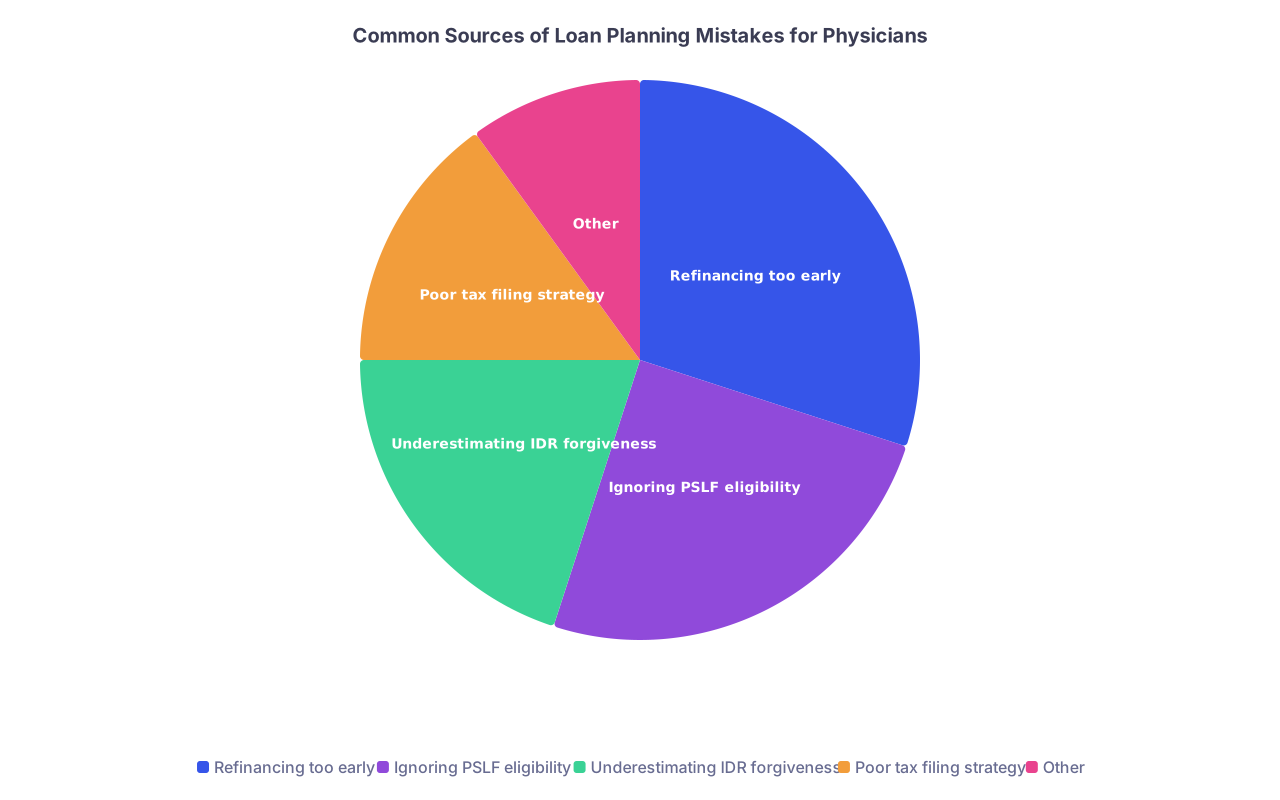
| Category | Value |
|---|---|
| Refinancing too early | 30 |
| Ignoring PSLF eligibility | 25 |
| Underestimating IDR forgiveness | 20 |
| Poor tax filing strategy | 15 |
| Other | 10 |
How to Treat the “Tax Bomb” Like the Boring, Solvable Problem It Is
Here’s the adult, evidence-based way to handle this instead of fear‑scrolling.
Get a real projection using your actual numbers
Not some generic calculator on a blog that assumes you’re a teacher. Use a detailed student loan projection tool or a specialist who regularly works with physicians. You want year‑by‑year:- Projected payments
- Projected balance
- Projected forgiven amount (if any)
- Modeled tax on forgiveness under different scenarios
If you’re PSLF-eligible, prioritize keeping that door open
Until you’re very sure you’re walking away from nonprofit/government for good, PSLF is usually the most powerful option on the table. The tax bomb does not exist in that path.If you’re realistically on a 20/25-year forgiveness path, build the tax bucket now
Automate a monthly transfer into a separate brokerage or high‑yield savings account labeled “Loan Tax Fund.” Invest it sensibly. Re‑evaluate every few years as laws and your income change.Compare apples to apples: full lifetime cost, not just balances
People fixate on “what my balance will be in 20 years” while ignoring what matters: total out-of-pocket, in today’s dollars, inclusive of taxes. Refinance vs PSLF vs 20/25-year forgiveness should be judged on that basis, not vibes.

| Step | Description |
|---|---|
| Step 1 | Finish Residency |
| Step 2 | Evaluate PSLF track |
| Step 3 | Private practice or locums |
| Step 4 | Optimize IDR for PSLF |
| Step 5 | Model PSLF vs refinance |
| Step 6 | Model 20 or 25 yr IDR forgiveness |
| Step 7 | Consider refinancing and faster payoff |
| Step 8 | Nonprofit or govt job |
| Step 9 | Plan to stay 10 years |
| Step 10 | Debt to income high |
- Accept that law may change—and that cuts both ways
Everyone imagines lawmakers waking up and saying, “Let’s tax doctors more!” Could they also make IDR forgiveness permanently tax-free? They already did temporarily. Planning should account for uncertainty both positive and negative, not only doomsday scenarios.
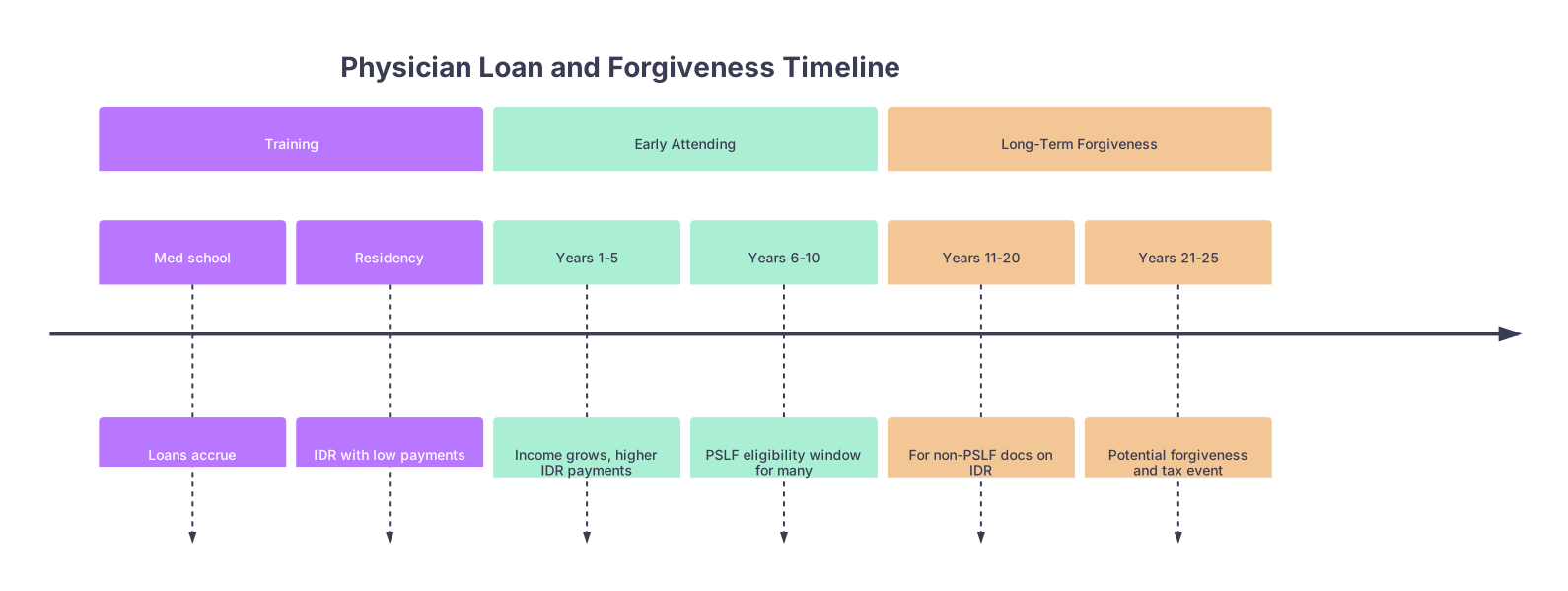
Quick Reality Check with a Timeline View
Just to reinforce how far away this supposed “bomb” really is for most physicians:
| Period | Event |
|---|---|
| Training - Med school | Loans accrue |
| Training - Residency | IDR with low payments |
| Early Attending - Years 1-5 | Income grows, higher IDR payments |
| Early Attending - Years 6-10 | PSLF eligibility window for many |
| Long-Term Forgiveness - Years 11-20 | For non-PSLF docs on IDR |
| Long-Term Forgiveness - Years 21-25 | Potential forgiveness and tax event |
The supposed “tax bomb” is usually 20–25 years from graduation. If you can plan for retirement, you can plan for this.
The Bottom Line
Loan forgiveness tax bombs make for dramatic headlines and anxious threads. They do not, however, justify the reflexive advice often given to high‑income physicians:
“Refinance everything ASAP.”
“Pay it off as fast as possible, no matter what.”
“Never trust forgiveness—it’ll screw you in taxes later.”
The actual data say something different:
- PSLF: no federal tax bomb. For many hospital-employed or academic physicians, this is the most powerful, tax-efficient tool available.
- 20/25-year IDR forgiveness: might be taxable after 2025, but the bill is predictable, plan‑able, and often far smaller (in real economic terms) than the cost of rapid full payoff.
- The primary dangers are poor strategy, bad timing, and ignoring the math—not some surprise IRS explosion in your 40s or 50s.
Years from now, you won’t remember the scary articles screaming about tax bombs. You’ll remember whether you made calm, numbers‑based decisions when everyone else was panicking.
FAQ (Exactly 5 Questions)
1. I’m a hospital-employed specialist making $450k. Should I still care about PSLF or just refinance?
You absolutely should care about PSLF. High income does not disqualify you. If your employer is a nonprofit or government entity and your loans are Direct, PSLF can wipe out six figures tax‑free. The right question isn’t “Am I too rich for PSLF?” but “What is my total lifetime cost under PSLF vs refinancing vs aggressive payoff?” Often, PSLF still wins, especially with large original balances.
2. What happens if IDR forgiveness is still tax-free after 2025?
Then most of the “tax bomb” narrative collapses entirely. You’d be looking at tax‑free forgiveness both under PSLF and long‑term IDR. That would make IDR strategies even more favorable, particularly for high-debt physicians whose IDR payments never fully amortize the loan. You should not count on this, but you should recognize that legislative risk can cut in your favor too.
3. I’m in private practice with $350k loans and $500k income. Is long-term forgiveness even realistic?
Probably not. At that income level, your IDR payments will usually be high enough to pay off the loan before you ever reach year 20/25 forgiveness, especially under SAVE. You’re likely in a payoff vs refinance decision, not a tax bomb scenario. For you, the question is: does staying in federal loans for flexibility (disability, death, potential policy changes) beat the lower rate and faster payoff of private refinancing? That’s a math problem, not a forgiveness problem.
4. Can I just set up an investment account to cover a future tax bomb? How much should I save?
Yes, and that’s usually the most rational approach if your projection shows non-trivial taxable forgiveness. Start with an estimate of forgiven amount × your expected marginal tax rate in that year. Divide by the number of years until forgiveness. That’s your rough annual savings target. Adjust every few years as your income, laws, and projections change. A competent CPA or student loan planner can refine the numbers, but the concept is simple.
5. Is it ever rational to pay off loans aggressively even if forgiveness might be cheaper mathematically?
Yes—but then you’re making a lifestyle or psychological choice, not a purely financial one. Some physicians sleep better being debt‑free early, even if it costs them an extra $100k over 20 years. That’s legitimate. Just be honest with yourself: you’re buying peace of mind, not avoiding a mythical, unavoidable future tax disaster.