
What if the thing you think is “responsible” — crushing your loans in 3–5 years — is actually one of the fastest ways to burn out of medicine altogether?
That is not hyperbole. I have watched residents and new attendings destroy their quality of life, sabotage their mental health, and sometimes quit clinical work altogether in the name of “financial freedom by 35.”
Let’s talk about what the data actually shows. Not what the loudest voices in physician finance blogs repeat.
The Myth: “If I Just Kill My Loans Fast, I’ll Be Less Burned Out”
There’s a very popular story in medicine right now:
You graduate with $250k–$400k of student loans.
You read a bunch of blogs or listen to podcasts saying, “Live like a resident, pay off everything in 3–5 years, then you’re free.”
You crank your payments to $5k–$10k a month, pick up every extra shift, delay vacations, push back starting a family, and convince yourself this is a temporary sacrifice.
The implicit promise: short-term pain → long-term joy → burnout cured.
Reality: when researchers look at burnout, the key driver is not “having debt.” It is how that debt collides with workload, loss of autonomy, and chronic stress. Over-aggressive payoff goals supercharge all three.
Let me be blunt: the data does not support the idea that “fastest possible loan payoff” is emotionally or medically optimal for most physicians. It supports a much more boring truth:
Moderate, sustainable payoff → better mental health and lower burnout.
Not sexy. But true.
What the Evidence Actually Shows About Debt and Burnout
Start with what’s known.
- Physician burnout rates hover around 50% in many major studies (AMA/Mayo collaboration, Medscape surveys, etc.).
- High educational debt is associated with higher burnout and lower career satisfaction.
- But the relationship is not linear, and it is not simple “more debt → more burnout.”
One large survey of US physicians (Medscape, 2023) showed something subtle: doctors with some debt but clear, manageable plans often reported less distress than those who had aggressively tried to nuke their loans via extreme lifestyle cuts and constant extra work. The pattern shows up repeatedly in resident and fellow surveys too.
Where you really see the problem is in residents and young attendings:
- Residents with >$200k in debt report more depression and burnout, yes.
- But the strongest predictors of burnout are still work factors: hours, call frequency, autonomy, mistreatment, and perceived work-life balance.
Debt becomes gasoline on that fire when it pushes people to:
- Work more shifts than they can handle safely
- Delay or avoid mental health care (“I can’t take time off; I need the money”)
- Stay in toxic jobs for the paycheck to meet an arbitrary payoff timeline
Several early-career physician well-being studies show the same thing: perceived financial strain is more predictive of burnout than the raw debt number. Perception is shaped by expectations.
And that’s where the “pay it off in 3–5 years no matter what” crowd quietly makes things worse.
The Over-Aggressive Repayment Trap (And What It Does to Your Brain)
Over-aggressive loan repayment is rarely about math. It’s about identity and fear.
“I’ll be a loser if I still have loans at 40.”
“I won’t be truly free until I’m debt-free.”
“Good doctors are disciplined and pay everything off fast.”
So you set a number. Say $7,000/month on a $300k balance. On attending income, that might be numerically possible. But you do not calculate the psychological interest rate.
High mandatory payments force your brain into a chronic scarcity mode. You’re always a few bad months from missing a payment or dipping into savings. That triggers:
- Constant low-level anxiety
- Hypervigilance about spending (“Can we afford dinner out?” despite making $300k+)
- Guilt anytime you don’t work an extra shift
Chronic financial stress is well documented to impair executive function, worsen sleep, and increase risk of depression. Physicians are not magical exceptions.
Push that for years and you get the classic “I hate this job and I hate this life, but I can’t stop now; I’m almost done!” That’s textbook burnout.
Now layer in another ugly reality: some specialties have very high burnout rates already. A high-debt EM doc or OB/GYN forcing ultra-aggressive repayment is basically playing burnout roulette with extra bullets in the chamber.
What the Numbers Say: Reasonable vs Aggressive Repayment
Let’s throw some concrete numbers on the table.
Suppose you graduate with $300,000 at 6.8% interest.
You’re a new attending making $280,000 in a non-PSLF situation.
You have two mental models:
- “Crush the loans”: pay them off in 4 years
- “Sane and sustainable”: pay them off in ~10 years while maxing retirement and living like an adult, not a monk
Here’s the rough math:
| Plan | Monthly Payment | Total Years | Total Paid (approx) |
|---|---|---|---|
| 4-year aggressive | ~$7,200 | 4 | ~$345,000 |
| 10-year standard-ish | ~$3,450 | 10 | ~$414,000 |
| 20-year stretched | ~$2,300 | 20 | ~$552,000 |
Yes, the aggressive plan “saves” you roughly $70k vs a 10-year payoff.
But the 10-year plan cuts your required payment by over half. That’s thousands of dollars a month in breathing room. Money that can go to:
- Therapy or coaching when you start to crack
- Time off between jobs instead of going straight from fellowship to 1.5 FTE
- Real vacations that prevent you from walking into work already exhausted
- Building an emergency fund so you’re not chained to a toxic department chair
There’s a reason burnout research keeps circling back to autonomy and control. A giant fixed payment obliterates control. You’ve hardwired your life to a number.
You saved $70k in interest. How much would you pay to avoid needing an SSRI, a divorce lawyer, or a neurologist for stress-induced migraines at 38?
A lot more than $70k.
Where Loan Strategy and Burnout Actually Intersect
Now, I’m not saying “always stretch your loans for 20–25 years” either. That’s another false extreme.
The data on burnout and mental health lines up best with something in the middle: aggressive enough that the debt doesn’t hang over you for decades, but not so aggressive that it hijacks your entire life.
Several early-career physician financial surveys (AMA, AAMC, Medscape) show that doctors who:
- Have a clear repayment or forgiveness plan
- Contribute meaningfully to retirement early
- Keep housing costs reasonable (basic 1.5–2x income rule)
- Maintain at least some real leisure and relationships
…report better well-being even when their payoff timeline is 10–15 years. The “timeline” itself isn’t the poison; the pressure is.
Medicine is already a high-stress environment with poor control of your schedule, EMR demands, productivity metrics, and administration. Voluntarily adding a self-imposed $6k–$8k/month obligation on top shows a kind of financial machismo that looks good in blog posts and quietly wrecks people in real life.
So what does sane look like?
The Evidence-Based Middle Ground: Realistic, Not Heroic
If you strip away the forum bravado and look at physician wellness plus basic finance, a healthier pattern emerges.
I’ve seen it work over and over:
First 1–2 years as attending:
- Don’t touch heroic payoff goals yet.
- Nail basics: disability insurance, emergency fund, actually learning your job, stabilizing your life.
- Use an income-driven plan or a standard 10–year-ish payment you can afford even in a bad month.
After that adjustment period:
- Reassess based on reality, not fantasy.
- If you like your job and your schedule is humane, you can ramp up payments a bit.
- If you’re already borderline burned out, do not pour gasoline on it by doubling your payments.
Prioritize retirement along with loans:
- The data is brutal here: most physicians actually under-save early because they’re busy smashing debt.
- That’s mathematically dumb. A dollar into a 401(k)/403(b) at 32 is far more powerful than at 45.
- A balanced plan (max retirement + reasonable debt payoff) beats “debt at all costs” almost every time.
Here’s the trade-off visually:
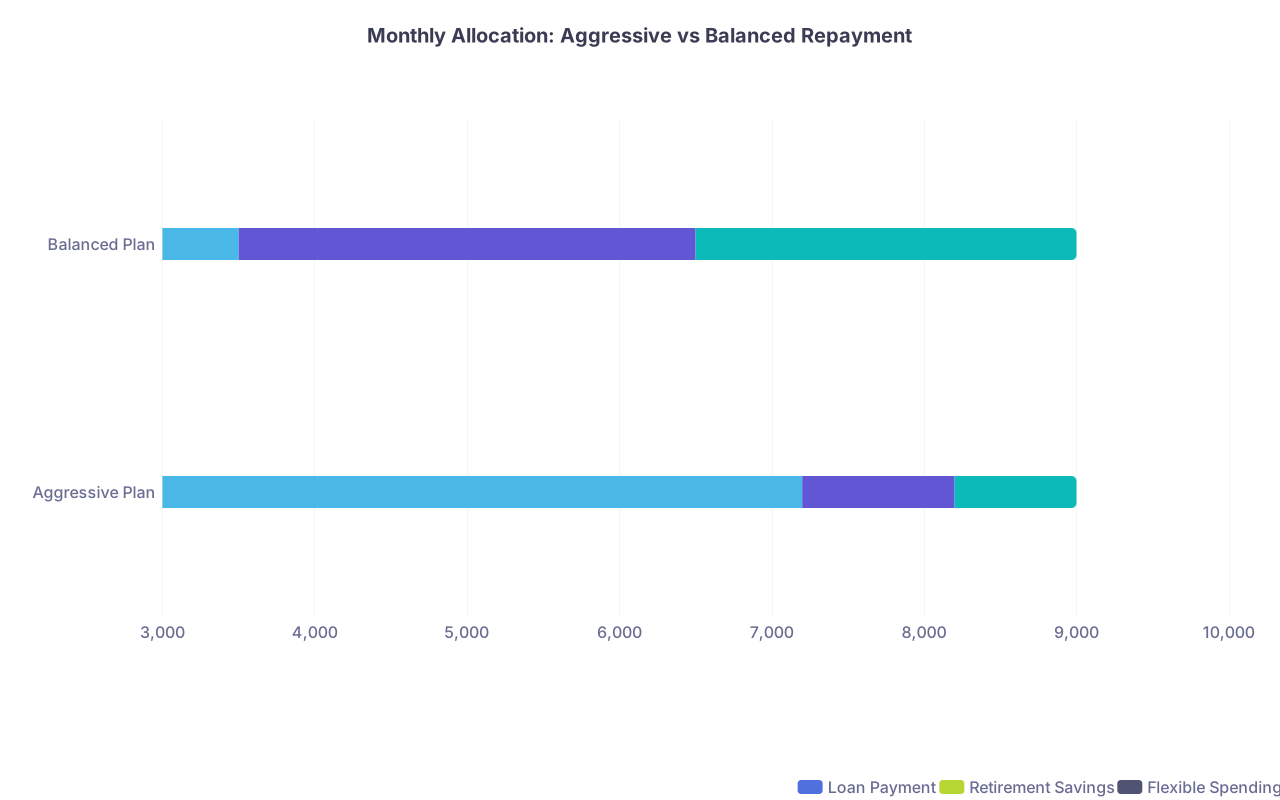
| Category | Loan Payment | Retirement Savings | Flexible Spending |
|---|---|---|---|
| Aggressive Plan | 7200 | 1000 | 800 |
| Balanced Plan | 3500 | 3000 | 2500 |
That extra $2k–$3k in flexible spending is exactly where vacations, reduced extra call, and basic life enjoyment come from. The stuff that actually prevents burnout.
Special Case: PSLF and IDR – The Burnout Wildcards
A lot of physicians in academics or safety-net systems could go for Public Service Loan Forgiveness (PSLF) or long-term income-driven plans with eventual forgiveness.
Here’s where the burnout myths get loud and wrong.
You’ll hear:
“Paying the minimum and going for PSLF is lazy or risky.”
“Being in debt for 10 years is emotional torture.”
“You should pay it off regardless, for peace of mind.”
Except:
- PSLF track attendings who treat their loans as a tax (predictable, low payments, eventual forgiveness) often show less financial stress than private-practice counterparts trying to nuke six figures in five years.
- Long-term IDR with a real investment plan can create higher net worth at year 15–20 than the payoff-at-all-costs crowd, because you invested aggressively instead of overpaying low-interest federal debt.
The burnout angle:
PSLF/IDR can actually reduce pressure to work insane hours or tolerate abusive environments because your required payment is tied to income, not some self-imposed “$8k or bust.”
The scary “tax bomb” people love to scream about?
For many, especially with new SAVE rules and employer-based forgiveness, it’s either modest or irrelevant. But the fear narrative persists because it sells consultations and content.
Again: I’m not saying PSLF is always superior. I’m saying the data does not support the claim that being on IDR/PSLF is inherently more mentally toxic than forcing yourself into a brutal 3–5 year payoff.
Often it’s the opposite.
What Actually Shows Up in Burnout Stories
Let me give you the pattern I see in real physicians, over and over.
The burned-out “financially responsible” doc’s story:
- “I paid $9k a month for 4 years.”
- “I picked up every extra shift; I was terrified of getting fired or cutting back because of that payment.”
- “We didn’t take a real vacation for years; I felt guilty if we spent on anything nice.”
- “By the time the loans were gone, I hated medicine and felt I’d lost my 30s.”
The calmer, less dramatic but healthier story:
- “We set a 10-year-ish plan and stuck to it.”
- “I maxed retirement, we took one decent vacation a year, and I didn’t feel forced into every extra shift.”
- “Five years in, I refinanced once my job felt stable and bumped payments. But not to the point I felt trapped.”
- “I still like my job. I’m not counting down the days to quitting.”
Both end up debt-free. One also ends up emotionally wrecked.
The only difference is ego and timeline.
A Quick Flow for Sanity-Checking Your Plan
If you want a litmus test for whether your payoff goals are setting you up for burnout, run yourself through something like this:

| Step | Description |
|---|---|
| Step 1 | Set Monthly Payment |
| Step 2 | Lower Burnout Risk |
| Step 3 | High Burnout Risk - Reduce Payment |
| Step 4 | Need Extra Shifts To Afford It? |
| Step 5 | Could You Cut Back Without Panic? |
| Step 6 | Still Afford Vacation And Savings? |
If dropping extra shifts or losing a bonus would instantly collapse your loan plan, you are lighting the burnout fuse.
The Bottom Line: Financial Freedom That Doesn’t Cost You Your Career
Debt is stressful. Big debt is more stressful. That’s obvious.
What’s not obvious — and what the data plus lived experience makes clear — is this:
Over-aggressive loan repayment is a burnout accelerant.
It converts a solvable financial problem into a chronic stressor by eliminating flexibility, forcing overscheduling, and tying your self-worth to an arbitrary payoff date.Slightly slower but sustainable payoff is often healthier and smarter.
A 8–12 year payoff while maxing retirement, preserving some joy, and avoiding extra shifts you hate tends to produce better mental health and better long-term net worth than the “all-out 3–5 year” strategy.Your repayment plan should protect your autonomy, not destroy it.
If your student loan goal makes you afraid to take a vacation, change jobs, cut back FTE, or see a therapist, it’s not “disciplined.” It’s dangerous.
You did not spend a decade training just to become an over-leveraged work robot chasing a payoff date. Build a loan strategy that lets you stay in medicine with your mind, relationships, and health intact. That’s real financial freedom.