
The blanket advice to “always choose PSLF” is lazy, often wrong, and in some cases financially disastrous.
You’ve probably heard the script: “You’re a doctor, you’ll have a ton of debt, just do income-driven repayment and Public Service Loan Forgiveness (PSLF). Don’t overthink it.” I’ve watched residents swallow that line without running a single number. Five to ten years later, some of them realize they quietly burned through six figures in avoidable costs.
So let’s dismantle the PSLF-worship and talk about who actually benefits, who really doesn’t, and how the math plays out in the real world—not in Twitter threads and Facebook groups.
What PSLF Actually Is (And What It Is Not)
Quick recap without the fluff: PSLF is a federal program that forgives your remaining Direct federal loan balance after you make 120 qualifying payments (10 years) while working full-time for a qualifying employer (most hospitals that are 501(c)(3) nonprofits, VA, academics, government).
Key pieces:
- You must have Direct loans (or consolidate to Direct).
- You must be on a qualifying income-driven repayment (IDR) plan (PAYE, SAVE, IBR, etc., depending on your eligibility).
- You need 120 separate qualifying payments, not necessarily consecutive.
- Forgiveness under PSLF is tax-free under current law.
What PSLF is not:
- It’s not a default “best choice” for every physician.
- It’s not free money if your payments would fully pay off your loans in under 10 years anyway.
- It’s not guaranteed permanence; it’s a statute that could change (though changes usually protect those already in the system).
The entire value of PSLF comes down to one question: After 10 years of IDR payments, how much is left to forgive? If the answer is “basically nothing,” then PSLF didn’t help you. You just paid your loans off the slow, complicated way.
The Big Myth: “If You Have High Debt, PSLF Is Always Better”
That is the soundbite. Here’s why it’s often wrong.
The core trade-off
With PSLF, you:
- Pay less during training (great).
- Stay in IDR while attending (payments based on AGI, not loan size).
- Stretch payoff over 10 years, hoping for leftover forgiveness.
With private refinancing and aggressive payoff, you:
- Lock in a lower interest rate (often dramatically lower).
- Pay more per month, but for fewer years.
- End up with no dependence on federal policy or employer type.
The right answer depends on your:
- Debt amount
- Interest rate
- Specialty (i.e., income trajectory)
- How long you’ll stay in qualifying employment
- Willingness to live like a resident for a few years attending-side
And yes, those are all knowable or at least estimable with ranges. The “always PSLF” crowd just doesn’t bother.
Follow The Numbers: PSLF vs Refinancing
Let’s look at stylized but realistic examples. No games.
Assumptions:
- Debt at graduation: $300,000 at 6.8% federal rate
- Residency: 3 years
- Fellowship: optional, note when used
- Tax filing: single, standard deduction, rough 22–35% brackets
We’ll contrast:
- PSLF path: IDR during training + attending, full 10 years in nonprofit
- Refinance path: IDR during training, then refinance as attending and aggressively pay off in 5–7 years
Example 1: Academic primary care, PSLF makes sense
- Debt: $300k
- Residency: 3 years at ~$65k → AGI about $65–70k
- Attending: Academic family med at $220k, stays employed in a 501(c)(3) indefinitely
Rough numbers (simplified):
- Training years: Payments under SAVE/PAYE maybe ~$250–350/month
- That’s ~$3k–4k per year → say ~$10k total payments during residency.
- Interest accrues, but SAVE subsidizes a chunk. Balance might grow slightly, maybe to ~$320–330k.
Now as attending:
- Income $220k, AGI maybe ~$200k after pre-tax retirement contributions.
- 10% of discretionary income (using SAVE-style logic) → ballpark $1,200–1,400/month in payments.
- Let’s say $1,300/month for 7 more years → about $109k.
Total out-of-pocket over 10 years: roughly $120k–130k.
If you’d instead refinanced at, say, 4% and aggressively paid the full $300k over 7 years with attending income, you’re easily north of $350k in total payments.
Here, PSLF is a huge win. No argument.
But now watch how quickly that reverses when the variables change.
Example 2: Ortho attending at a private group, PSLF is a trap
- Debt: $300k
- Residency: 5 years at ~$65–70k
- Attending: Private ortho at $600k+ (and does not stay at an academic hospital long-term)
During residency:
- IDR payments maybe ~$250–400/month, call it $4k/year over 5 years → ~$20k total.
- Interest accumulates; end balance maybe ~$330–340k.
You now become an attending at a private group. PSLF dies unless you stick to a qualifying employer for a full 10 years of payments. But most private ortho jobs aren’t PSLF-eligible.
So if you “chose PSLF” mentally and then bail after residency or a few years attending, here’s what often happens in real life:
- You stayed in federal loans at 6–7% (because “PSLF!”).
- Your balance climbed.
- Then 3–4 years out you realize PSLF is off the table.
- Now you finally refinance, but rates might not be as favorable, and you’re starting from a higher balance.
Compare that to a more rational plan:
- Use REPAYE/SAVE/PAYE during training for cheaper payments and/or interest subsidy.
- The moment you sign a high-earning private job, refinance aggressively at 3–4% (or whatever current market is).
- Hammer the loans down in 3–5 years with $8k–10k/month payments.
The interest you’d save by refinancing early, plus the shorter payoff period, can easily beat the “half-baked PSLF that never happens” approach by tens of thousands.
Example 3: High earner who actually qualifies for PSLF… and still doesn’t get much
Here’s the subtle case most PSLF fanatics ignore.
- Debt: $250k
- Residency: 3 years IM
- Fellowship: 3 years cards, all at a university hospital (qualifying)
- Attending: Academic cardiology at $500k and stays in 501(c)(3)
That’s 6 years of qualifying payments during training plus 4 years as attending = 10 years PSLF. The dream PSLF profile, supposedly.
Reality:
Training years:
- IDR payments maybe ~$250–400/month → say $3.5k/year → ~$21k total.
- Balance drifts to maybe $270–280k.
Attending at $500k:
- After maxing pre-tax accounts, call AGI ~$400k.
- Discretionary income under SAVE/PAYE is enormous.
- 10% of discretionary easily yields payments of $3,000–4,000/month or more.
- Over 4 years, that’s $144k–192k.
Total payments across 10 years: ~ $165k–210k.
Now ask: what’s left to forgive at year 10?
Given that those attending-year payments are massive, the answer might be: not much. Possibly nothing. In many of these “high-income PSLF” scenarios, you essentially fully amortize your loan with IDR over 10 years.
If the balance is near zero by year 10, you didn’t “get PSLF.” You just paid your loans off while dealing with federal bureaucracy and higher interest than a private refinance.
And you probably could have:
- Refi’d as an attending at 3–5%
- Paid $7k–8k/month
- Been done in 4–5 years
- Paid similar or less in total, and been debt-free much earlier
This is where the “always PSLF” mantra is not just simplistic—it’s mathematically wrong.
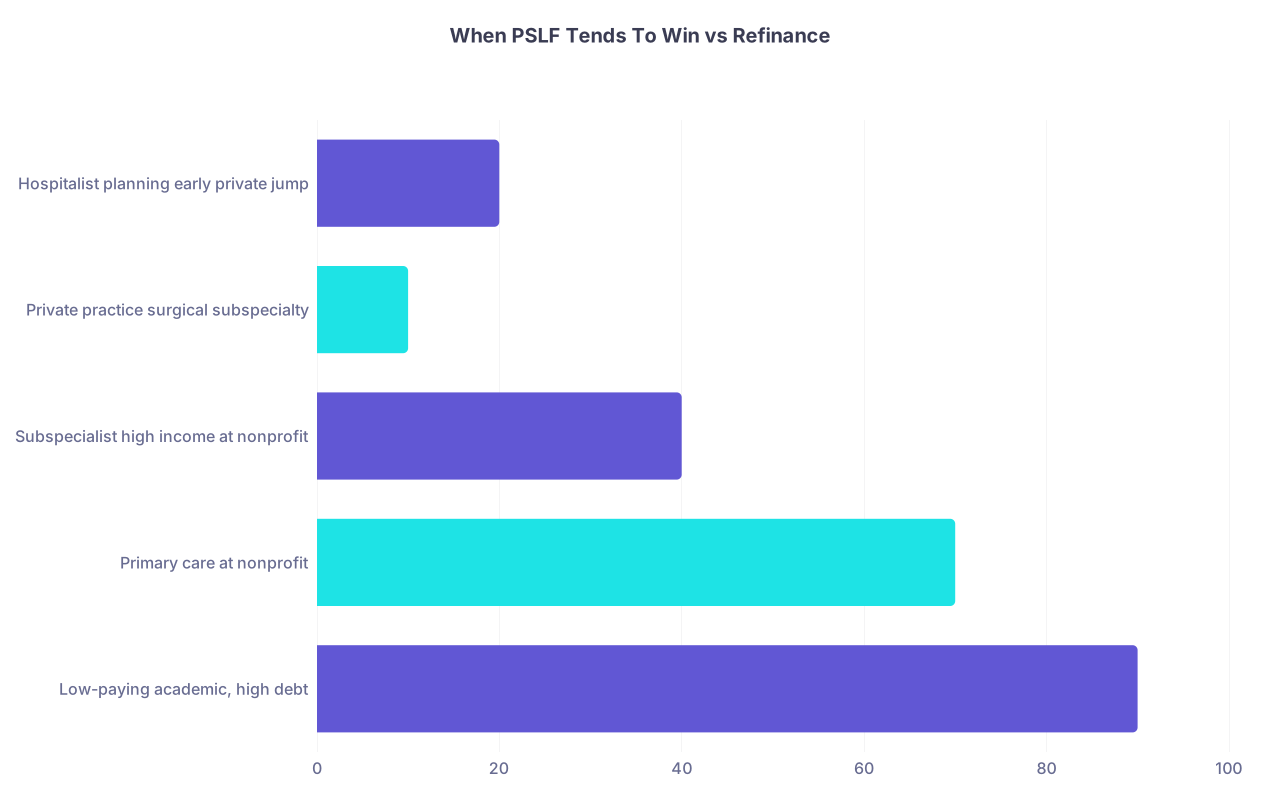
| Category | Value |
|---|---|
| Low-paying academic, high debt | 90 |
| Primary care at nonprofit | 70 |
| Subspecialist high income at nonprofit | 40 |
| Private practice surgical subspecialty | 10 |
| Hospitalist planning early private jump | 20 |
(Values are just a conceptual “PSLF advantage likelihood” out of 100—this is not a dataset, it’s a visual cue: PSLF is not a majority winner across all profiles.)
Where PSLF Clearly Makes Sense
Let’s be fair. PSLF is not bad. The dogma is bad.
PSLF is usually a strong option when most of these are true:
- Debt-to-income ratio is high (e.g., $300k+ loans with <$250k long-term income).
- You expect to stay at a 501(c)(3), VA, or academic center for 10+ years.
- You are in primary care, pediatrics, lower-paid specialties, or academic-heavy careers.
- You value geographic flexibility less than job stability within the nonprofit world.
Think:
- Academic pediatricians with $300–400k debt, making $180–230k.
- Academic family medicine, IM, psych, with large debt.
- VA physicians who plan to be career VA.
For these people, forgiveness can be large and real. The longer you’d otherwise take to pay off the loans at a reasonable lifestyle, the more that tax-free PSLF forgiveness matters.
Where PSLF Is Often Mediocre Or Actively Bad
Now the part most “student loan experts” gloss over.
PSLF is often a poor or marginal choice for:
High-income specialists who won’t stay in nonprofit for 10+ years
If you think you’re doing ortho, ophtho, derm, GI, cards, anesthesia, radiology—and you see yourself in private practice within a few years of training, PSLF usually dies on the vine. Clinging to it delays refinancing and stacks up interest for a benefit you’ll never get.
Doctors whose IDR payments will fully amortize the loans anyway
If your attending income is high enough that your 10% (or more) of discretionary income wipes your loan over 10 years, PSLF becomes a label, not a benefit. You’re just paying the loan off. You’d often be better off lowering interest and paying faster.
People who hate being tied to a specific employer type
PSLF is golden handcuffs. If you realize in year 6 that you want to join a private group, move to a high-paying locums job, or jump into an entrepreneurial venture, you’re walking away from future forgiveness. Sometimes staying just for PSLF is more expensive than leaving and paying aggressively.
Those with relatively modest federal debt (<$150k)
A doc with $120k at 6.8% who can make $300–400k as attending generally should not stretch this over 10 years hunting PSLF. Refinance, kill it in 3–5 years, move on with your life.
| Profile | PSLF Lean? | Why |
|---|---|---|
| Academic pediatrics, $350k debt, $200k pay | Strong Yes | High DTI, long nonprofit career, real forgiveness |
| Hospitalist, $250k debt, $280k pay | Maybe | Depends on career path and willingness to stay 10 yrs |
| Cards at academic, $250k debt, $500k pay | Weak | IDR may fully repay; PSLF benefit often small |
| Ortho, $300k debt, private practice | No | Short nonprofit stint, better with refinance |
| EM, $200k debt, mixed jobs (locums/private) | No/Maybe | PSLF uncertain; freedom often > potential benefit |
The Legal and Policy Risk Everyone Pretends Doesn’t Exist
No, I’m not saying PSLF will “go away tomorrow” and leave everyone in ruins. That’s fearmongering. But pretending the risk is zero is just as delusional.
Realistic risks:
- Congress or the Department of Education can change IDR formulas, definitions of qualifying employment, or program details.
- Future tweaks might make new borrowers less favored.
- Administrative errors, miscounted payments, and servicer screwups are common. I’ve seen attendings find out years later half their payments weren’t counted as “qualifying” because of a paperwork issue.
This doesn’t mean “avoid PSLF.” It means: you do not plan your entire financial life around PSLF unless the math is overwhelmingly in its favor. And you keep meticulous documentation: employer certification forms yearly, payment histories, copies of everything.

| Step | Description |
|---|---|
| Step 1 | Graduate Med School |
| Step 2 | Have Federal Loans |
| Step 3 | Use IDR in training |
| Step 4 | PSLF likely best |
| Step 5 | Run detailed PSLF vs refinance math |
| Step 6 | Refinance when high income and private job |
| Step 7 | Certify employment yearly and stay eligible |
| Step 8 | Plan to stay nonprofit 10 yrs? |
| Step 9 | High DTI and modest income? |
The Real “Best Practice” (Not a Soundbite)
Here’s the adult version of student loan strategy for physicians:
During training:
- Use an IDR plan (usually SAVE/PAYE) to minimize payments and maximize any interest subsidy.
- Do NOT refinance privately while income is low—you lose safety nets and potential PSLF upside for minimal gain.
Figure out your likely post-training path early.
- If you’re 80%+ sure you’ll be an academic lifer / VA doc / long-term nonprofit → PSLF should be modeled seriously.
- If you’re 50/50 or leaning private → you should assume PSLF may not happen and plan accordingly.
Actually run scenarios. Use a real calculator (StudentLoanPlanner, White Coat Investor-style spreadsheets, etc.). Compare:
- 10-year PSLF path: total out-of-pocket vs projected forgiven amount
- 5–7 year refinance path: realistic payment levels and total cost
Prioritize flexibility if the math is close. If PSLF benefit is modest (say < $50–70k difference over a decade), the value of being able to choose jobs freely often beats the theoretical savings.
Once attending:
- If PSLF clearly wins AND you are actually in qualifying employment → stay federal, stay on IDR, and lock in the paperwork trail.
- If PSLF clearly doesn’t win OR you are non-qualifying → refinance aggressively, then treat the loan like a 3–5 year cancer you’re removing from your balance sheet.
| Category | Value |
|---|---|
| Academic primary care | 70 |
| VA physician | 80 |
| Academic subspecialist | 40 |
| Mixed career path | 20 |
| Private practice | 10 |
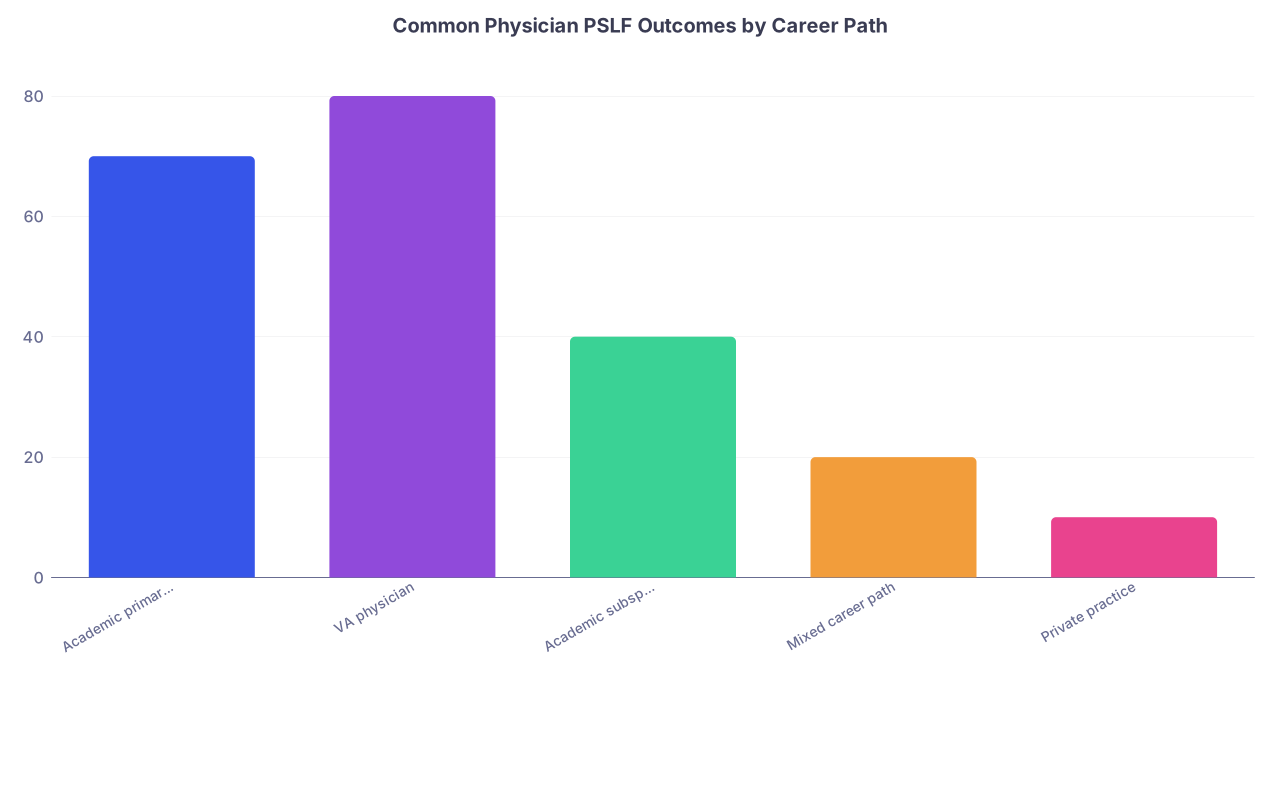
(Again: conceptual visualization. The point is simple—PSLF is not universally optimal.)
FAQs
1. Should I ever refinance during residency or fellowship?
Usually no. Your income is low, so you get the best benefit from federal IDR and interest subsidies. You also preserve PSLF eligibility. The only time private refi during training makes sense is if you’re 100% sure PSLF is irrelevant for you, you have relatively low debt, strong support (or side income), and the rate drop is huge. That’s rare. For most residents, stay federal until you’re an attending.
2. What if I’m not sure I’ll stay at a nonprofit hospital for 10 years?
Then you should treat PSLF as “possible upside,” not “the plan.” Use federal loans and IDR during training, certify employment if you’re in a qualifying setting, but emotionally and financially assume you might not hit 120 payments. Have a backup plan: refinance if/when you move to private practice and then pay aggressively. The mistake is assuming you’ll stay 10 years when your career goals clearly don’t match that.
3. Is PSLF safe politically for current borrowers?
For current borrowers already in repayment and especially those already working toward PSLF, it’s highly unlikely Congress will retroactively yank benefits. The political fallout would be huge. But “highly unlikely” is still not zero. More realistically, the program can be tightened for future borrowers or made harder to qualify for at the margin. That’s why you do not rely on PSLF unless the projected benefit is very large and your career path clearly aligns with it.
Key points:
- “Always choose PSLF” is bad advice because the benefit depends entirely on your income, debt, and how long you actually stay in qualifying jobs.
- High-income physicians, private practice folks, and those whose IDR payments already pay off the debt often get little or no real PSLF benefit.
- The right move is not a slogan—it’s running the numbers on PSLF vs refinance for your specific career path, then choosing based on math, not mythology.