The Myth of 0% Forbearance: Why Pausing Payments Isn’t Free Relief
What if I told you that the “0% interest” forbearance everyone got used to during the pandemic has quietly trained millions of borrowers to underestimate how brutally normal forbearance works?
Let’s tear this apart, because the confusion here is costing people tens of thousands of dollars over a couple of years. Not decades. Years.
How the COVID Pause Broke Everyone’s Intuition
For three years, you had this weird, once‑in‑a‑lifetime situation:
- Payments paused
- Interest rate set to 0%
- No interest accruing
- Months often counting toward forgiveness and PSLF
That was not forbearance as defined in federal loan law. That was emergency legislation stapled onto the student loan system.
The problem: servicers, media, and even some financial “gurus” kept calling it a “forbearance” or “pause.” So now people think:
“I can just go into forbearance again if I need to, and it won’t be that bad. I did it before.”
No. That previous thing was a unicorn. What you get now is a rhino.
Normal forbearance almost always means full interest accrues at your stated rate. And for federal loans, that rate isn’t small. Many of you are sitting at 5–8%+.
Let’s put numbers on that.
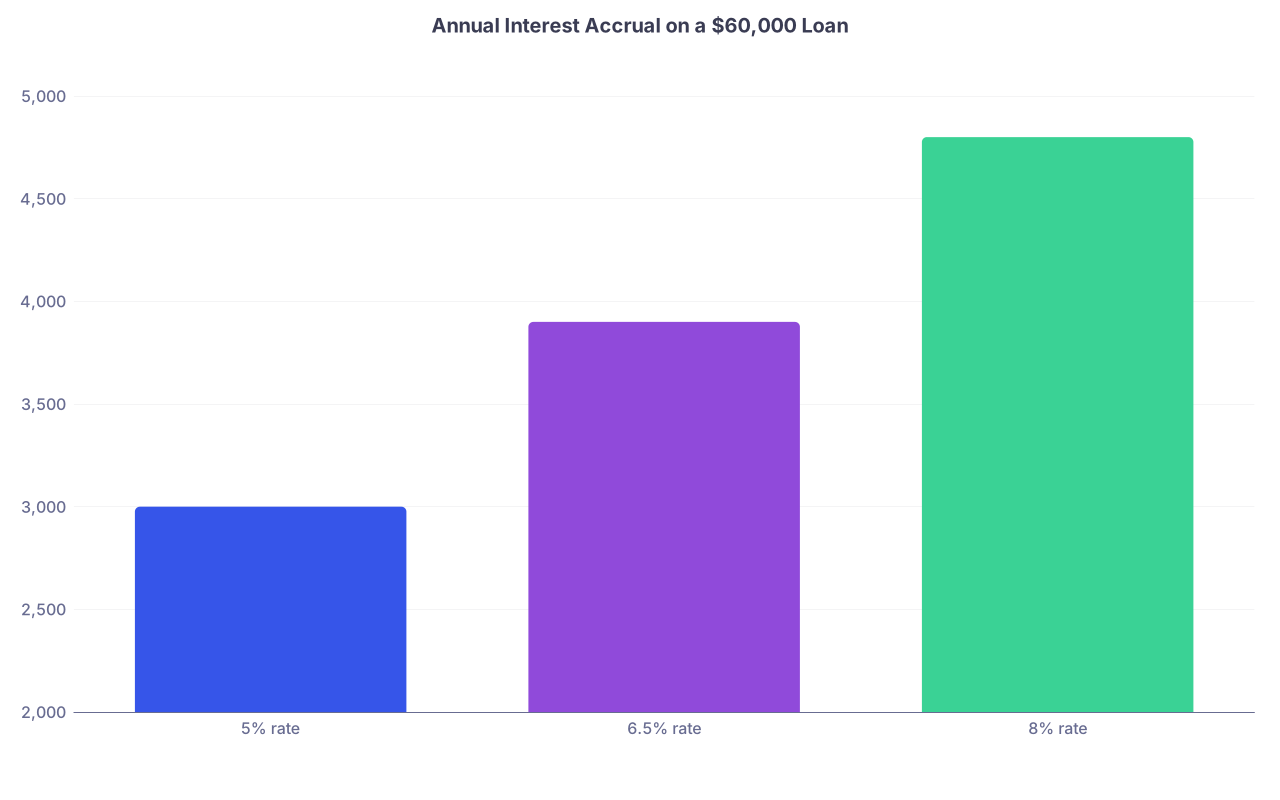
| Category | Value |
|---|---|
| 5% rate | 3000 |
| 6.5% rate | 3900 |
| 8% rate | 4800 |
A year of “pause” at 6.5% on $60,000? That’s $3,900 of new interest. That does not disappear when you restart. It either:
- Gets added to your balance (capitalized), increasing future interest, or
- Sits there as unpaid interest, growing your total cost and confusing the hell out of you when you see the bill.
The pandemic taught people that pausing is harmless. The law and the math say otherwise.
The Basic Lie: “I’m Not Paying, So Nothing’s Happening”
Let me be blunt: if you’re in standard forbearance and your interest rate is above 0%, your loans are not “on hold.” They’re on a treadmill.
There are three broad buckets people confuse:
- 0% interest emergency pause (CARES Act era) – no interest accrues, months may count toward certain forgiveness programs. Now over.
- Deferment – in some cases (like subsidized loans, certain hardship deferments), interest might not accrue on some loans. That’s limited and very specific.
- Forbearance – interest almost always accrues on everything. Unsubsidized, subsidized, grad loans, Parent PLUS, you name it.
Servicers aren’t going to explain the difference with the urgency it deserves. You get a calm email: “You may qualify for a temporary forbearance.” It sounds like a nice, gentle cushion.
Here’s what that “cushion” actually does to a very average borrower.
| Scenario | Monthly Payment | Total Interest Added in 1 Year | Resulting Balance Change |
|---|---|---|---|
| Keep Paying | $920 | $0 extra | Balance drops as normal |
| 12-Month Forbearance | $0 | ~$5,440 | Balance increases by ~$5,440 |
You didn’t “pause.” You paid $5,440 for the privilege of not paying for a year.
Capitalization: The Quiet Tax on Your Future Self
Most borrowers vaguely know “interest accrues,” but they miss the second hit: capitalization.
Interest accrues daily. In certain events — like exiting forbearance — unpaid interest can be capitalized. That’s when it stops being a separate line and gets rolled into principal. Which is brutal, because then:
- Future interest is calculated on a larger number
- Every payment going forward sends more money to interest and less to principal
Think of capitalization as compound interest working for the lender, not for you.
Example I’ve actually seen, almost number for number, with a resident physician:
- Starting federal loan balance: $220,000 at 6.3%
- Goes into forbearance for 3 years of residency
- No payments made
- Simple math: 6.3% of $220,000 ≈ $13,860 per year
- Over 3 years: about $41,580 in new interest
When forbearance ends, that $41k doesn’t just sit in a nice little “interest” bucket forever. It often gets capitalized. New “principal” ≈ $261,580.
Now your 6.3% interest is being charged on $261k instead of $220k. You just made your own interest rate functionally higher without “changing” the rate.
And yes, the rules around when capitalization happens have changed a bit recently at the federal level, but the core point stands: long forbearance = more total cost, sometimes much more.
The Forgiveness Trap: Forbearance Can Destroy Your Timeline
Here’s where the misunderstanding goes from “expensive” to “catastrophic.”
If you’re on an income-driven repayment plan (IDR) aiming for:
- Public Service Loan Forgiveness (PSLF) – 120 qualifying monthly payments while working full-time for a qualifying employer, or
- IDR forgiveness (20–25 years of qualifying payments)
then every month you’re in forbearance is usually:
- A month you’re not making a qualifying payment
- A month that does NOT count toward your 120 or 240–300 total
That’s not “neutral.” That’s extra years of repayment.
I’ve seen PSLF‑bound borrowers take “just a year or two” of forbearance in residency, thinking it’s harmless. Then they realize later they effectively:
- Added 12–24 months to their forgiveness clock
- Paid thousands in extra interest for the privilege
Those years are often their lowest-income years, when IDR payments might’ve been tiny, sometimes close to $0 but still counting toward forgiveness.
So they traded:
- $0–$150 monthly qualifying IDR payments
For: - $0 payments with full interest accrual that does not count toward forgiveness
(See also: No, You Don’t Always Need to Refinance the Day You Finish Residency for why refinancing isn’t always the answer.)
That’s a bad trade. Almost always.
If you’re in public service or planning to be, forbearance isn’t just “more expensive.” It can literally erase progress.

| Step | Description |
|---|---|
| Step 1 | Start PSLF in Residency |
| Step 2 | On IDR Plan |
| Step 3 | 120 Qualifying Payments |
| Step 4 | Use Forbearance in Residency |
| Step 5 | 0 Qualifying Payments |
| Step 6 | Extra Years to Reach 120 |
Private Loans: Even Uglier Behind the Curtain
Everything above? That was mostly about federal loans.
Private lenders do not care about your PSLF clock, and their forbearance policies are usually worse. Shorter durations, higher restrictions, and zero forgiveness in the long run.
Typical private loan forbearance behavior:
- 3–12 months at a time, often with a lifetime cap
- Interest always accrues
- Sometimes they even require partial interest payments during “forbearance”
And if you’re thinking, “I’ll just refinance later,” long periods of forbearance can make your balance fatter, your DTI worse, and your options narrower.
Private forbearance is rarely a strategy. It’s a last-ditch emergency lever. Treat it like calling 911, not like ordering DoorDash.
The Psychological Scam: Short-Term Relief, Long-Term Amnesia
Why do people keep accepting forbearance offers when the math is this bad?
Because of how your brain works.
- Payment right now feels painful; interest in the future feels theoretical.
- Servicers are incentivized to offer something that prevents you from defaulting today. Forbearance does that nicely.
- The paperwork for IDR and adjustment is annoying; clicking “accept forbearance” online is easy and fast.
So each time you feel squeezed, you’re offered a button that says, “Stop paying now.” No big flashing red warning: “This will add years and thousands of dollars to your loans.”
Servicers know exactly what they’re doing when they lead with forbearance instead of walking you through IDR options, payment recalculation, or genuine hardship benefits.
I’ve literally heard call transcripts where a borrower says, “I’m struggling with my payment,” and within 90 seconds they’re being guided into forbearance — with no talk of IDR alternatives.
That’s not advice. That’s damage control for the servicer’s default stats.
What Actually Is Better Than Forbearance?
Let’s be clear: I’m not saying “never, under any circumstances, use forbearance.” I’m saying the default move should almost always be something else.
You have several levers that are less destructive:
Income-Driven Repayment (IDR) – SAVE, PAYE (grandfathered), IBR, etc.
If your income is low, your payment can drop dramatically, sometimes to $0. Unlike forbearance, those $0 IDR months can still count toward forgiveness and PSLF.Payment recalculation / recertification off-cycle
If your income dropped this year, you don’t have to wait until the next annual certification. You can ask them to recalculate based on current income. That alone can cut payments sharply.Switching plans
Sometimes moving from a fixed plan (Standard, Graduated) to an IDR or an extended plan buys breathing room without shutting down your progress clock.Targeted deferment (if you qualify)
Certain deferments (e.g., cancer treatment, some in-school periods) don’t accrue interest on subsidized portions. Still not free, but materially better than raw forbearance.

Compare these two simplified scenarios for a federal borrower:
- $100,000 at 6.5%
- Working in a nonprofit hospital, earning $58,000 as a resident
- PSLF-eligible employer
Scenario A – 3 years forbearance in residency:
- Pay $0/month
- About $19,500 of added interest over 3 years
- 0 months added to PSLF count
- Restart PSLF clock basically from scratch when income rises
Scenario B – 3 years on IDR (SAVE):
- Payment maybe around $100–$250/month depending on family size and deductions
- Interest accrues, but some or all might be subsidized under SAVE
- 36 qualifying PSLF payments banked
- You’re 30% of the way to forgiveness before your attending salary even hits
Who “saved” more money and time? Not the one who paid nothing.
When Forbearance Might Actually Make Sense
Let me not be dogmatic. There are a few scenarios where forbearance is the least bad option:
- You just lost your job, have $200 in the bank, and rent due in five days. Survival wins.
- You’re not PSLF-eligible, not pursuing forgiveness, and this is a short, one-time spike in hardship (e.g., medical emergency) and you’ve already slashed every other expense.
- You need a 1–3 month bridge while paperwork for IDR or recalculation is processed, and you’ve already submitted that paperwork.
But even here, I’d treat it like using a fire extinguisher. You put it out, then you immediately figure out how to prevent it from happening again.
And if you do use it, keep it short. Weeks or a couple months, not years. Every extra month is real money.
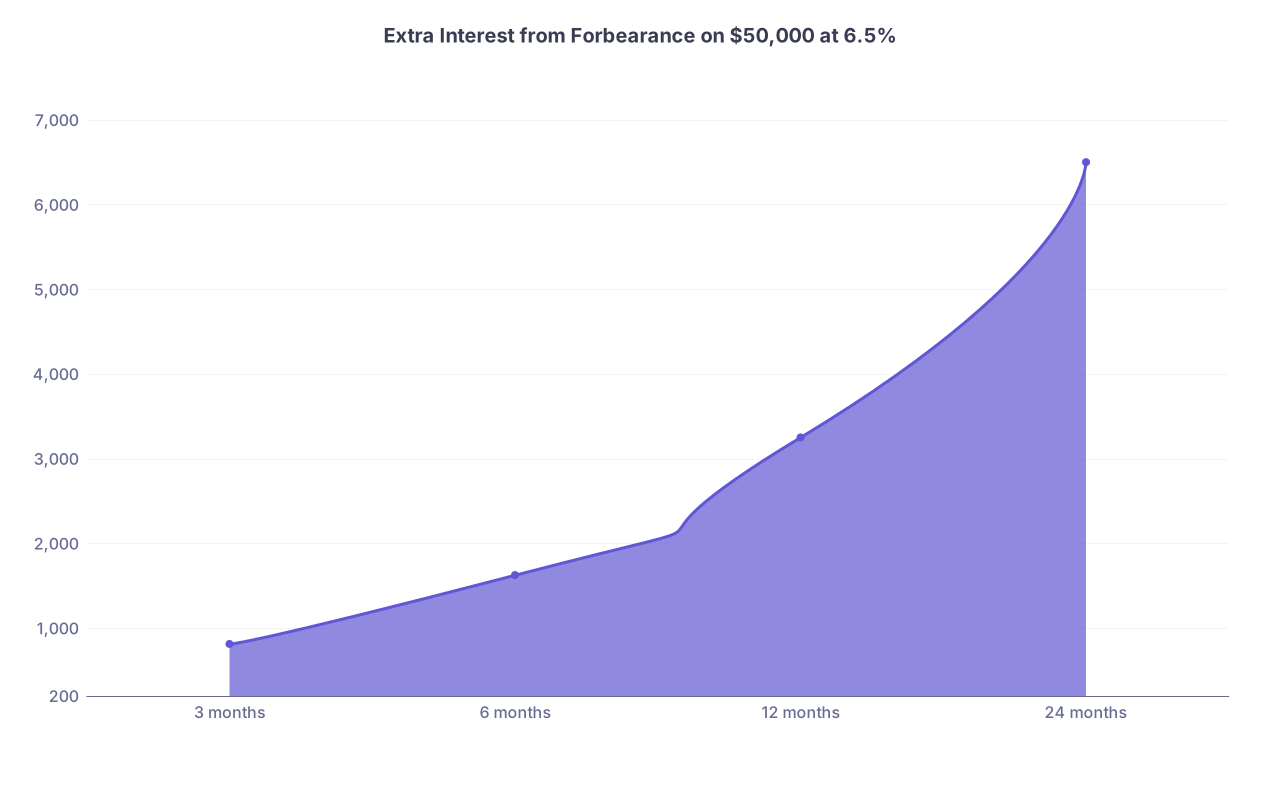
| Category | Value |
|---|---|
| 3 months | 812 |
| 6 months | 1625 |
| 12 months | 3250 |
| 24 months | 6500 |
Those are ballpark numbers, but you get the point: time in forbearance is not neutral.
The 0% Era Is Over. Stop Planning Like It Isn’t.
I still see borrowers making plans as if “they’ll probably do another pause” or “interest might go to zero again.”
Politically, that’s fantasy. The legal battles around debt cancellation have already shown how narrow the runway is for sweeping changes. The CARES Act‑style 0% forbearance was wartime policy. There’s no appetite in Congress to casually repeat it.
Banking your financial future on “they might rescue me again” is not a plan. It is denial.
What you can bank on:
- Your interest rate is real again.
- Forbearance is once more the expensive, interest‑accruing tool it has always been.
- IDR and PSLF actually exist in the law in a stable way and are far more powerful than most people realize.

How to Stop Falling for the 0% Forbearance Myth
Here’s how I’d approach it if I were you, with my usual low tolerance for nonsense:
- Pull your full loan details from studentaid.gov or your private lender. Interest rate, balance, type, servicer. Stop guessing.
- Run the numbers on at least one income-driven repayment plan, even if you “think” your income is too high. IDR often surprises people.
- If you’re even remotely PSLF-eligible, treat forbearance like poison for your timeline. Ask: “Will this month count toward forgiveness?” If the answer is no, be skeptical.
- If a servicer rep suggests forbearance, respond with: “Walk me through every IDR and payment adjustment option first, with actual dollar amounts.” If they can’t, hang up and call again.
- Use forbearance only for severe, short emergencies, and track the start and end dates like you track rent.
You’re not failing if you used forbearance in the past. You were trained to think it was harmless. Pandemic policy, sloppy language, and servicer incentives all pushed you there.
Now you know better.
The Bottom Line
Three things you should walk away with:
- Normal forbearance is not a free pause; it’s an interest machine that usually makes your future payments and total cost higher.
- For borrowers aiming for PSLF or IDR forgiveness, forbearance doesn’t just cost money — it often deletes progress. That’s the real disaster.
- In most cases, income-driven repayment, recalculated payments, or targeted deferment are smarter tools. Forbearance should be your emergency-only, last-line option, not your go-to button.