
The dogma that “private loans are always bad” is lazy, half-true, and sometimes financially harmful.
It’s the kind of line I hear repeated on campuses and Reddit threads by people who’ve never actually opened a loan promissory note or run a payoff spreadsheet. There are real dangers with private loans. But treating them as moral poison instead of financial tools is how you end up overpaying by tens of thousands of dollars or missing opportunities that actually fit your situation.
Let’s cut through the folklore and get into what the numbers, contracts, and policy rules actually say.
Myth #1: “Private Loans Are Always Bad”
This one refuses to die. It’s catchy, simple, and wrong in a very specific way.
Here’s the truth:
For most undergrads, federal loans are usually better.
For many grad and professional students, private loans can sometimes beat federal loans on raw cost—by a lot.
The key distinction nobody bothers to include:
Are we talking about subsidized/unsubsidized Stafford loans or PLUS loans?
Stafford (Direct) loans for undergrads have relatively low fixed rates, built-in protections, and generous repayment options. Demonizing private loans here makes sense most of the time. If you’re walking past a 5–6% fixed federal loan with income-driven repayment and forgiveness options to grab an 11% variable private loan with no safety net, that’s just bad judgment.
But then there’s grad PLUS and parent PLUS loans. Different animal.
For the 2024–2025 year, grad PLUS and parent PLUS interest rates are in the high single digits and come with origination fees over 4%. Meanwhile, strong-credit borrowers (especially with a creditworthy co-signer) can often get private loans at 5–7% with no or tiny origination fees.
Let me spell out why this matters:
| Loan Type | Interest Rate | Origination Fee | Key Protections |
|---|---|---|---|
| Federal Direct (Sub/Unsub) | ~5–6% | ~1% | IDR, PSLF, deferment, forbearance |
| Grad PLUS | ~8–9% | >4% | IDR via consolidation, PSLF |
| Parent PLUS | ~8–9% | >4% | Limited IDR (via consolidation) |
| Private (good credit) | ~5–7% | 0–1% | Varies (limited safety nets) |
If you’re a med student or law student who’s absolutely certain you’ll never use PSLF (private practice, high-income field, etc.), paying an extra 2–3% interest plus 4% upfront for federal grad PLUS can easily cost you tens of thousands more than a private loan over 10–15 years.
That doesn’t mean private loans are “good.” It means “always bad” is too dumb a rule for a six-figure decision.
When private loans are usually a terrible idea:
- You’re an undergrad who hasn’t maxed federal Stafford loans.
- You have unstable income, health, or career path.
- You’re even possibly a PSLF candidate (teaching, social work, nonprofit/academic medicine).
When private loans can legitimately make sense:
- Graduate/professional student not pursuing PSLF, with strong projected earnings.
- Borrower with excellent credit (or co-signer) who can lock a significantly lower fixed rate than PLUS.
- You’re refinancing existing high-rate federal loans you’re 100% sure you’ll never want IDR/forgiveness on.
The real rule:
Federal first. Then compare PLUS vs private with actual math, not vibes.
Myth #2: “Always Refinance Your Federal Loans If You Get a Lower Rate”
This one comes from the other tribe: the refinance evangelists who act like interest rate is the only variable that matters.
Yes, shaving your interest rate down from 7% to 4.5% can save a huge amount of money over time. But if you do that by giving up federal loan protections you might actually need, you’ve traded a theoretical future savings for a very real future risk.
When you refinance federal loans with a private lender, you do not keep:
- Income-driven repayment plans (PAYE, SAVE, IBR, etc.)
- Public Service Loan Forgiveness
- Federal forbearance/deferment rules
- Access to broad emergency relief (like the COVID forbearance)
You get whatever the private lender’s contract says. Full stop.
And those contracts look very different from federal rules. I’ve seen:
- “Forbearance” policies that cap at 12 months lifetime, total.
- No interest subsidies, ever.
- No payment adjustments tied to your income.
- Death or disability protections that depend on internal review with no transparent criteria.
So the question isn’t “Is the private rate lower?”
The question is: “Can I afford to permanently lose the federal safety net?”
If:
- You’re a new grad with unknown income trajectory
- You’re in residency/fellowship
- You might work for a nonprofit or government employer
- You have any medical, family, or location instability
…then reflexively refinancing federal loans is reckless.
The right play is more nuanced:
Never refinance loans you might want forgiven via PSLF.
If there’s even a 10–20% chance you will end up at a qualifying employer for 10 years, treat those federal loans as PSLF-eligible assets, not refinance fodder.If you refinance, consider doing it in layers.
Maybe you’ve got:- $60k at 6.8% you know you’ll aggressively pay off, and
- $100k at ~5% you might want on IDR.
You could refinance only the 6.8% chunk and leave the rest federal.
Pay attention to more than rate:
- Is the new loan fixed or variable?
- What are their hardship forbearance rules?
- Any cosigner? What’s the cosigner release policy?
Here’s what usually makes sense:
- Use federal IDR and protections while your income is constrained or uncertain.
- Once your income is stable, specialty settled, and PSLF clearly off the table, then consider refinancing for rate savings.
Panic-refinancing straight out of school because an email said “Save $200/month!” is how you lose federal protections you didn’t fully understand until it’s too late.
Myth #3: “You Should Never Pay More Than the Minimum on Federal Loans If You Might Qualify for Forgiveness”
This one is only half wrong. The other half costs some people a ridiculous chunk of money.
The logic:
“If my loans will eventually be forgiven under PSLF or an IDR plan, why pay more? Just pay the minimum and invest the rest.”
Under certain conditions, that’s absolutely correct. If you’re:
- Confident you’ll hit 120 qualifying PSLF payments in a public/nonprofit job
- Sure you’ll stay in qualifying IDR for 20–25 years
- Properly certified employment and handled paperwork
- Comfortable with policy risk over decades
…then yes, mathematically it often makes sense to pay just enough to remain in good standing and channel extra money into investments or other goals.
But here’s where the myth falls apart:
Most people think they’ll get forgiveness. A lot of them will not.
Reasons I’ve personally seen people miss out:
- Took a “nonprofit” job that didn’t actually qualify as a 501(c)(3).
- Switched out of public service halfway through their career.
- Messed up annual IDR recertifications and got kicked off IDR for years.
- Consolidated loans incorrectly and reset the clock.
- Miscounted qualifying payments because of wrong repayment type.
Or: they could get IDR forgiveness after 20–25 years, but the projected forgiven balance is low enough that the decades of interest offset the benefit.
There’s also the policy risk nobody likes to talk about.
Congress can and does change repayment rules. IDR plans keep mutating. PSLF got a major overhaul only after a complete mess of denials. You should not build your entire long-term plan on the assumption that every rule will stay favorable for 20–25 years.
Now, I’m not saying “Never chase forgiveness.” I’m saying:
- Run real projections (yes, actual math) on:
- Income growth
- IDR payments over time
- Estimated forgiven balance
- Then ask: “If forgiveness ended up not working out, how screwed would I be?”
For some borrowers, the best compromise is:
- Use IDR for flexibility and protection.
- Still pay some extra above the minimum—especially if your interest rate is high.
- Re-evaluate every 1–2 years based on your career reality, not your med school fantasy.
Blindly paying the minimum because “forgiveness” might happen is not strategy. It’s wishful thinking dressed up as optimization.
Myth #4: “Interest Rate Is All That Matters”
This is how smart people do stupid things.
Yes, interest rate is huge. But student loan decisions are risk management problems, not just arithmetic.
Other variables that matter more than people admit:
Repayment flexibility
Can payments actually drop when your income does? Federal IDR does this. Most private loans do not.Discharge policies
Federal loans discharge at death or total and permanent disability. Some private lenders do, some don’t, some only for the student but not the cosigner. I’ve seen grieving parents still hunted for cosigned private loans.Servicer competence
The difference between a decent servicer and a disaster isn’t theoretical. Misapplied payments, wrong IDR calculations, lost paperwork—those aren’t edge cases. They’re weekly occurrences.Borrower behavior
If you refinance to a lower rate but then stretch the term from 10 years to 20 to get a smaller monthly payment, you may actually pay more total interest at that “better” rate.
Here’s a visual of where different types of borrowers often land on this risk vs cost spectrum:
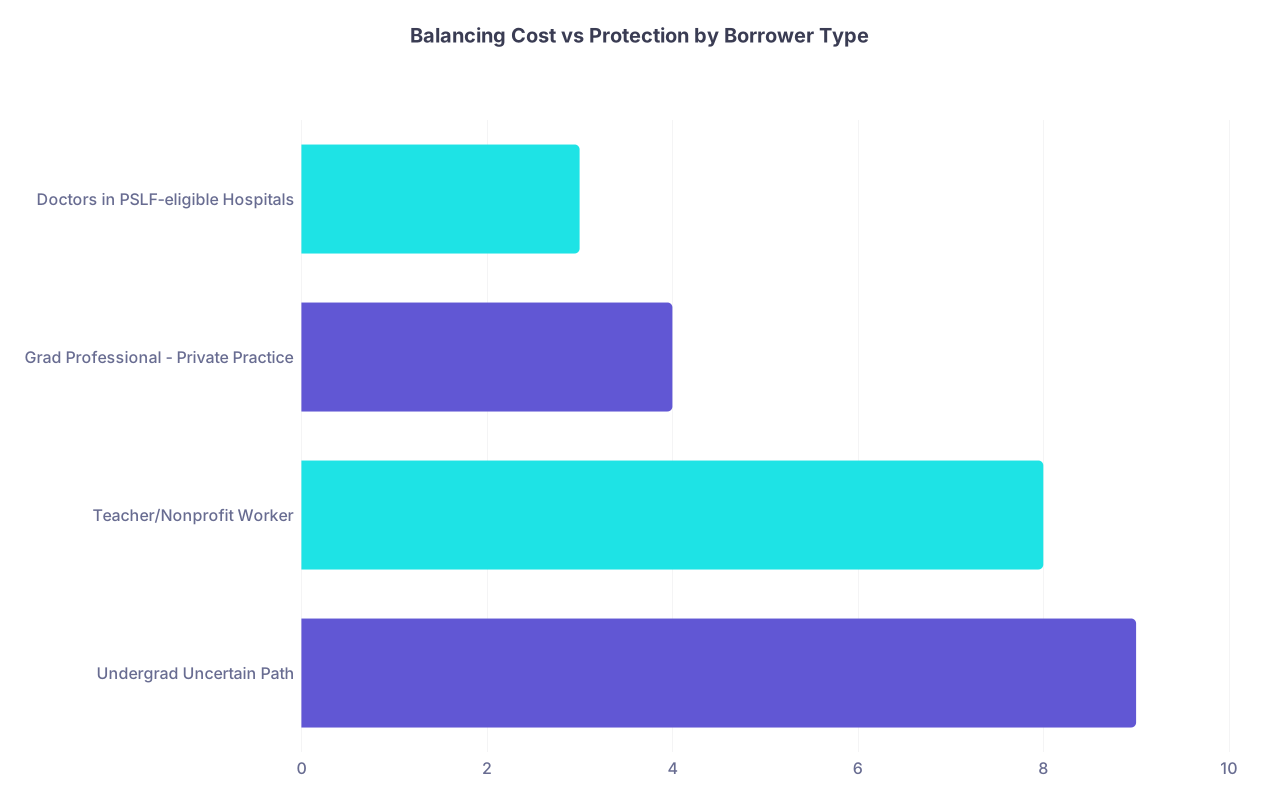
| Category | Value |
|---|---|
| Undergrad Uncertain Path | 9 |
| Teacher/Nonprofit Worker | 8 |
| Grad Professional - Private Practice | 4 |
| Doctors in PSLF-eligible Hospitals | 3 |
(Think of lower numbers as “more room for private/refinance” and higher as “stick to federal.”)
You’re not a spreadsheet. You’re a person with health risks, family obligations, career uncertainty, and a government that changes its mind every few years. Treating student loans purely as a rate-shopping exercise is how people optimize themselves into a corner.
Myth #5: “Debt Is Always Bad; Just Pay It Off As Fast As Possible”
There’s a certain moral panic around debt that completely ignores context. Debt isn’t “good” or “bad.” It’s a tool. Sometimes a very blunt, ugly one. But still a tool.
That med student taking on $250k in loans to become an attending making $280k?
That’s not the same as a random consumer racking up $250k on credit cards at 24% APR.
Student loans are backed by:
- Future earning potential (unevenly, true, but still real)
- Federal protections you don’t get with most other consumer debt
- Policy structures that sometimes reward strategic behavior over brute force payoff
The cult of “pay everything off immediately” ignores tradeoffs like:
- Are you killing loans aggressively while ignoring a 401(k) match? That’s lighting free money on fire.
- Are you throwing every extra dollar at 4.5% loans while carrying 20% credit card debt? That’s irrational.
- Are you ignoring emergency savings “because every dollar must go to debt”? That’s how one car breakdown or medical bill sends you straight back into high-interest debt.
You do not get extra credit from the universe for being debt-free at 32 if it means you’re broke at 45.
The better question is:
“How do I manage loans so they don’t control my life while still building a future that isn’t fragile?”
For some, that means aggressive payoff.
For others, it means using IDR and forgiveness while investing and building resilience.
For many, it’s a mixed approach.
How to Actually Think About Student Loans Like an Adult
Here’s the framework that replaces all the half-true myths:
Federal first, then compare
Take all the subsidized/unsubsidized loans you reasonably need. Then, if you’re at grad/parent level, compare PLUS vs private on real terms and projected career path.Separate your loans into “protected” and “fair game” buckets
- Protected: Anything you might want on PSLF/IDR long-term. Don’t refinance these.
- Fair game: High-interest loans with no forgiveness potential. These can be targeted for extra payments or refinancing later.
Look at your worst-case scenario, not your best-case fantasy
Assume:- Job loss at least once.
- A medical issue for you or family.
- Needing to relocate or switch jobs.
Which loan structure keeps you alive in that version of reality?
Revisit decisions every few years
Nothing about this is one-and-done. Income changes, laws change, goals change. A loan you keep federal now may be a great refinance candidate in 4 years.
Here’s a simple timeline of how a lot of borrowers should be thinking, instead of listening to blanket rules:
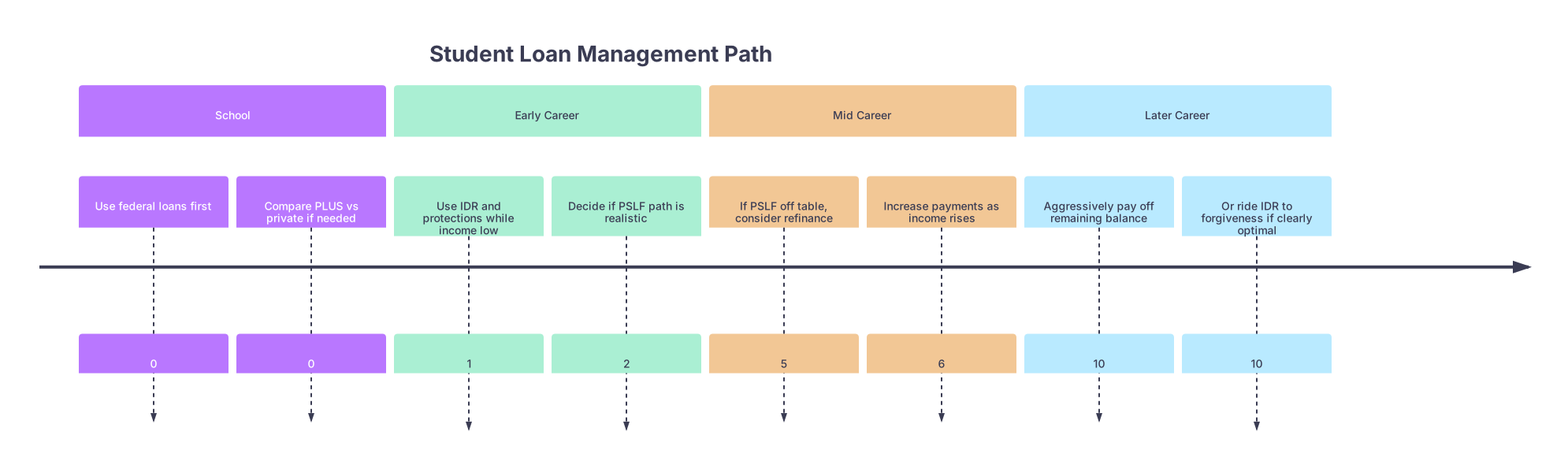
| Period | Event |
|---|---|
| School - Use federal loans first | 0 |
| School - Compare PLUS vs private if needed | 0 |
| Early Career - Use IDR and protections while income low | 1 |
| Early Career - Decide if PSLF path is realistic | 2 |
| Mid Career - If PSLF off table, consider refinance | 5 |
| Mid Career - Increase payments as income rises | 6 |
| Later Career - Aggressively pay off remaining balance | 10 |
| Later Career - Or ride IDR to forgiveness if clearly optimal | 10 |
The myths are popular because they let people feel smart without actually doing the hard, unsexy work: reading terms, running scenarios, accepting uncertainty.
You do not need a PhD in finance. But you do need to stop parroting slogans and start looking at your own numbers.