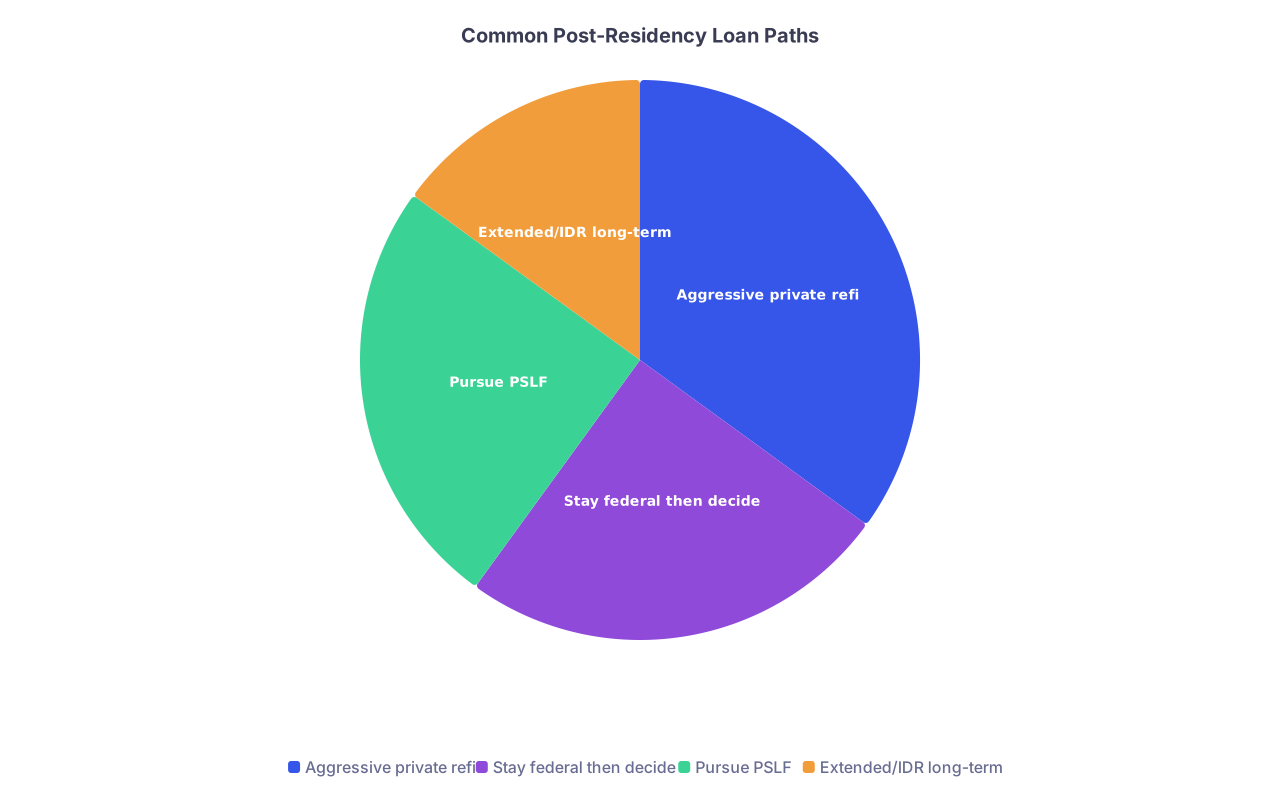
| Category | Value |
|---|---|
| Aggressive private refi | 35 |
| Stay federal then decide | 25 |
| Pursue PSLF | 25 |
| Extended/IDR long-term | 15 |
No, You Don’t Always Need to Refinance the Day You Finish Residency
The blanket advice to refinance your student loans the day you finish residency is wrong. Not “kinda suboptimal.” Wrong for a huge chunk of doctors.
If you’re coming out of training and some podcast, blog, or white-coat-influencer is yelling “REFI ASAP OR YOU’RE THROWING AWAY MONEY,” slow down. That might be good advice for the anesthesiologist with $120k at 6% going into a $500k private job. It’s terrible advice for the hospitalist with $350k of Direct Loans at 7% working at a 501(c)(3) on IDR heading straight toward PSLF.
I’ve watched people casually vaporize six figures of forgiveness because they reflex-refinanced at graduation. They thought they were “being responsible.” They were just uninformed.
Let’s dismantle the myth and replace it with an actual decision framework.
The Three Questions That Matter More Than the Interest Rate
Refinancing is sold like shopping for car insurance: find the lowest rate and you win.
For federal student loans, that’s fantasy logic. Before you look at a single rate quote, you answer three questions:
- Am I realistically on a path to loan forgiveness?
(PSLF or long-term IDR forgiveness) - How stable is my near- to mid-term career and income?
- How much do I actually value federal protections?
(safety nets you cannot “rebuy” later)
If you cannot clearly answer those, you have no business hitting “refinance.”
Let me spell this out.
1. Are You on a Forgiveness Track?
There are only three broad groups:
- PSLF candidates
- Long-term IDR forgiveness candidates
- True pay-it-all-back candidates
Where you fall drives almost everything.

PSLF: The Biggest “Do Not Refinance” Group
If you:
- Have Direct Loans
- Have been making payments on qualifying IDR in residency/fellowship (or could consolidate to start counting)
- Work (or plan to work) for a 501(c)(3) hospital, academic center, VA, or government employer
…you are very likely in PSLF territory.
For many of these physicians, PSLF is not a “nice perk.” It’s six-figure money.
I’ve seen real numbers like:
- $420,000 principal
- 7% interest
- 10 years of PSLF-qualifying employment
- Total paid before forgiveness: roughly $150–$220k
- Forgiven: $200k–$300k+, tax-free
Now imagine someone in PGY-4 told you: “I just refinanced to 4.5% private. Felt good to finally take control.” What they actually did: voluntarily gave up a tax-free six-figure benefit to save maybe a couple points of interest. That is financial malpractice.
Long-Term IDR Forgiveness
Then there are folks never realistically paying off $400k+ on modest incomes (peds, psych, primary care in certain regions, academic lifers), especially with the new SAVE plan.
These people might:
- Pay 5–10% of discretionary income for 20–25 years
- See a ton of principal forgiven at the end
- Face potential tax on that forgiveness (unless policy changes again)
Private refinancing completely nukes that possibility. Once it’s private, forgiveness programs don’t exist. Period.
Again: you cannot refinance “back” into federal.
True Pay-It-All-Back Group
This is who refi marketers are really talking about but somehow pretend everyone fits:
- High and stable attending income (think >$350k, often higher-paid specialties)
- Loan balance modest relative to income (e.g., $150–$250k, not $600k)
- No intention to pursue PSLF or long-term IDR forgiveness
- No realistic plan to work for qualifying employers long-term
For them, the game is simple:
Minimize interest, pay off quickly, kill the debt.
They are the ones who may benefit from refinancing soon after training. But “soon after” still doesn’t have to mean “on graduation day no matter what.”
What You Give Up When You Refinance (That Slick Ads Never Mention)
Refinancing means converting a federal loan into a private loan. Once you cross that line, you lose several features you cannot get back.
Let’s name them, because people conveniently handwave this away.
| Feature | Federal Loans | Private Refi Loans |
|---|---|---|
| Income-driven repayment (IDR) | Yes | No |
| PSLF eligibility | Yes | No |
| Automatic payment pauses (like COVID) | Yes | No |
| Death/total disability discharge | Strong | Varies by lender |
| Easy forbearance options | Yes | Limited/none |
Forgiveness Options
- Public Service Loan Forgiveness (PSLF) – 120 qualifying payments, tax-free.
- IDR Forgiveness – remaining balance wiped out after 20–25 years (current law).
Private loans have…none of this. You are paying principal + interest, period.
Income-Driven Repayment
Federal IDR (PAYE, SAVE, IBR, etc.) lets your payment drop with income. Private lenders offer “hardship” options at their discretion. Not guaranteed. Not formula-based. Not a legal right.
If you get sick, burned out, or your salary drops? Federal IDR adjusts. A private loan contract does not care.
Structural Protections
Federal loans: broad death and disability discharge written into law
Private: lender-specific policies; read the fine print
Federal: history of broad administrative actions (COVID pause, 0% interest for years)
Private: enjoy paying every month as agreed
If we get another economic shock and the government pauses federal payments again, your refinanced loans will happily keep accruing interest.
I watched residents and new attendings accidentally “win” huge by not refinancing before the COVID pause. They sat at 0% interest for years while the private-refi crowd kept paying real interest because someone told them, “always refi as soon as you’re done training.”
That’s what blind rules do. They blow up when the world changes.
When Immediate Refinancing Does Make Sense
Now let’s be fair. There are clean scenarios where refinancing right after residency is not only fine, it’s smart.
Case 1: High Income, No PSLF, Modest Relative Debt
Example:
- $180k federal loans at 6.8%
- Going into EM at $375k, exclusively private practice
- No history of working at qualifying PSLF institutions, no plan to
- Comfortable job prospects in multiple cities
Refi to a 5-year fixed at, say, 3–4% and throw $5–7k per month at it? Great. You avoid interest bloat and use your high income aggressively.
But notice the ingredients:
- Debt-to-income reasonable
- No forgiveness options in play
- High confidence about job type and location
That’s not “everyone.” That’s a slice.
Case 2: Specialty-Specific Stability and Private-Only Market
Certain specialties—like cosmetic-only practices, boutique concierge setups, pure locums without PSLF-eligible employers—are basically incompatible with PSLF from day one. If you are choosing that path and know it, you’re free to treat your loans as purely mathematical: rate vs payoff timeline.
But you have to be honest. Many residents think they’re going to be “private only” and then 2–3 years into attending life realize:
- They actually want a more predictable W-2 hospital employed job
- The best jobs near family or in preferred cities are at 501(c)(3) systems
- They’re tired of churn and want benefits and stability
If you’ve already nuked PSLF eligibility by going private refi early…too late.
The Gray Zone: Where You Shouldn’t Rush
The problem group is huge: people who could go either way.
You’re finishing IM, peds, psych, EM, anesthesia, or even surgery and you:
- Might work for a big nonprofit hospital
- Might do some locums
- Might stay in academics for a while
- Might join a private group that later gets acquired by a non-profit system
This is normal career uncertainty, not bad planning. But it makes “refi Day 1” a bad default.
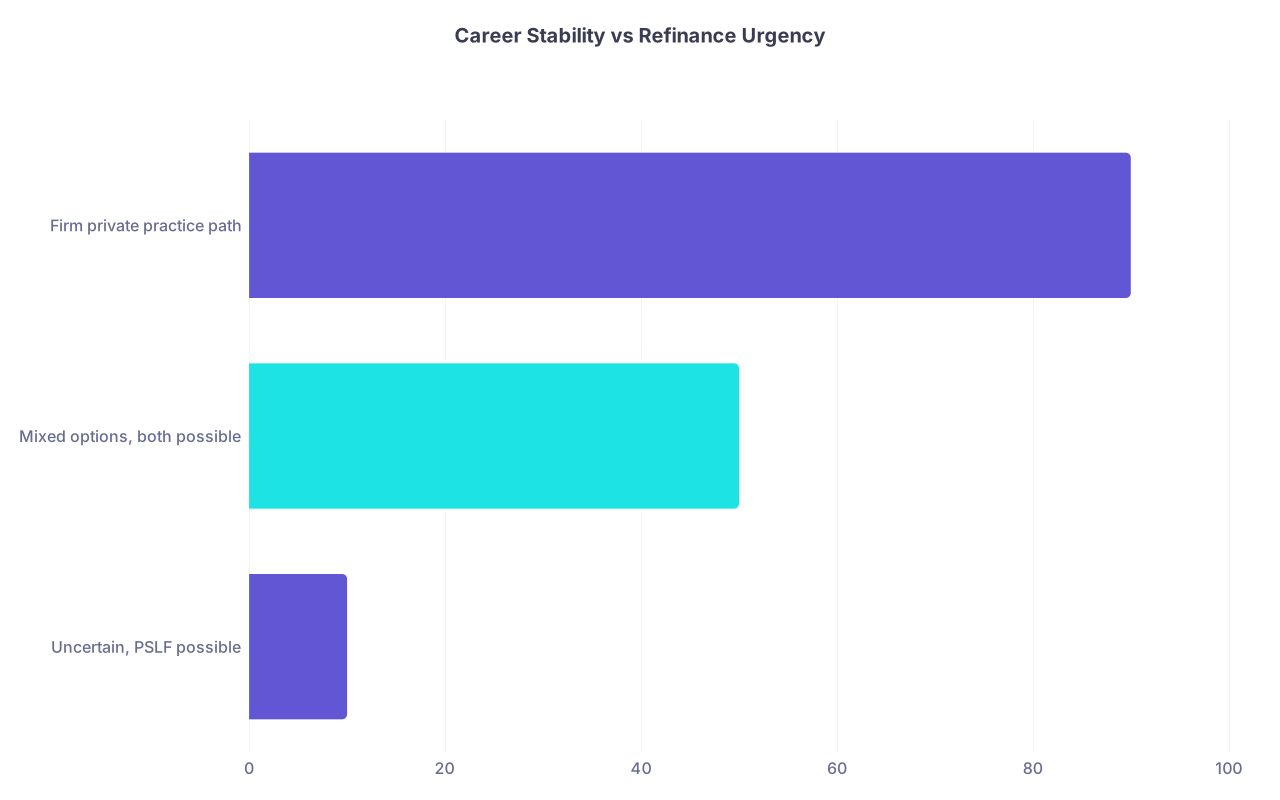
| Category | Value |
|---|---|
| Uncertain, PSLF possible | 10 |
| Mixed options, both possible | 50 |
| Firm private practice path | 90 |
The more your career path leans left on that spectrum (uncertain, PSLF-possible), the more valuable it is to keep loans federal a bit longer while you watch where life goes.
Example: The Hospitalist Drift
I’ve seen this exact arc repeatedly:
- PGY-3: “I’m probably doing a private hospitalist gig with a staffing company.”
- PGY-4 (chief or fellowship): “Actually, there’s a university-affiliated hospitalist spot with decent pay and teaching.”
- Attending year 2: They’ve stuck there, still like it, and now have 4–5 years of PSLF-qualifying payments under their belt thanks to residency + attending years combined.
If they’d refinanced at graduation, they’d have lost:
- 3 years of residency payments counting toward PSLF
- Several years of attending payments at a PSLF-qualifying employer
- The ability to pull the PSLF ripcord later
Instead, they can look up at year 7 and say, “Oh, I’m 3 years from forgiveness” and turbo-maximize retirement and other priorities.
That’s not a theory case. That’s dozens of real humans.
Why “Interest Rate Myopia” Gets You in Trouble
The most common defense of day-one refi is: “But I’m losing money by staying at 7% instead of 4%.”
That’s only true if:
- You are going to pay the entire balance back, and
- You ignore potential forgiveness and protections
Let’s be direct:
If you’re PSLF-eligible and end up having $200k forgiven, your effective interest rate on that forgiven chunk is irrelevant. You didn’t pay it.
I’ve seen people short-circuit their brain over a 1.5% difference in stated interest while ignoring a six-figure tax-free forgiveness outcome.
Yes, if you’re unquestionably in the pay-it-all-back camp, the rate matters. But if there’s any realistic shot at forgiveness, the decision is not “7 vs 4.” It’s “maybe pay $200k total vs definitely pay $400k total at a slightly lower rate.”
One of those is clearly worse.

A Simple, Sane Decision Framework
Let me strip this down. You want a rule? Use this instead of “always refi at graduation.”
Step 1: Classify Yourself
Right now, based on your loans and job:
Strong PSLF Candidate
- Working for 501(c)(3)/VA/gov or likely to
- On IDR or can consolidate to get there
- Debt high relative to income
→ Do not refinance federal loans. Period. Revisit only if you completely leave PSLF territory and plan to stay out.
Likely Long-Term IDR Forgiveness
- MASSIVE loans (e.g., $400k+)
- Lower-paying specialty/region or part-time preference
- You value flexibility more than being debt-free in 3–5 years
→ Probably stay federal, maybe forever. Refi only a small portion if it still makes sense.
Clear Pay-It-All-Back, No PSLF Path
- High income, relatively modest loans
- Private practice or non-PSLF employers only
- Confident in job market and career path
→ Refi can make sense within the first year of attending life. But even here you might wait 6–12 months to ensure stability and see where rates go.
Step 2: Use a Hybrid Approach If You’re Unsure
You don’t have to move everything at once.
Some people:
- Refinance a portion of their loans to private to start attacking aggressively
- Keep the rest federal on IDR as a hedge while career plans solidify
Is it perfectly optimized on paper? Maybe not. But it preserves optionality. Optionality has real dollar value when your life is changing fast.
The Quiet Reality: You’re Allowed to Wait
You’re transitioning from PGY-something to attending. You may be:
- Moving states
- Changing insurance panels
- Learning billing
- Figuring out call structure
- Discovering that your “guaranteed” RVU numbers were fantasy
This is a terrible moment to lock in an irreversible multi-hundred-thousand-dollar decision based on a rule some blogger repeated.
You’re allowed to:
- Sit in IDR for 6–12 months
- Build an emergency fund
- See if the job is what was promised
- Clarify whether PSLF is realistically in play
- Then decide on refinancing with actual data about your life
If that means you paid 7% instead of 4% on a shrinking balance for one year while making $300k+ as a new attending? That “lost” interest might be a few thousand dollars. Compare that to the six-figure risk of accidentally burning PSLF or ending up in the wrong repayment structure.
Most of you are not overpaying by six figures by waiting. You’re paying a small “uncertainty tax” in interest while buying clarity. That’s often a good trade.

| Step | Description |
|---|---|
| Step 1 | Finish Residency |
| Step 2 | Stay federal on IDR |
| Step 3 | Consider partial or full refi |
| Step 4 | Stay federal, reassess in 6-12 months |
| Step 5 | PSLF likely? |
| Step 6 | High income and stable private path? |

The Bottom Line
Stop treating “refinance the day you finish residency” as gospel. It is marketing, not math.
Three key points:
- If PSLF or IDR forgiveness is realistically on the table, early private refinancing is often financial self-sabotage, not sophistication.
- Federal protections and optionality are worth real money, especially when your career path is still stabilizing. You cannot buy those back once you refinance.
- Immediate refi only makes sense when you’re clearly in the pay-it-all-back group with a stable, non-PSLF career path and high income. Even then, waiting a few months is usually safer than rushing.
Run the numbers. Understand your path. Then, and only then, decide if refinancing belongs in your first year out—not just because someone told you it “always” does.