
It’s July 2nd. Your first real paycheck just hit. You’re standing in the hospital parking lot looking at your 2011 Corolla with the 180k miles and the missing hubcap, and your co-intern just pulled up in a brand-new Porsche SUV. Another one is talking about closing on a luxury condo downtown. Someone else is scrolling through diamond watches “for the culture.”
You’re wondering two things:
- Am I behind?
- Do program directors and attendings actually notice this stuff?
They do. And they talk about it. Not in the official meetings. In the real ones. The “close the door for a second” ones.
Let me walk you through what actually sets off alarms for PDs and senior faculty when it comes to “doctor lifestyle” purchases among brand-new hires, especially in the context of student loans and financial risk.
The uncomfortable truth: PDs absolutely judge your money decisions
Nobody will say this on a panel or in a brochure, but here’s the reality: attendings and PDs use your visible financial behavior as a proxy for judgment, reliability, and how big of a future headache you might be.
Not because they care how you spend your money in some moral way. They care about:
- Who will panic and moonlight unsafely because they’re drowning.
- Who is going to beg for contract tweaks, advances, or special favors.
- Who is a malpractice risk because they’re burnt out from chasing money.
- Who is likely to bounce quickly because the lifestyle is unsustainable.
They are not digging into your bank accounts. They’re watching the story you tell with your visible choices.
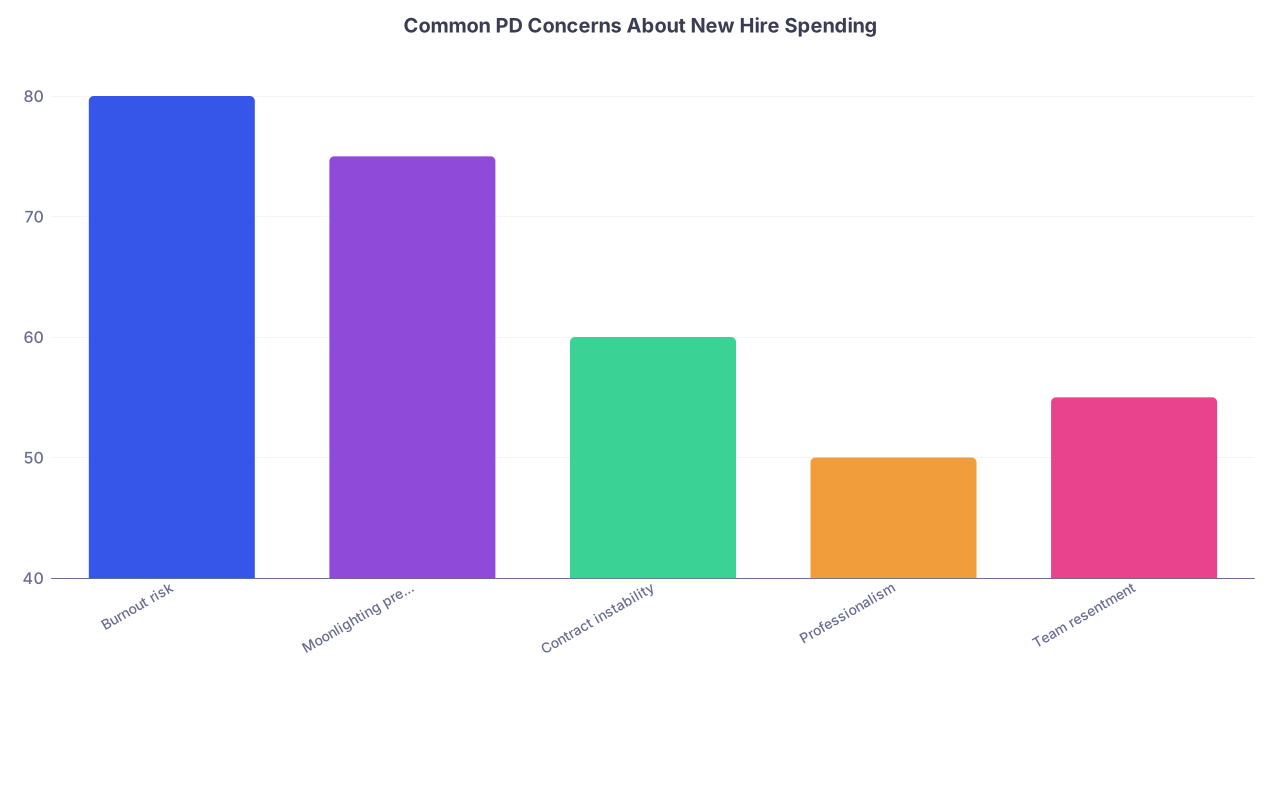
| Category | Value |
|---|---|
| Burnout risk | 80 |
| Moonlighting pressure | 75 |
| Contract instability | 60 |
| Professionalism | 50 |
| Team resentment | 55 |
Those numbers aren’t from a paper. That’s roughly how often I hear these concerns raised behind closed doors when a new doc’s spending becomes a topic.
Let’s get specific about the red flags.
The classic red flag: the luxury car in year one
If there’s one stereotype that’s real, it’s this: nothing gets faculty talking faster than the intern or fresh attending who shows up in a brand-new high-end car.
I’ve literally heard versions of:
- “He’s on PAYE with 400k in loans and just leased a BMW M5?”
- “She told me she’s stressed about payments and then bought a G-Wagon?”
- “If he’s making that kind of decision now, what’s he going to do when offered shady pharma money?”
The issue is not the car. It’s the mismatch. Low net worth, massive unsecured debt, and a depreciating luxury asset that screams “I think my life just changed overnight.”
Here’s how certain car choices are interpreted in real meetings.
| Car Scenario | Common Faculty Interpretation |
|---|---|
| 8–12-year-old reliable car, paid off | “Practical, grounded, probably understands money.” |
| Modest new Toyota/Honda/Hyundai financed | “Normal. Probably fine. Nothing to worry about.” |
| Used Lexus/BMW 5–7 years old, reasonable price | “Likes nice things, but might be thinking a bit.” |
| Brand-new BMW/Mercedes/Audi/Porsche on lease | “Uh oh. This one might be living ahead of income.” |
| Supercar / very high-end (AMG, M, RS, etc.) | “Financial child. Expect drama down the line.” |
Is this harsh? Yes. Is it real? Also yes.
What really sets people off:
- Leasing a $1,200–$1,800/month car while still on income-driven loan repayment.
- Complaining about student loans while driving a car that costs more than faculty daily drivers.
- Posting the car all over social media with #doctorlife while asking your PD for extra shifts.
Program directors know your resident/fellow/early attending salary range. They can do basic math. If your visible car payment eats 20–30% of your take-home pay, they assume you are not great with numbers or delayed gratification.
And here’s the part nobody tells you: once labeled “poor judgment” in one domain, you’ll be watched more closely in others. Medicine is conservative like that.
The big, fast house: the second red flag that worries PDs
The other major lifestyle trigger: the early huge house.
This usually looks like a brand-new attending, 0–2 years out of training, buying:
- A 4,000+ sq ft house
- In the most expensive neighborhood
- With minimal down payment
- On a variable or borderline-qualifying mortgage
Every program director has seen the same movie:
Year 1: “Just closed on the house! So excited. Payment’s a stretch but we’ll be fine.”
Year 3: RVU expectations change, call pay changes, or volumes drop.
Year 4: “I need more shifts / nights / bonus opportunities. I can’t afford to cut back.”
Year 5: Burnout, resentment, divorce, or they leave the group in a messy way.
Do faculty know your mortgage details? Not exactly. But they hear things:
- “Yeah, my mortgage is like $6,000 a month.”
- “We went with a doctor mortgage—no down payment.”
- “We’re house poor right now, but it’ll appreciate.”
For a PD or department chair, what they quietly hear is:
- “This person has to keep saying yes, even when they should say no.”
- “This person is financially locked in. They may not tolerate schedule or compensation changes.”
- “If revenue dips, they are at high distress risk.”
Remember: your employer wants to manage a service line, not rescue your personal finances. If your lifestyle depends on high income and maximum shifts forever, that makes you a less flexible, more fragile employee.
Student loans + flashy lifestyle = reliability concerns
Let’s bring loans into this, because that’s the intersection you actually asked about.
When a PD, division chief, or practice group partner hears:
- “I have $300–500k in loans”
- “I’m on an income-driven plan / PSLF”
- “I hate these loans; they’re suffocating me”
and then sees:
- Luxury car
- Expensive house
- Costly private school for kids immediately
- Designer everything, frequent international trips
the question isn’t, “Why don’t they tighten their belt?”
The question is, “What are they going to do when there’s a financial shock?”
I’ve heard this exact line from a department chair:
“The people who scare me are not the ones with big loans. It’s the ones with big loans and big lifestyle who think they’re entitled to solve it by working themselves into the ground or cutting ethical corners.”
Strong words. But the pattern is common enough that it has become a stereotype.
You get tagged (even if silently) as:
- Higher burnout risk
- More likely to chase exploitative side gigs
- More likely to bolt to the next “higher pay” job quickly
No one writes this in your file. But it gets mentioned.
Red flag subscriptions: status over stability
There’s another category that PDs notice: recurring status spending.
Not the occasional splurge. The pattern.
The new doc with:
- Multiple luxury brand subscriptions or memberships right out of training
(exclusive gyms, country clubs, luxury car club, high-end concierge everything) - A new $1,000+ phone, designer watch, and designer bag every year
- Constant “we deserve this” vacations financed on a thin savings cushion
The concern here isn’t the dollar amount. It’s the message:
“I define myself by spending like a doctor, not by being financially secure as a doctor.”
Some of the savvier PDs and attendings know the student loan math. They’ve heard the numbers for standard repayment vs. income-driven vs. refinancing. When someone clearly hasn’t done that homework but is meticulously curating an Instagram lifestyle, it irritates them.
Not because they care about Instagram. Because it tells them you’re asleep at the wheel where it matters.
Social media flexing: the silent professionalism ding
Very quietly, this has become a big one.
Faculty may not follow you, but residents, chiefs, and junior attendings do. Screenshots move around. And sometimes, right into a PD’s text messages.
I’ve literally been in the room when a PD said, scrolling through their phone:
- “This is the same resident who emailed me about inability to afford payments?”
- “They just posted a business class flight and a luxury resort with #payingoffdebt.”
- “Look, if you’re going to flaunt it, at least don’t complain to me about money.”
It’s not that you can’t travel. Or enjoy life. The issue is the juxtaposition:
- Public “balling out”
- Private “I’m struggling financially, can you help?”
Once that disconnect is visible, your future financial requests (schedule changes, extra compensation, hardship exceptions) get filtered through, “Are they actually in trouble, or just upside down on their choices?”
The PD’s unspoken matrix: how they actually judge risk
Most PDs aren’t formally trained in finance. But they use a kind of mental matrix whether they realize it or not.
| Scenario | Faculty Reaction |
|---|---|
| High loans + modest lifestyle | “Serious, probably fine. Just needs a plan.” |
| High loans + flashy lifestyle | “Risky. Watch for burnout and instability.” |
| Low loans + modest lifestyle | “Ideal. Likely stable and flexible.” |
| Low loans + flashy lifestyle | “Annoying maybe, but less dangerous long-term.” |
You only control two levers early on:
- Your actual financial decisions
- What you broadcast about them
If you’ve got crushing loans, you do not want to also be the person whose visible lifestyle screams “I didn’t learn anything from this mess.”
Specific purchases that raise eyebrows
Let’s get concrete. These are the recurring themes I’ve seen spark “here we go” conversations among PDs and faculty about new hires.
1. High-end car leases in residency or immediately post-training
Especially when the person:
- Is on income-driven repayment with massive loans
- Has no emergency fund
- Is constantly swapping cars or upgrading
To older faculty, it looks like: “You’re renting status with future money you don’t understand yet.”
2. “Doctor house” with razor-thin margin
The big house isn’t always a problem. The timing and ratio are.
Red flag examples:
- Mortgage + property tax + HOA > 30–35% of gross income
- Zero or tiny down payment on a jumbo or doctor mortgage
- Buying at the extreme top of what the bank will approve
Faculty have watched colleagues become trapped in jobs they hate because they simply can’t afford a pay dip or a move. They see you starting that story on day one.
3. Cosmetic overload while complaining about money
Nobody cares if you get your nails done or have a skincare routine. The issues:
- Multiple high-ticket cosmetic procedures early on (expensive injectables, elective surgeries, etc.) paired with complaints about being “crushed by loans”
- Financing cosmetic procedures while ignoring higher-interest debt
To older docs, that sends one message: “Wants appearance of success more than actual stability.”
4. “All on credit” lifestyle
You’d be shocked how often attendings hear from residents:
- “Oh, I just put it on a card.”
- “I’ll pay it off when I’m an attending.”
- “Yeah, my credit card debt is like 20k, but that’s future me’s problem.”
Put that next to a brand-new lifestyle purchase, and a PD thinks: “Future you is going to be my problem when you’re burnt out and bitter.”
What smart money actually looks like to a PD
Let me flip this around, because some of you care how to avoid being that red flag.
Here’s what tends to impress quietly:
- You drive something boring, reliable, and paid off for a few more years.
- You rent a reasonable apartment or modest house at first, even if you could stretch for more.
- When you talk about loans, you sound like you’ve run the numbers.
(“I’m on SAVE, projected forgiveness around year X; I’m maxing retirement because of the tax benefits and protection.”) - You do not perform poverty, but you also don’t perform wealth.
The experienced attendings recognize this immediately. It signals you understand:
- Human capital vs. net worth
- Time value of money
- Risk
You don’t need to be a personal finance guru. You just need to not look delusional.
How this ties to legal and contract issues
Here’s the part they definitely won’t say on orientation day: your visible financial decisions influence how leadership thinks about contract structure and exposure.
For example:
- A group debating productivity-heavy contracts will be more nervous about offering them to new hires who already look financially desperate.
- Someone who is visibly living far beyond their means is perceived as more likely to:
- Push RVUs too hard
- Overextend on unsafe moonlighting
- Take shady outside gigs or side arrangements
No PD wants to be in a deposition trying to explain why they ignored all the signs that a burned-out, overleveraged physician was working unsafe hours or cutting corners.
Is that a stretch from your car purchase? Maybe. But that’s exactly how human brains connect dots in real life.
How to enjoy your money without looking reckless
You’re not a monk. You didn’t go through a decade of training to live like a college student forever. So how do you enjoy your first real income without setting off alarm bells?
Practical guidelines that actually read well to faculty who’ve seen the cycle:
Delay the big flex by 1–2 years.
If you truly want the nice car or big house, nothing magic happens if you wait 18–24 months. In those two years, you can:- Build a real emergency fund
- Stabilize your loan plan
- See what your real post-tax, post-benefit income feels like
Keep the first car move reasonable.
Upgrade from the barely-safe beater to:- A reliable, modest new car
- Or a solid used one that doesn’t scream midlife crisis at 29
Start with a “starter” house or keep renting.
Renting for a couple of years while your life and job stabilize is not a failure. It’s intelligent. PDs know which new hires are thinking long-term.Talk about systems, not stuff.
When student loans come up, sounding like this earns respect:- “I’m on SAVE, contributing to retirement, and planning on PSLF.”
- “I refinanced because I know I’ll be in private practice long-term.” Not:
- “I don’t know, I just send them whatever they ask and hope for the best.”
Keep social media from betraying you.
If you’re going to flex, don’t also complain loudly about being broke or crushed by loans. Faculty see that contradiction and it colors everything.
The real reason this matters
You might be thinking: “Who cares what they think about my car or house? It’s my money.”
That’s true. But here’s the uncomfortable fact no one tells you in med school:
Your reputation in medicine is not just about clinical skill. It’s about how predictable, stable, and safe you appear to the people who sign contracts, manage schedules, and choose leaders.
Visible financial recklessness in a heavily indebted new doc doesn’t read as “fun” to them. It reads as:
- Volatile
- Vulnerable to pressure
- Likely to be dissatisfied
- Harder to manage when the inevitable financial or organizational storms come
The whole point of being smart with your first few years of income is not just to “be good with money.” It’s to buy yourself freedom. Freedom from being trapped. Freedom from quietly scaring the people who control your professional opportunities.
Years from now, you will not be proud that you got the AMG before your first loan recertification. You’ll be proud you weren’t owned by those choices. That you gave yourself room to walk away from bad jobs, bad contracts, and bad situations.
The lifestyle will feel better when it isn’t covering up a financial hole.