The belief that “the more OR time you get early in MS3, the better surgeon you’ll be” is mostly wrong.
Not completely. But mostly. It’s one of those seductive half-truths that sounds logical, gets repeated on rounds, and then quietly falls apart when you look for actual evidence instead of vibes.
Let’s walk through what we actually know.
What people think early OR exposure does
You’ve heard the script.
Attendings and senior residents tell MS3s some version of: “Get in the OR as much as you can. The students who start early end up better with their hands.” Students internalize that as: day-one OR exposure = better long-term technical skill.
The implied chain of reasoning looks like this:
- Early OR exposure → more time around surgery
- More time around surgery → better technical skills
- Therefore, early OR exposure → better surgical skills later
Simple. Intuitive. And incomplete.
The third step is where things fall apart. Because “time in the room” is almost meaningless unless you specify what kind of time and what kind of practice.
There’s a difference between:
- Standing at the foot of the bed retracting for 6 hours, terrified to move.
- Doing 30 minutes of focused, supervised suturing on a task trainer with good feedback.
Both technically count as “surgical exposure.” Only one actually trains your hands and brain.
What the evidence actually says about skill development
Most of the hard data on technical skill comes from three places: simulation labs, objective assessments like OSATS/GOALS, and resident case volume vs performance studies. Very little of it supports the magical power of “early OR exposure” by itself.
What consistently shows up instead:
- Deliberate practice beats passive exposure
- Quality feedback beats sheer hours
- Simulation and structured curricula beat random ad-hoc “see one, do one” exposure
The orthopedic and general surgery education literature is especially blunt about this. When you compare residents or students who get structured practice (sim labs, box trainers, supervised suturing with defined metrics) versus those who just “spend more time in the OR,” the structured group almost always wins on technical assessment.
Here’s the key problem: when people say “early OR exposure,” they’re usually describing unstructured, opportunistic time. Scrubbing in whenever, retracting, occasionally cutting a suture, rarely getting real feedback.
That isn’t a training program. That’s background noise.
Early exposure vs earlier practice: not the same thing
This is where everyone gets sloppy with language.
There are three very different concepts that get lazily lumped into “early OR exposure”:
- Chronological timing – When in your training you first step into an OR. MS3 vs MS4 vs intern.
- Quantity of exposure – Total hours scrubbed, cases observed/assisted.
- Quality of practice – How much hands-on, supervised, feedback-rich practice you get on defined skills.
Only the third one reliably predicts better technical skill.
If we’re asking, “Does early OR exposure in MS3 predict better surgical skills later?”, the honest answer is:
- Early chronological exposure alone? Weak predictor. Borderline irrelevant.
- Early high-quality deliberate practice that happens to start in MS3? Much more meaningful.
- Total OR hours logged as a student? Surprisingly poor proxy for actual skill, especially once you hit residency and start accumulating real case volume.
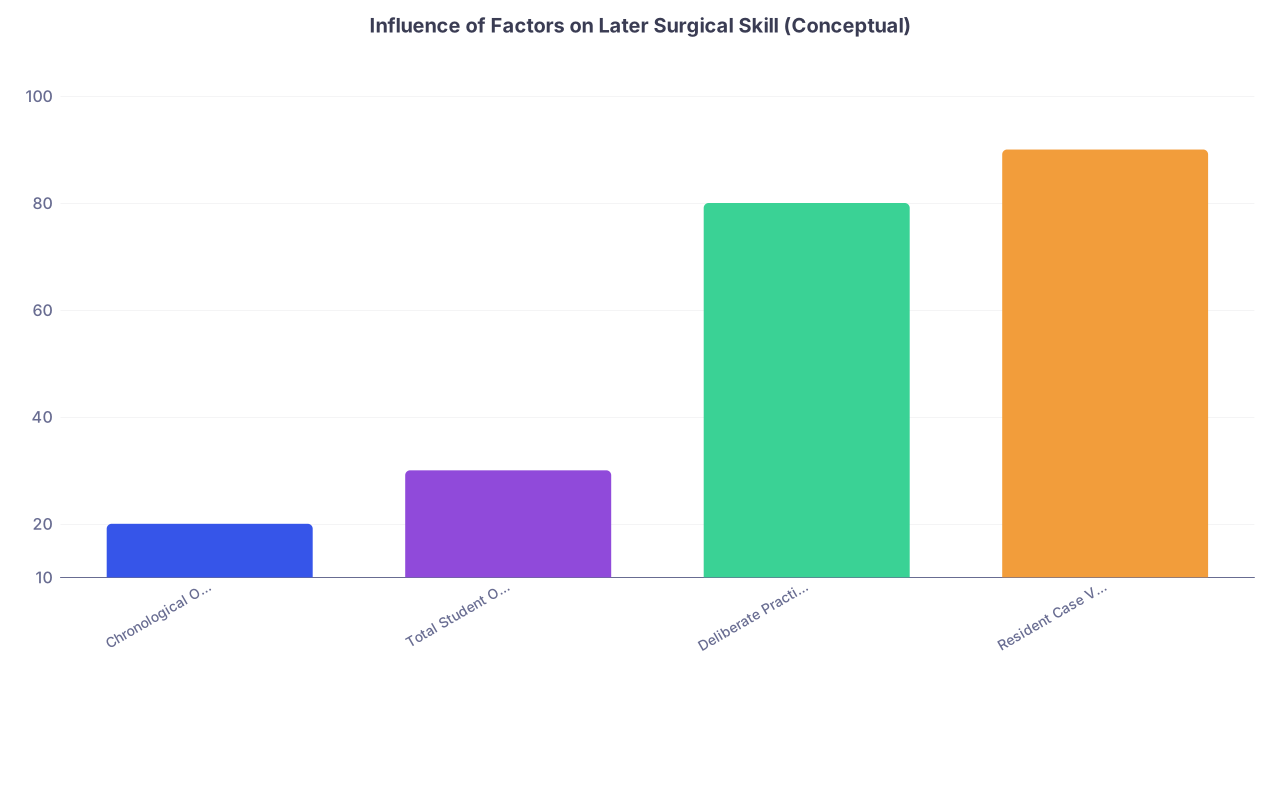
| Category | Value |
|---|---|
| Chronological OR Start (MS3) | 20 |
| Total Student OR Hours | 30 |
| Deliberate Practice with Feedback | 80 |
| Resident Case Volume | 90 |
Those numbers aren’t from a single study; they’re a conceptual summary of what multiple papers and assessments tend to show: early exposure matters a bit, but it’s not the heavyweight people pretend it is. Deliberate practice and resident case volume dominate.
What OR exposure actually does help with in MS3
Now, I’m not saying early OR exposure is useless. It does some things quite well. They’re just not the things people romanticize.
Three real benefits:
- Demystifying the OR and reducing anxiety
You can usually tell who’s never been in an OR before: terrified of contaminating the mayo stand, not sure where to stand, mentally overloaded by lights/monitors/people. The first few cases are cognitive overload. After a week, it’s normal.
Early exposure buys you comfort with:
- Sterile technique and workflow
- How to gown, glove, and move without chaos
- Who does what and when
That lowers anxiety later when you are expected to perform technically. Useful? Absolutely. Directly predictive of future suturing finesse? Not strongly.
- Understanding surgical culture and pace
There’s a social literacy to the OR: when to talk, when to shut up, how to anticipate, how to read a room that’s headed south. Early exposure accelerates that learning curve.
But again: that’s professionalism and team functioning, not raw technical hand skill. Different domain.
- Screening for fit
This one’s underrated. Some students discover early that they hate the OR. Or that they love it and can tolerate the hours, smells, hierarchy, and constant time pressure.
Early exposure is excellent for aligning career choice. It’s just not a magic injection of fine-motor talent.
Where early OR exposure fails as a predictor of skill
Let’s be blunt about the common myths.
Myth 1: “The MS3 who lives in the OR will be the best surgical resident”
I’ve watched those students. The ones who are on every case, know every patient, always volunteering to scrub.
Some of them become excellent surgeons. Some plateau. The ones who excel share patterns that have nothing to do with raw hours:
- They actively seek feedback on knot tying, suturing, scope navigation.
- They practice outside the OR on pigs’ feet, foam models, box trainers.
- They watch videos and mentally rehearse steps before cases.
The students who just accumulate scrub caps and Instagram stories? Often indistinguishable by PGY3 from the classmate who had modest MS3 OR time but took residency simulation seriously.
Myth 2: “Starting OR time earlier gives you a permanent head start”
Whatever advantage you gain as an MS3 is small and erodes fast once residency starts and everyone’s case volume explodes. Residents hit a point where exposure differences in medical school are dwarfed by what happens between PGY1 and PGY3.
There’s research on learning curves in laparoscopy and endoscopy showing sharp gains during early residency, with performance leveling off as people approach competence. Prior exposure helps with confidence more than final performance level.
In other words: early exposure may shift you a few notches up the curve at the start, but the final plateau is determined by what you do as a resident, not how many hours you retracted as a student.
| Outcome | Predictive Strength of MS3 OR Time |
|---|---|
| Comfort in OR environment | High |
| Understanding of OR workflow | High |
| Long-term suturing skill | Low–moderate (depends on practice) |
| Laparoscopic/endoscopic skill | Low |
| Overall resident performance | Low |
Myth 3: “If you’re not in the OR early, you’re already behind”
This one is pure anxiety marketing. MS3s who rotate late in surgery, or international grads who’ve seen relatively few ORs before residency, often catch up just fine.
Why? Because technical skills follow motor learning principles, not prestige folklore. With sufficient deliberate practice, spaced repetition, and competent feedback, you can close the gap quickly. What you can’t fake is work ethic and teachability. Those matter more than whether your first cholecystectomy view was at 22 or 26.
The real predictors of better surgical skill later
If you actually care about being technically strong, stop obsessing over “Did I get enough OR time in MS3?” and focus on the variables that do matter.
From the data and from watching residents over years, a few patterns are obvious:
- Deliberate, structured practice
Simulation works. Box trainers work. Suturing boards work. Not because they are fancy, but because they allow:
- Repetition without time pressure
- Clear metrics (time to completion, error counts, leakage, accuracy)
- Immediate feedback
Programs that mandate sim labs and track performance see measurable gains in technical OSATS scores. That’s where future attendings are made, not in how many hours a third-year retracted liver.
By PGY3–5, the number and complexity of cases you perform as primary surgeon dwarfs whatever “early exposure” you had. Multiple studies correlate resident case volume with technical performance and confidence. No surprise there.
- Quality of supervision and feedback
A resident who gets real teaching—“Here’s how you should hold that needle. Stop. Try again. Aim for equal bite depth.”—will always progress faster than someone who gets vague praise or is ignored at the table.
- Self-directed learning
The residents who watch operative videos the night before, mentally rehearse, and then debrief afterward look different in the OR. Their motion is planned, not random. They waste fewer moves. That’s not a function of when they first walked into an OR; it’s how they use each exposure they get.

| Step | Description |
|---|---|
| Step 1 | Early OR Exposure MS3 |
| Step 2 | Comfort in OR |
| Step 3 | More Willing to Engage |
| Step 4 | Deliberate Practice Sim and OR |
| Step 5 | Resident Case Volume |
| Step 6 | Technical Competence |
| Step 7 | Minimal Long Term Effect |
Where early exposure can give you a small technical edge
To be fair, there are scenarios where early OR exposure is modestly predictive of later skill—but only when it’s tied to real practice.
If, as an MS3:
- You’re allowed to suture skin regularly
- You practice knots repeatedly and attendings actually correct you
- You use downtime to tie knots on instruments and play with needle angles
- You supplement this with sim lab work and video review
Then yes, your first month of intern year might look noticeably smoother than your colleague who barely touched a needle driver as a student.
But notice what’s doing the work here. Not the date you started or the number of hours present, but the density of hands-on, feedback-rich, cognitive-engaged practice you squeezed out of that exposure.
Change the attending, change the culture, and the effect vanishes. I’ve seen students do 8-week surgical clerkships where they never throw a single deep dermal stitch. What is that exposure worth, technically? Almost nothing.
How you should actually think about early OR exposure
If you want to use MS3 OR time to set yourself up for later success, drop the magical thinking and treat it like what it is: an opportunity generator, not a guarantee.
Use it to:
- Get comfortable in the environment so anxiety doesn’t crush you when true expectations start.
- Learn the language, instruments, and workflow so you can anticipate instead of react.
- Start building habits: how you hold instruments, how you position your body, how you think in 3D.
- Identify mentors who are actually willing to teach you, not just talk about teaching.
Stop expecting it to:
- Lock in your destiny as “good with your hands”
- Compensate for lack of deliberate practice later
- Predict your peak as a surgeon more than very loosely
You’ll see classmates who live in the OR as MS3s and plateau in residency because they never learned how to practice consciously. You’ll also see quiet, late-blooming residents who had minimal student exposure and then explode technically once they’re finally given autonomy and structure.
The common factor among the best isn’t how early they started. It’s how intentionally they trained once they did.
The bottom line
Three points, no sugar-coating:
- Early OR exposure in MS3 is a weak, indirect predictor of later surgical skill. It helps with comfort and culture, not magically with fine-motor talent.
- What actually predicts better technical ability later is deliberate practice, structured simulation, high-quality feedback, and resident case volume, not the sheer number of hours you spent retracting as a student.
- If you want to be technically strong, stop counting how “early” you got into the OR and start maximizing every exposure you do get for real, hands-on, feedback-driven practice—because that’s what moves the needle, not the mythology.