
The OR restriction itself is not the thing that ruins your surgical career. How you handle those months is.
If you’re on remediation with OR restrictions right now, your brain is probably looping the same three fears:
- “My case log is dead.”
- “Everyone will know and I’ll never match / get a job.”
- “I’m falling permanently behind my class.”
You’re not crazy. Those are real risks. But they’re only guaranteed if you sit there, take whatever scraps of cases come your way, and hope it all works out.
Let me walk through how to handle this like a grown surgeon-in-training who plans to still have a career when the dust settles.
Step 1: Get Clear On The Exact OR Restriction
You cannot protect your numbers if you do not know precisely what’s restricted and for how long. Vague understanding = quietly bleeding out your log.
You need specifics on:
- Duration
- Type of cases or roles restricted
- Documentation and “exit criteria”
Do this in writing, not just hallway conversations.
Ask your PD or remediation lead, explicitly:
- “What’s the official duration of my OR restriction? Calendar dates, please.”
- “What exactly am I not allowed to do?
- No primary surgeon?
- No independent cases?
- Only with certain attendings?
- No night cases? Emergencies? Level 1 traumas?”
- “What are the objective criteria for lifting this?
- X number of clinic notes observed?
- Professionalism sign-offs?
- Simulation completion?”
Then you summarize it back in an email:
“Just to make sure I understand correctly, from [date] to [date], I am restricted from [conditions], but am still allowed to [assist/observe/see consults/etc.]. Exit criteria are [list]. Please let me know if I’m misunderstanding anything.”
That email is your shield later when someone says, “I thought you just weren’t supposed to operate at all.”
Once you know the boundaries, you can start gaming within them.
Step 2: Separate Your Two Problems
You actually have two separate but related problems:
- Remediation itself (professionalism, judgment, technical concern, whatever triggered this)
- Surgical case volume and log requirements
People screw this up by only thinking about problem #1 (“I just need to get off remediation”) and ignoring the fact that their case log is silently tanking for 3–6 months.
Your mindset needs to be:
- Problem 1: Fix the issue that got you restricted. Non‑negotiable.
- Problem 2: While that’s happening, run a parallel track specifically to protect your operative numbers.
Do not wait until you’re “cleared” to think about your log. That’s what PGY-5s scrambling at the last second do.
Step 3: Audit Your Baseline Numbers Now
Before you even think strategy, you need data. Right now. Not “later this year.”
Log in to ACGME case log (or whatever your specialty uses) and pull:
- Total cases by category and role (primary vs assistant)
- Your percentile against national averages (if available)
- Where you’re already weak
If you have access to national benchmarks, put yourself on paper:
| Category | Your Cases (PGY-3 mid-year) | ACGME Graduating Min | On Track? |
|---|---|---|---|
| Major abdominal | 120 | 250 | Borderline |
| Hernia | 45 | 85 | On track |
| Endoscopy | 30 | 50 | Behind |
| Vascular | 10 | 40 | Behind |
| Trauma laparotomy | 12 | 40 | Behind |
If your system has graphs, export/print them. You want something visual you can show later in a meeting and say: “Here’s where I was before remediation started.”
Now calculate:
- How many months of OR restriction you have
- Average cases per month you were doing before
- What that means you’ll lose
If you were averaging 25 cases/month and you’re on restriction for 4 months, that’s ~100 cases gone. That’s not catastrophic if you plan around it. It’s catastrophic if you pretend it doesn’t matter.
Step 4: Redefine What “Counts” While You’re Restricted
OR restriction usually means “you can’t be primary / you can’t independently operate / you can’t do high‑risk cases solo.”
It almost never means “go sit in the call room for three months.”
You need to squeeze everything you’re still allowed to do and convert it into value.
Ask directly:
- “Am I still allowed to scrub cases as assistant?”
- “Can I still enter cases where I’m first assist?”
- “Am I allowed to do parts of the procedure under direct attending supervision? If yes, can those be logged as first assist with description?”
- “Can I participate in minor procedures (bedside, ED, clinic) and log those?”
Many programs are fine with you:
- Scrubbing
- Holding camera
- Closing
- Running scope
- Doing simple parts of the case
…as long as the issue they’re addressing (e.g., judgment, boundaries, technical sloppiness) is being controlled.
Your job is to:
- Maximize the allowed operative exposure.
- Log every single appropriate case aggressively and accurately.
Do not “forget” to log because it “wasn’t a big case.” Right now your hernias, ports, and scopes might be what saves your totals.
Step 5: Design A Concrete Volume Preservation Plan
You cannot just say, “I’ll catch up later.” That’s fantasy thinking.
You need a documented plan that you can put in front of your PD.
Build a simple gap analysis
For each key category (per ACGME / board requirements), ask:
- What’s the graduating target?
- Where are you now?
- How many months left in training?
- How many cases/month do you need post‑restriction to hit target?
Be honest about reality. If your plan says you need 40 laparotomies per month for 6 months, that’s not a plan, that’s fiction.
Example structure for your PD meeting
You sit down with your PD or associate PD and say:
“I understand and accept the remediation and the OR restrictions. I also want to make sure I stay on track for graduation requirements. Here’s my current case log, projected loss from these four months, and a proposed plan to meet minimums once the restriction lifts.”
Bring:
- Printed case log summary
- ACGME minimums
- A one‑page plan with bullet points like:
- Add an extra trauma/acute care month PGY-4
- Swap one elective research month for a high-volume community general surgery rotation
- Front‑load endoscopy rotations after restriction lifts
- Extra night float weeks where more urgent cases happen
Attendings love residents who show they’ve thought like this. It shows you’re not just trying to “survive remediation”; you’re trying to still become a competent surgeon.
Step 6: Use Non-OR Time To Build Skills Strategically
If you can’t swing a knife as often, you still have a body and a brain. Use them.
Goal: when your restriction lifts, you should be technically sharper than before, not rustier.
Simulation – but done like a serious person, not a checkbox
You’ve seen the resident who “does sim” by scrolling their phone between suturing two anastomoses on a foam bowel. Do not be that person.
Create a weekly skills schedule:
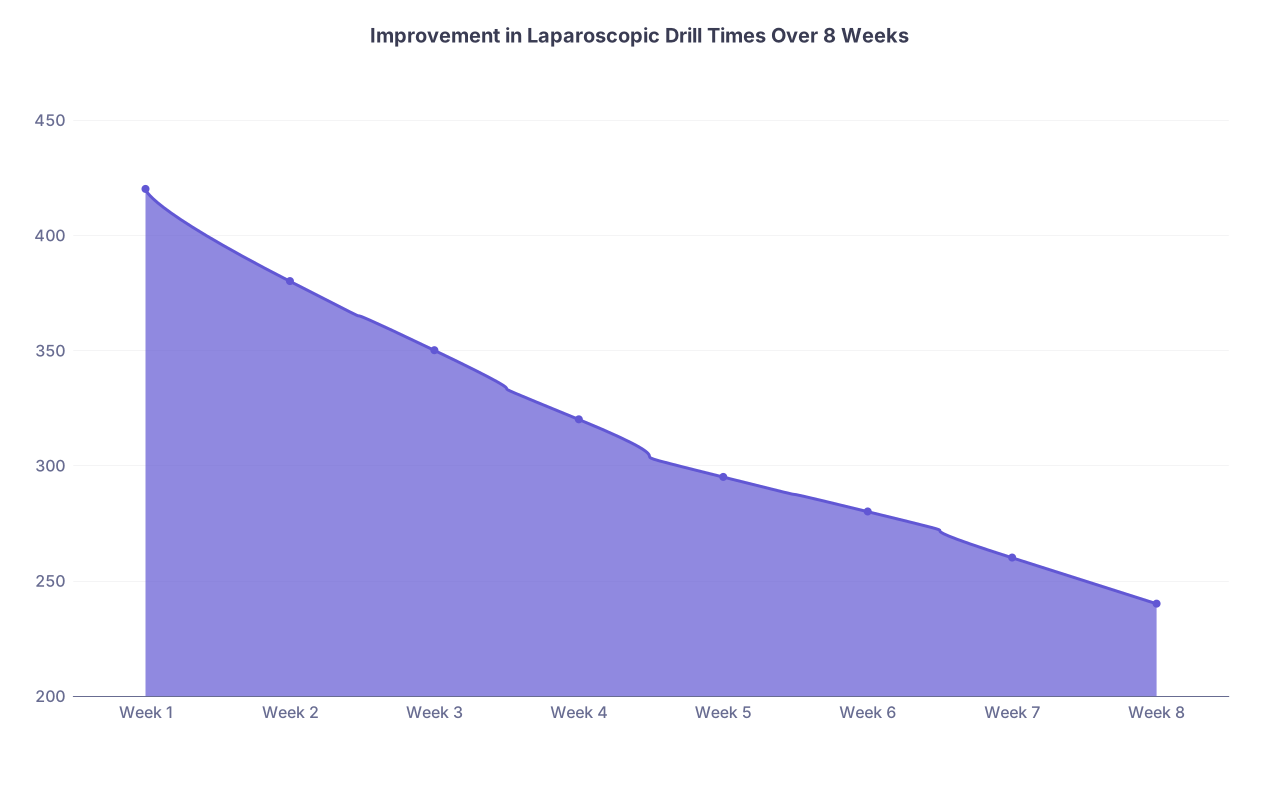
- 2 sessions/week of focused simulation:
- Knot tying and suturing under time pressure
- Laparoscopic drills: peg transfer, cutting circle, intracorporeal knots
- Scope navigation in the sim lab
- Track metrics:
- Time to complete task
- Number of errors
- Camera steadiness (if scored)
| Category | Value |
|---|---|
| Week 1 | 420 |
| Week 2 | 380 |
| Week 3 | 350 |
| Week 4 | 320 |
| Week 5 | 295 |
| Week 6 | 280 |
| Week 7 | 260 |
| Week 8 | 240 |
When you meet with faculty, you want to be able to say:
“I’ve been doing two structured sim sessions per week. Here are my timed drill improvements and faculty who’ve observed me.”
That framing turns your restriction period from “punishment” into “structured skills bootcamp.”
Clinics and perioperative medicine
You know what most residents lack that attendings actually care about? Pre‑op and post‑op judgment.
Hit clinic hard:
- Learn who should not go to the OR.
- Work on consent conversations.
- Read every post‑op complication and case discussion.
You’ll silently become the resident who doesn’t book nightmares. That matters more to attendings than seeing you do one more gallbladder badly.
Step 7: Bank Political Capital While You’re Restricted
You are under a microscope during remediation. That’s not paranoia. That’s reality.
You can use that microscope to your advantage.
During this period:
- Show up early and be visibly prepared
- Over‑communicate your plans for patients
- Ask for feedback, then visibly apply it
- Never be the problem on the floor, in clinic, or in conference
Why does this matter for surgical numbers?
Because when your restriction is up, you’re going to need:
- Extra opportunities
- Schedule flexibility
- Attending advocates willing to say, “They’re ready. Give them more OR time.”
People do that for residents they trust and like. Not for the one who sulked through remediation.
Step 8: Negotiate For High-Yield Rotations Post-Restriction
This is where preserving your numbers becomes very concrete.
Once there’s a projected end date for the OR restriction, you ask:
“Given my case log deficits, what adjustments can we realistically make to my PGY-4/5 schedule to ensure I meet requirements?”
Things that are often possible if you’re proactive:
- Swapping one “cushy” elective for a high-volume community rotation
- Doubling up on trauma/acute care surgery
- Adding an extra endoscopy month
- Doing away rotations at an affiliated high-volume site
Programs are actually motivated to help you hit your numbers. They don’t want a resident who can’t graduate or sit for boards.
You make their job easy when you show up with concrete “asks” instead of vague whining.
Step 9: Document Everything For Future Gatekeepers
You’re not just surviving residency. You’re building the file that a fellowship director, hospital credentialing committee, or future employer might look at.
For someone on remediation with OR restrictions, you want a clean, controlled paper trail:
- The formal remediation letter with:
- Reasons for remediation
- Clear restrictions
- Concrete, completed steps
- Statement of successful completion
- Your own case logs showing:
- You still met or exceeded minimums
- There was a temporary plateau or slower growth, then recovery
- Emails/meeting notes that show:
- You engaged
- You built a plan
- You followed through
Down the line, if someone asks:
“I see you had remediation in PGY-3—how did that affect your operative experience?”
You want to be able to say, calmly:
“I was under OR role restrictions for about four months. During that time I focused on simulation, clinics, and first-assist roles. When the restriction lifted, we adjusted my schedule to include an additional high-volume community rotation and an extra trauma month. I still finished with [X] laparotomies, [Y] endoscopies, and was well above minimums in all major categories.”
And that answer actually matches your logs.
Step 10: Don’t Lie. Don’t Fudge. But Do Frame.
Let me be blunt: lying about case logs, back‑entering fantasy cases, or gaming your numbers in a dishonest way is career‑suicide territory.
I’ve seen residents try it. It always comes out, and when it does, nobody cares that you hit 300 lap choles. You’re done.
What you can and should do is frame your story correctly:
- You had a problem.
- It was addressed.
- You took it seriously.
- You still trained hard.
- You graduated technically and professionally ready.
And you can lean into the upside:
- Residents who’ve been through remediation (and actually worked) often:
- Take feedback better
- Are more thorough
- Have fewer unforced errors
- Are less arrogant in the OR
Fellowship directors are not allergic to imperfection. They’re allergic to people who blame, minimize, or stay brittle.
Specialty-Specific Angles (Brief but Important)
Not all OR restrictions hit the same across fields.
General surgery
Your lifeblood is:
- Major abdominal
- Hernia
- Endoscopy
- Trauma / emergency ops
The good news: a lot of catch-up can happen via:
- Extra acute care/trauma months
- High-volume community electives
- Two solid endoscopy months

| Category | Value |
|---|---|
| Major abdominal | 40 |
| Hernia | 20 |
| Endoscopy | 20 |
| Trauma/Emergency | 10 |
| Other | 10 |
Your PD knows this, and many have used this flexibly for residents who did extended research, military leave, parental leave, or long illness. Your OR restriction is just another variant of the same math problem.
Ortho / neurosurg / CT / ENT
Here the issue is less numeric minimums and more:
- Reps in specific key procedures
- Comfort with certain approaches and anatomy
You still do the same playbook:
- Identify which operations matter most for you to be independent in
- Make sure your post‑restriction schedule is rich in those
- Use sim, anatomy lab, and case observation heavily while limited

Mental Game: Not Letting This Break You
Let me state it plainly: remediation with OR restrictions feels humiliating. You watch your co-residents scrub big cases while you’re in clinic or sim. You start to feel like an outsider in your own program.
And that mindset will quietly kill your performance more than the restriction itself.
Some things that actually help:
Treat this as your “redshirt year”
You’re not out of the game. You’re training off‑field to come back stronger.Anchor to specific, future OR days
“This restriction ends in July. I’ll be on trauma in August. My job now is to be scary-prepared when that month hits.”Limit the doom conversations
Venting is fine. Living in a group chat where everyone speculates about your career death is not.
If this is really grinding you down, talk to someone outside the chain of command: therapist, wellness office, trusted faculty in another department. You won’t protect your numbers if you’re too depressed to push for them.
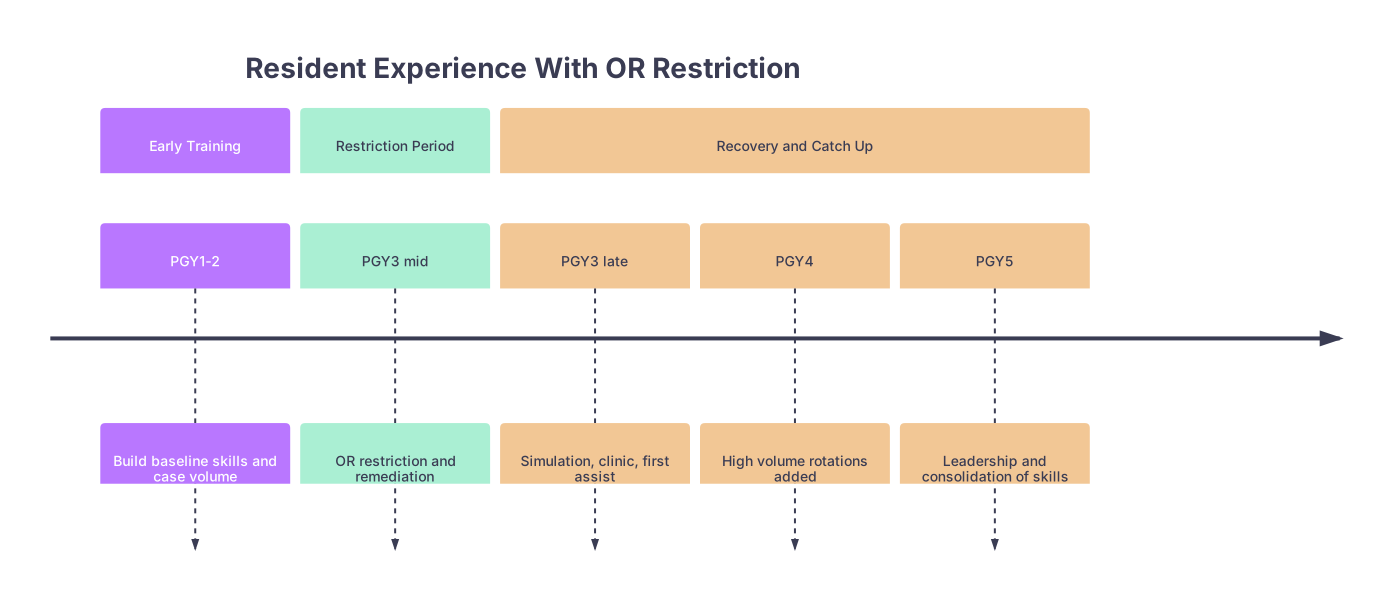
A Quick Visual: What A Recovery Plan Looks Like
Here’s a simple way to picture your training arc:
| Period | Event |
|---|---|
| Early Training - PGY1-2 | Build baseline skills and case volume |
| Restriction Period - PGY3 mid | OR restriction and remediation |
| Recovery and Catch Up - PGY3 late | Simulation, clinic, first assist |
| Recovery and Catch Up - PGY4 | High volume rotations added |
| Recovery and Catch Up - PGY5 | Leadership and consolidation of skills |
The point: this is a dip, not a death sentence—if you treat it as a phase with a plan, not a verdict.
Example Weekly Structure During OR Restriction
To make this painfully concrete, a “good” week during restriction could look like:
| Time | Activity |
|---|---|
| Mon AM | Clinic (see new consults, staff notes) |
| Mon PM | Sim lab – laparoscopic drills |
| Tue AM | Rounds + floor/ICU procedures |
| Tue PM | Observe OR cases, first assist if allowed |
| Wed AM | Academic half day + remediation meeting |
| Wed PM | Independent reading + case review |
| Thu AM | Endoscopy observation/first assist |
| Thu PM | Sim lab – suturing, anastomosis |
| Fri AM | Clinic/post-op follow-up |
| Fri PM | OR observation + log documentation |
You log your first assists. You log your procedures. You collect faculty names who saw real improvement.
Then when the restriction lifts, you pivot this structure into: “same work ethic, but back in the primary role.”
Do Not Make These Three Mistakes
Let me be blunt about the things that actually end careers in this situation:
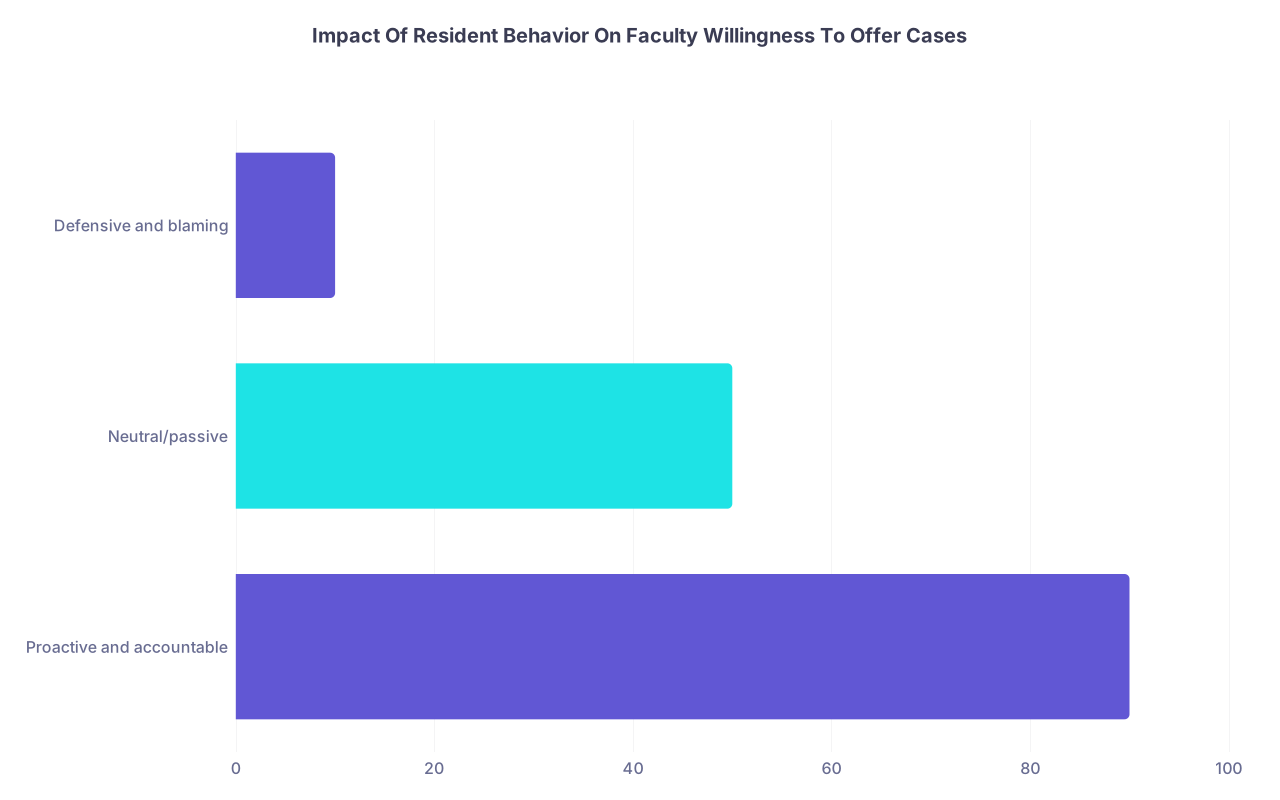
Going passive
Letting the program “figure out” your case volume, while you just endure remediation. They’re busy. You’re not their only problem. If you don’t push, you’ll be forgotten.Acting like the victim
You may have been treated harshly. Maybe unfairly. But if all your faculty see is resentment and martyrdom, nobody fights for your OR time later.Faking the numbers
Back‑entering cases you “probably did” or inflating your role to primary when you weren’t. That’s not “catching up.” That’s digging a deeper hole.
| Category | Value |
|---|---|
| Proactive and accountable | 90 |
| Neutral/passive | 50 |
| Defensive and blaming | 10 |
Final Reality Check
You’re in a tough, high-risk spot. No sugarcoating.
But I’ve seen residents:
- Take a 3–6 month OR restriction
- Own their mistakes
- Build a real plan
- Come out as solid, trusted senior residents
And I’ve seen others let the shame and passivity calcify until they do graduate light in experience and heavy in baggage.
So here’s what matters most:
- Get specific and get numbers. Know your exact restriction, know your exact case log, and quantify the damage early.
- Run a parallel track. While fixing the issue that got you here, aggressively plan how to protect and then rebuild your operative volume.
- Come out of this demonstrably stronger. Use simulation, clinics, and high-yield rotations so that when your restriction lifts, your performance—not your past—becomes the dominant story.