
Most students memorize pedigree buzzwords for Step 1. That is exactly why they keep missing the hard questions.
You do not need more lists of “autosomal dominant vs recessive features.” You need to see how NBME tricks you with patterns that look right but are wrong, and how association questions quietly test genetics without ever drawing a pedigree.
Let me break this down specifically, the way someone does after watching dozens of people bleed points on UWorld and NBME forms for the same 7–8 genetic traps.
1. The Real Game: How Step 1 Uses Genetics
On Step 1, “genetics” is not mostly karyotypes or Punnett squares. It shows up in three main ways:
- Pedigrees (classic pattern recognition, plus trick patterns)
- Disease–gene / disease–chromosome associations
- Mechanism–phenotype links (what exactly went wrong: LOF vs GOF, deletion vs frameshift, imprinting, mitochondrial, etc.)
Here is the split I see over and over in questions:
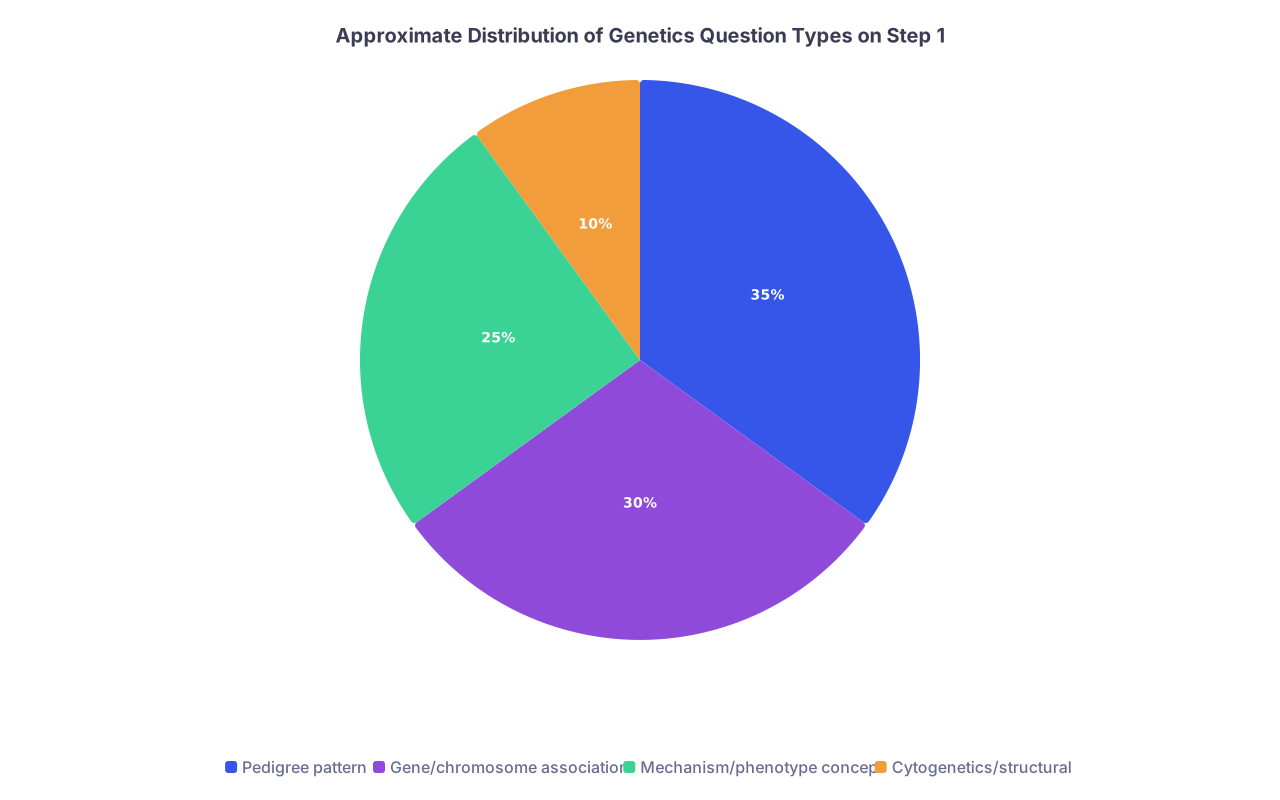
| Category | Value |
|---|---|
| Pedigree pattern | 35 |
| Gene/chromosome association | 30 |
| Mechanism/phenotype concept | 25 |
| Cytogenetics/structural | 10 |
If you are spending all your time re-writing Punnett squares, you are misallocating effort. You need:
- An automatic approach to pedigrees you can run in 10–15 seconds.
- A reliable mental “map” of high-yield gene and chromosome associations.
- A clear understanding of the small set of mechanistic frameworks that keep reappearing: imprinting, anticipation, mosaicism, variable expression, etc.
Let’s start with pedigrees, because that is where most students lose “easy” points by overthinking.
2. Pedigrees: A Ruthlessly Systematic Reading Method
Forget the noise. Every pedigree question should trigger the same 5-step script in your head.
Step 1: Look at who is affected, not the buzzwords
First pass: scan the entire pedigree and ask:
- Is every generation affected, or are there skipped generations?
- Are males and females both affected roughly equally?
- Is there any evidence of male-to-male transmission?
- Are only males affected? Only females?
You can decide 70% of patterns with those questions alone.
Here is the quick pattern table you should have burned in:
| Pattern Feature | Think First Of |
|---|---|
| Skips generations, both sexes | Autosomal recessive |
| Every generation, both sexes | Autosomal dominant |
| Only males, no male-to-male | X-linked recessive |
| Affected father → all daughters | X-linked dominant or mitochondrial (maternal) |
| Affected mother → all kids | Mitochondrial |
Now let’s dissect each.
Autosomal Dominant (AD): Students Overcall This Constantly
What you see:
- Affected individuals in every generation (vertical transmission).
- Male-to-male transmission present.
- Both sexes clearly affected.
What Step 1 tries to do:
- Give you small pedigrees with something that looks like a skipped generation. The “skipped” person is just not shown (they died young, married in, etc.).
- Make you think recessive because of one unaffected parent / one affected child.
Rule I use: if you see clear male-to-male transmission, and affected people in multiple generations, default to autosomal dominant unless the stem screams recessive (consanguinity, very rare disorder, etc.).
Classic Step 1 AD diseases:
- Marfan (FBN1)
- NF1, NF2
- Huntington disease (CAG)
- Familial hypercholesterolemia (LDL receptor)
- Hereditary spherocytosis
- Adult polycystic kidney disease (PKD1, PKD2)
Autosomal Recessive (AR): Skips and Consanguinity
What you see:
- Generations with no affected individuals (horizontal clustering: siblings affected together).
- Often parents are unaffected but “related” (first cousins, same small village, same ethnic group).
- Both sexes affected.
Step 1 trap:
- Small pedigree with just siblings affected → you must use clinical info (enzymopathy, early severe disease, often AR).
- “Only” 2 or 3 affected members and no obvious skipping; they push you to think AD if you are going too fast.
High-yield AR diseases:
- Classic enzyme deficiencies: most metabolic disorders (PKU, glycogen storage, organic acidemias, etc.).
- Sickle cell disease, most thalassemias.
- CFTR (cystic fibrosis).
Mental rule: Rare, severe pediatric diseases with enzyme problems are AR until proven otherwise.
X-linked Recessive (XR): The Misread Workhorse
What you see:
- Almost exclusively males affected.
- No male-to-male transmission.
- Carrier mothers with 50% affected sons.
Step 1 sneaky thing:
- They sometimes show a single affected female with a strong family history (that usually means she is homozygous if father had the disease and mother was carrier).
- They show one affected male and multiple unaffected males to make you doubt XR and call it sporadic.
Common XR:
- Hemophilia A/B
- Duchenne/Becker muscular dystrophy
- G6PD deficiency
- OTC deficiency (urea cycle)
- Fabry, Hunter, Lesch-Nyhan, Bruton agammaglobulinemia.
If you see “healthy mother, affected sons in different generations, no male-to-male” → X-linked recessive until the question convinces you otherwise.
X-linked Dominant (XD): Rare but Not Fiction
This one hurts people because they overcomplicate it.
What you see:
- Affected fathers pass to all daughters, no sons.
- Affected mothers pass to ~50% of sons and daughters.
- Both sexes affected, but often females more common (males might be severe or lethal).
Classic USMLE example:
- Fragile X (technically more nuanced, but functionally presented as X-linked dominant).
- Incontinentia pigmenti.
- Hypophosphatemic rickets (vitamin D–resistant rickets).
Key clue: Father is affected, every daughter is affected, and no sons are.
Mitochondrial Inheritance: Everyone Ignores It Until They Miss It
Pattern:
- Affected mother → all kids can be affected.
- Affected father → no kids affected.
- Often neuromuscular, myopathy, lactic acidosis, ragged red fibers.
Diseases:
- MELAS, MERRF, Leber hereditary optic neuropathy.
The NBME trick: They may show “variable expression” in siblings due to heteroplasmy. One sibling is severely affected, the other mildly, both from the same mother.
Concrete rule: “Affected mother, all children at some risk, father irrelevant” → mitochondrial. Do not overthink.
3. High-Yield Pattern Modifiers: The Stuff That Warps Pedigrees
Step 1 does not just give clean patterns. They add genetic phenomena that twist the picture. If you do not name these explicitly in your mind, you just call it “weird” and guess. That is how you lose.
Let us hit the big modifiers.
Variable Expressivity vs Incomplete Penetrance
Students mix these constantly. NBME loves that.
Variable expressivity: Same genotype, different severity or features in different people.
- Classic: NF1 – café-au-lait only in some, full neurofibromas and optic gliomas in others.
- Pedigree: multiple people affected, but the disease looks milder/atypical in one branch.
Incomplete penetrance: Some people with the mutant genotype have no disease at all.
- Classic: BRCA1/2, some AD diseases where not everyone manifests.
- Pedigree: Clearly dominant pattern, but 1–2 obligate carriers are phenotypically normal.
Association trap: if question stem says “the mutation is present in multiple family members who are clinically unaffected,” your brain should shout “incomplete penetrance.”
Anticipation
High-yield, very tested.
- Disease worsens or appears earlier in subsequent generations.
- Usually due to trinucleotide repeat expansion.
- Examples: Huntington, myotonic dystrophy, fragile X, Friedreich ataxia.
Pedigree tie-in: Younger generations showing earlier onset or more severe disease. The question might show “grandfather diagnosed at 60, father at 40, patient at 25.”
Imprinting and Uniparental Disomy
These are Step 1 favorites because they look complicated but are actually pattern problems.
Core idea:
- Imprinted = gene is silenced depending on whether inherited from mom or dad.
- If you delete the active copy, phenotype appears.
Two must-know pairs:
- Prader–Willi: microdeletion on paternal 15q (or maternal uniparental disomy). Obesity, hypotonia, hyperphagia, hypogonadism.
- Angelman: microdeletion on maternal 15q (or paternal uniparental disomy). Seizures, ataxia, severe intellectual disability, inappropriate laughter.

| Step | Description |
|---|---|
| Step 1 | Normal 15q |
| Step 2 | Paternal allele active |
| Step 3 | Maternal allele active |
| Step 4 | Loss of paternal copy |
| Step 5 | Loss of maternal copy |
| Step 6 | Prader-Willi phenotype |
| Step 7 | Angelman phenotype |
Association trap: They may not say “Prader–Willi” at all. They simply describe an obese child with hypotonia and ask “which chromosome region is most likely deleted?” or “which parental allele is abnormal?” If you do not anchor to 15q and paternal vs maternal, you get it wrong.
Mosaicism
Definition:
- Two (or more) genetically distinct cell lines in the same individual, derived from one zygote.
Two quick contexts:
- Somatic mosaicism: Disease only in some tissues (e.g., segmental neurofibromatosis).
- Germline mosaicism: Parent is unaffected but produces affected gametes → multiple affected children with a supposed “de novo” AD mutation.
Pedigree clue: Unaffected parents with >1 child having a disease that is usually AD, with no family history upstream. That suggests germline mosaicism.
4. Association Traps: Gene Names, Chromosomes, and Mechanisms
This is where strong students still bleed points. Not because they have no idea, but because they confuse similar associations. Let’s be concrete. I will not list everything; I will highlight what Step 1 actually likes to ask.
Disease ↔ Chromosome Hotspots
You do not need every chromosome. You need the big clusters.
| Chromosome | Associations (Step 1 relevant) |
|---|---|
| 3 | VHL, RCC (chromosome 3p deletion) |
| 4 | ADPKD (PKD2), Achondroplasia, Huntington |
| 5 | APC (FAP), Cri-du-chat (5p deletion) |
| 7 | CFTR, Elastin (Williams 7q deletion) |
| 11 | Wilms tumor (WT1), Beta-globin cluster |
| 13 | RB1 (retinoblastoma), BRCA2 |
| 15 | Prader–Willi, Angelman |
| 17 | NF1, BRCA1, TP53 (Li-Fraumeni overlaps) |
| 21 | Down syndrome |
| 22 | NF2 |
Do not rote memorize a big table. Learn the clusters:
- Chromosome 17: think tumor suppressors and NF1.
- Chromosome 13: retinoblastoma, BRCA2 – eye and breast/ovary.
- Chromosome 21: Down syndrome, plus associated AML, ALL risk and Alzheimer early.
Here is how Step 1 uses this: they describe a syndrome clinically, then ask which chromosome or gene is mutated. If you do not connect phenotype to the named condition first, you are dead.
Example:
- A child with hyperphagia, obesity, hypotonia → Prader–Willi → paternal deletion on 15q.
- A young woman with breast cancer and mother with ovarian cancer → BRCA1 (17q) or BRCA2 (13q).
- A patient with café-au-lait spots, neurofibromas, optic gliomas → NF1 on 17.
Activating vs Inactivating Mutations (GOF vs LOF)
Mechanism matters. NBME often frames genes as:
- Gain-of-function → oncogenes → require 1 hit (dominant at cellular level).
- Loss-of-function → tumor suppressors → usually require 2 hits.
High-yield oncogenes (GOF):
- BCR-ABL (CML) – t(9;22), always active tyrosine kinase.
- c-MYC (Burkitt) – t(8;14), transcription factor.
- N-MYC (neuroblastoma, 2p).
- HER2/neu (ERBB2) – breast cancer.
- RAS – many solid tumors.
High-yield tumor suppressors (LOF):
- TP53 – Li-Fraumeni, many cancers.
- RB1 – retinoblastoma, osteosarcoma.
- APC – FAP → colon cancer.
- VHL – hemangioblastomas, RCC.
Step 1 association angle: They give a cancer and ask which gene is likely altered. Or they describe LOH (loss of heterozygosity) and you should think tumor suppressor.
LOH, Knudson Two-Hit, and “Second Allele”
Phrase checklist that should ping “tumor suppressor”:
- “Both alleles must be inactivated.”
- “Loss of the remaining normal allele.”
- “Loss of heterozygosity.”
- “Second hit.”
If the question says: child with bilateral retinoblastoma → germline mutation in one RB allele, second hit occurs → classic two-hit tumor suppressor model.
This is not just oncology. They use this framing to test that you know why AD tumor suppressor conditions (like familial retinoblastoma) show high penetrance: one hit is inherited, second is acquired.
5. Silent Genetics in Non-Genetics Questions
Some of the nastiest Step 1 items hide genetics in plain sight inside pathology, biochem, or pharmacology questions. You will miss them if you compartmentalize “genetics” as pedigree diagrams only.
1. Pharmacogenetics and “Weird Drug Reactions”
Obvious examples:
- G6PD deficiency → hemolysis with sulfonamides, antimalarials, fava beans.
- HLA-B*57:01 → abacavir hypersensitivity.
- HLA-B*15:02 → carbamazepine-induced Stevens–Johnson in certain Asian populations.
- TPMT deficiency → severe myelosuppression with azathioprine / 6-MP.
Question style: They describe a patient who develops catastrophic side effects at standard drug doses, then ask about the underlying mechanism (e.g., decreased enzyme activity due to genetic polymorphism). That is genetics, even if they never say “inheritance pattern.”
2. Enzyme Deficiencies and Carrier Risks
Metabolic diseases are mostly AR, but Step 1 embeds that idea into counseling-style questions:
- “What is the risk that another child will be affected?” (25% for AR if both parents carriers).
- “What is the carrier risk for a sibling?” (2/3 for unaffected sibling of an affected AR child).
Here is the classical but often-forgotten 2/3 rule illustrated:
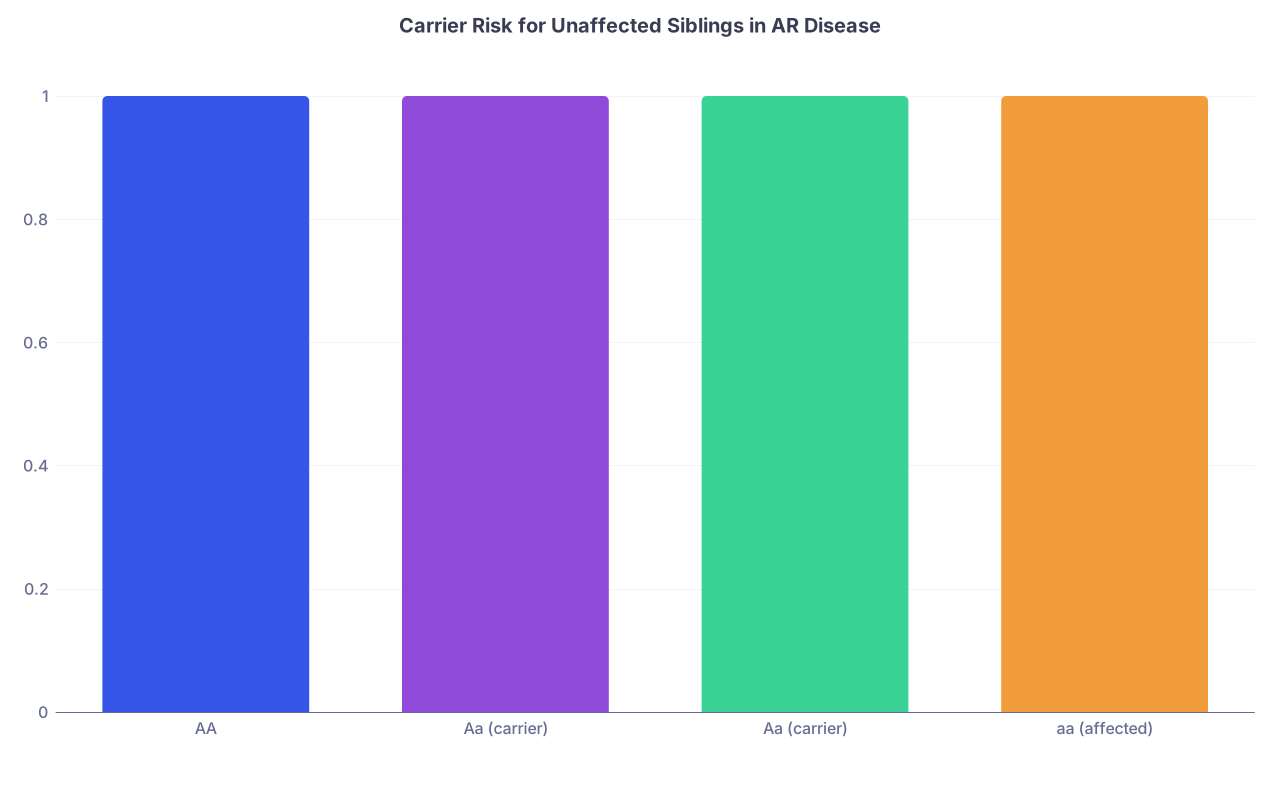
| Category | Value |
|---|---|
| AA | 1 |
| Aa (carrier) | 1 |
| Aa (carrier) | 1 |
| aa (affected) | 1 |
If one sibling is affected (aa), and you know both parents are carriers, the remaining three genotype possibilities for an unaffected sibling are AA, Aa, Aa → 2/3 carrier probability.
They will not write that out. You must recognize the pattern, or you get it wrong.
3. Copy-Number Variations and Deletions as “Missing Bands”
Question example pattern:
- Karyotype or FISH shows “microdeletion” of short arm of chromosome 5.
- Crying infant → high-pitched cry → Cri-du-chat.
- Microdeletion of 22q11 → DiGeorge (thymic aplasia, hypocalcemia, conotruncal defects).
- Microdeletion of 7q (elastin gene) → Williams syndrome (elfin facies, extreme friendliness, hypercalcemia).
Notice: these are association questions. The actual genetics is trivial; the game is linking phenotype to the right syndrome and locus.
6. How to Practice This Intelligently (Not Just Doing Random Questions)
If you want this to stick, you need targeted, pattern-based practice.
Step 1 genetics prep should look like this:
- One focused pass through First Aid genetics + pathoma genetics sections.
- A dedicated block of 50–100 UWorld questions filtered for genetics/biochem/path.
- After each session, you draw the pedigree or locus mapping yourself from memory and label:
- Mode of inheritance
- Any modifiers (anticipation, imprinting, variable expression, mosaicism)
- Gene / chromosome if relevant.
I like a simple 3-column notebook for this:
| Column 1 | Column 2 | Column 3 |
|---|---|---|
| Disease / Scenario | Inheritance + Special Phenomena | Gene / Chromosome / Classic Clues |
Example entry:
- Huntington disease | AD + anticipation (CAG repeat expansion) | HTT gene, chromosome 4, caudate atrophy, chorea, depression, dementia.
This matters because when a question says “father diagnosed at 55, patient at 35, expansion of CAG,” you do not need to memorize; you just “recognize the story.”
7. Common Mistakes You Must Stop Making
Let me be blunt about the patterns I see repeatedly.
Calling anything in multiple generations “autosomal dominant” without checking:
- For consanguinity.
- For male-only expression.
- For male-to-male transmission.
Forgetting that most enzyme deficiencies are autosomal recessive:
- When in doubt about an inborn error of metabolism, AR is usually correct.
Mixing up imprinting and anticipation:
- If the story is about earlier/severe disease in later generations → anticipation.
- If the story is about different phenotypes from maternal vs paternal mutation → imprinting.
Treating association tables as trivia instead of stories:
- BRCA1 on 17q → young woman with breast/ovarian cancer and family history.
- APC on 5q → hundreds of colonic polyps in a teenager.
- NF1 on 17 → café-au-lait, neurofibromas, optic glioma.
Ignoring “healthy” individuals in pedigrees:
- An unaffected parent in an AD tree might be incomplete penetrance.
- Or you mis-read the symbol (one of the simplest but real causes of errors).
If you fix those 5, your genetics score jumps, even without learning a single new gene name.
FAQ (Exactly 4 Questions)
1. How many specific genes and chromosomes should I memorize for Step 1 genetics?
You do not need a thousand. You need the ~20–25 truly high-yield ones that keep recurring across UWorld, NBME, and First Aid: NF1, NF2, BRCA1/2, APC, RB1, TP53, VHL, FBN1, CFTR, PKD1/2, HTT, various trinucleotide repeats, CFTR, and the chromosomal loci for the classic microdeletion syndromes (5p, 7q, 15q, 22q11). If a gene is a First Aid “bolded name” and appears in multiple organ systems, know it cold. Everything else can be “familiar but not forced.”
2. How much pedigree calculation (probability math) actually shows up on Step 1?
Very little formal Punnett square calculation, but you do see conceptual probability: carrier risk (2/3 rule for AR unaffected siblings), 25% vs 50% affected offspring payments, and “what is the chance next child will be affected?” style questions. You should be comfortable computing simple Mendelian probabilities and interpreting them quickly, but you do not need advanced probability theory. Focus on understanding AR, AD, XR, XD, and mitochondrial ratios.
3. Are detailed cytogenetics (like banding patterns, full karyotype notation) worth studying?
No. They rarely test the detailed nomenclature. What they care about is: which chromosome is affected, whether it is a deletion vs translocation, and which syndrome that corresponds to clinically. t(9;22) BCR-ABL, t(8;14) c-MYC, 22q11 deletion, 5p deletion, 15q microdeletions, and general ideas like Robertsonian translocation and balanced vs unbalanced. If you are memorizing exact p/q arm positions beyond these, you are over-investing.
4. How should I review genetics in the last 1–2 weeks before Step 1?
You do a high-yield sweep, not a rebuild. One afternoon for pedigrees: go through 20–30 pedigree questions, label each pattern out loud, and reinforce XR vs AD vs AR vs XD vs mitochondrial. One afternoon for association tables: quickly review gene–syndrome–chromosome clusters in First Aid and your own notes. Then, go back through any UWorld/NBME genetics questions you previously missed and write a one-line “lesson” for each. At that point, you should be in recognition mode, not discovery mode.
Key takeaways:
- Treat pedigrees as pattern-recognition with a fixed algorithm, not as puzzles you re-solve each time.
- Genetics questions are often disguised as association or mechanism questions; train yourself to see the gene/chromosome story behind the clinical vignette.
- A small, well-memorized set of inheritance patterns, modifiers (anticipation, imprinting, mosaicism), and gene–syndrome associations will cover the vast majority of Step 1 genetics.