
Most students ruin their final Step 1 week by doing too much. Do not be one of them.
This last week is not about “catching up.” It is about consolidation and control. At this point you should be protecting your score, not gambling with it.
I will walk you day‑by‑day from 7 days out to the morning of your exam with a clear, structured review and rest plan. Follow the order. Do not improvise wildly unless you have a compelling reason.
7 Days Before Step 1: Set the Structure and Stop the Panic
At this point you should lock in your schedule and boundaries.
Main goals:
- Fix your sleep schedule
- Decide exactly what you will review (and what you will not)
- Run one of your last full-length practice tests
Morning (7 days out)
Wake up at exam-day time.
- If your exam starts at 8:00, you are up at 6:00–6:30. Starting today.
- No “I study better at night.” You do not test at midnight.
Baseline check:
- Quick self-assessment: Where are you weak? (Systems, disciplines, test-taking)
- Look at your last 2 NBME/UWSA score reports. Circle:
- Organ systems below ~60–65%
- Disciplines below ~60–65% (pharm, biostats, etc.)
Build your 7-day plan on paper (or a visible digital calendar).
Include:- Which practice exams you still have (NBME, UWSA, Free 120)
- Dedicated “light review days”
- One real rest afternoon and one very easy day before the exam
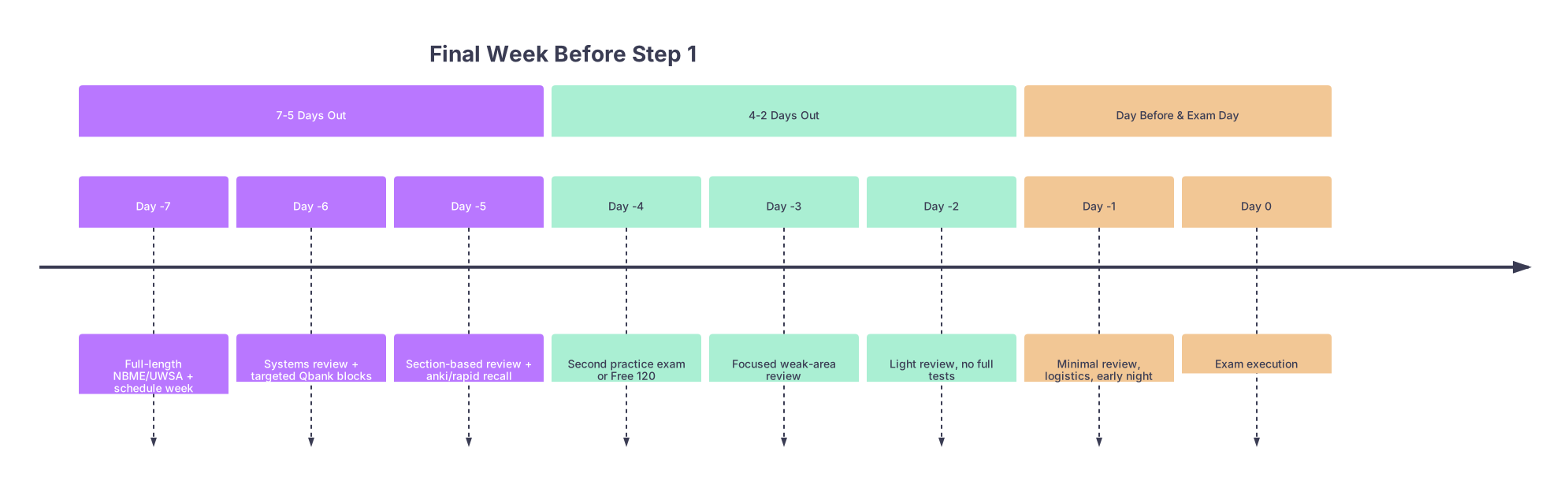
| Period | Event |
|---|---|
| 7-5 Days Out - Day -7 | Full-length NBME/UWSA + schedule week |
| 7-5 Days Out - Day -6 | Systems review + targeted Qbank blocks |
| 7-5 Days Out - Day -5 | Section-based review + anki/rapid recall |
| 4-2 Days Out - Day -4 | Second practice exam or Free 120 |
| 4-2 Days Out - Day -3 | Focused weak-area review |
| 4-2 Days Out - Day -2 | Light review, no full tests |
| Day Before & Exam Day - Day -1 | Minimal review, logistics, early night |
| Day Before & Exam Day - Day 0 | Exam execution |
Midday: Full-Length Exam (if you still have one)
You are 7 days out. This is your last true “stress test.”
- Take:
- NBME (online) or
- UWSA2 if you have not done it yet
- Simulate exam conditions:
- Same wake time and start time as real exam
- Limited breaks
- No pausing to look up answers
Evening: Fast Review + Reality Check
Review only the big-ticket misses
- Concepts that could appear in many flavors:
- Renal physiology curves
- Acid-base disorders
- Heart murmurs
- Classic pathology associations (e.g., HLA-B27, CD markers, oncogenes)
- Concepts that could appear in many flavors:
Set score expectations.
- This is not the time to chase a fantasy number.
- If your last 2–3 tests cluster in a range, that is your lane. You are stabilizing, not reinventing.
Hard rules going forward (write these somewhere):
- No new resources.
- No new qbanks.
- No changing your test date unless your scores are catastrophically below passing and consistent.
6 Days Before: System-Level Cleanup and Active Recall
At this point you should be tying together organ systems, not diving into obscure minutiae.
Primary goal: Turn fragmented knowledge into integrated patterns.
Morning (90–120 minutes blocks)
Pick 3–4 high-yield systems, for example:
- Cardio
- Pulm
- Renal
- Neuro
For each 90-minute block:
15–20 minutes: High-yield skim
- First Aid / Boards & Beyond notes / your master outline
- Focus:
- Pathways
- Classic disease presentations
- Hallmark buzzwords (yes, they still matter)
25–30 minutes: Targeted Qbank (tutor mode)
- 10–15 questions only, system-based
- Read explanations for:
- Your misses
- Any question that feels “lucky”
10 minutes: Rapid recall dump
- Close everything.
- Write from memory:
- Key drugs and their adverse effects
- Top differentials for classic complaints (chest pain, shortness of breath, confusion, etc.)
Repeat for 3–4 systems. Then stop. Review does not mean “all of First Aid in one day.” That is delusion.
Afternoon: Cross-Discipline Focus
Choose 2–3 of:
- Pharm
- Micro
- Biostats/Epi
- Immunology
- Behavioral science/ethics
Structure:
- 45 minutes: cards / rapid grids (e.g., antibiotics by class, autonomic drugs, DNA viruses)
- 20–25 minutes: 8–10 mixed questions
- 10 minutes: Summarize what you keep forgetting (on a single sheet you will revisit later in the week)
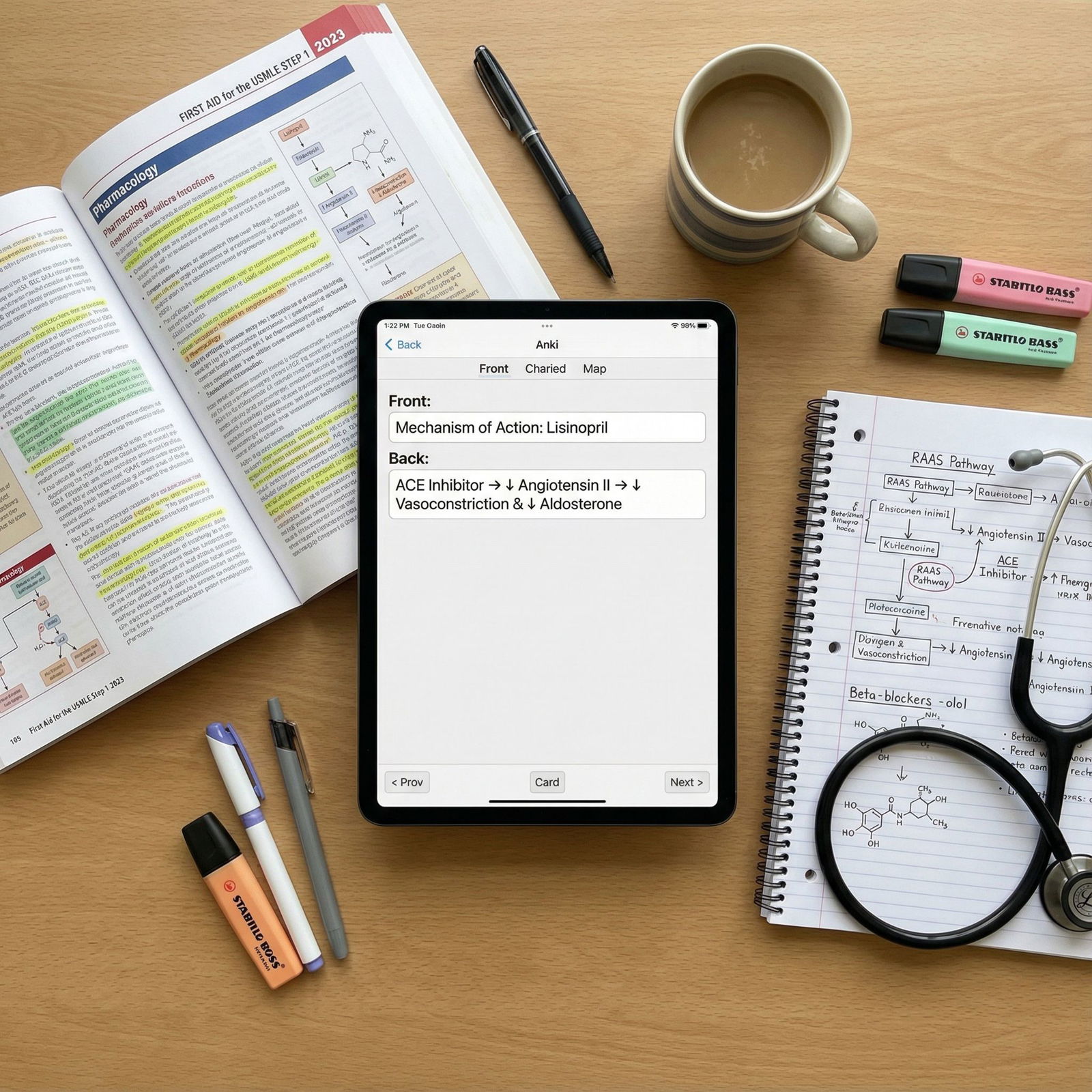
Evening: Light Anki / Flashcards + Walk
30–45 minutes of spaced repetition:
- Suspend overly detailed low-yield cards that always take 30 seconds to answer.
- Focus on big, test-likely items: mechanisms, side effects, path hallmarks.
20–30 minute walk. No headphones or just music. Let content settle.
5 Days Before: Discipline-Heavy and Biostats Day
At this point you should reinforce disciplines that appear across systems.
Morning: Biostats and Ethics
This is the day you make sure statistics and ethics are locked. They are cheap points for people who do the work.
60–90 minutes:
- Go through:
- Sensitivity, specificity, PPV, NPV
- Likelihood ratios
- Type I/II errors, power
- Study designs and biases
- Work 15–20 dedicated biostats questions.
- Go through:
45–60 minutes: Ethics / behavioral
- Physician–patient scenarios
- Professionalism questions
- “What is the best next step?” style reasoning
Midday: Pharm + Micro Core Review
Organize around mechanisms and patterns, not rare bugs.
- 60 minutes: Pharm
- Choose 3–4 classes: e.g., antihypertensives, psych drugs, antibiotics, chemo agents
- For each: mechanism → major use → key adverse effect → contraindication
- 60 minutes: Micro
- Bacteria: Gram-positive vs Gram-negative structure in your head
- Viruses: DNA vs RNA, enveloped vs non-enveloped, major clinical syndromes
- Sketchy-style mental recall if you used it
| Discipline | Priority Level | Time Block |
|---|---|---|
| Biostats | Very High | 60–90 min |
| Ethics | High | 45–60 min |
| Pharm | Very High | 60 min |
| Micro | High | 60 min |
| Anatomy | Moderate | 30–45 min |
Afternoon: Short Mixed Block
- 1 block of 20–25 mixed questions, timed.
- Goal: Practice switching gears between topics.
- Review selectively; do not deep-dive into every explanation.
Evening: Sleep Protection Starts Now
You are 5 days out. At this point you should:
- Be in bed within a 1-hour window every night.
- Have caffeine cut off by 2–3 PM max.
4 Days Before: Second “Proof of Concept” Exam
This is your dress rehearsal. Not optional unless you are severely burned out.
Morning: Practice Exam
Options:
- NBME (if available)
- UWSA you have not used yet
- Free 120 (best 3–4 days out if you have not done it)
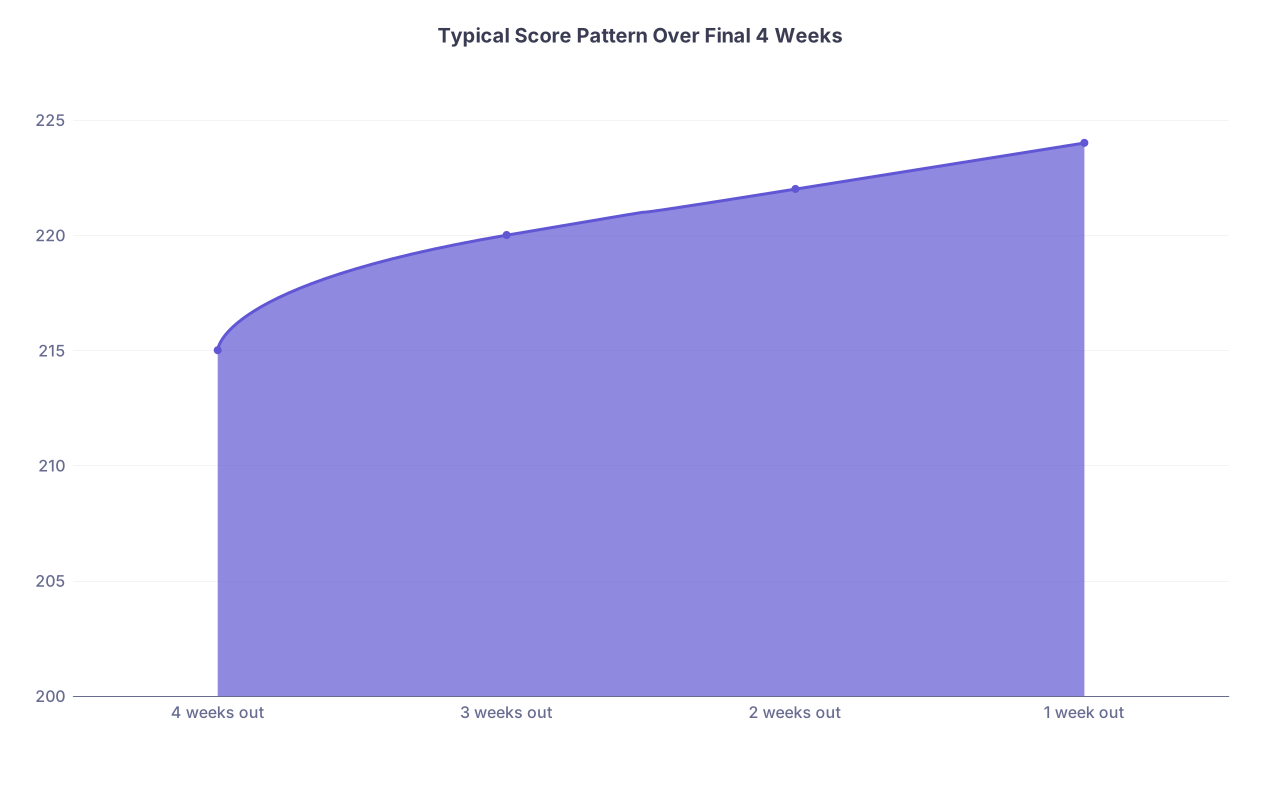
| Category | Value |
|---|---|
| 4 weeks out | 215 |
| 3 weeks out | 220 |
| 2 weeks out | 222 |
| 1 week out | 224 |
Conditions:
- Wake at exam-day time.
- Simulate breaks.
- Eat exactly the type of breakfast you plan for test day.
Afternoon: Targeted Autopsy, Not Self-Torture
Sort misses into:
- Concept you did not know at all.
- Concept you knew but misread / rushed.
- Concept you overthought.
Prioritize:
- Repeated weak systems (e.g., endocrine, neuro)
- Repeated disciplines (e.g., pharm side effects, renal phys)
Create a “30 Concepts for the Next 3 Days” list.
This is gold. One sheet. Handwritten or digital. You will revisit this again and again.
Evening: Light Review + Something Normal
- 30–45 minutes flipping through your “30 concepts” sheet.
- Then do one non-medical thing:
- Dinner with a friend
- Episode of a show
- Long shower and early bed
If you push hard every night this week, you will be mentally flat on exam morning. I have watched that movie. It ends badly.
3 Days Before: Focused Weak-Spot Attack
At this point you should be precise and a bit ruthless.
Morning: System-Targeted Review (Your Weakest 2–3)
Example plan:
- 60 minutes Neuro
- 60 minutes Renal
- 45 minutes Endocrine
For each:
- 20 minutes: High-yield overview (your notes/First Aid)
- 15–20 minutes: 8–10 questions
- 10 minutes: Rapid recall and add to your “30 concepts” sheet if something is still shaky
Midday: Diagrams and Pathways
Spend 60–90 minutes on:
- Visuals:
- Cardiac pressure-volume loops
- Lung volume curves
- Hemoglobin dissociation curve
- Renal tubule segments and what happens where
- Metabolic pathways:
- Urea cycle basics
- Glycolysis vs gluconeogenesis regulation
- TCA and ETC choke points
You do not memorize every enzyme and cofactor now. You nail the logic and big regulatory sites.

Afternoon: One Short Timed Block + Review
- 15–20 mixed questions, timed.
- Purpose:
- Maintain question stamina.
- Practice reading carefully.
- Review only:
- Misreads
- “I knew this but changed my answer” items
Evening: Wind-Down, Not Wind-Up
- 30 minutes of flashcards or skimming your main summary.
- Then off screens at least 30–45 minutes before bed.
2 Days Before: Consolidation and Confidence
At this point you should shift from heavy learning to reinforcement and calming your nervous system.
Morning: Review Your Own Material Only
No new PDFs. No new YouTube marathons.
90–120 minutes:
- Go through:
- Your personal high-yield notes
- Marked pages in First Aid
- The “30 concepts” list you created
- Goal:
- Clarify.
- Shorten.
- Link concepts together.
Midday: Logistics and Exam-Day Rehearsal
Treat this like a mission brief.
Route check
- How long does it take to get to the test center?
- Backup route if there is traffic?
Bag prep
- ID (double-check expiration)
- Confirmation email if needed
- Earplugs (if allowed)
- Snacks and drinks for breaks (nothing new to your stomach)
- Light sweater / layers
Block timing strategy
- How many minutes per question target?
- When will you take breaks? After which blocks?
| Block | Action | Duration |
|---|---|---|
| 1 | Quick stretch | 3–5 min |
| 2 | Snack + bathroom | 7–10 min |
| 3 | Short break | 3–5 min |
| 4 | Lunch | 15–20 min |
| 5 | Quick stretch | 3–5 min |
| 6 | Snack | 5–7 min |
| 7 | Usually straight | — |
Afternoon: Very Light Practice
- 10–15 easy–moderate questions or a few Free 120-style questions.
- Focus on:
- Reading the stem carefully
- Eliminating wrong answers methodically
Evening: Mental Reset
You are 2 days out:
- Short walk
- Normal dinner
- No high-stress conversations about scores or “what if I fail?”
1 Day Before: Minimal Review, Maximum Rest
This is where strong students separate from the anxious crowd trying to “cram all of First Aid” in 10 hours. That is how you sabotage months of work.
At this point you should be protecting your brain.
Morning: One Last Gentle Pass
Limit yourself to 2–3 hours total.
Priority:
- Your “30 concepts” sheet
- Any small personal lists:
- murmurs
- lysosomal diseases
- immunodeficiencies
- biostat formulas
- Maybe flip through favorite high-yield pages in First Aid (path slides, classic tables)
Midday: Stop Studying
Yes, stop.
Do:
- Light physical activity:
- 20–30 minute walk
- Stretching or yoga
- Simple errands if needed, but avoid anything chaotic
Do not:
- Start a new Qbank block
- Watch 5 hours of new content
- Obsessively search Reddit for “Step 1 experience”
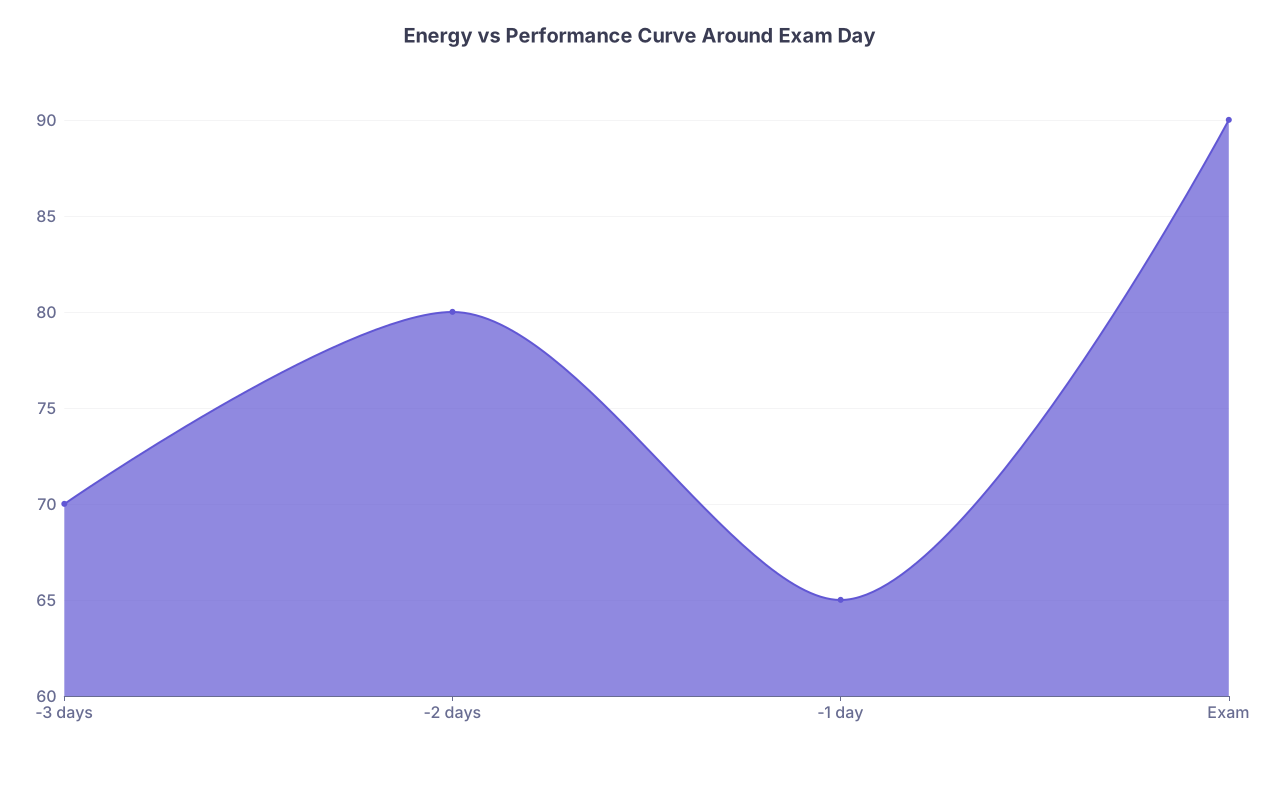
| Category | Value |
|---|---|
| -3 days | 70 |
| -2 days | 80 |
| -1 day | 65 |
| Exam | 90 |
Afternoon: Prep for Sleep and Exam
- Lay out:
- Clothes for exam day
- Bag and snacks
- ID and keys in one obvious place
- Plan:
- Wake time
- Departure time
If you are too wired to nap, fine. Rest is still helpful. Lie down. Eyes closed. Low stimulation.
Evening: Relaxation, Not Perfection
- Light dinner. Nothing experimental.
- Screen cut-off 60 minutes before bed if you can manage it.
- If you must review, only:
- A few flashcards you enjoy
- Skim your summary for 15 minutes max
You might not sleep perfectly. Most people do not. That is fine. One slightly rough night does not destroy your performance if the prior week was consistent.
Exam Morning: Execute the Plan You Built
You are not learning now. You are executing.
3–3.5 Hours Before Exam Start
- Wake up.
- Light breakfast with:
- Protein
- Some complex carb
- Modest caffeine (same type and amount as usual)
1.5–2 Hours Before
- Quick scan (10–15 minutes) of:
- Biostats formulas
- Murmur summaries
- Anything you know boosts your confidence
Then stop.
Arrival at Test Center
At this point you should:
- Arrive 30–45 minutes early.
- Use bathroom.
- Do a quick mental check:
- Remind yourself of break plan.
- Set realistic expectations: You will see things you do not know. That is normal.
Between blocks:
- Do not autopsy questions.
- Focus on:
- Breathing.
- Hydration.
- Simple snacks.
Last block:
- When fatigue hits, slow down intentionally for the first 5–10 questions. Set the pace and your brain will follow.
You do not need perfection. You need consistent, competent decisions over several hours. The work to make that possible happened long before this week. Here, you are just not screwing it up.
FAQ (Exactly 4 Questions)
1. Should I ever move my Step 1 date in this final week?
Only if your last 2–3 practice scores are consistently and clearly below passing and you have not exhausted your qbank or core resources. If you are hovering around your target or slightly below but trending up, moving the date usually backfires. You add anxiety and lose momentum.
2. How many questions per day should I do in the final week?
From 7 to 4 days out, 20–60 questions per day is plenty, depending on whether you are taking a full-length exam. In the last 3 days, shift toward shorter blocks (10–25 questions) and more review of your own notes. The day before the exam, you can get away with 0–15 questions or even none.
3. Is it a mistake to take the Free 120 the day before the exam?
Yes, usually. It is too long and mentally draining at the wrong time. Best window: 3–7 days before your exam. The day before is for rest, light review, and logistics. Not six more hours of maximal cognitive load.
4. What if I feel like I am forgetting everything during this week?
That feeling is nearly universal. It does not mean your knowledge is gone; it means your brain is reorganizing under stress. Stick to structured review, resist the urge to add new resources, and prioritize sleep. On test day, context and repetition will pull more back than you expect.
Key points:
- In the final week, narrow your focus: no new resources, only consolidation and targeted repair.
- Use a clear day-by-day structure: full exam early in the week, weak-spot work midweek, then tapering review and rest.
- Protect sleep and mental energy; your brain is the limiting factor now, not how many more pages you can force yourself to read.